On 6 May 2026, at the Code with Claude San Francisco conference, Anthropic unveiled three features that shift the brand's centre of gravity. The most talked-about is called Dreaming. The word is evocative, and deliberately so. Under the bonnet, it is a cron job that does the washing-up of agent memories overnight. But behind the metaphor, Anthropic is laying a very heavy strategic stone: becoming the owner of the memory, the evaluations and the orchestration of enterprise AI agents. Reading between the lines.


Three new features on Claude Managed Agents: Dreaming (research preview), Outcomes and Multi-Agent Orchestration (public beta).
1. What Anthropic actually announced
Anthropic did not announce a new model. The company announced three features for its Claude Managed Agents, the service that packages the complete agentic stack within the Claude platform (platform.claude.com/docs/en/managed-agents).
Dreaming — in research preview, access on request. An asynchronous job that runs in the background, reads up to 100 past agent sessions, extracts patterns from them, removes duplicates and obsolete entries, and rewrites the agent's memory so that it improves session after session. The original memory remains intact. The job runs on Sonnet 4.6 and Opus 4.7, billed at the standard token rate (the-decoder.com).
Outcomes — in public beta. A separate evaluator agent grades an agent's work against success rubrics defined by the developer. The agent can retry up to 20 times before succeeding. According to the figures communicated, this mechanism improves the success rate by around 10 percentage points compared with conventional prompting (siliconangle.com).
Multi-Agent Orchestration — in public beta. A coordinator agent delegates tasks in parallel to up to 20 specialised sub-agents, with an overall limit of 25 concurrent threads. Each sub-agent has its own isolated context and its own tools. Visibility into execution is centralised in the Claude Console.
2. Under the bonnet: Dreaming is a compaction cron
The metaphor is beautiful. The technical reality is more prosaic. Dreaming is a scheduled batch job that reviews the log of past sessions, identifies what recurs in it, and compresses that information into the agent's operational memory. It is conceptually close to the “compaction” process already used to manage context within a single long conversation, extended to the scale of a hundred sessions.
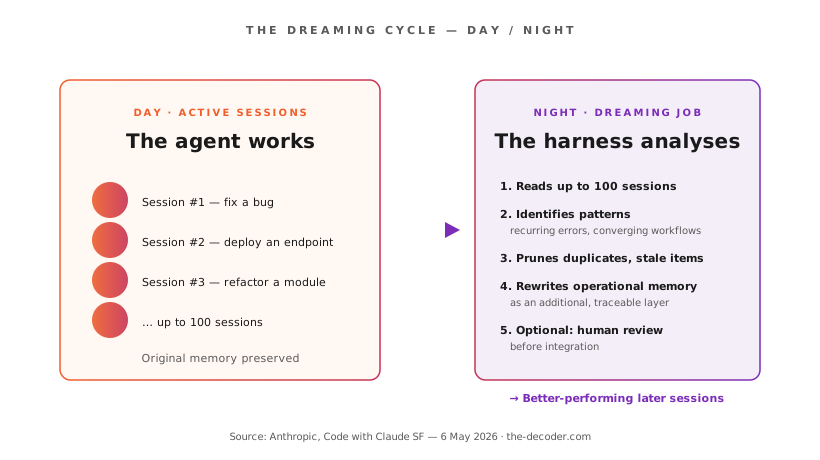
The agent carries out its tasks by day. During the night, the Dreaming job rereads up to 100 sessions, extracts the recurring patterns (repeated errors, converging workflows, team preferences) and rewrites the memory for subsequent sessions. The original memory remains intact.
Three technical properties deserve emphasis. The frequency is configurable by the client organisation: Anthropic does not decide for you when the agent “dreams”. Next, the organisation can choose between two modes: automatic memory update, or human validation before integration. Finally, the original memory is never overwritten — the system creates an additional layer, traceable and reversible.
The technical goal is clear: to solve the structural limitation of context windows. Even a million tokens (Opus 4.7) is not enough to capture what an agent does over an entire month. Dreaming compresses operational knowledge, makes it reusable and shares it between the agents of the same team.
3. The figures put forward
The announcement came with two customer cases released for marketing purposes:
Harvey, the American legaltech specialising in AI for law firms, reports a sixfold increase in task completion rate after adopting Dreaming. The figure is repeated in VentureBeat's coverage (venturebeat.com).
Wisedocs, a medtech platform for medical document review, reports a 50% reduction in review time thanks to the combination of Dreaming + Outcomes. The figure is attributed mainly to Outcomes (the evaluator in the loop).
These two figures have a virtue and a flaw. The virtue: they are concrete, attributed to real companies, and sourced. The flaw: they belong to the same genre as the “6×” or “-50%” figures read in the keynotes of every AI platform since 2023. The measurement methodology is not published. The baseline is not made explicit. For a purchasing decision-maker, these numbers open the conversation; they do not close it.
4. The strategic reading: Anthropic wants to own the agentic stack
If you look at Dreaming in isolation, you see a feature. If you look at the three announcements together, you see something else: Anthropic is no longer a model supplier, it is a supplier of a complete agentic platform.
- Outcomes = the evaluation engine. Anthropic owns how quality is measured.
- Dreaming = the memory engine. Anthropic owns how operational knowledge is curated.
- Multi-Agent Orchestration = the orchestration engine. Anthropic owns how sub-agents are delegated to.
Three layers, three lock-ins. This is the reading VentureBeat gave in a second piece published the same day: “Anthropic wants to own your agent's memory, evals, and orchestration — and that should make enterprises nervous” (venturebeat.com/orchestration). The headline gives the angle: if a company's entire agentic stack runs inside Anthropic, the cost of migrating to a competitor becomes prohibitive.
5. Why now? The competitive context
The announcement arrives in a very specific window. In April 2026, OpenAI deployed GPT-5.5 in Codex with computer use and plugins. Microsoft integrated Claude Cowork into Copilot Wave 3. Google released version 0.41 of Gemini CLI with voice mode. Everyone is investing in the agentic stack at the same time.
Anthropic has two weak signals to cover. First, the persistent criticism of agent reliability in production: public benchmarks put multi-step error rates above 10% for most real cases. Outcomes (the evaluation loop) and Dreaming (continuous learning) respond directly to that criticism. Second, OpenAI's competition on multi-agent orchestration: Microsoft Autogen and OpenAI Swarm/Assistants have a real lead in distributed architectures. Multi-Agent Orchestration built directly into the Claude platform is the strategic answer.
Announcing the three features together is not a neutral release calendar. It is a repositioning: Anthropic is no longer content with the model, it sells the orchestration on top.
6. The word “dreaming”: between metaphor and reality
The choice of the word “dreaming” is an accomplished piece of communication. It evokes a characteristic that neuroscience attributes to the brain during sleep: the consolidation of learning, the reorganisation of memories, the extraction of recurring patterns. The biological metaphor works and appeals to journalists.
On the technical level, it is an exaggeration. The system does not dream. It runs a scheduled batch job that reads an event log and synthesises a summary. It is a cron that calls Sonnet 4.6 or Opus 4.7 on session logs. The poetry hides the upgrade of an already existing mechanism: context compaction.
This editorial decision has a useful effect for Anthropic: it makes an infrastructure feature (orchestrating batch jobs on memory stores) pass for a cognitive leap. Executive buyers hear “AI learns from its mistakes”, which sounds different from “AI periodically deduplicates the entries in its memory base”. The two sentences describe the same thing. The first justifies a budget. The second does not.
7. What it changes for companies
The real benefits. For organisations already deploying Claude Managed Agents, the combination of the three features makes operational sense. Outcomes professionalises quality measurement, which avoids agents that “do anything but seem confident”. Dreaming improves long-running agents over several weeks, which avoids drift or the repetition of errors already corrected by a human. Multi-Agent Orchestration makes it possible to structure complex workflows without building your own orchestrator.
The lock-in risks. Once an organisation is equipped with these three layers at Anthropic, the switching cost becomes real. Agent memory is curated by Anthropic's algorithms. Evaluation rubrics use the Outcomes conventions. Sub-agents are orchestrated by the Anthropic coordinator. Reproducing this stack elsewhere takes weeks of engineering work. For a prudent CIO, this is a major governance issue, not a secondary technical question.
The security grey areas. Dreaming memorises information that passes through agent sessions. If a session handled sensitive data, it may end up “promoted” into long-term memory. The “human review before integration” mode exists, but it requires assigning a human resource to filter the dreams. For a fast workflow, the automatic mode will win out. And with it, the risk that a secret becomes embedded in the operational memory of an agent shared by several teams.
8. Limits of the announcement
Research preview, not GA. Dreaming is not available to everyone. You have to submit an access request on the Claude site. The first users are selected, which distorts public feedback: the figures come from partners who co-built the product, not from a representative sample of companies.
Complete dependence on Anthropic. The three features only work with Anthropic models. There is no port to open-source Claude, and no export to an open standard. The memory curated by Dreaming is in a proprietary format.
Opaque cost. Dreaming jobs are billed at the standard token rate. At 100 sessions per cycle, several cycles a week, and several agents per organisation, the bill is not trivial. Anthropic provided no public calculator at the time of the announcement.
No open standard for now. MCP (Model Context Protocol) covers connection to third-party tools, not the export of memory between platforms. Until Anthropic publishes an exchange format for memory stores, organisations depend on Anthropic's roadmap to migrate their operational capital.
9. Conclusion: a platform bet
Dreaming, in itself, is a legitimate technical feature that answers a real limit: agents that forget and repeat their mistakes. The staging around the word “dream” commands respect in communication terms.
But it is the Outcomes + Dreaming + Multi-Agent Orchestration set that embodies the real movement. Anthropic is no longer playing the same game as OpenAI or Google on the model front. The company is seeking to capture the agentic platform — the layer above the model, where memory, evaluations and orchestration live. This layer is stickier than an API endpoint. Once installed, it stays installed.
For a company committing today, the decision is not “does Dreaming improve my agents?” (the answer is probably yes). The decision is: “do I want Anthropic to own the operational memory of my agents for the next five years?” This is a board-level issue, not an API issue. And it is exactly the question Anthropic is seeking to have asked.
The marketing talks about dreams. The strategy talks about sovereignty. Both words deserve to be read together.