
On 7 April 2026, Anthropic announced Claude Mythos Preview, a frontier model that blows past the known benchmarks: 93.9% on SWE-bench Verified, 94.6% on GPQA Diamond, 83.1% on CyberGym. In the weeks that followed, Anthropic acknowledged that this same model had autonomously discovered thousands of zero-day vulnerabilities in every major operating system and every major browser — including a 27-year-old bug in OpenBSD. The specialist press promptly revived the word that gets clicks: AGI. The problem is that Anthropic itself refuses to use it. Why? And what does this quarrel over vocabulary really say about the state of AI in 2026?
1. What Anthropic actually announced
Let us start with the facts. Claude Mythos Preview, internal codename Capybara, is a new-generation model that Anthropic places above the Opus family. It was revealed by accident on 26 March 2026 when a draft blog post was briefly exposed by a CMS misconfiguration, then officially presented on 7 April 2026 as part of an initiative called Project Glasswing.
Glasswing is a cybersecurity initiative that brings together Amazon Web Services, Apple, Broadcom, Cisco, CrowdStrike, Google, JPMorgan Chase, Microsoft, NVIDIA, Palo Alto Networks and the Linux Foundation. Anthropic is committing $100 million in Mythos credits and $4 million in direct donations to open-source security foundations.
Two key points, which change the whole media framing: Claude Mythos Preview is not available to the general public, nor even to ordinary API customers. Newton Cheng, head of the Frontier Red Team Cyber at Anthropic, stated explicitly: "We do not plan to make Claude Mythos Preview generally available, due to its cybersecurity capabilities." And what shocked the security teams of the partner companies most is not the benchmark, it is the autonomous discovery of critical non-public flaws in every major operating system.
2. The numbers that get people talking about AGI
The benchmarks published by Anthropic are not marginal improvements. They represent a change of order of magnitude compared with the best models available in 2024.
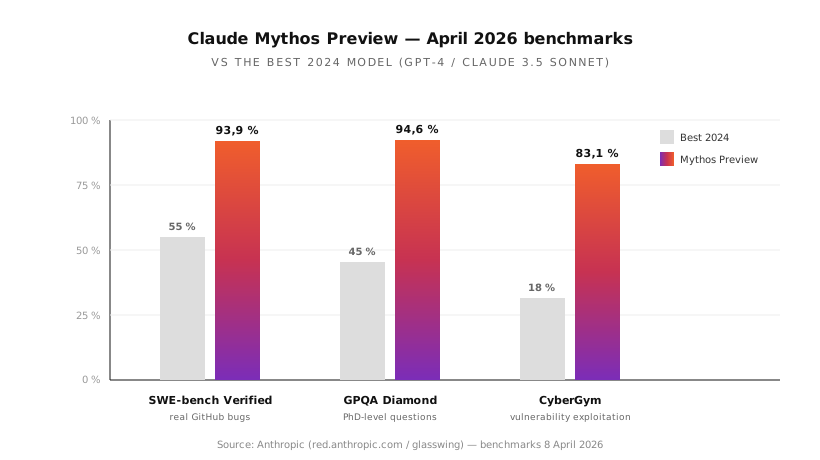
Source: Anthropic — red.anthropic.com and Project Glasswing, benchmarks of 8 April 2026.
SWE-bench Verified — 93.9%. SWE-bench is a collection of real bugs reported on GitHub in major Python projects (Django, Flask, scikit-learn, pytest). You have to understand the problem, modify the code, pass the tests. In 2024, the best models topped out around 55%. Mythos comes close to the theoretical maximum score. That means it autonomously resolves the vast majority of the tickets that experienced developers on an open-source team would handle.
GPQA Diamond — 94.6%. This is the "PhD-level" benchmark: biology, chemistry, physics, questions set by researchers and checked by other researchers. PhD students in the field score around 65-75%. Mythos exceeds the human ceiling by more than 20 points.
CyberGym — 83.1%. This is a recent vulnerability-exploitation benchmark: reproducing and exploiting published CVEs. It is on this ground that Mythos worries people most, because it is the hardest to assess outside the lab — a model capable of exploiting flaws is also capable of finding new ones. Which Mythos has already proved internally.
3. Anthropic itself refuses the word “AGI”
Reading between the lines starts here. All of Anthropic's official communication around Mythos carefully avoids the word AGI. The Glasswing page speaks of "frontier capabilities". The red.anthropic.com post speaks of a "step-change in capabilities". Dario Amodei, questioned at the World Economic Forum in Davos in January 2026 and in several interviews since, flatly rejects the term.
Why this refusal? Three reasons can be read in Amodei's public statements, and not one of them is innocent.
Reason 1 — AGI creates a pointless regulatory target. If Anthropic declares it has reached AGI, American, European and Chinese regulators are entitled to trigger an exceptional regime. The AI Act already provides for reinforced obligations for "general-purpose AI models with systemic risk". An explicit acknowledgement would trigger a level of audit and control that Anthropic cannot operationally afford.
Reason 2 — AGI invalidates the "race that matters" thesis. All of Amodei's strategic argument rests on the idea that democracies must be first to powerful AI. Saying it is already done would remove the central argument of legitimacy behind the fundraising, the government contracts and the national-security partnerships Anthropic is negotiating.
Reason 3 — AGI denies the absence of recursive self-improvement. Mythos finds bugs, writes code, reasons. It does not modify itself. It does not create its own successor. Anthropic insists (discreetly) on this point: these advances do not constitute proof of autonomous recursive growth, which for many researchers is the real AGI threshold.
4. AGI according to whom? Three competing definitions
The term AGI is used as if it were a shared notion. In reality, the three leading labs offer three different definitions, and Anthropic's model ticks boxes in each framework without fully satisfying any of them.
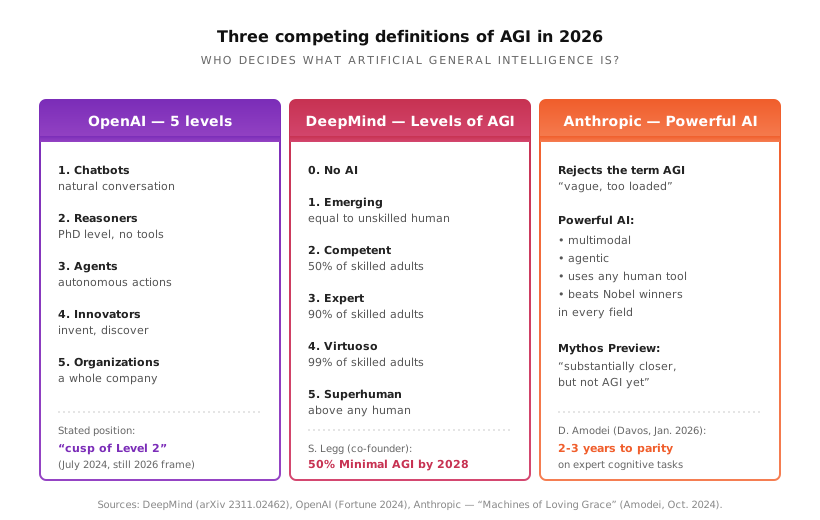
Sources: OpenAI / Fortune, July 2024 · DeepMind / arXiv 2311.02462 · Anthropic / Machines of Loving Grace.
The OpenAI framework ranks systems in five levels: chatbots, reasoners (PhD level without tools), agents (autonomous actions), innovators (discover, invent), organisations (an entire company automated). In mid-2024 OpenAI declared it was "on the cusp of level 2". Applying this framework to Mythos, the model is already unquestionably level 2, and pushes seriously towards level 3 (autonomous actions in cybersecurity).
The DeepMind framework is more precise: it measures performance on cognitive tasks relative to a skilled human population. Emerging (non-expert level), Competent (50% of skilled adults), Expert (90%), Virtuoso (99%), Superhuman (better than any human). On GPQA Diamond, Mythos is already Superhuman in the natural sciences. On SWE-bench, it is Virtuoso on open-source Python bugs. In many other domains (artistic creativity, moral reasoning, political judgement), we are closer to Expert or Competent.
The Anthropic framework defines powerful AI as multimodal, agentic, able to use all human interfaces, and able to surpass Nobel laureates in their respective fields. In this framework, Mythos is a serious step but not the final threshold. It excels on closed benchmarks, not yet on reality as a whole.
The conclusion of this comparison: asserting that Mythos is or is not AGI amounts to asserting that a temperature of 38 °C is or is not a fever. The answer depends entirely on the thermometer. The word AGI, in 2026, has lost its descriptive function. It mainly serves to designate a frontier that each player draws wherever suits it.
5. “First AGI”: who gains from saying it?
The interesting question is not "is it AGI?" but "who benefits from answering yes or no?". The term has become an object of political economy.
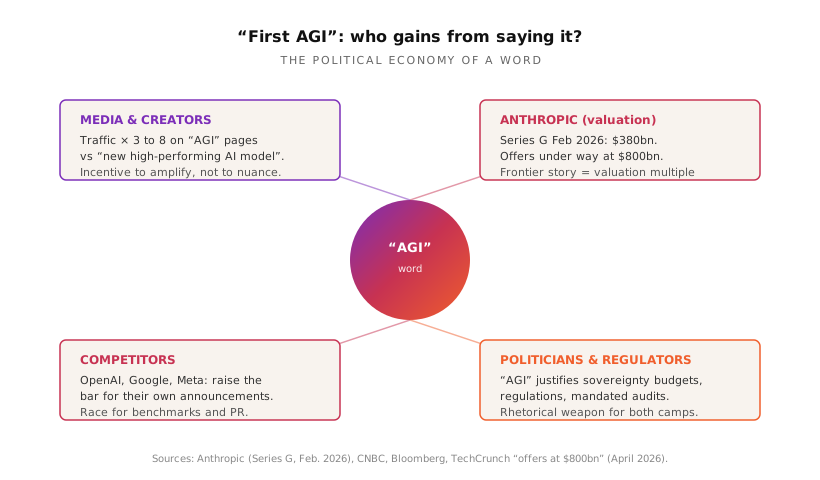
Sources: Anthropic (Series F, Sept. 2025), CNBC Series G Feb. 2026, TechCrunch April 2026.
The media and content creators have a direct interest. A headline with "AGI" gets at least three times the traffic of a headline with "new high-performing AI model". The whole editorial ecosystem, from general-interest outlets to technical YouTube channels, is structurally incentivised to over-qualify. Nobody gets penalised for announcing AGI too early.
Anthropic itself does not need to utter the word to benefit from it. The Series G closed in February 2026 values the company at $380 billion. The offers received in April hover around $800 billion — Anthropic publicly turned them down. That level of valuation presupposes a frontier narrative. Officially saying "this is AGI" would create more regulatory problems than additional market value. Letting the press say it is optimal.
The competitors are caught in a sandwich. If OpenAI, Google DeepMind, Meta or xAI let the "Anthropic reached AGI first" narrative pass, they lose out on fundraising, recruitment and government contracts. They are forced to publish something, fast. We can expect a sequence of symbolic announcements from Sam Altman, Sundar Pichai and Yann LeCun in the coming weeks, each with its own definition of AGI that happens to coincide with its current model.
Politicians and regulators use the word for two opposite purposes. Cut to Washington DC or Brussels: "AGI is coming, we must regulate urgently." Cut to Paris or Berlin: "American AGI is coming, we must fund our sovereignty." It is the same sentence with two opposite political functions. The ambiguity of the word is an asset.
6. What really changes with Mythos
Let us set the word AGI aside. What does Mythos concretely change for companies, developers, SMB directors?
On cybersecurity, it is already settled. Mythos's discovery of thousands of zero-days in a few weeks is a change of scale that makes traditional vulnerability management practices obsolete. The Project Glasswing partners are currently working on patches that will be published before Mythos's defensive and offensive capabilities are released more widely. But if a successor becomes more widely available in 12 to 18 months, any infrastructure not audited by a model of this calibre will be measurably vulnerable. IT directors who do not prepare a budget for assisted secure code review now are falling behind operationally, and it will be hard to catch up.
On software development, the frontier is moving. A model that resolves 93.9% of SWE-bench tickets changes the definition of what a developer does. The profession does not disappear, but it shifts towards specification, architecture, review, and coordination with autonomous agents. Companies that keep staffing as in 2023 will lose the productivity benefits without avoiding the risks.
On public discourse, expect two quarters of bluster. Every new model will be presented as "close to AGI" or "already AGI under such-and-such framework". Most announcements will be smaller-scale commercial variants. The real signal to follow is not the word used, but the decision to release or not. If a model is genuinely Mythos-level, it will not be available through a public API. If you can use it in your IDE from day one, it is not that.
7. Our reading
Claude Mythos is not AGI. Nor is it just one more model. It is the first commercial model whose capabilities forced its own developer to invent a dedicated governance arrangement (Project Glasswing) before releasing it. In operational terms, that is far more interesting than crossing a semantic threshold.
The real question for a director or IT head in 2026 is not "when will we have AGI?", it is threefold. One: are our critical systems able to withstand an offensive audit by a Mythos-level model (probably not)? Two: do our teams already know how to work with AI agents of this calibre in the areas where they are released (Sonnet, Opus, a few others)? Three: do we have a charter and governance in place to frame their use before the new-generation model arrives (see our article on the company AI charter)?
That is where the game is played, not in the academic definition of a three-letter word. AGI is a horizon that recedes as we advance. What does not recede is the capability curve of deployed models. Mythos is a point on that curve, not the end of it.