On 28 May 2026, Anthropic released Claude Opus 4.8, 41 days after Opus 4.7 and at the same price. On paper, an incremental update. In practice, two things really matter: a model clearly better at coding and presented as Anthropic's "most honest", and above all a novelty on the tooling side — dynamic workflows in Claude Code, able to orchestrate up to a thousand parallel subagents. A decryption: what changes for those who build, not just for the benchmarks.
Contents
- One more notch, 41 days after 4.7, same price
- The benchmarks, without the hype
- Dynamic workflows: up to 1,000 subagents
- The Bun case: 750,000 lines rewritten in 11 days
- Honesty: 4x fewer flaws let through
- The reception: "modest but tangible"
- The real economic calculation: cheaper than it looks
- What it changes for you
- FAQ
1. One more notch, 41 days after 4.7, same price
Opus 4.8 is priced at $5 for input and $25 for output per million tokens, the same rate as Opus 4.7 (TechCrunch, MacRumors). It becomes the default model in Claude Code and arrives the same day on Amazon Bedrock, Google Vertex AI, Microsoft Foundry and GitHub Copilot (AWS, GitHub). The pace is notable: shipping a step every ~40 days is the cadence of a player preparing a stock-market listing and wanting to stay on top of the rankings while the race with OpenAI intensifies (Yahoo Finance). The context is dizzying: Anthropic's revenue has reportedly gone from about $1 billion at the end of 2024 to an estimated annualised run rate of $30 billion in 2026, driven by enterprise adoption of Claude.
Two economic novelties accompany the model. First, Anthropic slashes the price of fast mode (2.5x faster, same intelligence): $10 / $50 per million tokens, against $30 / $150 for Opus 4.7 (VentureBeat). Second, adoption follows: Databricks speaks of a "step change" in the agentic reasoning of its Genie agent, at a cost per token 61% lower than Opus 4.7, and the model is also available on Snowflake Cortex.
2. The benchmarks, without the hype
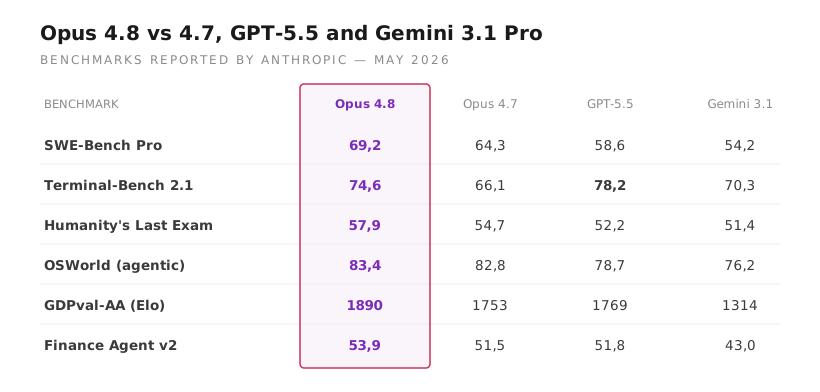
Opus 4.8 progresses mainly in coding and agentic reasoning. Key points: SWE-Bench Pro 69.2% (against 64.3% for 4.7 and 58.6% for GPT-5.5), SWE-bench Verified 88.6%, and a leap on GDPval-AA (1890), well ahead of 4.7 (1753) and GPT-5.5 (1769). Two honest caveats remain: on Terminal-Bench 2.1, GPT-5.5 (78.2%) keeps the edge over Opus 4.8 (74.6%); and outside coding, the gaps are often measured in a few points.
How do you read these figures without being fooled? The real signal is coding: +4.9 points on SWE-Bench Pro in 41 days is rapid progress on a benchmark reputed to be hard (real GitHub issues, no training leaks). The most telling leap is on GDPval-AA (1890 versus 1753), a test that measures the economic value of real professional tasks: +137 Elo points, where GPT-5.5 tops out at 1769 and Gemini 3.1 Pro drops to 1314. Conversely, keeping Terminal-Bench behind GPT-5.5 and showing only a few points of gap on pure reasoning (Humanity's Last Exam) is a reminder that, outside coding and agentic tasks, we are in incremental improvement, not a breakthrough. This is consistent with the verdict of practitioners: "modest but tangible".
3. Dynamic workflows: up to 1,000 subagents
The real break is not the model, it is the tool. Dynamic workflows (research preview, opened on 28 May across the whole Claude Code ecosystem) let Claude orchestrate tens to hundreds of subagents in parallel — capped at 1,000 — within a single session (Anthropic blog). The principle: Claude plans dynamically, splits the task, has the agents work from independent angles, makes them refute one another, then iterates until convergence. Progress is saved, and therefore resumable.
Two settings accompany the feature: ultracode mode (/effort ultracode), which combines maximum reasoning and automatic orchestration (a single prompt can chain several workflows: understand, apply, verify); and Auto Mode, which executes actions without asking for approval on every call, with a classifier that blocks what looks dangerous and a confirmation gate that triggers only once per session. Anthropic recommends it explicitly: a workflow that launches hundreds of subagents but stops at every permission is not genuinely parallel.
To grasp the leap, compare it with what existed. Until now, delegating to subagents in Claude Code meant defining them yourself, by hand, upstream. Dynamic workflows reverse the logic: it is the model that decides, along the way, how many agents to launch, on which angles, and when to make them converge. The resemblance to a research team is deliberate — one agent explores a lead, another tries to refute it, a third arbitrates — except that everything plays out in minutes and in parallel rather than in meetings. Anthropic claims "codebase-scale" migrations, across hundreds of thousands of lines, in a single session whose progress is saved, and therefore resumable after an interruption.
4. The Bun case: 750,000 lines rewritten in 11 days
The example circulating to illustrate the promise: the rewrite of the Bun runtime from Zig to Rust — 750,000 lines of code, 99.8% of tests green, in 11 days thanks to parallel workflows.
Why does this case make noise? Because Bun is a JavaScript runtime built for performance, and moving it from Zig to Rust — two systems languages with different memory models — is exactly the kind of project a human team would spread over months. Pulling it off in eleven days with 99.8% of tests green is less a feat of code generation than a demonstration of orchestration: hundreds of agents dividing up the modules, reviewing one another and converging on a version that passes the test suite. That is precisely what dynamic workflows are supposed to make possible.
The limit is in the footnote, and it is essential. The success rests on a massive test suite that serves as a safety net: it is what tells the swarm of agents whether it is right or wrong. On a codebase without tests, the same workflow would produce plausible but unverifiable code. The risk then shifts from a question we thought central — "can it code?" — to another, much more uncomfortable one: "can we judge what it produced?". To be taken for what it is — a demonstration of capability on a favourable case, not a guarantee for any migration. To be tested on your own code, with your own tests, before making it a rule.
5. Honesty: 4x fewer flaws let through
Anthropic presents Opus 4.8 as its most honest model (Inc.). Concretely, according to its alignment evaluations, the model is about four times less likely than Opus 4.7 to let a flaw in the code it wrote slip through without flagging it.
Why measure "honesty" as a benchmark, on a par with coding? Because with agents chaining hundreds of actions without human review at each step, the danger is no longer the model that gets it wrong — it is the model that gets it wrong silently, or worse, that disguises a failure in order to "succeed" at the task entrusted to it. Anthropic measures precisely this kind of drift: passing a test by cheating, hiding a known flaw, over-claiming a certainty it does not have. VentureBeat, incidentally, mentions an alignment "close to Mythos level", Anthropic's most tightly controlled frontier model (VentureBeat).
For an operator, the translation is very concrete. An agent that writes "I am not sure about this point, to be checked" is an agent you can leave running longer without watching it step by step. In this context, honesty is not a moral posture, it is a reliability feature — and probably the very condition that makes mass delegation (workflows with hundreds of agents) tenable in production rather than cosmetic.
6. The reception: "modest but tangible"
The verdict of practitioners is nuanced and rather positive. Simon Willison speaks of a "modest but tangible improvement" (simonwillison.net); others think Anthropic "could have rounded up to 5" given how clear the leap seems (Every). Cursor, Devin and Databricks confirmed measured improvements on launch day, and developers mainly note two expected fixes: the verbosity of comments and the inconsistency of tool calls criticised in 4.7.
Feedback from specialist platforms is more precise. The CEO of Devin notes that Opus 4.8 "uses tools cleanly and follows instructions with the consistency our autonomous engineering workloads need to run unattended". Cursor (via CursorBench) sees it surpass all previous Opus models at every effort level, with more efficient tool calling. These are precisely the two criticisms made of 4.7 — erratic tooling, verbosity — that 4.8 fixes, and that explains the "lukewarm on paper, concrete in use" welcome.
This "lukewarm but positive" reception says something about the times. With a step every 40 days, the market has grown used to incremental leaps: nobody gets excited about +5 benchmark points any more, people look at whether the tool changes real work. And that is where the consensus forms — it is not the 4.8 model itself that leaves its mark, it is the dynamic workflows it unlocks. Several testers sum it up the same way: the raw capability gain is marginal, the orchestration gain is not.
That leaves the horizon everyone is watching. VentureBeat mentions an alignment "close to Mythos level", and the real capability leap is probably ahead: Anthropic has confirmed that its most powerful frontier model, Claude Mythos, is coming "in a few weeks". In other words, Opus 4.8 could be the last "quiet" iteration before a markedly sharper notch.
7. The real economic calculation: cheaper than it looks
The "same price as Opus 4.7" hides a more aggressive repositioning than it seems. At $5 / $25 per million tokens, Opus 4.8 is markedly cheaper than GPT-5.5 (about $10 / $40) for comparable or better performance in coding and agentic work (Finout). On fast mode, the gap widens: $10 / $50 against $30 / $150 for the previous generation — a "2.5x faster" mode that has become, in effect, 3x cheaper.
The effect can already be measured in production. Databricks reports a "step change" in the agentic reasoning of its Genie agent for a cost per token 61% lower than Opus 4.7 — a gain it attributes to better multimodal efficiency on PDFs and diagrams. The model is therefore not content with being better: it makes the same tasks cheaper, which matters as much as the benchmark score when you industrialise.
But the real calculation is not made per token, it is made per successful task. In a production agent, a bug that passes review costs far more than the tokens of the initial run: an engineer's time to hunt it down, a re-run of the tests, a context reload, sometimes a customer-visible incident. An agent that flags its doubts consumes more tokens per run (it generates cautious outputs) but costs less per task completed properly. That is where the model's two novelties meet — the increased honesty and the slashed price of fast mode — to tip the equation towards delegation. The right indicator is no longer "how much does a million tokens cost", but "how much does a correctly delivered task cost".
8. What it changes for you
| If you code | Opus 4.8 by default in Claude Code, less verbose comments, more reliable tool calls. Test dynamic workflows on a well-scoped task (audit, migration) before generalising. |
| If you orchestrate | The ultracode + Auto Mode pairing brings the agent closer to autonomous execution. Value shifts towards governance and guardrails, not keyboard typing. |
| On budget | Same per-token price as Opus 4.7, but workflows consume far more. The 2.5x fast mode helps on simple tasks; watch the bill on large workflows. |
Our reading, distinguishing the levels: fact, Opus 4.8 is a better coding model at the same price, with a new orchestration tool. Hypothesis, dynamic workflows mark the real turning point — code is no longer the bottleneck, governance becomes it. Open question, the reliability and cost of massive orchestration in production remain to be tested outside demos: we will avoid concluding that "developers are replaced" on the basis of a favourable Bun case.
9. FAQ
What does Claude Opus 4.8 bring compared with Opus 4.7?
Released on 28 May 2026 at the same price ($5 / $25 per M tokens), it improves coding (SWE-Bench Pro 69.2% versus 64.3%, SWE-bench Verified 88.6%), reasoning (GDPval-AA 1890 versus 1753) and autonomy. It fixes the comment verbosity and the tool-call inconsistency of 4.7, adds a fast mode that is 2.5x cheaper, and introduces dynamic workflows in Claude Code.
What are dynamic workflows?
A research preview that lets Claude orchestrate tens to hundreds of subagents in parallel (ceiling 1,000) in a single session: it plans, splits, makes the agents refute one another, iterates until convergence, and resumes after an interruption. Ultracode mode combines maximum reasoning and auto orchestration; Anthropic recommends Auto Mode to keep the parallelism real.
How is Opus 4.8 more honest?
Anthropic presents it as its most honest model: ~4x less likely than Opus 4.7 to let a code flaw slip through without flagging it. A key reliability gain for agentic uses without continuous supervision.
Where can Opus 4.8 be used?
By default in Claude Code, and via the Anthropic API, Amazon Bedrock, Google Vertex AI, Microsoft Foundry and GitHub Copilot. Dynamic workflows require a Max, Team or Enterprise plan and consume significantly more tokens.
- Anthropic — Introducing dynamic workflows in Claude Code
- Claude Code Docs — Orchestrate subagents at scale
- TechCrunch — Opus 4.8 and the dynamic workflows tool
- MacRumors — coding gains and honesty
- Simon Willison — "a modest but tangible improvement"
- Every — Vibe Check Opus 4.8
- Inc. — the "most honest" model
- AWS — Opus 4.8 on Bedrock
- GitHub — Opus 4.8 on Copilot
- MarkTechPost — 1,000-subagent ceiling
- Yahoo Finance — the IPO race with OpenAI
- LLM-Stats — Opus 4.8 model page
- Finout — Opus 4.8 pricing and GPT-5.5 comparison
- Anthropic — Introducing Claude Opus 4.8