AI is no longer held back by its code. It is held back by concrete, transformers and drinking water. In April 2026, nearly half of the planned American data centres had been cancelled or postponed, the hyperscalers are installing generators on site, and Elon Musk says he wants to send most of his future servers into orbit. Behind the $650 billion of investment announced this year, the physical wall has already been reached. Decryption without the marketing talk.
1. The electricity grid wall
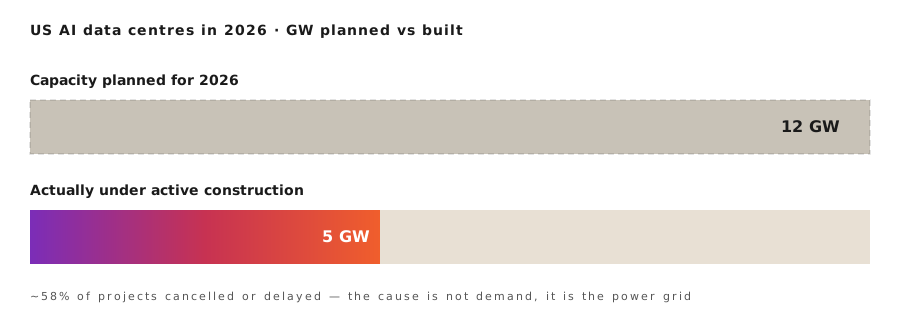
Of the 12 GW of data centre capacity planned in the United States for 2026, only 5 GW is under active construction. The rest — nearly 58% — is frozen, cancelled or postponed indefinitely. The problem is neither demand nor capital: both exceed expectations. The blockage lies elsewhere.
Sources: Tom's Hardware, Tech Insider, European Business Magazine.
A modern AI training data centre consumes between 100 and 300 MW — the equivalent of a mid-sized city. It can be built in under 18 months. But the electrical infrastructure that has to power it takes up to five years to deploy. That asymmetry is enough to explain the whole wave of cancellations.
The technical detail that blocks everything: high-voltage transformers. Before 2020, their delivery time was 24 to 30 months. Today, contracts are signed with a five-year lead time. The same problem affects circuit breakers, batteries and connections to the national grid. The electrical supply chain, planned for the growth of the 2010s, cannot absorb the AI curve of the 2020s.
What the hyperscalers are doing in response
Microsoft announced $80 billion of AI investment in 2026, then quietly slowed down. The company is chasing sites connected to natural gas in Texas and West Virginia (Data Center Frontier).
Meta and xAI are installing gas generators directly on site, so as to stop depending on the grid (Tom's Hardware). This solution works in the short term. In the medium term, it turns AI data centres into the largest CO₂ emitters in their region, and renders void the carbon commitments of the companies that host them.
The paradox is not resolved. It is moved from the grid to the atmosphere.
2. The water wall
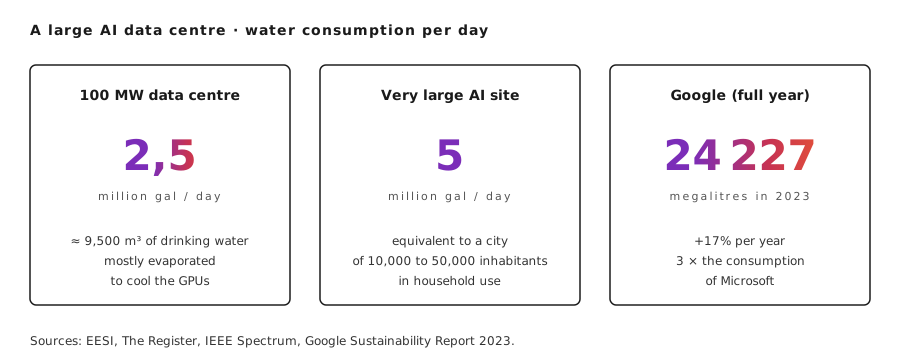
A 100 MW AI data centre consumes between 0.5 and 2.5 million gallons of water a day, depending on the local climate and the cooling technology (EESI). The very largest sites reach 5 million gallons, the equivalent of the daily consumption of a city of 10,000 to 50,000 inhabitants.
Sources: EESI, The Register, IEEE Spectrum, Google Sustainability Report 2023.
Google consumed 24,227 megalitres of water in 2023, three times Microsoft's consumption, growing at 17% a year. At this rate, projections from the US Department of Energy forecast that by 2030 data centres will need between 697 million and 1.45 billion additional gallons of water a day. For comparison, the whole of New York City distributes about 1 billion gallons a day.
It is not water in itself that is the problem — it is drinking water, drawn locally, evaporated. Data centres set up where land is cheap and solar power is available, which often means arid areas (Arizona, Texas, Spain). They compete directly with agriculture and urban drinking water.
The zero-water promise and its realism
The hyperscalers are announcing the shift to zero-water cooling (closed systems, on-chip liquid cooling, atmospheric free cooling) as the standard by the end of 2027. Google and Microsoft have promised to be water positive by 2030 — that is, to return more water than they consume.
The commitment is real. So is the scale of the challenge: the existing estate is massively dependent on evaporative cooling. The transition is expensive, takes time, and new AI sites consume even more during the switchover period.
3. The $650 billion that no longer builds
Alphabet, Amazon, Meta and Microsoft have announced a combined total of more than $650 billion of AI infrastructure investment for 2026 (Data Center Knowledge). This figure does not reflect what will be actually spent on construction. It reflects what will be committed, including land purchases, Nvidia GPU pre-reservations, long-term energy supply contracts and options on sites not yet connected.
At the current rate of grid connection, a significant share of these $650 billion is blocked upstream of any construction. It is this mismatch between available capital and deliverable infrastructure that is giving rise to "out-of-the-box" solutions such as Terafab.
4. Terafab: the flight forward into space
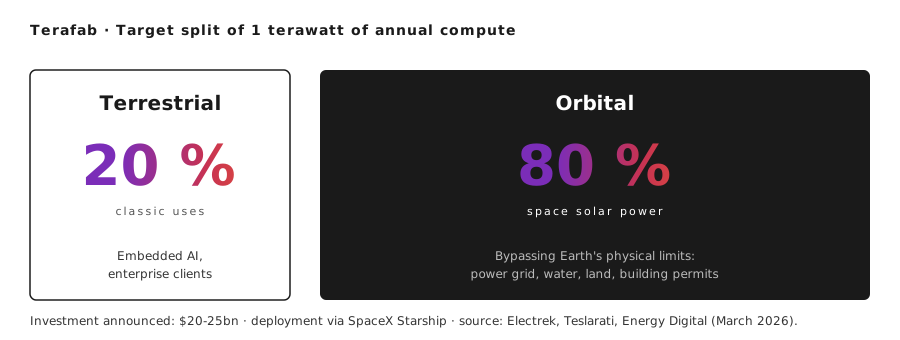
On 21 March 2026, Elon Musk announced in Austin the launch of Terafab (sometimes spelt Terrafab), a $20 to $25 billion Tesla-SpaceX-xAI joint venture. The stated goal: to produce one terawatt of AI compute a year, of which 80% deployed in orbit, powered by space-based solar panels launched via Starship (Teslarati, Environment+Energy Leader).
Sources: Electrek, Teslarati, Energy Digital — March 2026.
The pilot site is planned on the North campus of Giga Texas. The long-term goal: 1 million wafer starts a month, 100 to 200 billion AI and memory chips a year.
Reading Terafab as a technological breakthrough would be naive. Reading Terafab as the admission that AI data centres can no longer be built on Earth at the desired pace is more instructive. Orbit becomes attractive for a simple reason: no building permit, no grid connection, no health authority checking water consumption. Space is less regulated.
Technical feasibility remains to be demonstrated. Space-based solar power requires transmission by microwave beam to Earth or use on site, and no operational mission of this scale exists today. Electrek calls the announcement a "reek of desperation" — it smells of desperation — and the remark is a lucid one.
5. What it means in practice
For a company deploying AI
The energy cost per query is today under-specified by suppliers, and the pressure will grow. Two lines of discipline become critical: use the smallest model that does the job (Haiku rather than Opus where possible), and use prompt caching, which cuts the bill and the energy footprint by 90% on repeated contexts.
For a citizen
Data centres are no longer abstract infrastructure. They compete with your drinking water, your local land and the stability of your electricity grid. AI has a material footprint. The talk of the "dematerialisation" of digital technology is a pleasant fiction.
For a public decision-maker
The hyperscalers' carbon and water commitments are voluntary and non-binding. Europe is starting to regulate via the Energy Efficiency Directive, while the United States largely lets things take their course. The regulatory gap will shape the geography of future deployments.
Conclusion
AI has hit its physical glass ceiling. Not the ceiling of the algorithm, nor that of capital. That of concrete, copper and water. In 2026, building a data centre goes faster than building the power line that must supply it, extracting the water that must cool it and obtaining the permit that authorises both.
Public responses are still lagging. Private responses boil down to two strategies: installing gas power plants on site to bypass the grid, or going into orbit to get round the Earth itself. Both have the merit of being sincere about the current impasse. Neither is seriously sustainable on a decade-long scale.
The question nobody asks openly: should we deploy everywhere every AI capacity that can be deployed, or begin to sort uses according to their real usefulness? That is the real debate of the next two years.