Ford handed a growing share of its quality control to automated systems. Then the carmaker rehired around 350 seasoned engineers when quality slipped. The press headlined the return of the "gray beards", the grey-haired veterans. But the interesting story is not that AI failed: it is why it failed. The cause fits in one sentence, and it bears directly on any company about to automate an expert job.
1. What actually happened at Ford
Ford's chief operating officer, Kumar Galhotra, acknowledged it to journalists: the group had "relied more and more on automated quality systems", with disappointing results. The response was not to double down on technology. It was to go back and find humans — around 350 experienced quality engineers and specialists, some of them former employees, others poached from suppliers (Bloomberg, TechCrunch).
The role of these veterans is precise: retrain the automated tools, train the younger staff, and "hunt down failure points before a part reaches the line". In other words, put back in the loop the people who know where to look.
The result is measurable. CEO Jim Farley referred to a drop in warranty and recall costs "contributing hundreds and hundreds of millions of dollars" of favourable effect. Ford also took first place among mainstream brands in the JD Power initial quality study published that same week. The U-turn paid off.
2. The real cause: knowledge that left before it was captured
Galhotra delivered the sentence that explains everything: some of the most experienced employees left before their knowledge was "captured" in the systems. As a result, the AI tools were trained on incomplete information.
This is the heart of the problem. A seasoned quality engineer does not just follow a written procedure. They carry tacit knowledge: the abnormal sound they recognise, the surface defect that signals a problem upstream, the setting that "smells" wrong even though no measurement leaves its thresholds. That knowledge is not in the files. It is in people's heads. When those heads leave without passing it on, they take half the reference base with them — and nobody notices as long as the AI runs on what remains.
3. Why this is not "AI doesn't work"
The temptation is to read this case as a victory of human over machine. That would be the wrong lesson. Automated quality systems work: they inspect faster, never tire, never skip a part at 3 a.m. Ford did not switch them off — it is retraining them with the veterans.
The failure is not technological, it is methodological. Ford reversed the order of operations. The company automated and cut expert headcount before consolidating their knowledge. The machine then inherited a reference base full of holes. The same tool, fed the full knowledge, would have produced the opposite result — which is what Ford is now finding, having put humans back in the loop.
4. The sequencing trap
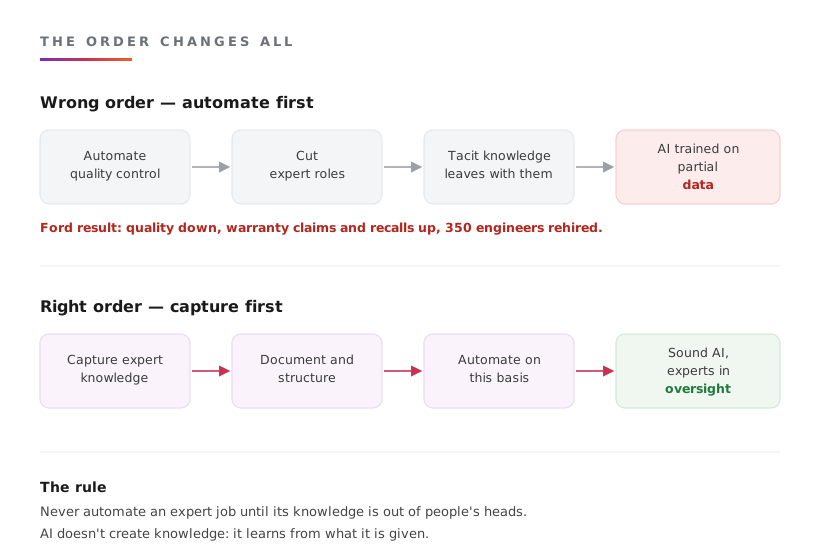
Otium reading of the 2026 Ford case, based on statements by Kumar Galhotra and Jim Farley.
The trap is that in the short term, the wrong order looks more profitable. You automate, you cut the payroll, the financial indicators improve immediately. The debt is paid later, when defects come back in warranty claims, recalls and reputation. Ford paid that debt in hundreds of millions of dollars, then had to buy back at a high price an expertise it had let walk away.
The right order costs more up front — you have to fund the experts and the documentation of their knowledge in parallel — but it does not create a hole in the reference base. This is exactly the kind of trade-off that a decision made on the spreadsheet alone underestimates.
5. What you must do before automating an expert job
The transposition to an SMB or a mid-sized company is direct. You do not have 350 engineers, but you often have one or two people who "know", and whose departure would empty out an entire body of know-how. Before automating their work, four steps.
Capture before cutting. Run structured interviews with your experts: not "what is the procedure", but "what do you look at that nobody else looks at, and how do you decide". It is the tacit knowledge that has value, not the procedure that is already written down.
Document the edge cases. An automated system handles the normal case well. It fails on the exception. Work with your experts to list the rare situations, the misleading defects, the false alarms. This body of exceptions is what separates a credible tool from one that "misses what the human used to see".
Automate on that basis, in stages. Do not switch everything over at once. Run the tool alongside the expert for a period, compare their verdicts, correct the gaps. The expert becomes the model's corrector, not its victim.
Keep the human in a supervisory role. The goal is not zero humans, it is the human in the right place: supervising the cases the machine flags as uncertain. This is precisely the role Ford is giving back to its veterans.
6. The hidden cost of "replacement"
The Ford case puts a number on an intuition that is often ignored: replacing an expert with a tool does not erase their cost, it moves it. In the short term, you save a salary. In the medium term, you pay in degraded quality, then in buying expertise back — often at a higher price, because you then have to poach urgently from suppliers or call back former employees who are in a position of strength.
The real question is therefore never "can we replace this person with an AI". It is "has their knowledge left their head, and has our system learned it". As long as the answer is no, automation does not remove the risk: it defers and amplifies it.
Ford had the means to correct course and absorb the bill. A smaller company, with rarer know-how, would not necessarily have that margin. The order of operations is not a detail of method — it is what separates an automation that holds from an automation that will have to be undone.
Frequently asked questions
Why did Ford rehire engineers after automating its quality control?
Because its automated systems had been trained on incomplete data. Some of the most experienced engineers had left before their knowledge was documented, and the tools did not detect the defects those engineers spotted. Ford rehired around 350 veterans to retrain the tools and train the younger staff.
Does this prove that AI does not work for quality control?
No. Automated systems work when they are fed the right knowledge. Ford's failure is not AI itself, it is the order of operations: automating and cutting expert headcount before capturing their tacit knowledge.
What is the lesson for an SMB that wants to automate a job?
Capture the experts' knowledge first, structure it, then automate on that basis while keeping the experts in a supervisory role. You do not automate an expert job until its knowledge has left people's heads.
Conclusion
The return of Ford's "gray beards" is not a revenge of human over machine. It is a reminder that AI does not invent knowledge: it learns from the knowledge it is given. The carmaker did not fail because it automated. It failed because it automated in the wrong order, letting knowledge walk out before capturing it.
Sequence is the only thing that really matters. Capture, document, then automate — and keep your experts where the machine hesitates. It is less spectacular than a grand replacement plan, and that is precisely why it holds.