


In 2020, NVIDIA drew half of its revenue from gaming. In 2025, gaming accounts for only 9% of its turnover — the data centre makes up 91%. The silicon has not changed. The architectures (Ada, Blackwell) come off the same TSMC wafers. The customer, on the other hand, has switched. Meanwhile, the biggest game ever produced, GTA VI, is getting ready to launch in May 2026 with an estimated budget of $1 to $2 billion — an amount that, in 2026, costs less than a single frontier AI training run as projected by Epoch AI. And while Rockstar finalises nine years of craftsmanship, Google DeepMind, Microsoft and NVIDIA are publishing models that generate the game frame by frame. This article tells the story of that shift, with sourced figures.
1. The same silicon, two packagings
We must begin with a technical fact that is often overlooked: the RTX 5090 that powers a high-end gaming PC and the B200 that trains GPT-5 or Claude Opus 4.7 share the same architecture. Both belong to the Blackwell generation, announced by NVIDIA in March 2024 and manufactured by TSMC on the 4N process (an optimised 5 nm variant). The RTX 5090 carries 92 billion transistors, the B200 carries 208 billion (two linked dies). But the design of the CUDA cores, tensor cores, RT cores and the graphics pipeline all come from the same architectural family.
What sets them apart is the packaging. Three main differences:
- Memory. The RTX 5090 uses GDDR7 (32 GB), which is fast but less dense and less suited to giant models. The B200 carries HBM3e (192 GB per GPU), stacked directly next to the die via a silicon interposer. HBM3e costs about ten times more per gigabyte but delivers a memory bandwidth that is many times higher.
- Interconnect. The RTX 5090 talks to its host over a PCIe 5.0 bus. The B200 uses NVLink 5, which lets eight GPUs behave as a single shared virtual processor. It is this interconnect that makes large-scale training possible.
- Thermal regime. The RTX 5090 has a peak TDP of 575 W, air-cooled. The B200 can reach 1,000 W, requires direct liquid cooling, and ships only as an HGX rack module (eight cards at once).
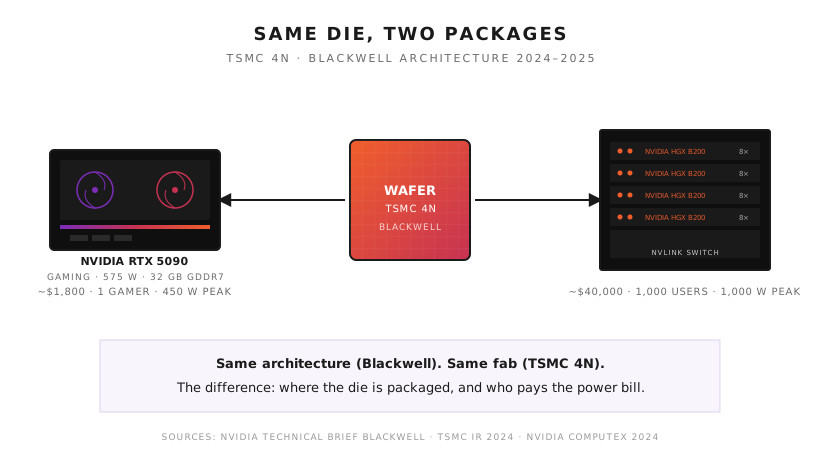
Sources: NVIDIA Technical Brief Blackwell (March 2024) · NVIDIA COMPUTEX 2024 · NVIDIA HGX B200 · RTX 5090 datasheet.
The economic consequence is the gap in unit price: about $1,800 for an RTX 5090, about $40,000 for a B200. A ratio of 22. But the real ratio, the one that matters to NVIDIA, is usage. An RTX 5090 serves one player at a time. A B200 in a data centre serves a thousand simultaneous Claude users. It is this lever that explains why, segment by segment, the relative weight of gaming has melted away.
2. NVIDIA's shift: gaming stagnates, the data centre explodes
NVIDIA publishes its results by segment every quarter. The company's fiscal year closes in January. Putting together the annual 10-Ks filed with the SEC, the curve is unambiguous.
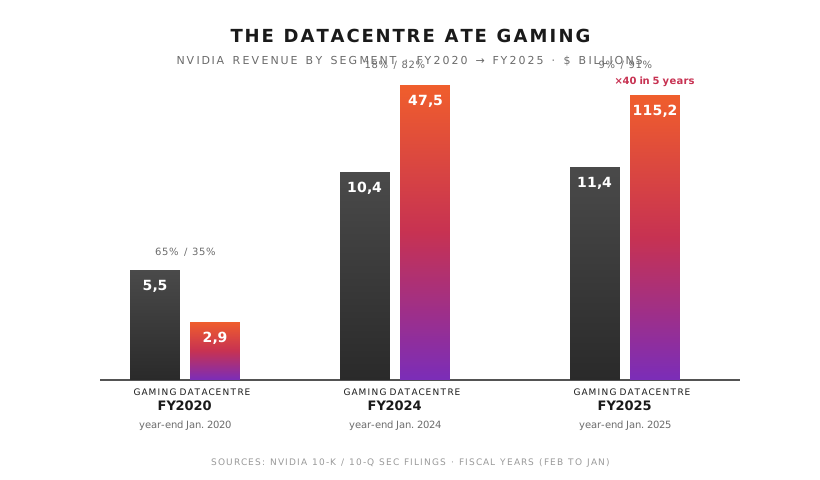
Source: NVIDIA 10-K / 10-Q SEC filings · fiscal years ending in January.
FY2020, ended January 2020: $5.52 billion of Gaming revenue, $2.98 billion of Data Center revenue. Gaming is the first segment, the data centre a dynamic but minority second. Ratio 65 / 35.
FY2024, ended January 2024: Gaming rises to $10.45 billion, Data Center explodes to $47.52 billion. In four years, gaming gained 90%, the data centre was multiplied by 16. Ratio 18 / 82.
FY2025, ended January 2025: Gaming reaches $11.35 billion, Data Center peaks at $115.19 billion. Over five fiscal years, the data centre was multiplied by 39. Gaming, by 2.1. Ratio 9 / 91.
In other words: of every additional dollar generated by NVIDIA between 2020 and 2025, 95 cents come from the data centre, five cents from gaming. Gaming has not disappeared, it has simply become a secondary segment, which the company looks after but which no longer drives either the roadmap or the wafer-allocation priorities.
3. GTA VI vs frontier training: the order of magnitude flips
GTA VI is due out on 26 May 2026, according to the official schedule reaffirmed by Rockstar in 2025. The most credible estimates of the production budget — relayed notably by Jason Schreier of Bloomberg in 2024 — put the total cost between $1 and $2 billion, over about nine years of development and more than 2,000 people involved. It is by far the largest investment ever made in a single entertainment product.
To gauge the scale of the shift, this figure must be compared with what it costs to produce the AI models that now run in the same data centres as the GPUs NVIDIA allocates.
| Product | Year | Cost | Source |
|---|---|---|---|
| GTA V (Rockstar) | 2013 | $265M | Take-Two / Pachter analysis |
| Cyberpunk 2077 (CD Projekt) | 2020 | $316M | CDPR annual report |
| GPT-4 training (OpenAI) | 2023 | $78M | Epoch AI |
| Gemini Ultra training (Google) | 2023 | $191M | Epoch AI |
| GTA VI (Rockstar) — estimate | 2026 | $1,000 – 2,000M | Bloomberg / J. Schreier 2024 |
| AGI training — projection | 2027 — | $406M – 8,200M | Epoch AI, "Can AI scaling continue through 2030?" |
Three observations emerge. One: until 2024, AAA productions cost more to produce than frontier AI model training runs. GPT-4 was trained for a third of the cost of Cyberpunk 2077. Two: with GTA VI, the games industry reaches its own ceiling — $1 to $2 billion for a single title is an anomaly that nobody in the sector knows can be repeated. Three: at the same moment, the cost benchmark for AI training runs is taking off. If Epoch AI's projection for the next tier of frontier models (often described as "AGI candidates") comes true, a single training run will reach or exceed the cost of GTA VI by 2027-2028.
This is not an anecdotal detail. It is an inversion of the cost hierarchy that defines a sector: gaming held the role of the most expensive cultural industry to produce throughout the 2010s. AI takes that role in the 2020s, using the same silicon.
4. The inversion: AI begins to generate the game
The last stage of the shift is the most recent. Between August 2024 and February 2025, four major technical announcements showed that beyond infrastructure, the very content of the video game can now be an output of generative AI. Not yet at the scale of GTA VI — but the first demonstrations exist, are published, and work.
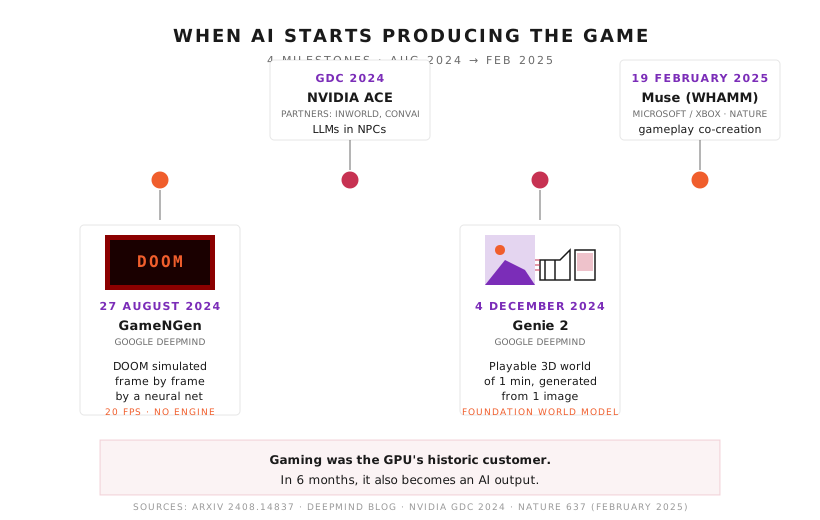
Sources: arXiv 2408.14837 · DeepMind Genie 2 · NVIDIA ACE · Nature 638 (Microsoft Muse).
GameNGen (27 August 2024, Google DeepMind). A neural network trained on DOOM games generates each frame of the game one by one, at 20 FPS, without any underlying game engine. The user can play — the controls are taken into account, the physics emerges correctly, the enemy moves. It is not an emulated DOOM: it is a DOOM hallucinated in real time by a neural net. The resolution is low, the fidelity imperfect, but the principle is demonstrated.
NVIDIA ACE (GDC 2024). NVIDIA announces a suite of building blocks that let developers integrate LLMs directly into non-player characters. The flagship demonstration, Covert Protocol in partnership with Inworld AI, shows an NPC that answers in natural language, decides its actions according to a dynamic context, and remembers previous interactions. Convai provides a comparable building block. The biggest studios (Ubisoft, Tencent) have announced pilots on the subject.
Google Genie 2 (4 December 2024, DeepMind). This is the most striking mainstream milestone of the wave. A foundation world model — from the same ecosystem as Gemini and trained on the same Google TPU infrastructure — generates, from a static image (photo, painting, render), a playable 3D environment that can last up to a minute. The user can move around in it, interact with objects, and observe a plausible physical coherence. Genie 2 does not yet produce a publishable game, but it produces a playable prototype in a few seconds where a human level designer takes several days. For the first time, a user can create their own game from an image they import, with no game engine, without coding a line, without scripting a shader. The prompt replaces the production pipeline.
Microsoft Muse (19 February 2025). Published in Nature, Muse — the public name of a system developed by Microsoft Research with Xbox Game Studios — is a gameplay-generating model designed as a creative assistant. It proposes, extends and remixes playable sequences, trained on multiplayer gameplay from studios such as Ninja Theory. It is the first model of this type published in Nature — a detail that matters: the industry is now asking science to qualify its tools.
5. Profitability per unit of compute: why NVIDIA prefers AI
NVIDIA's shift from gaming to the data centre is not only a story of volume. It is a story of profitability per GPU-hour switched on. Two economic models coexist on the same silicon, with opposite logics: gaming is a one-off purchase with a licence, AI is a recurring subscription with usage-based billing. Here are the orders of magnitude, calculated on the basis of public pricing in April 2026.
| Use | Revenue / user hour | Revenue / GPU / year | Economic model |
|---|---|---|---|
| Classic AAA purchase GTA VI $70 × 50 hours played |
$1.40 | — | One-off licence (no recurrence) |
| Xbox Game Pass Ultimate $20/month × 80 hours played |
$0.25 | — | Catalogue subscription, player's local GPU |
| Claude Pro $20/month × ~40 user hours |
$0.50 | ~$10,000 * | Subscription, data centre inference |
| Claude Sonnet API $3/$15 per million tokens in/out |
$0.80 – 3 ** | ~$10,000 * | Pay-as-you-go tokens |
| Enterprise AI agent reasoning + tools, sustained use |
$8 – 25 *** | ~$15,000 * | B2B subscription per seat or usage |
* Order-of-magnitude estimate: Anthropic ARR ∼ $5bn (2025) / estimated fleet of 500,000 H100-equivalents ≈ $10,000/GPU/year. Gross value, before operating costs.
** Based on a typical conversation (15k tokens in + 5k out) in production on Claude 4.5 Sonnet.
*** Based on public enterprise pricing from Anthropic / OpenAI / Microsoft Copilot for Sales ($40/month/seat) to Zendesk AI ($75 per active agent).
Three observations emerge from this table. First observation: Claude Pro's revenue per hour of use already exceeds revenue per hour of subscription gaming ($0.50 against $0.25). Consumer AI is already twice as profitable per minute of attention as subscription gaming. For NVIDIA, which supplies both, this means that the same silicon, rebadged, structurally generates more downstream value when it ends up in a data centre.
Second observation: the enterprise AI agent is an order of magnitude above premium gaming. A Claude or GPT agent plugged into a company's tools, billed at $500 to $2,000 a month per active user — which has become commonplace for a sales assistant, a legal analyst or an augmented senior developer — generates between 10 and 50 times more revenue per hour than an Xbox player. It is this enterprise segment, not consumer conversation, that structures NVIDIA's data centre revenue.
Third observation, the most important: gaming does not bill for compute, AI bills for it every second. A GTA VI player pays $70 once to play fifty hours, perhaps two hundred. The GPU they use (their RTX 5090) was sold by NVIDIA for about $1,800, once, and its added value for NVIDIA stops there. Conversely, a B200 deployed in an Anthropic data centre generates several thousand dollars of API revenue a year, over the three to five years of its operational life. It is mathematical: for the same surface of silicon produced at TSMC, the AI economy closes a recurring billing loop that the gaming economy does not close.
6. What this shift means
Several readings are possible. The first, the most trivial, is economic: NVIDIA has changed its main customer, and that explains its market price and its 2023-2026 stock trajectory. End.
The second reading is more interesting: gaming financed the infrastructure that now absorbs it. It was the games industry that, between 2000 and 2020, created the mass market for the high-performance GPU. That market allowed NVIDIA to invest in the R&D that gave us CUDA, tensor cores and RT cores. These building blocks, originally designed for graphics rendering, turned out to be exactly what was needed to train neural networks. No gaming engineer could have predicted it in 2010. In 2026, the result is that AI needs the same silicon as gaming, at margins ten to twenty times higher. Gaming has been disrupted by its own infrastructure.
The third reading is forward-looking: if GameNGen, Genie 2 and Muse are the first signs of a whole generation of AI-generated games, the production calendar will compress by several orders of magnitude. GTA VI takes 9 years. A generative game could take 9 months. That does not mean Rockstar will be replaced by a model tomorrow — the quality barrier remains enormous, and human art direction remains irreplaceable. But it does mean that an entire layer of mid-market games (production between $1M and $50M) could be recomposed. And that the metric "number of people needed to produce a game" will fall, not rise.
The fourth reading, finally, concerns non-gaming leaders. Why does this article appear in the AI Decryption silo of a bespoke AI atelier? Because this same curve — a consumer tool becomes critical infrastructure, whose economics shift towards professional use within five years — is repeating everywhere right now. The personal cloud became the AWS of enterprises. The consumer smartphone absorbed the business tools. Consumer conversational LLMs (ChatGPT, Claude) are becoming the APIs that drive internal processes. The signal to remember is not the GPU, it is the structure: a tool becomes critical when the market that grew it is no longer the one driving its roadmap.
7. Our reading
The GPU has changed sides. Gaming remains a customer, not a driver. GTA VI will come out and break records, but in an ecosystem where the strategic priority of its silicon supplier lies elsewhere. Generative models are beginning to produce games directly. The marginal cost of a frontier training run already exceeds the cost of an AAA blockbuster.
For a leader, three concrete questions now arise, even if their company is neither gaming nor AI. One: which consumer technologies we use in 2026 are becoming critical infrastructure for someone else, and what does that mean for their price, availability and roadmap? Two: are the internal assets we produce at great cost starting to fall within the scope of what a generative model can produce at 1% of the price? Three: have we identified the suppliers whose main customer has changed in six quarters, and do we understand the consequences for our own dependence?
AI did not kill gaming. It absorbed it into a wider industrial chain, in which gaming is now one segment among others. It is the same logic that, in the years ahead, will reclassify other industries. The GPU is not the special case. It is the pioneering case.
To go further on AI infrastructure and its figures: see our AI infrastructure lab, which maps 12,873 data centres, 29 accelerators and the costs of each layer, from rock to token.