On 15 September 2026, a San Francisco company called TypeSafe AI came out of stealth with about $40 million raised and a model that cannot write a sentence. Jev writes nothing: you put a structured question to it, and it returns a typed decision and a probability, within a few hundred milliseconds. Its founder, Diogo Almeida, spent more than four years at OpenAI making language models more pleasant to converse with. He is now building the opposite: a model whose only interlocutor is software. Fifteen days after its launch, OpenAI and Amazon each presented their own.
1. Diogo Almeida, from InstructGPT to TypeSafe

Diogo Almeida's career begins in medical imaging. He first worked at Enlitic, a start-up that applied deep learning to radiology, before joining OpenAI, where he spent about four and a half years. His name there is attached to one specific paper: he is the fourth of the twenty authors of InstructGPT, published at NeurIPS in 2022. That work showed that a language model trained to follow instructions through human feedback was preferred by users to a model a hundred times larger that was not. It is the method that made ChatGPT possible, and Diogo Almeida is among the contributors to ChatGPT.
A clarification is needed, because coverage of the launch has often omitted it. Several articles present Diogo Almeida as the "co-inventor of RLHF", reinforcement learning from human feedback. The method itself was published in 2017 by another team, that of Paul Christiano, Jan Leike and Dario Amodei among others, without him. His contribution was to be among the principal authors of its application to language models. The nuance takes nothing away from his career; it avoids attributing to him an invention that is not his.
He founded TypeSafe AI in 2024 with Erik Gafni, chief technology officer, previously at the genomics companies Invitae and Freenome, and Sasha Sheng, chief operating officer, a former engineer at Meta and its FAIR lab. The company stayed in stealth for two years and trained its model exclusively on synthetic data. It came out on 15 September 2026 with a seed round of about $40 million led by DCVC.

"I spent years working on models designed to make AI better at interacting with people. But if AI is going to fundamentally change how work gets done, people can't be the only consumers of intelligence." In other words: today's models are optimised to converse with humans, whereas most of the decisions software has to make need neither sentences nor politeness.
2. What a "System One" model is
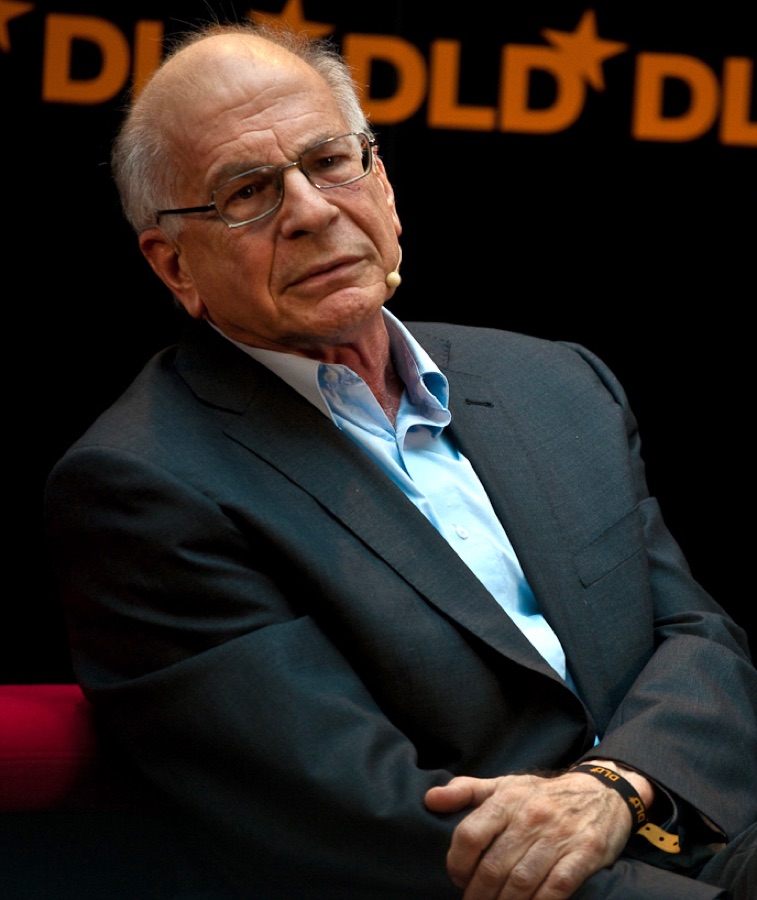
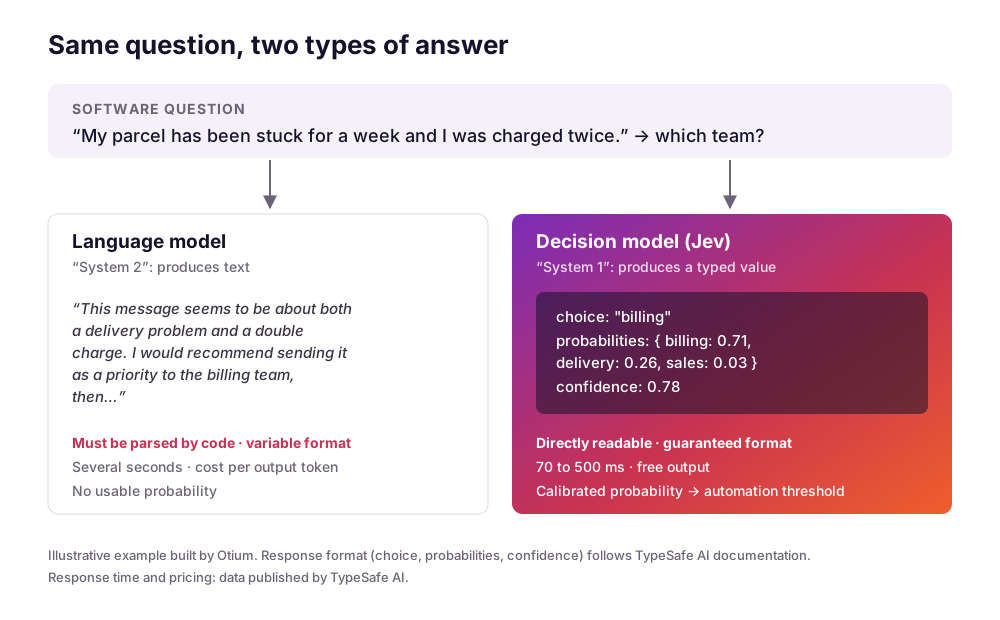
TypeSafe calls Jev a "System One Model". The reference comes from the psychologist Daniel Kahneman, Nobel laureate in economics, who distinguished in Thinking, Fast and Slow two modes of thought: a fast, intuitive system that decides without deliberating, and a slow system that reasons step by step. In TypeSafe's reading, conversational language models are System 2 tools: they unfold a line of reasoning in text. Jev is designed for System 1: fast, repeatable judgements that software has to make thousands of times per second.
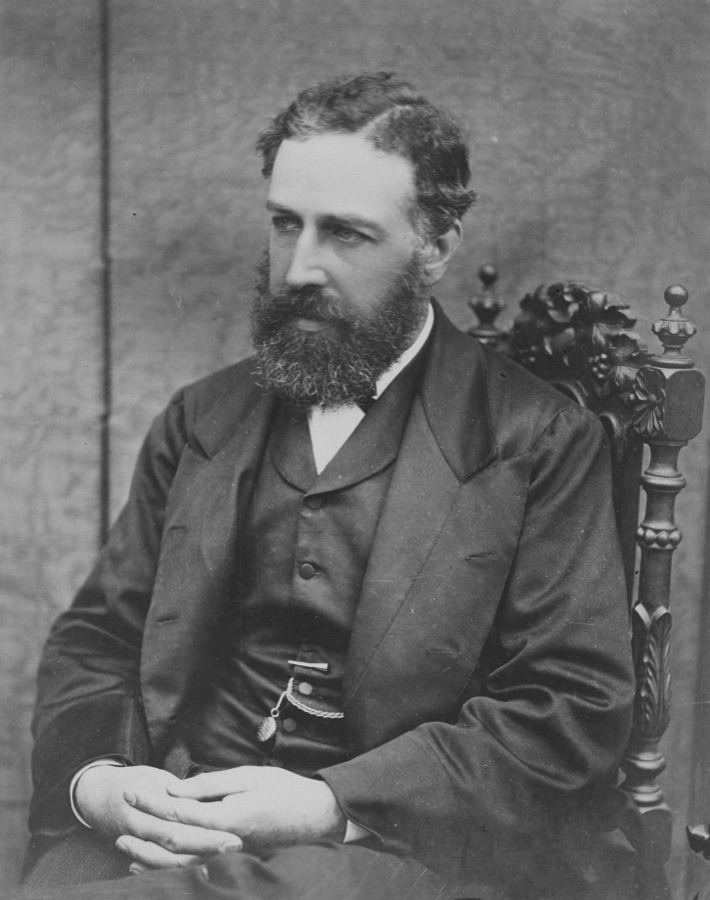
The model's name has an origin too. Jev is named after William Stanley Jevons, the British economist who observed in 1865 that steam engines that used less coal did not reduce its consumption but increased it, because they made its use profitable in new sectors. Applied to AI, Jevons's paradox describes TypeSafe's bet precisely: a decision that costs almost nothing does not replace existing decisions, it brings new ones into being, where a language model was too slow or too expensive to be called.
3. How Jev works
Jev accepts text or JSON objects as input, and answers three types of question, which can be combined in a single call:
- Choice — choose an option from a defined list. The response contains the chosen option, a probability for each option and a confidence level.
- Score — rate a piece of content on a scale of described levels. The response contains the score, a probability per level and a confidence level.
- Noul — assess a yes-or-no statement. The response is the probability, between 0 and 1, that the answer is yes.
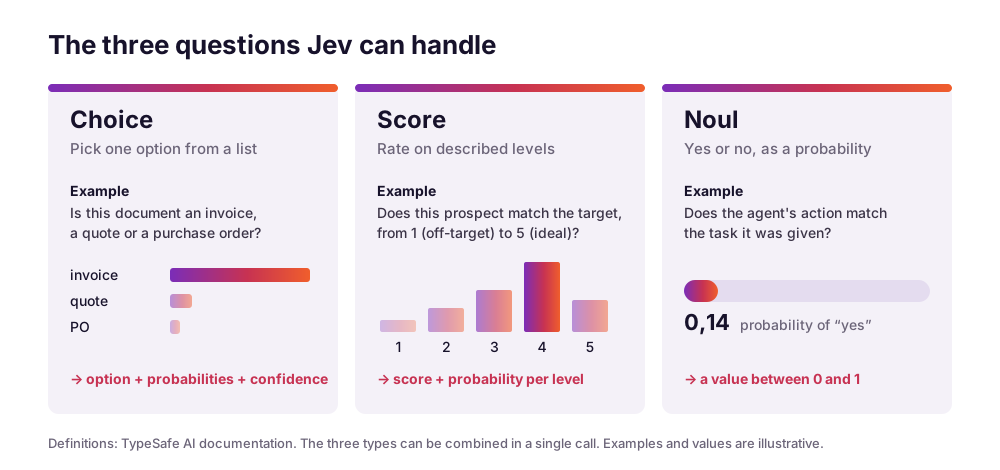
The Register gives an example of routing a customer message: the response takes the form {"billing": 0.08, "technical": 0.85, "sales": 0.07}, with a confidence of 0.82. The code has nothing to parse: it reads the highest value, compares the confidence to a threshold, and acts.
The model is trained by a method TypeSafe calls Reinforcement Learning for Calibrated Decisions, or RLCD. The aim is no longer to produce the answer a human would prefer to read, as in reinforcement learning from human feedback, but calibrated probabilities: when Jev states 80% confidence, it should be right about eight times in ten. It is this property, more than speed, that distinguishes a decision model from a language model asked to answer in JSON.
TypeSafe states a response time of 70 to 500 milliseconds. In the demonstration on its home page, a task handled in 0.114 seconds for $0.000081 is compared with 8.566 seconds and $0.013880 with a language model. The company draws from this the figures of 193.6 times faster and 244.6 times cheaper. These are the vendor's measurements, on its own tasks, and have not been independently verified.
4. What Jev really costs
Jev is billed at $0.042 per million input tokens, or $42 per billion, and output is free. TypeSafe highlights an input price 238 times lower than that of Claude Fable 5.1. The comparison is accurate, but it pits Jev against the top of the range. The useful calculation for a business is that of a given volume of decisions, against the models it would actually use for that task.
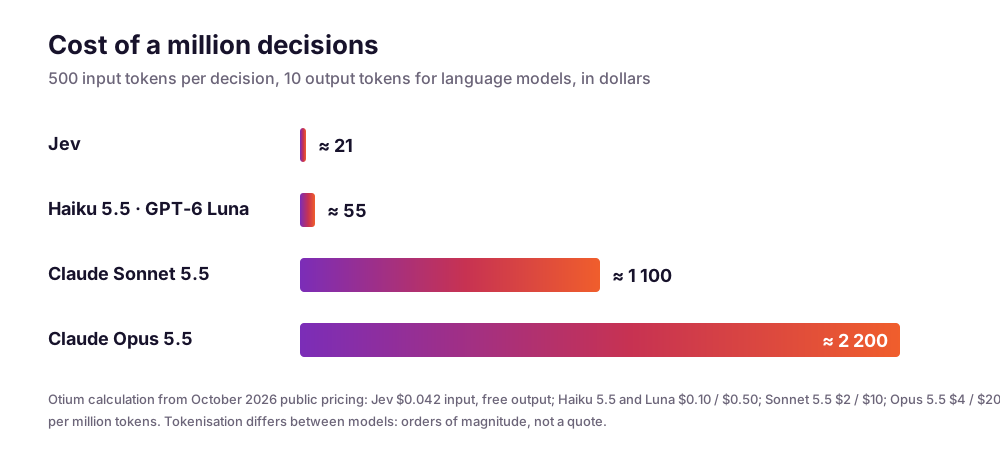
Take a million decisions, each involving 500 tokens of context, with ten output tokens for the language models. With Jev, the bill is about $21. With Claude Haiku 5.5 or GPT-6 Luna, billed at $0.10 and $0.50, it is about $55. With Claude Sonnet 5.5, about $1,100; with Claude Opus 5.5, about $2,200. These orders of magnitude assume comparable tokenisation, which is not the case: Haiku 5.5 consumes about 1.25 times more tokens than its predecessor for the same text.
Against frontier models, Jev is fifty to a hundred times cheaper. Against small language models, the gap is only a factor of two to three. The decisive argument is therefore not price, but what price does not buy elsewhere: a typed output that never breaks the code reading it, a calibrated probability on which to set a threshold, and a latency compatible with a call on every user request.
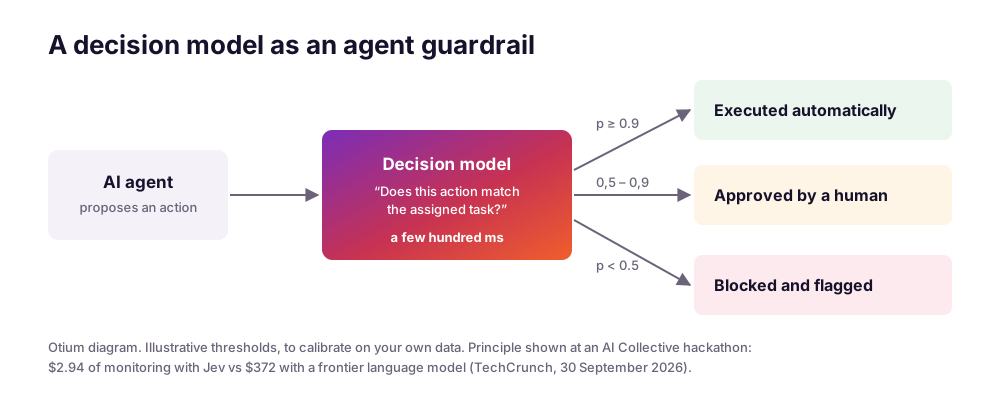
A concrete case illustrates the stakes. At a hackathon organised by the AI Collective, cybersecurity specialist Shapor Naghibzadeh built a system that checks each action of an AI agent against the task assigned to it, and blocks or flags deviations. With Jev, the monitoring cost $2.94, against $372 with a frontier language model, according to TechCrunch. The weeks that followed, marked by OpenAI agents straying outside their remit on government sites and on Wikipedia, gave this type of use immediate relevance.
5. OpenAI and Amazon follow within fifteen days
On 29 September, at its DevDay, OpenAI introduced a Decisions API in limited preview. It has its GPT-6 Luna model choose an option from a predefined list, image categories or agent behaviours for example. Sam Altman described it this way: "By focusing the model on that choice, we can make it extremely fast while keeping capabilities like image understanding, broad language support, and safety protections." The price has not been published.
On 1 October, Amazon released Strands Decider 2B, a two-billion-parameter model built on Qwen3.5-2B by the Strands Labs team of Marc Brooker, a distinguished engineer at Amazon. It is fully open source and small enough to run on a local machine. Marc Brooker presents it as "a perfect decider for a workflow step — "what is the next thing for me to do here, based on where I am?"". It briefly took the top of the Jevbench ranking in its size category. TechCrunch notes that dozens of similar models have been produced by researchers since Jev's launch.
Diogo Almeida does not dispute the rush: "I get that people think it's a gold rush, but they might be underestimating the difficulty of making the models actually smart." And he sets his criterion: "Intelligence is the hard part, and my North Star is always pushing the intelligence-per-dollar Pareto curve." The output format can be copied in a few weeks; the quality of the decisions and their calibration cannot. This is where the comparison between Jev, OpenAI's Decisions API and Strands Decider will be decided, and no independent evaluation yet allows them to be told apart.
6. What Jev does not do
TypeSafe displays "Zero Hallucinations" on its home page. The Register finds the phrase unfair: a model that produces no text cannot invent a citation, but it can perfectly well get a category wrong with confidence. What is guaranteed is the absence of format errors: the response is always of the expected type. What is not guaranteed is that it is right.
Jev does not write, does not summarise, does not reason over several steps and does not explain its decision. It assumes the question is well posed: exhaustive and mutually exclusive options for a Choice, unambiguously described levels for a Score. A bad list of options will produce a well-calibrated decision on the wrong problem. Finally, the model was trained solely on synthetic data: its calibration on the real data of a given sector remains to be measured, case by case.
7. Where a decision model belongs
In an automation chain, a large share of calls to a language model are not for writing but for deciding: which department to send this message to, whether this document is an invoice or a quote, whether this prospect fits the target, whether this comment should be moderated, whether the action the agent is about to take matches its task. These steps are exactly what a decision model targets.
Identify your repetitive decisions. Go back over your automations and spot the calls whose output is a category, a score or a yes/no. These are direct candidates, and often the most frequent ones.
Use the probability, not just the answer. The value of a calibrated decision is that it lets you set a threshold: above it, the software acts alone; below it, a human takes over. It is this threshold, tuned on your own data, that determines the share that is genuinely automated.
Put a check in front of your agents. Verifying each agent action against its task cost too much with a frontier model. At a few dollars for thousands of checks, the question is no longer whether you can afford it, but why you would go without.
Measure before switching. The published figures are the vendors'. Build a sample of a few hundred real cases already decided, and compare Jev, a small language model and, if the data cannot leave your premises, Strands Decider locally. The calibration measured on your cases is worth more than any speed multiplier.