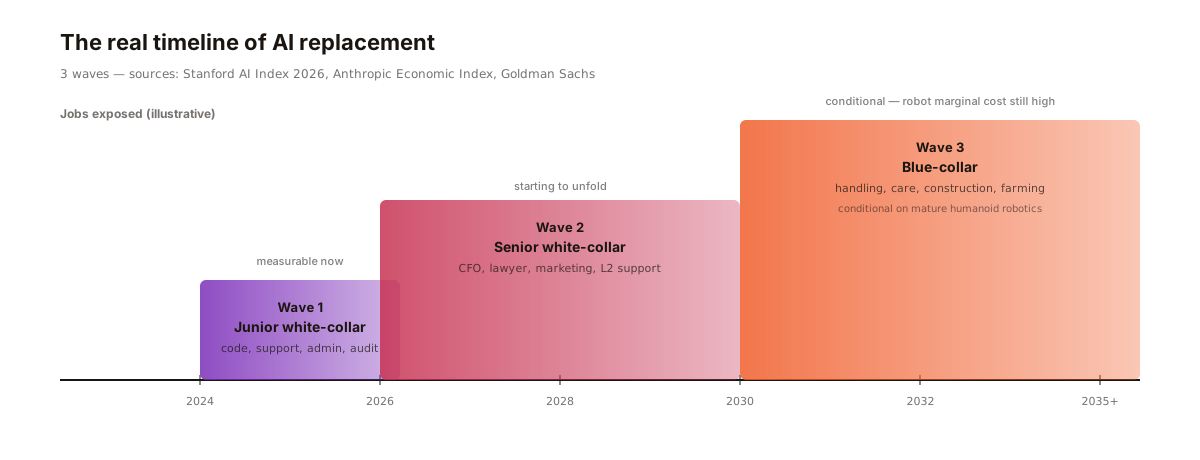
The "will AI replace jobs?" debate is badly framed. The real question is in what order. And we already have the answer: junior white-collar workers first, over 2024-2026 — it is measurable. Experienced white-collar workers next, over 2027-2030 — it is anticipated by the reports. Blue-collar workers last, after 2030 — it is conditional on mature humanoid robotics that does not yet exist. Three distinct waves, verified sources, and a timeline that radically changes executives' HR decisions in 2026.
1. Wave 1: junior white-collar workers, already affected
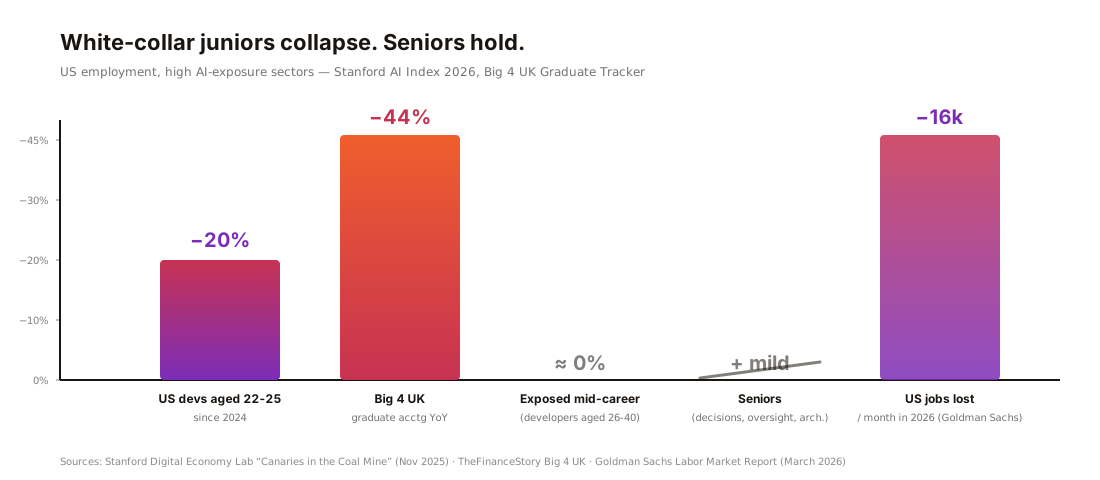
The Stanford AI Index 2026 report, published by the Human-Centered AI Institute, documents the first measurable contraction of a white-collar occupation clearly attributable to generative AI: employment of American developers aged 22 to 25 has fallen by about 20% since 2024. Over the same cohorts, mid-career and senior developers see their employment stable or growing.
The Stanford Digital Economy Lab published in November 2025 a paper with an eloquent title — "Canaries in the Coal Mine" — which generalises this finding to all white-collar occupations with high AI exposure: customer support, research, audit, first drafting. The pattern is constant: entry into the profession closes, the top holds.
In the United Kingdom, graduate job offers in accounting at the Big 4 (Deloitte, EY, KPMG, PwC) have fallen by 44% over one year. What young graduates used to do — compliance checks, document summaries, internal memos — is now handled by GenAI tools. KPMG announced a 10% reduction in its partner headcount in the United States on the audit side, explicitly justified by the new AI audit tools. McKinsey cut about 200 back-office positions in late 2025, in functions where generative AI produces in a few minutes what pyramids of analysts used to bill over several weeks.
Sources: Stanford Digital Economy Lab, Big 4 UK Graduate Tracker, Goldman Sachs Labor Market Report (March 2026)
Goldman Sachs, in its March 2026 report, estimates that AI is reducing monthly US payroll growth by about 16,000 jobs a month since the start of 2026. The bank highlights a point that the French media pick up little: the disproportionate concentration of Gen Z in administrative, support, data and billing functions — exactly the profiles that AI agents handle first.
Why juniors go first
The ideal task profile for an AI agent is well known: repetitive, structured, with codified inputs and outputs, and a human supervisor downstream who validates. That is the very definition of junior work in any hierarchical organisation. The Anthropic Economic Index 2026 in fact measures that 75% of computer programmers' tasks are already covered by Claude, and that coding accounts for 35% of conversations on Claude.ai. Junior tasks are the most codified in the organisation.
Customer service holds second place in the Anthropic report. Payment, billing and level 1 ticket resolution flows are massively automated. Between November 2025 and February 2026, Claude API usage by business sales and automated trading workflows doubled, indicating that the second wave (expert white-collar workers downstream of juniors) is starting to engage.
2. The ladder paradox
This is the point that macro reports most often avoid, and which already worries the HR directors of large organisations: if juniors disappear, how do seniors train?
A classic organisation runs on a hierarchical pyramid where learning the trade happens through performing supervised repetitive tasks. The future partner of an audit firm checked thousands of accounting documents. The future software architect wrote thousands of basic functions. The future CFO produced hundreds of summary memos. It is the task-based learning chain that forms experience.
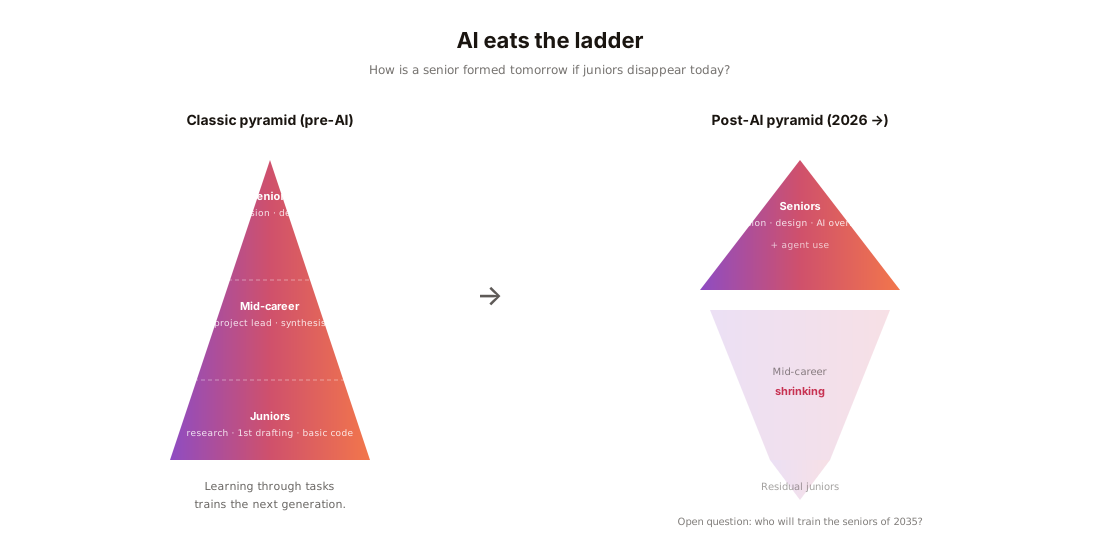
When AI absorbs the base, two scenarios coexist:
- Optimistic scenario — augmented learning: the residual juniors are trained by observing the outputs of AI agents, through critical review, through active supervision. Rather than writing a thousand basic functions, the junior validates a thousand functions generated by the agent and learns to detect hallucinations. This mode already exists in teams that have integrated Claude Code, Cursor or GitHub Copilot. The premium goes to those who master the technical critique of AI code, not to those who simply know how to write it.
- Pessimistic scenario — the generational fracture: organisations simply cut the junior base to save money, without reinvesting in training. In 7 to 10 years, they discover they no longer have internal candidates to replace retiring seniors. They then pay for the shortage at a high price, or replace them with contracts to external consultants — who are themselves cutting their junior base.
The Anthropic Economic Index of March 2026 already documents a growing gap between experienced users and new users of Claude. The experienced treat AI as a collaborator whose outputs they improve. The new ones let the AI do the work. The skill that creates value is now the ability to supervise an agent, not the ability to execute the task.
3. Wave 2: senior white-collar workers, 2027-2030 window
The second wave concerns the intermediate and expert functions of white-collar work: chief financial officers, in-house counsel, product marketing, level 2 technical support, management controllers, consultants. The Goldman Sachs and Anthropic reports converge on a 2027-2030 window, conditional on the maturing of agents.
Goldman Sachs estimates that 46% of tasks in administrative functions and 44% in legal functions can be automated. The report projects a ten-year adoption horizon, during which 6 to 7% of the workers concerned would be displaced and the unemployment rate would rise by about 0.6 points.
What holds out longer
Three skills fall outside the automatable model:
- Signed legal liability. An AI agent cannot sign an attestation, a statutory audit, a notarised deed or an employment contract. Civil and criminal liability remains borne by an identified human. This maintains demand for seniors who validate, not for juniors who produce.
- Interpersonal trust. High-ticket commercial negotiation, crisis management with a key client, internal mediation of an HR conflict — all these functions rest on a human relationship of trust that nobody, in 2026, outsources to an agent.
- Arbitration under radical uncertainty. Decisions on reorganisation, mergers and acquisitions, strategic pivots are made on incomplete, contradictory, sometimes false data. Generative models hallucinate precisely when uncertainty is radical. The senior premium lies there.
Conversely, intermediate functions that produce structured deliverables from existing data — market syntheses, internal legal memos, standardised financial analyses, product marketing plans — are on the front line for wave 2. For these roles, the AI agent will gradually move from copilot to pilot, with a human supervising rather than executing.
4. Wave 3: blue-collar workers, after 2030 and conditionally
The third wave is the inverse of the first in terms of timing: protected by physics, blue-collar workers arrive only at the end of the road, for a simple reason — general-purpose humanoid robotics is not mature in 2026, and its marginal cost remains several times that of a human.
Tesla started series production of the Optimus robot at Fremont in March 2026. The price target announced by Elon Musk remains $20,000 to $30,000 per unit at full scale, which assumes a volume above one million units a year. The current real production cost is estimated between $50,000 and $100,000 per unit, according to the specialist press. No commercial pre-order is yet open at the time of writing. On the Chinese side, Unitree markets its G1 humanoid at $13,500 as an entry price, and its H1 at about $90,000 for the research community.
Why robotics is 5 to 10 years behind generative AI
The marginal cost of a software agent answering a question is a few cents in tokens. The marginal cost of a humanoid robot tightening a screw adds:
- Amortisation of the machine over its lifetime (the battery, actuators and sensors wear out),
- Energy consumed (a humanoid draws 500 watts to 1 kilowatt in operation, 5 to 10 times the consumption of a PC under load),
- Preventive and corrective maintenance,
- Workplace safety and civil liability insurance (a robot can injure),
- Social and union acceptance, which slows deployment even when the economics would justify it.
As long as these frictions persist, blue-collar workers remain protected by the physics of the real world. The promise of a massive wave 3 is coming — Optimus, Figure 02, Unitree, 1X Neo and Apptronik are publishing roadmaps converging towards 2030 — but it remains conditional on industrial leaps that wave 1 (software) did not have to make.
5. Concrete implications for executives
Four operational consequences, to be decided from 2026 and not in five years:
Redesign the internal training pipeline
If you cut your junior base to save money and do not invest in parallel in an augmented learning system, you pay the debt in 7 to 10 years at a far higher cost. Concretely: the remaining juniors must learn to supervise, critique and improve agent outputs, not to execute the tasks that agents do better than they do. This requires active senior coaching, not a passive replacement of juniors.
Identify automatable tasks without breaking the value chain
Not all junior tasks are equal. Some are purely productive and can disappear without harm. Others are formative in the sense that they build the skills of the future senior. Cutting indiscriminately erodes the base; cutting intelligently means keeping the formative tasks and automating the productive ones. The distinction is made occupation by occupation.
Recruit for supervision, not for execution
The junior profiles that create value in 2026 are no longer those who execute fast, but those who detect agents' errors. This requires solid initial training in business logic, critical analysis and operational ethics. Sourcing is evolving: rigorous generalist tracks rather than narrow technical tracks, capacity for judgement rather than speed of execution.
Anticipate the second wave before it hits
The senior white-collar workers who will create the most value over 2027-2030 are those who master the agentic chain of their occupation: how to brief an agent, how to compose several agents, how to audit their outputs, how to integrate them into existing systems. This skill is not built in a one-week continuing education course. It requires daily practice, integrated into deliverables, framed by the right safeguards (AI Act, GDPR, internal charter).
Conclusion
The media narrative "AI will replace jobs" flattens a reality that unfolds in three distinct phases. Junior white-collar workers are already paying the price of wave 1, without the public debate in France having taken the measure of it. Senior white-collar workers are holding, but their window is opening. Blue-collar workers, contrary to the predictions of the 2010s, are the least exposed in the short term — physics protects them.
For executives, the issue is not whether to automate, but what to automate, when and how to preserve the learning chain that trains tomorrow's seniors. Cutting the base without reinvesting creates an invisible skills debt, which becomes visible — and costly — at the moment of generational renewal. Wave 1 is not a temporary crisis: it is a signal that the internal training pipeline must be redesigned before wave 2 makes it impossible to catch up.
Sources
- Stanford HAI — 2026 AI Index Report
- Stanford Digital Economy Lab — Canaries in the Coal Mine (November 2025)
- Anthropic Economic Index — Learning Curves (March 2026)
- Anthropic — Labor Market Impacts of AI
- Fortune — Anthropic mapped jobs AI could replace
- Goldman Sachs — Jobs AI is likely to boost and those it may disrupt
- Fortune / Goldman Sachs — AI cuts 16,000 US jobs/month, Gen Z hardest hit
- The Finance Story — Big 4 graduate hiring slowdown
- Metaintro — McKinsey layoffs 2026 AI
- Wikipedia — Tesla Optimus, production start 2026
- Standard Bots — Tesla robot price 2026