Seventy-two hours between two memos. On 21 April 2026, an internal Meta note, revealed by Reuters, announced the rollout of monitoring software called the Model Capability Initiative on the computers of the group's US employees. Explicit aim: to capture clicks, keystrokes, mouse movements and screenshots in order to train Meta's internal AI agents. No option to withdraw. On 23 April, Meta announced the layoff of 8,000 people, 10% of its workforce, plus the closure of 6,000 open positions. Departures begin on 20 May. A reorganisation into AI-focused pods takes over, with new roles: AI builder, AI pod lead, AI org lead. Taken in isolation, each of these two events is commonplace in the American tech industry of 2026. Taken together, they trace a cycle unknown until now: employees trained the agents that will replace them, without having had the possibility of opting out. This article tells the sequence, documents what American law allows by contrast with European law, and draws the useful conclusions for a French SMB leader who is watching.
1. The sequence in thirty days
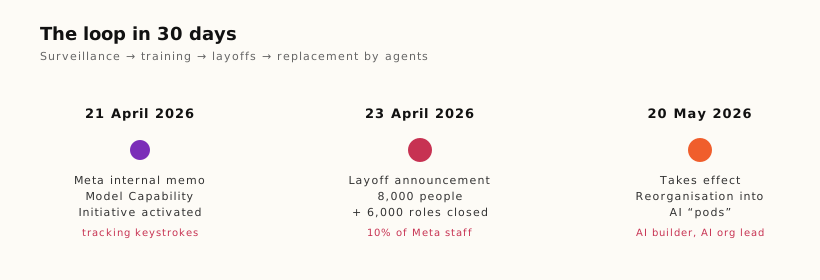
21 April 2026 — Reuters publishes the content of an internal Meta note. Software will capture "mouse movements and keystrokes" on the computers of US-based employees, across a list of several hundred applications and websites including Google, LinkedIn, Wikipedia, GitHub (Microsoft), Slack (Salesforce) and Atlassian. The software also takes "occasional screenshots for context". The stated purpose is to improve the internal models on tasks where they struggle, explicitly cited as: "choosing from drop-down menus and using keyboard shortcuts". The wider stake, confirmed by the note, is building AI agents able to carry out skilled work tasks autonomously. No opt-out procedure is provided.
23 April 2026 — Meta announces a redundancy plan of 8,000 people. That represents 10% of the workforce. In parallel, the company closes 6,000 positions it had not filled, bringing the net cut in hiring prospects to 14,000. The announcement stresses the reorganisation of the company around AI agents: teams are reconfigured into pods, and engineers are transferred from across the group to the Applied AI Organization. Three new job titles appear in the organisation chart: AI builder, AI pod lead, AI org lead. Financial context: Meta spent $72.2 billion in AI CapEx in 2025, and plans to exceed $115 billion in 2026.
20 May 2026 — departures begin. In the meantime, the Model Capability Initiative will have run for a month on employees' workstations, feeding the training corpus of the agents meant to inherit the freed-up tasks.
2. Why Meta is doing this

Mark Zuckerberg is playing a heavy hand. The $115 billion of CapEx for 2026 is not an announcement effect: it corresponds to contractual commitments on data centres, Nvidia Blackwell chips and long-term electricity contracts. Meta is in the frontier race against OpenAI, Anthropic, Google and xAI, with the disadvantage of not having its own cloud (unlike Google and Microsoft) with which to amortise the investment through B2B resale. The only model that justifies $115 billion a year is the integration of AI agents into all Meta products (Facebook, Instagram, WhatsApp, Threads, Quest headsets, Ray-Ban glasses) and a lower marginal cost per unit of internal labour.
The second branch — lowering the marginal cost of labour — depends on building up a training raw material that exists nowhere else: the complete traces of the daily work of 60,000 engineers, designers, product managers and lawyers at one of the best-performing tech groups in the world. That is what the Model Capability Initiative collects. Public networks (Reddit, Stack Overflow, public GitHub) have already been vacuumed up by the frontier LLMs since 2022-2023. What is missing to train operational agents is the complete traces of tasks carried out, not the frozen results. Meta, with its fleet of 80,000 employees, owns this material. It is converting it into a training corpus.
3. What American law says — and does not say
Meta's internal note is not illegal in the United States, which is the first thing to understand before any moral judgement. US federal law provides no general limit on employers monitoring employees on work equipment. Some states (California, New York, Connecticut) require prior written notification, which Meta complies with through its internal policies. But no federal legislation gives the employee a right of individual consent or opt-out.
Ifeoma Ajunwa, a law professor at Yale and a specialist in algorithmic surveillance of workers, summed up the situation in one line: "there is no limit, at the US federal level, on the surveillance of employees". The gap goes back a long way. For about a decade, delivery drivers (Amazon, UPS), Uber drivers and gig-economy workers have been subject to real-time tracking (routes, speed, breaks, output) that no longer shocks anyone within the American legal framework. What Meta is doing in April 2026 is extending the regime that weighed on digital blue-collar workers to the white-collar workers of the Californian headquarters.
In Europe, the same arrangement would simply be unworkable. The GDPR requires a legal basis (Article 6) and compliance with the principles of minimisation and proportionality. The French Labour Code requires the works council (CSE) to be consulted on any monitoring system, along with prior individual notification. The CNIL's case law is unambiguous on continuous keyboard and mouse monitoring: a penalty is likely at the first inspection. The European AI Act, applying in stages since 2024, classes algorithmic worker-surveillance systems as "high risk" (Annex III), implying a conformity audit, an impact assessment and a mandatory register.
| Question | US law (federal) | EU / French law |
|---|---|---|
| Individual consent required | No | Yes (GDPR Article 6, unless a specific legal basis applies) |
| Opt-out possible | Generally not | Yes (GDPR Article 21 right to object) |
| Consultation of employee representative bodies | No | Yes (CSE mandatory, Labour Code L.2312-38) |
| Continuous keystroke tracking | Legal | Generally illegal (CNIL case law) |
| Periodic screenshots | Legal | Strong constraints (proportionality + necessity) |
| AI Act classification | — | High risk (Annex III) |
| Maximum potential penalty | — | 4% of worldwide turnover (GDPR) + €35 million (AI Act) |
4. The loop: surveillance → training → layoff → replacement
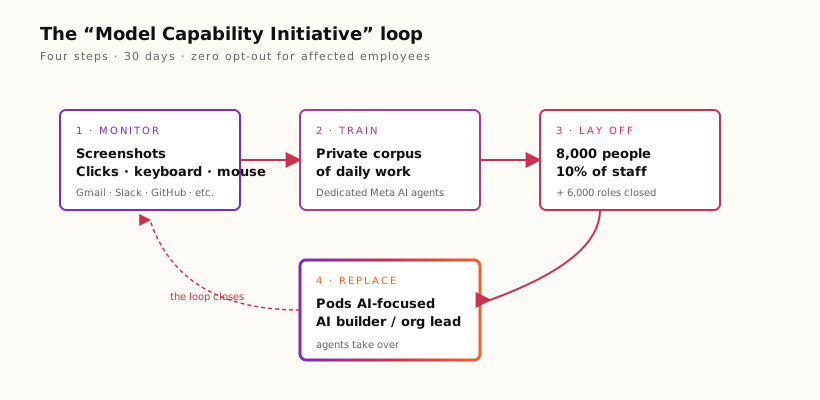
The numbers are instructive. Meta is not just sending 8,000 people home. It is installing a continuous system that will draw on the training corpus as long as there are employees left to monitor. The 72,000 employees remaining after the 20 May wave will feed the agents of a second wave of departures, which will feed the third, and so on. The loop closes on itself.
What makes the Model Capability Initiative methodologically original is not the surveillance — that is commonplace. It is that the employer explicitly states that the purpose is to train agents to perform the same tasks. The loop between the captured human effort and the automaton that inherits the effort is no longer hidden. Meta puts it on the table. That is what makes the sequence documentable and instructive.
5. The precedents we ignored
The Meta case is not a bolt from the blue. It is the white-collar culmination of a dynamic that has been built on digital blue-collar workers for fifteen years. A few markers.
Amazon has measured the time spent between two parcels in its warehouses since 2014. Deviations trigger automatic alerts and, beyond a threshold, an algorithmic dismissal with no human intervention. Uber scores each driver on speed, braking and ride-acceptance time, and automatically deactivates those who fall below a threshold. UPS tracks door opening, seat belt and route, and calculates productivity in minutes per stop.
In all these cases, the aim was not to train an AI to replace the worker. It was to optimise them. The qualitative difference in the Meta case lies in the openly acknowledged change of purpose: tracking no longer serves to improve the employee's performance, it serves to build their replacement. Shoshana Zuboff named this dynamic "surveillance capitalism" in her 2019 book. Six years later, Meta provides its most direct publicly documented illustration.
6. What it means for a French SMB
A French SMB leader reading this story from a distance may tell themselves that Meta is Meta, that California is California, and that none of this concerns them. That is a short-sighted reading. Three concrete reasons not to hold it.
The implicit contract of skilled work is changing everywhere, including in France. The question of consent to tracking is becoming the new friction point of corporate AI plans. French employees are watching what Meta does to American employees. The day you deploy Microsoft Copilot or a RAG agent on your document base, there will be questions from the CSE that there would not have been six months ago. These questions are legitimate. Anticipating them spares you a standoff.
Competitive advantage is shifting towards companies that know how to do without surveillance. In 2026, a lead-qualification agent does not require tracking your employees: it can be built on prompts and anonymised data, with the same operational value. The illusion that surveillance is the shortcut to building operational AI is an American illusion that French SMBs have no interest in reproducing. The Otium teams who support AI deployments see it: the projects that succeed quickly and are adopted by the teams are the ones that require no additional surveillance.
The internal AI charter is becoming a practical obligation, not only a legal one. We detailed this in Writing an AI charter for your company: the concrete template. Meta's 21-23 April sequence will accelerate requests for clarification from employees. SMBs that set down in writing what they do and do not do regarding AI surveillance will have a healthier internal climate than those that let uncertainty breed doubt.
7. Our reading
Meta's sequence in spring 2026 is not an isolated moral flaw. It is the frontal version of a mechanism that Hannah Arendt named the banality of obedience, and which she saw hiding not in ferocity but in the erasure of the why. Meta's 80,000 employees have nothing to reproach themselves with individually. They go to work, they produce, they use the tools the company provides. And by doing so, within the new framework established by the Model Capability Initiative, they feed their own succession without wanting to. The asymmetry is not between a wicked employer and kind employees. It is between a system that collects tirelessly and individuals who lack the levers of opposition (a strong union, a protective legal framework, the possibility of opting out) that their European colleagues still have.
The Meta precedent has two important consequences for everyone. The first: it sets an acceptable level of tech-industry surveillance that OpenAI, Google, Microsoft, Amazon and xAI can now reproduce without having to invent it. The bar has been set. The second: it creates a lasting competitive asymmetry between American AI systems, trained on complete and authentic work corpora, and European systems, which the GDPR and the AI Act force to do without this material. In the long run, that advantage could justify a rethink of European doctrine. The same asymmetry can also be read the other way: European models will be less performant on white-collar assistance tasks, but the working ecosystem they serve will be healthier. A choice will have to be made.
We will return to the philosophical framework in an upcoming article, Claude Code: the banality of obedience, which describes the psychological mechanisms by which integrating an AI tool into a workflow can, with no malicious intent, turn the user into the executor of an invisible principal. The Meta affair gives the practical case at company scale. The next article will give the individual generation of it.
For complementary reading already published: Writing an AI charter for your company, How to eliminate Shadow AI, Cybersecurity: does AI amplify the risks?.