We thought Midjourney had fallen behind in image generation. In reality, the company had been quietly working on something else entirely. On 18 June 2026, it unveils Midjourney Medical and its first physical device: an ultrasound scanner that aims, in time, to image the whole body in 60 seconds, with no radiation, in a water basin. The company that learned to invent images is now building a machine to measure reality — and, strikingly, without a shred of generative AI inside.
1. The news
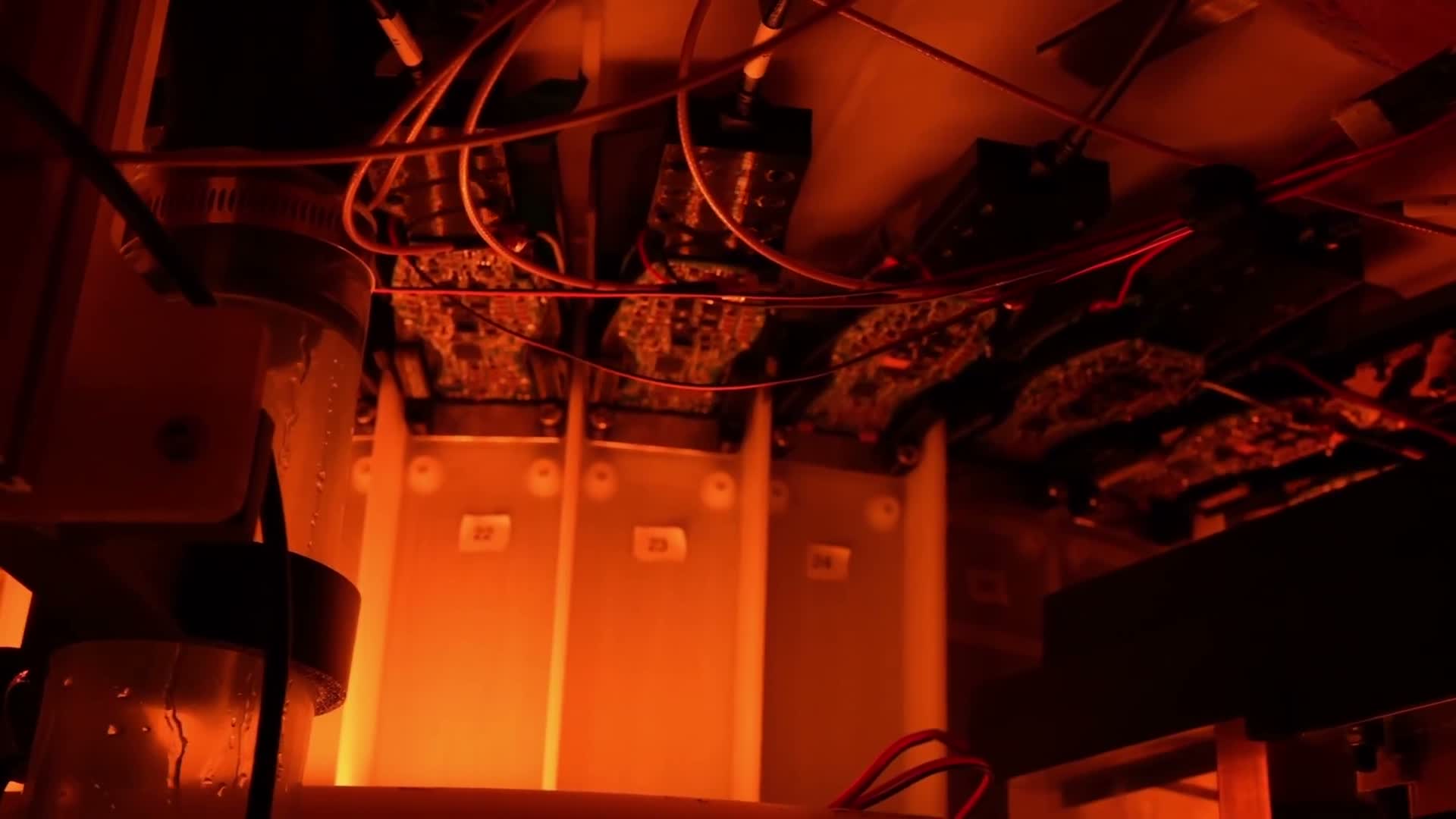
In a post titled "A New Era of Midjourney", founder David Holz presents the new division and its ambition: "a machine as powerful as an MRI, and as simple as a visit to the spa". The product is called the Midjourney Scanner. The principle: you step into a pool of golden light and slowly lower yourself into the water; your body passes through a ring of ultrasound sensors that "act like dolphins", emitting waves and listening for their echoes from every angle. From those waves, the system reconstructs an image of the inside of the body.
2. How it works
The technical detail is dizzying. The ring is made up of roughly half a million tiny squares, each the size of a grain of sand, and each able to behave as both a micro-loudspeaker and a micro-microphone. Together, they emit ultrasound and record the returning waves millions of times a second — "a choir and an audience" at once. The waves change shape with every variation in density (water, skin, fat, muscle, bone); by analysing these distortions, thousands of computers reconstruct a 3D map of the body, to a fraction of a millimetre.
The Midjourney Medical announcement, on video
3. The numbers that make your head spin
The company claims an image that "looks a lot like today's MRIs, but at nearly 100 times the speed". The goal is a full scan in under 60 seconds: you enter the water, you come out, and it is done. The amount of data is colossal: a single second of scanning produces the equivalent of 500 hours of HD video. No machine of this kind had ever been built, precisely because of the number of mechanical elements and the computing power required.
4. The striking detail: no generative AI
Here is the most striking paradox. The company best known in the world for "inventing" images has put none in its machine. The medical image is not generated: it is reconstructed from real waves. AI only comes in for segmentation — identifying tissues in the resulting image — not for producing the image. When it comes to the human body, there is no question of imagining a detail: here, AI measures reality, it invents nothing.
It is, at bottom, a lesson in discernment. Generative AI, which made Midjourney famous, was not the right tool for this problem. The company chose the technology suited to the challenge — measurement — rather than the one that made it famous.
5. The vision: a spa, a fleet, a promise of health
Midjourney intends to build its scanners into an unexpected venue: the Midjourney Spa, the first of which will open in San Francisco in 2027, with saunas, hot baths and cold baths. The scan there becomes "a side effect": you come for the spa, and you leave with a library of data on your health. The long-term ambition: a fleet of more than 50,000 scanners and one billion scans a month by 2031 — enough to offer a monthly scan to a billion people.
The stated promise is immense: according to Holz, widespread early screening could prevent up to 30% of deaths and 50% of healthcare costs. All of it carried by a singular model: Midjourney has no investors. In its own words, it is a "research lab supported by its community", funded by the revenue of its image business.
6. What we take from it
Fact: an image-generation company unveils a whole-body medical scanner, with no generative AI, and aims for a billion scans a month. Hypothesis: if the promise of 60 seconds and of quality holds at scale, low-cost medical imaging changes category. Opinion: the most interesting decision is not technical but strategic — choosing measurement over generation is admitting that there is not one AI, but many AIs, and that each problem has its right tool.
Sources: Midjourney (official post), Bloomberg, RDWorld Online, Latent.Space — June 2026.