 GPT Image 2 · 21 Apr 2026
 Nano Banana 2 · 26 Feb 2026
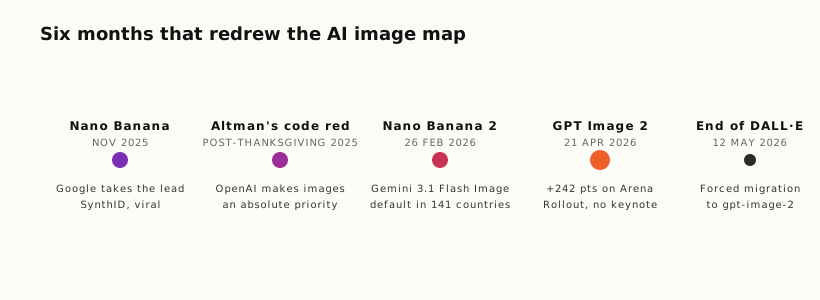
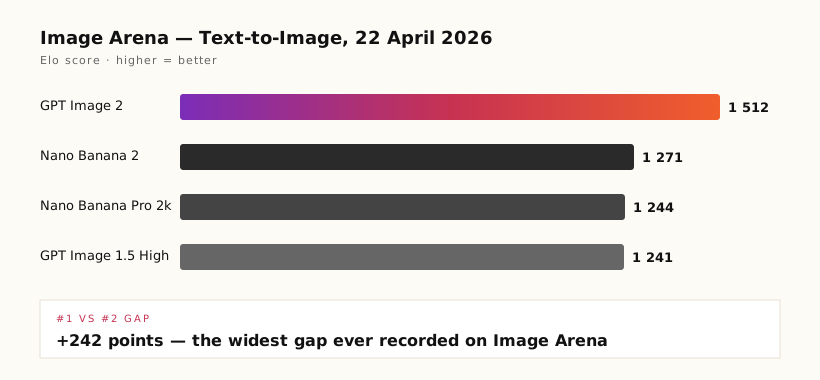
On 21 April 2026, with no keynote, no livestream and no teaser of any kind, OpenAI released GPT Image 2 (commercial name: ChatGPT Images 2.0). Within 48 hours, the model had taken first place on Image Arena with 1,512 Elo points, or +242 over Nano Banana 2, Google's image model. Arena specified that this was “the widest gap ever recorded between first and second” in the ranking. This shift did not come out of nowhere: it is the result of an internal reorganisation triggered by Sam Altman five months earlier, after Google took the lead in late 2025. Here is what happened, and what it changes for the teams who produce visuals every day.
1. How Google took the lead first
To understand the 21 April counter-attack, we have to go back to November 2025. Google DeepMind released Nano Banana, an image model integrated into Gemini, which went viral on X and TikTok within days. Its strengths: a certification watermark (SynthID) that makes it possible to verify AI origin, and a “studio”-type rendering that outperforms DALL·E 3 on portraits and complex scenes. According to Google's official communication, SynthID has been used more than 20 million times since launch.
On 26 February 2026, Google drove the point home with Nano Banana 2, technical name Gemini 3.1 Flash Image. The model became the default image generator across the entire ecosystem: the Gemini app, Google Search AI Mode, Google Lens, Google Ads, AI Studio, Vertex AI, the Flow film platform. It handles resolution up to 4K, maintains the consistency of five characters and fourteen objects within a single workflow, and integrates real-time web search to “render specific subjects precisely”. Rollout: 141 countries, eight additional languages.
At that point, the battle was not balanced. OpenAI had DALL·E 3 and GPT-Image-1.5, competent models but clearly outclassed on the leaderboard and in public perception. Several tech journalists noted that “the centre of gravity of AI imaging has shifted to Mountain View”.
2. Sam Altman's “code red”
This is the part we learn after the fact. According to Implicator.ai, which cross-checks several internal sources, Sam Altman sent an internal “code red” memo just after Thanksgiving 2025, in reaction to the Nano Banana momentum. The memo put imaging back at the top of the priority list. Two operational decisions followed.
Decision 1: kill the Sora video app. The consumer video-generation app, launched with great fanfare in mid-2025, was withdrawn from the product catalogue. The resources (people, GPUs, budget) were reallocated to imaging. Officially, OpenAI spoke of “consolidation”. In reality, it was a categorical strategic choice: video can wait, imaging cannot.
Decision 2: reposition imaging as “language, not decoration”. This wording, taken up in internal communication and then in the press briefings of 21 April, reflects a change of architecture. Imaging ceases to be a standalone tool with its own interface. It becomes a layer of the general-purpose model's reasoning stack. We no longer generate an image; we “speak in images” to the model, which reasons before producing.
Sources: Google Blog · TechCrunch 26 Feb 2026 · Implicator.ai · MindwiredAI.
3. What the official video shows
OpenAI did not hold a keynote, but the company published a presentation video on its YouTube channel on launch day. In five minutes it condenses the use cases the product team wants to push first: multilingual infographics, slides, maps, a one-page manga from a single image, a series of consistent visuals for marketing campaigns.
Official OpenAI video · 21 April 2026
The video deliberately shows no benchmark. The communication choice is clear: it does not sell a score, it sells an ability to transform the workflow of a team that produces visuals every day. It is a direct response to Google, whose Nano Banana 2 communication stressed ecosystem integration more than raw performance.
4. The Image Arena figures: +242, a historic gap
Quantitatively, the signal is unusually clear. Image Arena, maintained by LM Arena, is the reference leaderboard for image models. It combines blind human votes (Elo method) across three categories: text-to-image, single-image edit, multi-image edit.
Sources: OfficeChai · Artificial Analysis · Implicator.ai.
The breakdown by sub-category is more revealing than the overall score. Compared with GPT-Image-1.5 High Fidelity, OpenAI's previous model, the improvements are as follows: +316 points on text rendering, +296 on portraits, +296 on cartoon/anime/fantasy, between +247 and +277 on photorealism, cinematic, 3D and product/branding, +197 on art. Text rendered within the image is the most spectacular gain, and it is no accident: it is the worst historical weak point of generative models, and the one that unlocks the most professional uses (slides, infographics, packaging, UI).
GPT Image 2 also takes the lead in both editing categories: 1,513 on Single-Image Edit (+125 over Nano Banana Pro), 1,464 on Multi-Image Edit (+90 over Nano Banana 2). This is cross-category dominance, not an isolated feat on a single test.
5. Head-to-head tests: where GPT Image 2 wins, where it loses
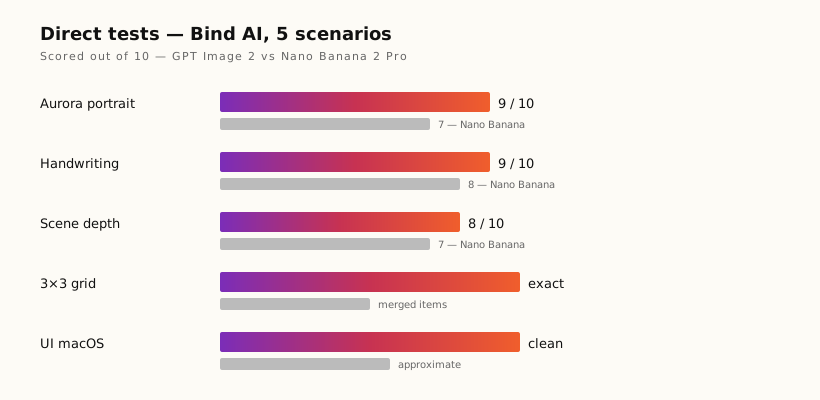
An Elo ranking aggregates votes without explaining them. To understand what is really going on, direct comparative tests are more instructive. Bind AI published a protocol of five scenarios applied to both models. The results are not one-sided.
Source: Bind AI — The results are in, April 2026. Scored out of 10 by the test team.
Where GPT Image 2 wins: multilingual text rendering (~99% accuracy in Latin, CJK, Hindi, Bengali), layout precision (3×3 grid respected where Nano Banana 2 merges the items), reconstruction of user interfaces (clean replication of the macOS UI), generation speed in the Bind AI protocol (around 3 seconds against 10 to 15 for Nano Banana 2 Pro).
Where Nano Banana 2 Pro stays ahead: realistic portraiture (the “studio rendering” is judged more faithful), cinematic lighting (see the tests on film atmospheres), enterprise compliance through the mandatory SynthID watermark — an asset for large groups that must trace the AI origin of every published asset.
A note of caution: speed measurements are contradictory depending on the source. The Bind AI test measures around 3 seconds in Instant mode, but ImagesPlatform reports times of 30 to 60 seconds in Thinking mode on ChatGPT Plus. The mode used changes everything, and OpenAI had not published an official latency benchmark as of 23 April 2026.
6. The dashboard: what each model does better
| Criterion | GPT Image 2 | Nano Banana 2 |
|---|---|---|
| Public release | 21 April 2026 | 26 February 2026 |
| Image Arena (text-to-image) | 1,512 | 1,271 |
| Max resolution | 2K | 4K |
| Consistent objects per scene | 100+ | 14 |
| Consistent characters | 8 images from 1 prompt | 5 in a workflow |
| Multilingual text rendering | ~99% Latin, CJK, Hindi, Bengali | Legible text, scripts not detailed |
| Reasoning mode | Thinking (Plus/Pro/Business) | Built into Flash Image |
| Real-time web search | Yes | Yes (via Google Search) |
| Mandatory AI watermark | Not documented | Systematic SynthID |
| Distribution | ChatGPT, Codex, API (early May) | Gemini, Search, Lens, Ads, Flow, Vertex |
| Countries covered to date | ChatGPT-wide | 141 countries, 8 additional languages |
| API price (estimated) | Input $8/M, output $30/M tokens · ~$0.21 per HQ image | Not publicly published at the same granularity |
Read this way, the map can be read in a second: OpenAI wins on raw performance and creative density (text, objects, editing), Google keeps the advantage on distribution, resolution and enterprise traceability (SynthID, Search, Lens, Ads). An executive choosing a model for their marketing department in 2026 must therefore look at what really matters in their pipeline, not at the leaderboard in isolation.
7. The limits the press does not mention
GPT Image 2 is not without flaws. The technical tests published in the week following launch document several weaknesses, which you need to know before moving a production workflow to this model.
Brand logos. Reproduction of specific logos remains unreliable. Characters and proportions drift slightly. For a precise print or advertising use, you still need to composite the original logos in Figma or Photoshop after generation.
Technical diagrams. Engineering diagrams (network architecture, circuits, flow charts) remain prone to reversed flows, wrong labels and missing nodes. Human verification remains indispensable. The model is better than the previous generation, but not to the point of fully delegating the production of a critical technical diagram.
Long paragraphs in the image. Beyond about twenty words, characters start to deform, even in English. The technical recommendation from OpenAI and independent evaluators is to use CSS or InDesign overlays for long text blocks, and to reserve GPT Image 2 for short headings and labels.
Creative granularity. Unlike Midjourney, GPT Image 2 does not allow you to specify a film stock, a lens focal length or a grain texture with the same precision. The model has its own aesthetic bias, and getting it out of that takes applied prompt engineering. Creative teams working on fine art direction will keep Midjourney in their stack.
Generation of identifiable people. OpenAI has tightened the restrictions on generating real public figures. Uses such as political satire or historical reconstruction that worked on DALL·E 3 are now refused. Press publishers who relied on the old model need to revisit their cover templates.
8. What is at stake from now on
Three deadlines structure the coming weeks.
12 May 2026 — end of DALL·E. OpenAI is withdrawing DALL·E 2 and DALL·E 3 from its catalogue. Applications that use the API must migrate to gpt-image-2 or the alias chatgpt-image-latest. Any product team that has wired DALL·E into an automation chain (e-commerce asset generation, creation of visuals for email campaigns, automated YouTube covers) must plan a migration sprint before that date.
Early May 2026 — opening of the GPT Image 2 API. Developer access arrives in the first week of May according to OpenAI's announcements. The pricing grid communicated by integrators is around $8/M input tokens, $30/M output, $2/M for cache reads. A high-quality image will come out at around $0.21. At that price, high-volume use cases (marketplace e-commerce, consumer retouching apps, no-code tools integrating image generation) become viable without enterprise negotiation.
Google response expected by summer. The Google I/O announcement cycle falls in late May. It is very likely that DeepMind will publish an update to Nano Banana 2 (an optimised Nano Banana Pro 4k, or Gemini 3.2) to respond specifically on multilingual text rendering and object density, the two grounds where OpenAI has just dug in. The asymmetry — OpenAI leading on the benchmark, Google on distribution — will probably not last more than three to four months.
9. Our reading
The interest of this sequence goes beyond the OpenAI-Google war. It illustrates a structural fact of 2026: capability leaps are no longer played out on a single axis. Arena measures an average human preference. SynthID answers a regulatory requirement. Google's 141 countries create a network effect. OpenAI's $0.21 per image unlocks app economics. An executive comparing two models should ask their team not “which generates the most beautiful image”, but “which one moves our pipeline”.
Three useful questions to ask internally this week: One — in our current visual production flow, how many human steps (brief, design, review, retouching, multi-format export) can GPT Image 2 shorten without loss of quality? Two — do we have a regulatory or client constraint that requires an AI watermark (finance, healthcare, public sector), in which case Nano Banana 2 remains the default choice? Three — does our dev stack use DALL·E in a production script? If so, the migration to gpt-image-2 must be planned before 12 May.
What is happening between OpenAI and Google on imaging in 2026 resembles what happened between Claude and GPT-4 on code in 2024-2025: an alternation of leads that forces clients to think multi-model rather than single-model. Teams that decide to lock themselves into a single ecosystem pay the price of that rigidity at every new launch. The real strategic victory is not to choose between GPT Image 2 and Nano Banana 2, but to have an infrastructure that lets you switch from one to the other depending on the use case, without refactoring every quarter.