In February 2026, OpenAI closed the largest funding round in the history of venture capital: 122 billion dollars, at an 852 billion valuation. Two months later, Anthropic announces it has overtaken OpenAI in revenue: 30 billion in ARR against 25. On 17 April 2026, three OpenAI executives resign on the same day. Sam Altman announces a pivot to B2B and a new biometric project with Tinder.
The announcements of a company that is winning do not look like this. They look like those of Yahoo between 2008 and 2013.
In February 2008, Yahoo rejected Microsoft's takeover offer of 44.6 billion dollars, or 31 dollars a share, judging the price too low. Eight years later, in July 2016, Verizon bought its core business for 4.83 billion. About 10% of the rejected offer. In between, Yahoo had lost its place as the world's leading web portal, multiplied contradictory strategic pivots, and changed CEO four times. The market had understood before the company did that the golden age was behind it.
History does not repeat itself. It rhymes.
Two things to understand at the same time. Why OpenAI is becoming Yahoo. And why throwing oneself with open arms into the Anthropic monopoly now taking hold would be an equally costly mistake.
1. The Yahoo pattern
Yahoo did not die because a competitor crushed it. Yahoo died because, by growing in every direction, the company stopped excelling where it had started.
A company wins its category thanks to a strong product. It becomes the market's benchmark. The valuation explodes, and management convinces itself that the empire is secure. It diversifies. Each new front slows R&D on the original front. Technical users leave first, without making a sound. Budgets follow. When management understands, it attempts pivots. Nothing works.
The Yahoo pattern is not a curse. It is the mechanical consequence of two things: losing focus, and losing your best engineers. Both happen together.
2. OpenAI is playing the same script, six years later
Let us compare the facts at the same level of detail.
The CEO's chair is burning, and so are the executives'
Yahoo, 2008–2012. Four CEOs in four years. Jerry Yang resigns in November 2008 after rejecting the Microsoft offer. Carol Bartz replaces him in January 2009; she is fired by phone by board chairman Roy Bostock in September 2011. Tim Morse takes over on an interim basis. Scott Thompson is appointed in January 2012 and fired in May after a scandal over a fraudulent degree on his CV. Ross Levinsohn in turn takes the interim role. Marissa Mayer arrives in July 2012. In April 2012, several executives including chief product officer Blake Irving had resigned.
OpenAI, 2023–2026. Of the eleven original co-founders, two are still there: Altman and Greg Brockman. Ilya Sutskever, chief scientist, gone. Mira Murati, CTO, gone. Bob McGrew, chief research officer, gone. John Schulman, co-founder, gone. Barret Zoph, VP research, gone. On 17 April 2026, three executives resign on the same day: Bill Peebles (head of Sora), Kevin Weil (VP of Science), Srinivas Narayanan (CTO of B2B Applications). The three pillars Altman had just appointed to carry the pivot announced the previous week. Kate Rouch, marketing chief, left in early April. Fidji Simo, product and business chief, on extended medical leave.
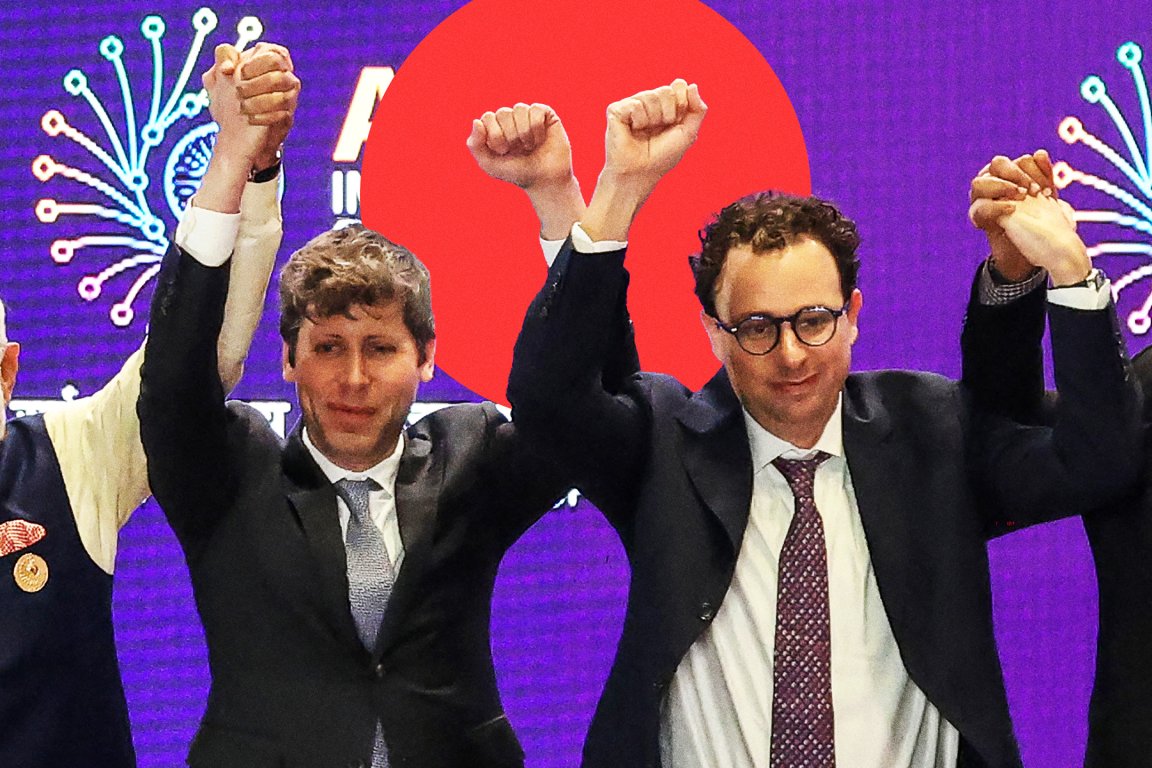
A single one of these departures would be an accident. The accumulation is a signal. Senior executives do not resign from a company that is winning.
Products that will not pay off tomorrow get shut down
Yahoo. GeoCities, bought for 3.6 billion dollars in 1999, shut down on 26 October 2009. Seven million web pages deleted. A visible part of the 1990s web disappears with it. Yahoo! Photos sacrificed in September 2007 to push users towards Flickr. Delicious, bought for between 15 and 30 million in 2005, "sunsetted" and then resold in 2011 to AVOS Systems with its features cut back.
OpenAI. Sora shut down in April 2026, three years after a boastful launch. The same day, Bill Peebles, who had carried the product, resigns. The science team, the one working on the next foundation models, dissolved at the same moment.
The logic is identical in both cases. When cash is burning, you cut the superfluous. And the superfluous is whatever you had publicly said would be structural.
Improbable acquisitions and partnerships are attempted
Yahoo. Marissa Mayer buys Tumblr in 2013 for 1.1 billion dollars. The company had never been profitable. Mayer keeps going: fifty small startups over the following two years, for roughly another billion. She seeks a mobile salvation that will never come. Yahoo would eventually write Tumblr down to 482 million in 2016, then to zero.
OpenAI. In April 2026, Sam Altman announces a partnership with Tinder for Project World, his biometric verification initiative. A company that positions its identity verification technology on a dating app is not trying to conquer banks or governments. It is trying to find something to bill, fast, to anyone.
Pivots under pressure, in opposite directions
Yahoo. July 2009: ten-year agreement with Microsoft to use Bing as Yahoo's search engine. The company that had been built on search outsources search. Then come the successive pivots announced by each CEO: media focus, mobile focus, content focus, video focus. Each new strategy erases the previous one.
OpenAI. April 2026, B2B pivot. The problem: the B2B market was patiently built by Anthropic between 2023 and 2025. Claude has been on Amazon Bedrock since September 2023, available in four major AWS regions (Northern Virginia, Tokyo, Ireland, Stockholm), SOC 2 Type II audit completed, private deployment for regulated sectors. Eight of the ten largest American companies are Claude customers. More than 500 companies spend over a million dollars a year. And OpenAI arrives in 2026 with a product, without equivalent cloud infrastructure, without three years of enterprise integration, and with a B2B CTO who has just resigned.
Layoffs
Yahoo. 4 April 2012: 2,000 layoffs, 14% of the workforce, targeting savings of 375 million dollars a year. The announcement is presented as a "restructuring to refocus on the core".
OpenAI. April 2026: dissolution of the science team. The core of the core. The one working on the next foundation models. Upstream R&D is cut when immediate monetisation has to be prioritised.
The valuation that lies
Yahoo, 2008–2016. 44.6 billion dollars rejected from Microsoft in February 2008. 4.83 billion accepted from Verizon in July 2016. The 2008 valuation was not false in absolute terms: the company had a revenue stream, a user base, a strong brand. It was false in trajectory.
OpenAI, 2026. An 852 billion valuation, a 122 billion round made conditional by SoftBank on OpenAI's conversion into a for-profit company, with a deadline in early 2026. If the conversion failed, only half of the funds would be released, and in the worst case the investments already paid in had to be repaid. This is not a valuation. It is a contractual bet.
Every move OpenAI has made in the past six months is the mechanical translation of that bet. Sora is closed. The science team is cut. B2B is announced. A deal is signed with Tinder. These are not decisions taken in the calm of a board meeting. They are trade-offs to secure the next financial tranche. And it is felt internally. The best leave.
OpenAI will not disappear tomorrow. Yahoo did not disappear in 2009. The company survived twelve years in a trompe-l'œil before Verizon validated what everyone already knew. OpenAI is following the same curve. It will keep consumer revenue for another two or three years. It will sign a few contracts to reassure shareholders. It will keep announcing models. But the central place in the ecosystem, the one that dictates the pace of the market, it lost in spring 2026 when Anthropic moved ahead in ARR.
3. The trap on the other side
The interesting article does not stop at "OpenAI lost, Anthropic won". That article is easy to write and strategically useless.
The part nobody says is that an AI ecosystem with a single dominant player is a problem.
Anthropic is an excellent company. Their models are the best today, their product discipline surpasses OpenAI's, their safety positioning gives them a lasting advantage with regulated companies. None of this is disputed here.
But the day a company signs a Claude subscription for a hundred employees and plugs all its code into the Anthropic API, it is not deploying a tool. It is installing a dependency.
Amazon invested 8 billion dollars in Anthropic in three tranches: 1.25 billion in September 2023, 2.75 in March 2024, 4 in November 2024. In the same movement, AWS became the primary cloud partner and the main training infrastructure. And in April 2026, Amazon announced a complementary commitment of up to 25 billion more. That is a potential total of 33 billion, for a structure that is not listed.
This is no longer sponsorship. It is a capital structure. And a structure dictates choices in the medium term. Ask any company that has built its business on AWS since 2010 how the relationship evolves. Prices rise. Terms harden. The supplier's roadmap priorities no longer always align with yours.
An AI company with a single credible supplier is not a company with a supplier. It is a company negotiating without leverage.
4. What to do concretely in 2026
The right reflex is not to throw yourself 100% into Anthropic because OpenAI is dying. It is to organise yourself so you can change supplier if the day ever comes.
- Claude as the workhorse for uses that demand quality. Reasoning, long documents, code, analysis. This is where Anthropic dominates.
- Never 100% dependence on Anthropic. For non-critical uses (summarisation, extraction, short generation), a local open-source model or an alternative API covers most cases at a fraction of the cost per token. Mistral Large, Qwen 3.6, which has just overtaken Gemma 4 on coding benchmarks, Llama 4. Keeping these uses elsewhere preserves flexibility.
- API compatibility preserved. The code must not be written for Anthropic. It must be written for an LLM abstraction, with Anthropic as the default supplier. If tomorrow you need to switch, it should cost a few hours, not a few months.
- ChatGPT as secondary. For what it still does uniquely well: images, certain mainstream creative tasks, and the writing and refinement of prompts that will then feed Claude. GPT-4 remains excellent for brainstorming a prompt's structure, challenging an angle, proposing ten variants of the same ask. Claude is better at then executing it on the real corpus. The 2026 pattern: ChatGPT to think, Claude to do.
- Active monitoring of open source. Mistral is rising. Meta is investing massively. The landscape moves every quarter.
Conclusion
OpenAI is becoming Yahoo. It is no longer a hypothesis: every symptom of the Yahoo pattern has its OpenAI equivalent dated 2024–2026. Cascading departures, shutdowns of structural products, improbable acquisitions, contradictory pivots, upstream layoffs, a valuation held up by a contractual bet. This is not an interpretation. It is a superposition.
Yahoo rejected 44 billion in 2008 and accepted 4.8 in 2016. What matters is not the figure, it is what its customers lived through in between: emergency forced migrations, broken services, integrations to redo. They had not made a strategic error in 2008. They had simply forgotten that their dependence would cost them more than their subscription.
Today, the war between OpenAI and Anthropic is not your subject. Who wins, who survives, who gets bought in 2030, those are their problems, not yours. Yours is that your use of AI must be able to change supplier without your company suffering.
That is the real decision to make in 2026. Not Claude or ChatGPT. An organisation able to pivot without starting from zero.