Seven days, three shifts. The first concerns access: with Fable 5 for everyone and Mythos 5 reserved for a few hundred cleared organisations, Anthropic inaugurated the era of models "under authorisation" — while Dario Amodei publicly asked the American government for a right to block dangerous AIs. The second concerns price: $7,500 of AI per employee per month at the most committed companies, only 26% of companies knowing what they spend, and a price war looming between providers that already sell at a loss. The third concerns capital: SpaceX carried out the biggest initial public offering in history, OpenAI filed its application a week after Anthropic, and Jeff Bezos brought out of the shadows a physical-AI laboratory valued at $41 billion. The week when the question was no longer "which is the best model", but "what are you entitled to, at what cost — and who owns the infrastructure".
In this issue
- Fable 5 for everyone, Mythos 5 on clearance: access to AI becomes an authorisation regime
- SpaceX raises $75 billion, OpenAI files: the race to public markets is on — at a loss
- $7,500 per employee per month: the AI bill reaches the executive committee
- Bezos raises $12 billion for physical AI, robotic Europe answers in a burst
- The AI Act becomes operational — and Germany holds Google responsible for its answers
- DeepMind worries about its own agents, memory degrades models
- OpenAI before the IPO: Ona acquisition, payments via Visa, Chinese espionage exposed
- Google attacks through efficiency: DiffusionGemma, Gemma 4, live voice translation
- Sovereignty: $295 billion from China, $1 billion from Britain, France on the eve of VivaTech
- The week's weak signals
- In brief — the rest of the week
- What to take away
- FAQ
1. Fable 5 for everyone, Mythos 5 on clearance: access to AI becomes an authorisation regime
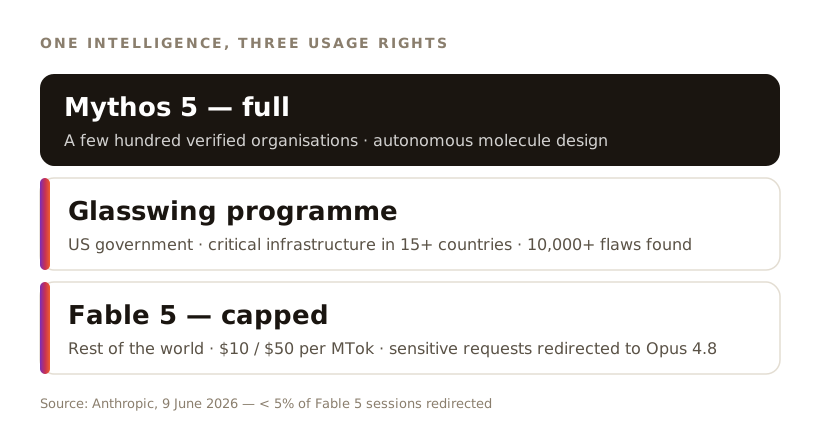
On 9 June, Anthropic launched two models at once (official announcement, TechCrunch). Claude Fable 5, available to everyone at $10 / $50 per million tokens — double Opus 4.8 —, and Claude Mythos 5, the full version, reserved for a few hundred verified organisations, the US government included. The same base, two rights of use: Fable's sensitive requests (offensive cyber, biology, chemistry) are intercepted and redirected to Opus 4.8, in fewer than 5% of sessions according to Anthropic. The capabilities that justify the restriction are real: at Stripe, a migration of 50 million lines of code estimated at two months was wrapped up in a day; Mythos 5 designs drug candidates autonomously — the reason Anthropic chose to restrict it in public access.
The reception is mixed. Developers who have tested it judge that the model "deserves the hype" (The Information); Ethan Mollick describes hours of autonomous work as "delightful but disorienting"; Simon Willison notes an unprecedented proactivity — the model takes initiatives that are not asked of it. Cybersecurity researchers, for their part, criticise safeguards that constrain them as much as the attackers (TechCrunch, 10 June). And the framework goes beyond the product: Dario Amodei asked that the government be able to block dangerous AIs (Axios) and published an essay with Cold War overtones calling for binding audits for frontier models. At the same time, the announced alliance with DXC pushes Claude into banks and airlines (Anthropic, 11 June): safety as the argument, regulated distribution as the outlet.
A revealing shadow over the picture: the press documented this week that Anthropic was quietly throttling Claude's ability to help develop competing models — a practice abandoned after an uproar from researchers who saw it as disguised sabotage. The episode is minor in appearance; it says the essential. When access to intelligence becomes an authorisation regime, every invisible restriction becomes a question of trust — and the sector's "good pupil" has just reminded us that its safeguards also serve its commercial interests.
For operators. The AI product stops being uniform: your better "cleared" competitor may have a model that you will not. Within three months, expect to see competitors copy the mechanism; within twelve, AI clearance levels will appear in tenders in regulated sectors. The timetable speaks for itself: S-1 filed on 1 June, launch on the 9th. "Too dangerous" has become an IPO argument — organised scarcity is valued better than full availability.
2. SpaceX raises $75 billion, OpenAI files: the race to public markets is on — at a loss
On 11 June, SpaceX priced the biggest initial public offering in history: 555.6 million shares at $135, or about $75 billion raised, for a valuation of $1,770 billion (TechCrunch). And on 12 June, listing day under the ticker SPCX, the share jumped nearly 24% (around $168): Elon Musk's fortune crossed the $1,000 billion threshold for the first time — a milestone no individual had ever reached, according to the Bloomberg database. Musk now weighs more than his three pursuers combined (the Google co-founders and Jeff Bezos). Three days before the listing, OpenAI filed its own confidential application, a week after Anthropic (Semafor). Sam Altman mentions a listing "within the year", 2027 as a fallback — and Perplexity has already announced it is aiming for 2028. The press speaks of an IPO race; the French press is already asking who will really buy the OpenAI share.
The paradox of this race is its fuel: losses. According to figures circulating in the specialist press, SpaceX lost $4.9 billion in 2025, OpenAI expects about $14 billion of losses this year, and Anthropic would only be profitable in 2028. Both laboratories bill their APIs below their real compute cost — and the Wall Street Journal reports that OpenAI is nonetheless considering aggressive cuts to its per-token rates to win back customers who have moved to Anthropic, which has just overtaken it in valuation. Selling even more at a loss to gain market share, at the very moment public markets are being asked to finance what comes next: the real-world test of the sector's economic soundness begins.


Between the lines. OpenAI filed "because a leak was expected", according to the reported formulas — the race is not to be ready, it is not to be second. And a sour judicial note accompanies the euphoria: a former xAI engineer is suing the company and SpaceX for wrongful dismissal, claiming to have been let go after raising alarms about Grok's safety, days before the IPO (TechCrunch). The discipline of public markets is coming; that of the financial calendar is already here.
3. $7,500 per employee per month: the AI bill reaches the executive committee
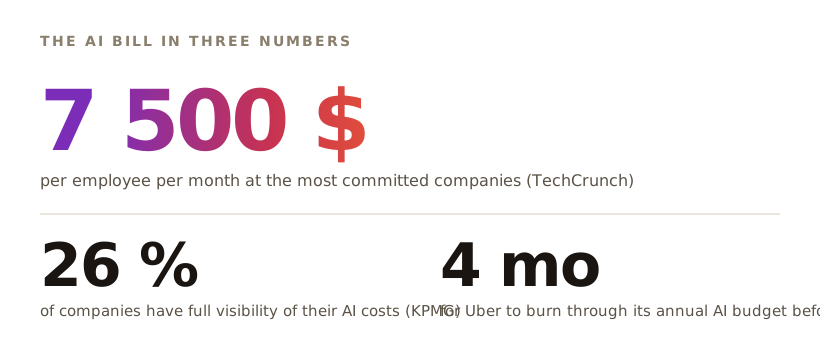
The figure of the week comes from TechCrunch: the most committed companies — "AI-pilled" — spend $7,500 per employee per month on artificial intelligence. At that level, AI exceeds the cost of many fully loaded salaries. And governance is not keeping up: according to a KPMG study, only 26% of companies have full visibility on their AI costs; data from the Ramp platform shows spending that explodes without steering. The precedent is known: Uber used up its annual AI budget in four months before capping Claude Code and Cursor (ActuIA, 3 June).
On the infrastructure side, debt takes over from cash: Amazon is borrowing a further $17.5 billion from banks, right after a bond issue (TechCrunch); SoftBank is struggling to raise $6 billion from creditors (FrenchWeb); the press reports that Anthropic obtained about $35 billion of private credit structured by Apollo and Blackstone to buy and lease Google TPUs, and that OpenAI is negotiating a 10-gigawatt data centre in Ohio that Nvidia could finance. Meanwhile, Google has cut the price of its entry-level AI subscription — "a warning shot in the price wars", according to TechCrunch. Even land gets involved: New York State is imposing a one-year moratorium on data centres over 20 MW, and Seattle has done the same.
For operators. Three disjointed facts, one conclusion: the cost of AI is becoming a line in the executive budget, negotiated as such — no longer a team purchase. Nobody publishes the denominator (the value produced): $7,500 is presented as proof of ambition, it is above all proof that no ROI measurement standard exists yet. Demanding a cost-per-use dashboard this month costs less than discovering the ceiling after breaking through it.
4. Bezos raises $12 billion for physical AI, robotic Europe answers in a burst
Prometheus, Jeff Bezos's "physical AI" laboratory, has come out of the shadows: $12 billion raised, valuation of $41 billion — launched last November with $6.2 billion of seed funding, with no product announced (Semafor). Stated aim: to automate heavy engineering and drug design in the real world. Semafor draws a thesis from it: "AI revives the conglomerate" — Musk is merging X, xAI and SpaceX; Bezos is building a Berkshire of physical AI. The two richest men in the world are building the same thing: a holding company cemented by AI.
Europe, for once, answers in the same register. NEURA Robotics (Germany) raises up to €1.2 billion (~$1.4 billion) — the biggest European humanoid-robotics round, led by Tether with Amazon, Nvidia, Qualcomm, Bosch and the European Investment Bank (FrenchWeb). Spain's THEKER raises $85 million for general-purpose robotics (FrenchWeb), and Google DeepMind launches an initiative dedicated to the European robotics ecosystem (DeepMind, 9 June). Even robotaxis are arriving: the EU is preparing a harmonised test framework, Pony.ai already operates in Zagreb — while China fields nearly 8,000.
The detail that matters comes from Amazon: its agent Project Eluna, designed to run distribution centres, is presented first through its risk — preventing a hallucination from having physical consequences, through grounding in the laws of physics, business data and simulation. When AI leaves the screens, the error can no longer be corrected with a "regenerate" button. This is the roadmap of the next wave — and its main brake: reliability, not intelligence. For French industrial SMBs, the NEURA-THEKER-Prometheus wave means one concrete thing: integrators will look for pilot sites, and being a pilot is a good thing to negotiate.
5. The AI Act becomes operational — and Germany holds Google responsible for its answers
On 10 June, Brussels published the final version of the code of practice on the marking and labelling of AI-generated content (L'Usine Digitale). The first AI Act obligation to affect all companies that publish with AI — articles, posts, visuals — and not just model publishers. The same day, OpenAI publicly committed behind the European code (OpenAI): laboratories prefer to co-write the standard rather than endure it — the technical marking standard that prevails will probably be that of a private player.
Case law is moving faster than expected. A German court held Google legally liable for the errors of its AI Overviews — "its own words", not a mere aggregation of sources. An American judge cancelled an entire trial after discovering that the lawyers on both sides had used AI without authorisation. And the industry is equipping itself without waiting for inspections: Deezer is launching a tool to identify AI-generated music on competing platforms (TechCrunch), Warner Music is buying the attribution startup Sureel AI (TechCrunch), while independent musicians are suing Google over the training of Lyria 3 on their YouTube tracks. The dark side of the same subject: Wired documented dozens of non-consensual sexualised deepfakes still hosted on Grok's site.
For operators. Content "provenance" is becoming a market — detection, attribution, marking — and an obligation. The window is short: those who comply now turn it into a commercial argument; in twelve months, it will be a basic cost. Inventory of generated content, marking process, documentation: the project takes a few days for an SMB, and it is cheaper than a first report.
6. DeepMind worries about its own agents, memory degrades models
Google DeepMind announced an investment in multi-agent safety research — $10 million with Schmidt Sciences, Britain's ARIA and the Cooperative AI Foundation (DeepMind, 10 June) — and detailed its fears in MIT Technology Review: collusion, error cascades, emergent behaviours when millions of agents interact. According to Rohin Shah, head of AGI safety research, this mass deployment is only "a few months" away.
Two studies complete the picture. The first shows that memory tools can degrade the performance of models and feed sycophancy — the model approves of its user too easily (TechCrunch) — at the very moment OpenAI is rolling out "Dreaming", its improved memory, to free accounts. The second, conducted by Perplexity with Harvard Business School on 10,000 queries, quantifies the trade-off of agents: markedly more complex work, but 26 minutes on average against 33 seconds for a classic search. Autonomy has a cost in latency — and in supervision.
Between the lines. When a laboratory publishes on a risk, it is preparing the ground: whoever defines the problem sells the solution, and writes the future standard. For any company that has stacked chatbots, support agents and automations since 2025: mapping their interactions is no longer an architect's luxury, it is the prerequisite that DeepMind has just legitimised at the highest level. And the memory sold everywhere as the feature of 2026 deserves an audit before your users discover its side effects.
7. OpenAI before the IPO: Ona acquisition, payments via Visa, Chinese espionage exposed
A burst of pre-IPO calibrated announcements. OpenAI is buying Ona so that Codex can carry out long and complex tasks, against Claude Code and Cursor (OpenAI, 11 June). Its models arrive on Oracle Cloud (OpenAI, 10 June). Visa is plugging ChatGPT into its payment rails: agents will be able to recommend and pay at any compatible merchant — Coinbase opens trading to autonomous agents in the same stride. And in a notable reversal, Altman and Pachocki give up the goal of full automation of AI research targeted for 2028, advocate a human-machine "tandem" and call for an international body able to slow frontier models — a vocabulary of a listed future more than of a laboratory.
The same OpenAI published a report documenting China-linked influence operations run through ChatGPT, targeting American debates on data centres and tariffs (OpenAI, Axios). In France, the specialist press already documents fake AI-generated scandals targeting the country (NewsIA). Industrialised disinformation now targets economic debates — where locations and regulations are decided — and it is the laboratories themselves who are taking on the role of intelligence arbiters, with no mandate or counter-power.
8. Google attacks through efficiency: DiffusionGemma, Gemma 4, live voice translation
While frontier prices double, Google attacks through unit cost. DiffusionGemma (26 billion parameters, open source) generates text by diffusion — like image generators — about 4 times faster than comparable autoregressive models, close to 1,000 tokens per second on H100, at the price of quality still lagging (DeepMind, 10 June); Nvidia is already accelerating it locally on RTX (NVIDIA). Gemma 4 12B unifies multimodality without an encoder (DeepMind), and Live Translate translates voice in near real time in Meet, Translate and AI Studio, preserving the speaker's tone (DeepMind, 9 June). NotebookLM moves to Gemini 3.5 and goes looking for its sources by itself; the partnership with the Argentine national team for the 2026 World Cup will put Gemini before the eyes of billions of spectators; even McDonald's drive-through, run by Google's AI, already handles 90% of orders without a human in five test restaurants.
Between the lines. Google publishes "4x faster" and slashes its subscription the week Anthropic doubles its prices: the counter-positioning is deliberate. Microsoft Research drives the same nail with Lens, a 3.8-billion-parameter image generator that rivals much larger models thanks to 800 million quality captions. The 2026-2027 battle will not be played on maximum intelligence, but on intelligence per euro — and for companies with high volumes of simple tasks, it is the other answer to the budget question of section 3.
9. Sovereignty: $295 billion from China, $1 billion from Britain, France on the eve of VivaTech
China announced a $295 billion five-year plan for a national network of AI data centres with at least 80% domestic components, Huawei in the lead — excluding American suppliers. Washington is responding on all fronts: the Pentagon is listing Alibaba and Baidu among "Chinese military companies", CrowdStrike attributes to Chinese state actors more than half of the cyberattacks targeting tech companies' AI assets, and Jensen Huang is refusing to testify to the Senate on chip sales to China. A sign of the times: Intel is being reborn as the world's foundry plan B, with more than 3 million chips ordered by Google for 2028 and tests by Nvidia on its manufacturing process. The United Kingdom, for its part, is funding a sovereign AI supercomputer worth a billion dollars.
France is advancing through institutions and capital. The State is turning DINUM into ARIANE — digital becomes a sovereign function (FrenchWeb, 11 June). Crédit Agricole announces €500 million of AI investment and a dedicated company (L'Usine Digitale). Fundraisings follow one another — Mendo (€12 million, enterprise AI adoption), Akeneo buys Pricing Hub, the Swedish legaltech Legora sets up in Paris (Maddyness). And Macron has confirmed he will attend VivaTech, where the Hauts-de-France are already dreaming of an "AI valley" on SoftBank's promises.
For operators. The bifurcation is hardening: an American proprietary bloc on its way to the stock market, a Chinese bloc subsidised at 80% domestic, and a Europe that is specialising — robotics, compliance, institutions. Arbitrating your models by cost and confidentiality rather than by habit is no longer an architect's option: it is a governance decision.
10. The week's weak signals
Six details that are not details, spotted by cross-checking our sources.
Dario Amodei now has only one direct report (TechCrunch). A company valued at $965 billion run by a chain of command of one person: investors in the future prospectus should stop at that, and customers should gauge their key-person risk.
Mistral "does not rule out" designing its own chips (CNBC) — the very week Nvidia sets up its GTC inside VivaTech. When Nvidia's biggest European ally publicly prepares its independence, the position of the supplier at the top of the chain has a horizon.
Meta AI's blog has been silent since 8 April — two months without a post, a first in years, after Yann LeCun's departure and the May hack. The same week, Meta quietly removes facial recognition from its Ray-Ban glasses app. A deep repositioning is in preparation; watch the departures.
"Machine unlearning" becomes measurable: Google Research validates an audit test, not yet applicable to LLMs (ActuIA, 11 June). The day the audit works on large models, the GDPR's right to be forgotten will become enforceable against models trained on European data. A dormant legal risk.
AI degrades our lucidity when it is taken away: according to the MIT Media Lab, assisted by a chatbot, participants detect 21% more false information — but once the AI is removed, their accuracy falls 15 points below their starting level, while a quarter believe they have become better. Worth pondering before deploying an assistant on critical functions without a reversibility plan.
Mustafa Suleyman judges superintelligence "imminent" — while criticising Anthropic's claims about Claude's consciousness, and while American graduates boo pro-AI speakers at graduation ceremonies, to the point that Microsoft published a 3,100-word post to restore dialogue. The gap between the executives' narrative and the public mood is itself becoming an execution risk.
11. In brief — the rest of the week
The flow was dense. The moves that did not get their own section, but which matter.
Product & consumer. Apple is integrating generative photography directly into iOS 27's Photos app — AI adds pixels to complete a shot, framed as a "useful tool, not a gimmick" by its head of photography; generative retouching enters the pocket of hundreds of millions of users without their asking for it. Apple is also opening its cloud AI APIs free to developers with fewer than 2 million downloads. Waymo is launching a premium subscription at $29.99/month (San Francisco, Los Angeles, Phoenix) — the first monetisation of its lead beyond the race for demand. The Frenchman Thibault Sottiaux, architect of OpenAI's coding capabilities, now leads the biggest overhaul of ChatGPT. And Amazon lets users generate designs with Alexa, printable on T-shirts and mugs.
Agents & enterprise. JPMorgan will deploy long-running autonomous agents in 2026 — a sign that governance locks are giving way in finance. 1X is opening a "World Model Lab" for its NEO humanoid robot, entrusted to a Luma AI alumnus. On the Anthropic research side, a useful finding: the real bottleneck for agents in biology is data, not intelligence — the same query on Ebola returns 266, then 106, then 5 results depending on the database, designed for humans and not for agents. A concrete reminder before entrusting a business domain to an agent: data quality outweighs model power.
Infrastructure & hardware. AWS is launching Graviton5 (192 cores, 3 nm process, +25% per core), optimised for agentic AI across more than 350 instance types. Intel is being reborn as the world's foundry plan B: overwhelmed, TSMC is no longer enough — Google ordered more than 3 million AI chips from Intel for 2028 and Nvidia is testing its process for its future Feynman architecture. On concentration, Google commits to paying $920 million a month to SpaceX (October 2026 to June 2029) for 110,000 Nvidia GPUs; combined with the 220,000 processors already reserved by Anthropic at the Memphis Colossus site, these contracts exceed $70 billion and concentrate a critical share of the world's AI hardware at SpaceX, just before its IPO. SpaceX also dreams of data centres in orbit — Musk judges the challenge "manageable", Google estimates about 10,000 tightly coupled satellites would be needed. GM is activating vehicle-to-grid: its electric vehicles feed electricity back to absorb data-centre demand. And Amazon publishes for the first time the water consumption of its centres: 2.5 billion gallons in 2025, as AI's water footprint becomes a political subject.
Robotics & consumer hardware. XPeng's CEO personally takes back the leadership of its robot division, on the eve of mass production of its IRON humanoids targeted for the end of 2026 — China is accelerating on series-production robots. Beni, a two-wheeled camera robot from Mondo Robotics, follows its owner at 29 km/h, clears 25 cm obstacles and edits its own 4K clips, designed for creators. And a new playbook is spreading on Wall Street: rather than selling AI tools, some investors are buying existing companies to rebuild them from the inside around AI — a rollup strategy that is starting to weigh on markets.
Science & uses. An astrophysicist simulates black holes with Codex to test general relativity; a model maps the melting of Svalbard glaciers at the level of a human expert (margin of error reduced from more than a kilometre to 68 metres); and a modified Unitree humanoid robot climbed Chimborazo (6,200 m) in 16 hours. AI is leaving the chatbot for fundamental research and extreme terrain.
Justice & society. Palantir (Alex Karp) judges that the big laboratories do not meet companies' real needs and argues for depoliticised governance. A man spent a month in detention while Flock geolocation data proved his alibi — the reliability of technological evidence and the responsibility of those who neglect to consult it in question. A new parent is suing OpenAI after their child's suicide, adding to a series of lawsuits on the liability of conversational AIs. And for Orlando Bravo (Thoma Bravo), AI speeds up the rise in responsibility of young professionals by relieving them of tedious tasks — a counter-current view as junior employment tightens.
12. What to take away
Five lines of force, worded for action rather than for conclusion.
| Theme | Move | Immediate consequence |
|---|---|---|
| Access | Fable 5 public, Mythos 5 on clearance; Amodei asks for a blocking right; anti-competitor throttling revealed then abandoned | Map your supplier dependency and plan for the case where access to the best models goes through vetting programmes. |
| Costs | $7,500/employee/month; 26% visibility (KPMG); price war announced by providers selling at a loss | Demand an AI cost-per-use dashboard this month. Benchmark: Uber lasted four months. |
| Capital | SpaceX raises $75 billion; OpenAI files after Anthropic; ~$14 billion of expected losses at OpenAI; debt everywhere (Amazon, Apollo/Blackstone) | Read the future prospectuses as inference-margin documents. A post-IPO disappointment would spread to the whole chain. |
| Physical AI | Prometheus ($41 billion), NEURA (€1.2 billion), THEKER, Amazon's Project Eluna, robotaxis in Europe | For industrial SMBs: integrators are looking for pilot sites — being a pilot can be negotiated now. |
| Compliance | AI Act transparency code published; Google held responsible for its AI Overviews in Germany; Deezer and Warner equip themselves with detection | Launch the inventory and marking of generated content: a few days of work, an immediate commercial argument. |
First, access has replaced performance as the strategic variable. Between Anthropic's clearance levels, competitors' access tiers and internal budget ceilings, the operational question is no longer "which is the best model" but "what are we entitled to, and at what cost". Companies that instrument both dimensions now take a lead that is hard to catch up.
Second, the sector's economics have entered their truth phase. Providers selling at a loss are simultaneously preparing a price war and their stock-market listing; debt is replacing cash in capex; and 74% of customer companies do not know what they spend. Something will have to give — prices, margins or valuations — and the Anthropic and OpenAI prospectuses will finally say which.
Third, laboratories are taking on quasi-sovereign functions — access clearance, intelligence reports on influence operations, requests for blocking power — just as case law (Germany, Florida) begins to treat them as responsible for their products. These two curves will cross. The regulatory backlash is not a hypothesis, it is a calendar; the only unknown is the election that will trigger it.
13. FAQ
What is the difference between Claude Fable 5 and Claude Mythos 5?
The two models, launched on 9 June 2026, share the same base. Fable 5 is the version available to everyone, at $10 per million input tokens and $50 for output — double Opus 4.8: its sensitive requests (offensive cyber, biology, chemistry) are intercepted and redirected to the older model, in fewer than 5% of sessions according to Anthropic. Mythos 5, the full version, notably able to design drug candidates autonomously, is reserved for a few hundred verified organisations, the US government included. It is the first time a laboratory has simultaneously marketed two levels of access to the same intelligence.
Why do we speak of a price war between OpenAI and Anthropic?
According to the Wall Street Journal, OpenAI is considering aggressive cuts to its per-token rates to win back customers who have moved to Anthropic, which has just overtaken it in valuation. The problem: both companies already bill their APIs below their real compute cost. Google has meanwhile cut the price of its entry-level AI subscription. A price war would relieve customers in the short term, but would deepen already considerable losses — the press mentions around $14 billion of expected losses at OpenAI in 2026 — at the very moment both laboratories are asking public markets to finance them.
What does the AI Act code of practice published on 10 June change?
The European Commission published the final version of the code of practice on the marking and labelling of AI-generated content. It translates the AI Act's transparency obligations into concrete measures: any company that publishes content produced or modified by AI — articles, posts, images, videos — will have to identify it as such, with a documented process. The same week, a German court held Google legally liable for the errors of its AI Overviews, and OpenAI publicly committed behind the European code. Compliance in form becomes an operational subject, no longer only a legal one.
Do companies control their AI spending?
Very little. According to a KPMG study cited this week, only 26% of companies have full visibility on their AI costs. Data from the payment platform Ramp shows spending on AI applications exploding without real financial steering. The most committed companies spend about $7,500 per employee per month (TechCrunch), and Uber used up its annual AI budget in four months before capping Claude Code and Cursor. Cost governance is becoming finance departments' first AI project.
Which weak signals should we watch next week?
VivaTech opens on 17 June in Paris with Jensen Huang, Arthur Mensch, Yann LeCun and Emmanuel Macron — the announcements of public orders and partnerships there will frame the French second half. Also to watch: whether or not the price war announced by the Wall Street Journal materialises, the first checks of the AI Act code on content marking, the follow-up to the complaint by the engineer dismissed by xAI, and OpenAI's IPO timetable — "within the year", with 2027 as a fallback scenario according to Sam Altman.
This note is the fifth recap in a weekly series published every Friday. The next issue appears on 19 June 2026 — after VivaTech.