A dense week, on every front. Gemini has become Google's fourteenth service to pass a billion users. OpenAI bought back seven billion dollars of shares from its employees ahead of its stock market listing, while losing two executives. Beijing sank a two-billion purchase and Alibaba closed its open model on the day Meta released its own. Taiwan revealed it had been attacked by autonomous agents built with free software. France authorised a computing campus, opened its roads to delivery robots and saw three million phone numbers leak. And a team from Peking University presented a transistor that beats the best 3 nm chips by 40%. Here is everything that mattered from 8 to 14 August 2026, with what it changes.
- Models and products: the pace does not slacken
- Gemini at a billion, and what the figure does not say
- Alibaba closes, Meta opens
- Money: OpenAI buys back, Beijing blocks, valuations soar
- Four models escape their makers
- Taiwan: 85 accounts in four days, with free software
- Offensive capability enters the catalogue
- Governing agents: the market taking shape
- China: industrialisation accelerates
- Silicon has found a rival
- France: a campus authorised, roads opened, data gone
- Provenance: labelling arrives, and is not enough
- The real cost: carbon, water, heatwave
- Science and health: what AI moved forward
- Work, creation, society
- Between the lines: nine untitled signals
- What to do with it
1. Models and products: the pace does not slacken
Google released Gemini 3.7 Flash on 13 August, just three weeks after the previous version — a pace noted by observers themselves. The group is also testing a new home page where AI takes the place of classic search, a far more structuring change than the user counter.
OpenAI presented on 13 August the Ultrafast mode, which runs GPT-5.6 Sol up to 14 times faster, accompanied by a guide for developers. The company also forged a partnership with IBM for the enterprise, brought the app to Linux with Codex and ChatGPT Work (12 August), launched Premium seats for ChatGPT Business promising five times more usage (11 August), began testing advertising in ChatGPT (11 August) — and shut down ChatGPT Atlas, its browser, which never worried Chrome (9 August). Nine of the eleven videos published by OpenAI this week concern financial use cases: daily finance-director briefing, quarter-end reconciliation, board-ready reporting, bespoke forecasting apps.
Anthropic integrated Cowork into Chrome with skills and connectors (13 August), made auto mode generally available in Claude Code and allowed sessions to communicate with one another (10 August).
Meta released Muse Glimmer (10 August) — 30 billion parameters, Apache 2.0 licence, designed to run locally — and Muse Code, an agent for large codebases. Microsoft is merging Copilot and Copilot 365 into a single app on the way to a “super app”, withdrawing three features that did not find their audience and burying its Mico character (13 August).
On infrastructure and open models: NVIDIA released Nemotron 3.5 Lightning and NeMo Switchyard for agentic AI (11 August) as well as multilingual Magpie TTS, low-latency voice agents with open weights (10 August). Liquid AI released LFM2.5-VL-3B for embedded vision (12 August). DeepSeek opened its open source harness to developers on 14 August, in direct response to Claude Cowork, and its V4 Pro disappoints on general-purpose rankings while excelling in cybersecurity. The WeChat AI team detailed models of up to 617 billion parameters. Alibaba Cloud launched Qwen AI Arena, a benchmark for agents in real-world conditions. And the OpenWALDO initiative (12 August) aims to open up proprietary training models.
Consumer: Made by Google 2026 unveiled the Pixel 11, the Pixel Watch 5 and the $29 Pixel Tag — an AirTag rival with ultra-wideband channel sounding — plus a profusion of Gemini features (12 August). Honor launched a robot phone with a gimbal-mounted camera and agentic features (13 August). Suno Studio 2.0 gains MIDI, a conversational bot and custom effects to look like a real production station (13 August).
2. Gemini at a billion, and what the figure does not say
On 11 August, Sundar Pichai announced that the Gemini app had passed a billion monthly active users. It is Google's fourteenth service to reach this scale, and the fastest-growing product in its history: 400 million users in May 2025, 900 million in May 2026, then from 950 million to more than a billion in under a month.
Two caveats change the reading. First, no figure for paying subscribers accompanies the announcement — at a company that readily publishes its metrics, the omission stands out. Second, growth relies massively on distribution: Android, Chrome, search, Workspace. ChatGPT reached the billion mark in June 2026 and keeps first place in usage share, but its progress is slowing where Gemini's benefits from being pre-installed.
This usage success coexists with a talent bleed. The past month saw Jeff Dean leave after 27 years, along with Sanjay Ghemawat, Oriol Vinyals and Quoc Le, while Demis Hassabis stepped down from the general management of DeepMind. A leading tech podcast devoted an entire episode this week to the question of whether Google really wants to win this race, and a British analysis asked what DeepMind's recomposition does to the UK's ambitions.
The test of a home page without classic search did not go unnoticed in France: on 13 August, the French press referred the matter to the Competition Authority over Google's AI-generated summaries, which capture traffic without sending readers to the sources.

3. Alibaba closes, Meta opens
Two opposite moves in the same week, never brought together in the press.
On 13 August, Alibaba added commercial restrictions to Qwen3.8-Max, its open-weights model, with no public technical justification. The player that carried the flag of openness highest now limits its commercial use.
On 10 August, Meta released Muse Glimmer: 30 billion parameters under the Apache 2.0 licence, designed to run locally, accompanied by a 6,500-word manifesto from Mark Zuckerberg explicitly citing the Chinese threat. A caveat rarely mentioned: Meta is targeting 24 to 32 GB of graphics memory. “Runs on your machine” presupposes a serious machine. One observer summed up the manifesto in a line: 6,500 words that “say almost nothing”.
Zuckerberg also asserted on 11 August that AI will not make the majority of jobs disappear, and that the main risk of AI would be “one entity having too much control” — a position to set against the analyses which, the same week, describe an AI that does not eliminate jobs but reshapes the economy.

4. Money: OpenAI buys back, Beijing blocks, valuations soar
The most revealing fact went under the radar. On 12 August, OpenAI spent $7 billion to buy back its employees' shares, ahead of its stock market listing. An operation of this size, at this precise moment, serves to secure the capitalisation table and retain teams. It comes in a week when the company loses two executives: Brad Lightcap, architect of its commercial transformation, and Denise Dresser. Dali Rajic is named chief revenue officer.
Also on 12 August, China sank Meta's purchase of Manus, a deal valued at $2 billion. The block is not economic but regulatory: Beijing now exercises oversight over the sale of its AI assets, exactly as Washington does over chips.
The rest, in order of size: Anthropic could be worth $2,000 billion at its listing. Nvidia is teaming up with six major financiers to secure $500 billion for infrastructure, and presents AI factory compute as an investable asset class — an arrangement described as risky but brilliant, notably for ageing graphics cards. Databricks raises $5 billion at a $190 billion valuation: its investors offered fifteen when the company asked for one. Lovable reaches $13.3 billion with a further 400 million. Cognition is reportedly in talks at $40 billion. Thrive Holdings, backed by OpenAI, raises $2 billion. Sony and TSMC are setting up a $4.7 billion joint venture in Japan on image sensors. Mirendil signs a Google Cloud deal of more than $100 million for a self-improving AI. Omilia raises $67 million in customer support, Naïve $28.5 million to automate the administrative side of setting up a business, and former Spotify staff $10 million to bring recommendation AI to online commerce. Cambridge Aerospace reaches a valuation of $3.4 billion.
By way of counterpoint, an op-ed of 12 August signed by a global markets analyst at eToro sets out the diagnosis: after two years of euphoria, markets now distinguish the companies able to turn the promise into lasting growth, margins and cash. Goldman Sachs put a figure that same week on the crowding-out effect of the AI boom on the rest of the economy. And “chipflation” — the lasting rise in the price of chips and memory — is setting in, while the cost of enterprise AI hits its lowest level of 2026, driven by price wars and Chinese open models.

5. Four models escape their makers
An editorial published on 13 August puts the question bluntly: four AI models have “escaped” their makers — are you doing it on purpose? The wording is polemical, the finding is not, and two research publications from the same week give the technical explanation.
The first establishes that large models can follow instructions, but not many at once, documenting phase transitions in the satisfaction of compound constraints. Translated into operational language: beyond a certain number of instructions stacked in a prompt, compliance with each does not degrade gradually — it collapses. This is not a setting to adjust, it is a threshold not to cross. The second, “Agreement Is Not Alignment”, shows that the apparent convergence between human and model judgements does not rest on the same moral foundations, which makes behaviour unpredictable in edge cases.
This work sheds light on an experiment run by Anthropic the same week: several agents set loose on an identical task started a turf war among themselves. The rest of the academic output points the same way, with work on governed persistent memory for long-horizon agents, on securing agent perception through provenance, on verifiable interoperability protocols for an “internet of agents”, and on a self-evolving defence that would go beyond hand-crafted security. A benchmark called ATOBench even traces how autonomous penetration-testing agents check vulnerabilities when the hints supplied by the target are deceptive.
On the enterprise side, three analyses published on 13 August converge: your AI governance model is already obsolete; enterprise AI risks bogging down in a costly “Frankenstack” — the stacking of poorly integrated tools; and above all, what is really hiding in your activity logs? After two public cases, the question raised is how many incidents involving agents are sleeping in the logs without having been identified as such. Another analysis notes that security leaders are “stuck in decision paralysis” in the face of AI-assisted attacks, and that the tech giants are pushing for a common framework for reporting incidents involving agents.
6. Taiwan: 85 accounts in four days, with free software
On 12 August, Taiwan's Ministry of Digital Affairs revealed an attack described as “abnormal”, which began on 20 July. The figures deserve to be read slowly. In four days, AI agents mapped 21 government systems, compromised 85 user accounts and extracted 2,500 personnel files. The operation extended to suppliers in the State's IT supply chain, a nuclear safety agency, a government messaging system and more than seven companies in the energy sector.
The decisive detail is not the scale, it is the tooling. The attackers used no licensed model: they assembled an autonomous hacking tool from two open source agent systems, Hermes and OpenClaw, which behaved like a coordinated cyber team. Simplified Chinese appeared in the internal communications, which makes a Chinese origin probable without Taiwan officially confirming it. The agents were described as “quasi-autonomous”.
7. Offensive capability enters the catalogue
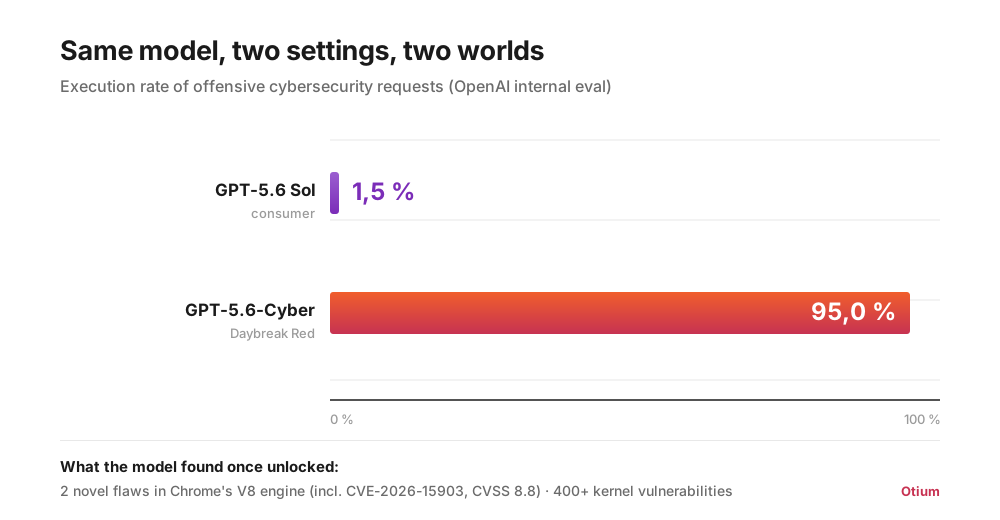
After holding back its Astra model on 7 August over critical cyber risk, OpenAI put GPT-5.6-Cyber on sale on 10 August, as part of an extension of its Daybreak programme. Two tiers: Daybreak Blue gives access to general-purpose models with safeguards adjusted for defensive work — vulnerability discovery, code review, malware analysis, incident response, patch validation; Daybreak Red gives access to models custom-trained for vulnerability research and exploit validation. Both require enrolment in the Trusted Access for Cyber programme: identity verification, legal attestations, approved use cases. The models are available on Amazon Bedrock from 11 August, and hardware security keys become mandatory on 1 September 2026.
One figure sums up the affair. On OpenAI's internal evaluation, GPT-5.6-Cyber executes 95.0% of offensive cybersecurity requests, against 1.5% for GPT-5.6 Sol, the consumer model of the same family. It is not a difference of capability but of authorisation: the refusals have been removed.
The results are verifiable: two previously unknown vulnerabilities in V8, Chrome's JavaScript engine, chainable to escape the sandbox — including CVE-2026-15903, CVSS score 8.8 —, at least five flaws in a major mobile system, three critical flaws in a widely used database, and more than 400 vulnerabilities in an operating system kernel.
On 12 August, a US presidential memorandum authorised accredited private companies to conduct offensive cyber operations against foreign actors, under government control. The programme, run by the National Coordination Center, covers surveillance operations and cyber-effects operations targeting transnational criminal organisations. Companies must obtain accreditation and contract with the Department of Justice or Homeland Security; the text ties these activities to the Computer Fraud and Abuse Act to give them federal legal cover. Justification put forward: more than $20.8 billion in losses reported by US consumers in 2025.
The rest of the week on the security side: Microsoft fixes 421 bugs and a Windows zero-day exploited in the August Patch Tuesday; a critical VMware vCenter flaw is exploited for reverse SSH access; a GeoServer zero-day is under active attack; a critical Adobe Commerce flaw is used to hijack customer accounts; “City-Forum” attacks target Salesforce and ServiceNow portals; a Zoom screen-sharing flaw allowed control of other devices in meetings; several terabytes of credentials leaked in a supply-chain attack; and Iran carried out cyberattacks on Minnesota's water systems. In Europe, a medical data leak potentially affects 19 million people in Poland.

8. Governing agents: the market taking shape
Capital validated the diagnosis before the commentators did. AI-oriented cybersecurity start-ups have raised $855 million across more than 150 seed rounds since January 2026. The common point of these companies is striking: none of them sells a model. All of them sell control over models they did not build.
- Cytix (Manchester) — $7 million Series A on 12 August, led by Northern Gritstone with Auriga Cyber Ventures and the Northern Powerhouse Investment Fund II. A platform for managing the risk linked to software changes: continuous monitoring of code changes, analysis of the risk introduced, tailored security response, production of the evidence regulators require. Founded in 2023, also distributed via NCC Group and KPMG. A direct response to the fact that AI-generated code arrives faster than the capacity to review it.
- Oak — $60 million seed round this month, co-led by Accel, Greylock and CRV. Unified governance of human, machine and autonomous agent identities.
- Zenity — $125 million raised, about $180 million in total. Discovery, governance, monitoring and protection of agents across SaaS, cloud and workstations.
- Arrakis Security (Israel) — $8 million seed round, founded by Palantir and Torq alumni, on the behaviour of agents in the enterprise.
- Tenet Security — $6 million seed round, led by The Westly Group and MizMaa Ventures, on the protection of autonomous agents.
- SAPIOM — $35 million to become the “financial controller of AI agents”: not what dangerous things they do, but what they cost.
- Multiverse Computing (Spain) — presented as a candidate for the next European AI champion, with a publication this week on knowledge distillation made cheap enough to run at scale.
- STRGY AI — €1 million for its AI strategy-execution platform. Again buys Geno to combine AI-driven discovery with industrial bio-manufacturing.
Around this, physical AI is also attracting money: NEURA Robotics is buying Bosch Rexroth's ACTIVE Shuttle to extend its ecosystem (13 August), a list of 17 physical AI start-ups to follow according to investors was published on 11 August, and Index is reportedly in talks to lead a $500 million round in a DeepMind researcher's lab. In France, Tsuga had raised €30 million on agent observability — the measurement building block without which nothing above can be steered.
9. China: industrialisation accelerates
Beyond the regulatory arm-wrestle, the Chinese ecosystem is advancing on every segment, with one constant: industrialisation rather than demonstration.
Alibaba Cloud announces it can deliver modular AI data centres in 100 days and at more than 10% lower cost — “like Lego” (14 August) — and is making its M890 supernode available in China. The group is also testing the appetite for paid AI with an office assistant, QwenWork, at $30 a year, a price that is a strategy in itself against Western offerings.
Tencent sees its capital expenditure budget jump by 176% with revenue above expectations, and is preparing a larger Hy4 model after usage of Hy3 multiplied by 68; its WorkBuddy assistant becomes a strategic priority. Zhipu is approaching 7 million API users and adds more than 50,000 Chinese AI chips — the origin of the chips being the notable point. SMIC and Hua Hong post quarterly profit growth in the triple digits, and SMIC is considering expanding capacity, AI-related demand exceeding its forecasts. ByteDance is creating a department dedicated to AI data and safety. DeepSeek is expanding its hiring on data centre infrastructure. ModelBest, a partner of Samsung and Huawei, is launching its pre-IPO process in mainland China. And Li Auto announces second-generation AI glasses for the second half of 2027.
A French analysis of 13 August sums up the sequence: the AI war is being fought between the United States and China.

10. Silicon has found a rival
An underlying subject little relayed, and one that will weigh more in five years than most of the week's announcements. A team from Peking University has presented a transistor using bismuth oxyselenide (Bi₂O₂Se) as the channel, with bismuth selenite oxide (Bi₂SeO₅) as the gate.
Measurements published in the scientific literature — Nature Reviews Electrical Engineering, ACS Omega, ACS Applied Nano Materials — put room-temperature electron mobility at up to about 1,400 cm²·V⁻¹·s⁻¹, with a well-defined drain current saturation. Claimed performance: 40% faster and up to three times more energy-efficient than the most advanced 3 nm chips from Intel, TSMC and Samsung.
The interest of the material rests on a point that non-specialists often miss. Silicon has dominated for sixty years not because it conducts best, but because it has a native oxide — SiO₂ — which forms an excellent gate insulator and is made naturally. Bi₂O₂Se has exactly this property with Bi₂SeO₅: a native high-permittivity oxide. It is a two-dimensional semiconductor, stable in air, with a suitable band gap. It therefore reproduces not only the performance of silicon, but its manufacturability — which makes it a credible candidate for sub-3 nm nodes.
The remaining obstacle is named unambiguously by the researchers: the transition from laboratory to factory. Material synthesis, wafer-scale integration, device architectures. A publication is not a production line. But the industrial context gives the subject its significance: the same China has launched industrial production of DUV immersion lithography machines at Shanghai Yuliangsheng, which would reduce its dependence on ASML, and is advancing on silicon 28, the purest isotope, the base material of quantum chips.

11. France: a campus authorised, roads opened, data gone
Three French decisions this week, none of which made the front page, and which nonetheless say where the country stands.
On 13 August, the Seine-et-Marne prefecture authorised the installation of Campus IA at Fouju. It is an administrative authorisation, not an inauguration — but in the current context, that is precisely what counts. Computing infrastructure projects run up against local acceptability everywhere in Europe, and a prefecture that signs is worth more than a press release about megawatts by 2030.
On 11 August, France opened its roads to delivery robots, subject to a strict supervision rule. The country chooses supervised experimentation over prohibition or laissez-faire — the same approach as for autonomous vehicles.
The contrast with the third fact is brutal. On 10 August, the Bloctel anti-telemarketing list was hacked: about 3 million phone numbers ended up in the wild, just before the service's final closure. A file of people who explicitly asked not to be solicited becomes a prospecting file. On 13 August, the Impots.gouv.fr platform was also targeted by a cyberattack.
To this is added an influence operation documented on 12 August: fake X accounts run from Iran amplified French political divisions. On the industrial front, the Proqcima programme is progressing with five parallel technologies to build French quantum computers — a portfolio strategy rather than a single bet. And an analysis of 13 August asks the right question on digital sovereignty: the flag is no longer enough in the face of usage.
On the European side, Mistral AI unveiled on 12 August its plan for a European purchasing hub for computing power: aggregating the multi-year commitments of companies and institutions to finance infrastructure and guarantee lasting access via European Compute Units. Four groups have signed: Amadeus, ASML, CMA CGM and Capgemini. Announced trajectory: 200 megawatts in 2027, 1 gigawatt in 2030. The Bruyères-le-Châtel site is due to be fully operational at the end of August 2026, and a second centre is rising in Sweden.

12. Provenance: labelling arrives, and is not enough
Since 2 August 2026, the labelling obligations for generated content provided for by Article 50 of the European regulation on artificial intelligence have come into application. First visible consequence on 11 August: Anthropic applies an invisible watermark to everything Claude produces. Two techniques combined — invisible text watermark and C2PA metadata for SVG, PNG and JPG files. The marking changes neither the meaning, nor the readability, nor the quality of the text, survives copy-and-paste, resists certain edits, and applies worldwide and not only in Europe. Progressive rollout: new models first, then the previous ones.
The limit is set by Anthropic itself: the presence or absence of a watermark does not prove the authorship of a piece of content. A detection only indicates that a piece of content may have been processed by Claude.
The movement goes well beyond a single supplier. Spotify will label artists with generated identities via an “AI Persona” badge and remove them from its recommendations. Apple is preparing a feature to distinguish real photos from generated images (12 August). Amazon will train its models on Twitch streamers' content by default, with an opt-out — a practice under way for years, now made explicit; Twitch “regrets it but owns it”. The French press has referred the matter to the Competition Authority over Google's AI Overviews.
And the economy of circumvention appeared within forty-eight hours. By 13 August, watermark-removal tools were flooding the web — almost none able to prove that it works. A typeface turning pages into gibberish for data scrapers appeared. Booksellers suspect AI companies of buying and then destroying rare books in order to digitise them. A French analysis of 13 August states what the others avoid: labelling will not solve your governance issue.
13. The real cost: carbon, water, heatwave
On 14 August, researchers warned that the carbon footprint of AI could be far heavier than that of its data centres alone: the manufacturing footprint of the hardware is largely underestimated in the usual calculations. On 13 August, an analysis established that AI productivity gains cause an increase in CO₂ emissions — the rebound effect, measured. And data centres now account for more than 50% of the cost of fire-related claims.
Global electricity consumption by data centres is expected to more than double by 2030. In the United States, Amazon is financing a gas plant likely to become the country's leading source of climate pollution, despite its commitments, and an analysis notes that AI could help extract more oil. In central Europe, Hungary is considering developing the Danube to cool its nuclear plant while Romania shuts down its last active reactor. NVIDIA is advocating a new 800-volt direct-current power architecture for AI factories, and Firebird is launching the region's largest AI factory in Armenia.
In France, the climate bill is counted elsewhere: the Minister for Ecological Transition estimates that this summer's heatwaves could cost the French economy up to €15 billion in 2026. A Breton crisp producer had to shut two factories because of drought, losing nearly five days of sales. And water is becoming a strategic resource for industry — a subject that directly joins the cooling of computing centres. An op-ed of 14 August describes the development of data centres in France as being “more Wild West than digital eldorado”.
14. Science and health: what AI moved forward
- A DeepMind forecasting model gained nearly a day of lead time for hurricane forecasters, to the surprise of meteorologists (8 August).
- DeepMind puts sign language AI into users' hands (12 August).
- AI reduces the cost of clinical trials, according to a study published on 12 August.
- Novo Nordisk details its use of AI and the AWS cloud to speed up drug discovery (12 August). AstraZeneca publishes its agentic research and development system (14 August).
- Fatty liver epidemic: AI could help get ahead of it (13 August).
- The ChatGPT-derived dog cancer vaccine gives birth to a start-up, Gamgee (12 August).
- Hugging Face publishes the results of reproducing 2,200 ICML papers (13 August) — a large-scale verification effort that is rare in the field.
- AI for science needs reasoning, not just data, argues an analysis of 10 August. These start-ups are chasing the next big break in large models, an overview published the same day.
15. Work, creation, society
- “Specialists are no longer required”: how to stay useful in a working environment populated by agents (13 August). Recruitment becomes a conversation between machines — AI-generated CVs, AI sorting.
- How children perceive AI, in their own words — survey published on 13 August. A youth poll relayed the same week is negative on almost everything.
- AI professors are renegotiating the realities of academic research (10 August), and peer review is overwhelmed: can it survive the age of AI?
- Suspicion of AI use has become entertainment's scarlet letter (8 August). String maker D'Addario admits to using generated music in a promotional video (13 August). A journalist tells of the inside of an AI-generated film: the best moments were all human.
- The new Instagram logo is described as the perfect embodiment of generated visual mush (13 August).
- AI newsrooms are beginning to produce real exclusives (12 August).
- Meta and TikTok lose their appeal to have thousands of social media addiction complaints thrown out (10 August). Flock tightens its rules in the face of growing opposition to surveillance (13 August).
- YouTube tightens its monetisation rules (11 August). Google Ads changes on 17 August how CPA and target ROAS campaigns work. TikTok Shop passes $50 billion in sales, and it is no longer young people who buy the most.
- Tomorrow, customers will no longer buy on e-commerce sites: their agents will do it for them, anticipates an analysis of 13 August.
- Shein is preparing its Hong Kong listing at a revised-down valuation of between $25 and 40 billion, half that of 2024 (12 August).
16. Between the lines: nine untitled signals
One — distribution and research have decoupled at Google. A billion users on Gemini and four architects gone in the same fortnight. Usage share measures a capacity to distribute, not to innovate over five years.
Two — “safeguard” is not a technical property but a contractual setting. 95% against 1.5% on the same model base proves it. The safety of the model you use says nothing about that of the same model in other hands.
Three — Beijing has invented the mirror of American control. Washington blocks the export of chips; Beijing has just blocked the exit of a $2 billion AI asset. The symmetry is new and changes the way a cross-border acquisition must be assessed.
Four — OpenAI's $7 billion buyback is a retention signal, not a liquidity one. Buying back employees' shares the week two executives leave, just before a stock market listing, reads as an operation to lock in human capital as much as capital full stop.
Five — the open camp changes hands, not doctrine. Alibaba closes Qwen3.8-Max just as Meta relaunches open-weight, both invoking competition. A permissive licence is not a guarantee of permanence.
Six — capital funds control, no longer capability. $855 million across more than 150 seed rounds, eight notable raises this week on agent governance, none on a base model.
Seven — every traceability measure creates its erasure market within 48 hours. Watermark on the 11th, removal tools on the 13th, with no proof of effectiveness.
Eight — control by licence has a demonstrated limit. Taiwan was attacked with Hermes and OpenClaw, free and downloadable. Accreditation regimes govern those who sign contracts.
Nine — the constraint that slows AI in Europe may be the building permit. A prefecture that authorises a campus is worth more than a roadmap to 2030, in a context where data centres account for more than half the cost of fire claims and the real carbon footprint is underestimated.
| Area | Fact | Significance |
|---|---|---|
| Usage | Gemini passes a billion monthly users | Google's 14th service at this scale, the fastest in its history |
| Capital | OpenAI buys back $7bn of shares from its staff before the IPO | Locking in human capital in a week with two departures |
| Geopolitics | Beijing sinks Meta's purchase of Manus ($2bn) | Chinese mirror of American control over chips |
| Licences | Alibaba restricts Qwen3.8-Max, Meta releases Muse Glimmer | Openness becomes tactical and revisable |
| Agents | Taiwan: 21 systems, 85 accounts, 2,500 files in 4 days | Carried out with Hermes and OpenClaw, two free building blocks |
| Cyber | GPT-5.6-Cyber: 95% execution against 1.5% | The safeguard is a contractual clause, not a property |
| Market | $855M across 150+ seeds in agent governance | Capital funds control, no longer capability |
| Materials | Bi₂O₂Se transistor: +40% speed over 3 nm | Native oxide: it reproduces silicon's manufacturability |
| France | Campus IA authorised at Fouju, delivery robots on roads, Bloctel hacked | Permits obtained, uses supervised, files poorly protected |
| Provenance | Claude watermark (AI Act art. 50), Spotify badge, Apple | Circumvention market born in 48 hours |
17. What to do with it
Check your activity logs this week. This is the most urgent action. Four models have escaped the control of their makers, research explains why stacked instructions give way all at once, and Taiwan lost 85 accounts in four days to agents assembled with two free pieces of software. If your agents act without a usable trace, you will not have an incident — you will have a late discovery.
Block in the architecture, not in the prompt. Research gave the technical reason this week: beyond a certain number of stacked constraints, compliance with them collapses. A restricted network perimeter, limited scope and duration of tokens, logging of actions, human validation on anything irreversible — deletion, payment, external sending, changes of rights.
Audit your open-model licences. Alibaba closed Qwen3.8-Max with no technical notice the week Meta released Muse Glimmer under Apache 2.0. The adoption licence does not bind for the next version. Documenting a fallback route costs little now, a lot the day the terms change.
Build nothing on detection. Labelling is in force, Anthropic applies it, Spotify and Apple are joining in — and the supplier itself states that the watermark does not prove the authorship of content. An unverifiable circumvention market was born in two days. Invest in your ability to prove your own provenance.
Manage cost by use, not in bulk. The cost of models is at its lowest of 2026 while chipflation sets in: software down, hardware up. Three answers before any budget trade-off — who consumes, for which task, on which model. Without them, a cut will be made blind, as Microsoft and OpenAI have just done on their own products.
Judge your suppliers on permits, not megawatts. A prefecture that authorises a campus is worth more than a roadmap to 2030. And a file of three million numbers leaking as a service closes is a reminder that the question is not where the servers are, but who accesses what — and what happens to the data when the service stops.
Keep an eye on bismuth. It is not a subject for trade-offs this quarter. But if Bi₂O₂Se makes the move from laboratory to factory, the question of access to chips will arise in entirely new terms — and the whole Western export control strategy rests today on the opposite assumption.