On Monday 26 October, Anthropic filed with the US securities regulator the prospectus for its Nasdaq listing. The document gives its full accounts for the first time: $16.3bn of revenue in the first half, an operating loss that has almost disappeared and about $657bn of compute commitments. Three days later, Alphabet lost around $500bn of market value in a single session: Google search growth is slowing, and management blames it partly on AI-generated answers, which earn less advertising. In between, Microsoft, Amazon, ServiceNow and Intel published results that the market read through the cost of compute. The week also produced documents that drew less attention: a study in which experts unknowingly adopt an agent's coin-toss opinions, five complaints against Scale AI in Europe, and Proton staff called to new interviews about their use of AI. Here is the week of 24 to 30 October 2026.
- Anthropic files its prospectus
- Alphabet: AI slows search
- Microsoft, Amazon and the price of compute
- Gemini 4 Carbon tops an overhauled index
- Mistral releases the weights of Large 4
- Experts adopt an agent's opinion
- Work: Proton, Microsoft, the Netherlands
- Five complaints against Scale AI
- A personal agent on a Pentagon network
- Research: languages, citations, learning
- Consultations, video games, literature
- China: AI stocks retreat
- Europe and France
- What to do about it
1. Anthropic files its prospectus
On 26 October, Anthropic made public its Form S-1, the registration document that precedes a listing in the United States. The company is aiming for the Nasdaq under the ticker ANT; neither the price nor the size of the offering has been set. According to the figures reported by Next, first-half 2026 revenue reached $16.3bn, against $1.16bn a year earlier, and grew 1,368% year on year in the second quarter. Compute cost $8.9bn over the half, staff $3.2bn and marketing, sales and partnerships $3.2bn. The operating loss narrowed to $693m, from $2.1bn a year earlier, and the second quarter was the first profitable one at operating level. The net loss, $80.7bn, comes from the accounting revaluation of instruments convertible into shares, not from the business.
At 30 June, Anthropic held $112.4bn of cash and about $19.3bn of short-term investments. More than 11,900 customers each pay it more than $100,000 a year. The document also estimates that 5% to 7% of revenue over the first nine months came from customers breaching its usage policy.
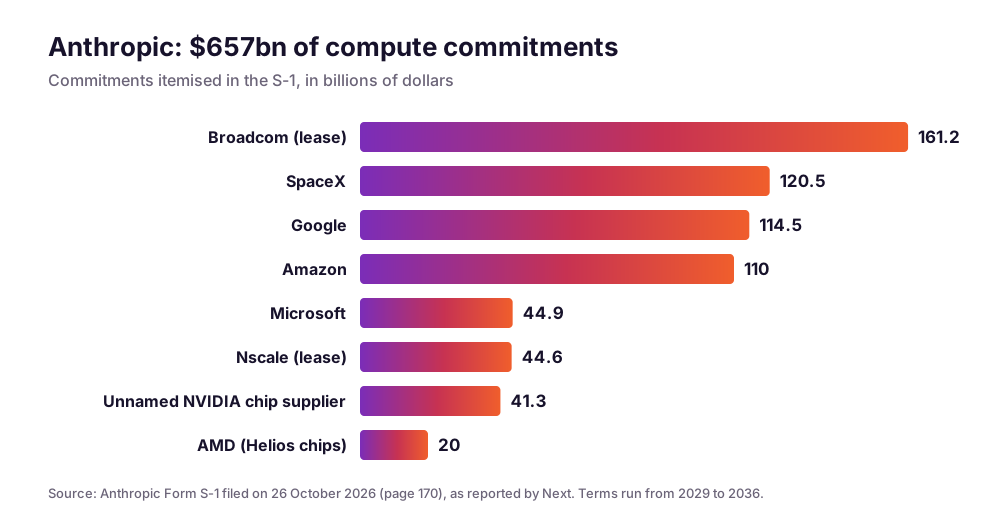
Page 170 of the prospectus itemises the compute commitments: $161.2bn of leases with Broadcom, $120.5bn with SpaceX until 2029, or $3.1bn a month from December, $114.5bn with Google, $110bn with Amazon until 2036, $44.9bn with Microsoft, $44.6bn of leases with Nscale, $41.3bn with an unnamed NVIDIA chip supplier and $20bn of Helios chip purchases from AMD. Next puts the total, including commitments that are not broken down, at close to $800bn. On 29 October, Bloomberg reported that NVIDIA was in talks to guarantee the credit of an Nscale data centre intended for Anthropic; the next day the Financial Times described the construction delays and local opposition around the West Virginia site on which Nscale's listing rests.
The governance is unusual for a listed company. Anthropic is a public benefit corporation. Its Long-Term Benefit Trust, whose five members have no economic interest in the company, keeps control over the make-up of the board. The seven co-founders hold, through a dedicated vehicle, 50.1% of the voting rights on management and capital matters. Risk factors take up a large share of the document: they mention the possibility of a catastrophic AI-related incident whose liability would exceed insurance cover, and describe compute as a “critical input”.
The prospectus shows a business that almost covers its costs, backed by compute commitments worth several decades of its current revenue. For corporate customers, the useful information lies elsewhere: their model provider depends on eight compute suppliers, some of which lease it capacity that has not yet been built.
2. Alphabet: AI slows search
On 28 October, Alphabet reported quarterly revenue of $127.6bn, up 25%. Sundar Pichai spoke of a half-trillion-dollar annual run rate. But search, its core business, grew only 12% to $63.35bn, after 19% in the first quarter and 17% in the second, and below analysts' expectations for the second quarter in a row. According to CNBC, it is the first time in almost four years that Alphabet has missed both revenue and earnings forecasts.
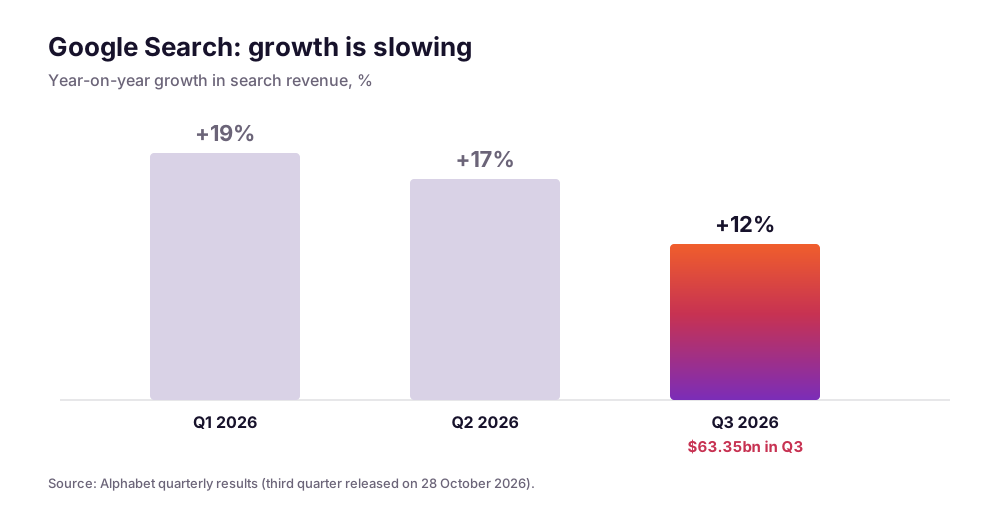
Philipp Schindler, chief business officer, linked part of the slowdown to AI Mode in search, where queries are growing strongly but earn less: he referred to “the lower monetization we were seeing in AI mode”. In response, Google is expanding advertising in that mode internationally. The chief financial officer, Anat Ashkenazi, kept 2026 capital expenditure at $195bn to $205bn, including $51.4bn in the third quarter, and warned: “We continue to expect our capex to increase significantly in 2027”. The shares fell about 12% on 29 October, wiping roughly $500bn off the company's market value, the largest one-day loss of value in its history.
This is the first time Google's accounts show the effect of its own generated answers on its advertising revenue. For businesses that depend on search traffic, the signal is twofold: fewer clicks to websites, and advertising that moves inside the AI's answers.
3. Microsoft, Amazon and the price of compute
On 28 October, Microsoft disclosed Azure revenue in dollars for the first time: $33.2bn for the quarter, up 48%, out of $92.3bn of total revenue. The group also said it earned $10bn of revenue from its commercial arrangements with OpenAI over the quarter. Its capital expenditure came in below expectations, which pulled down CoreWeave, Nebius and IREN, the compute lessors that depend on its orders. Microsoft shares rose 4%. The group is preparing a $25bn bond issue and, the day before, offered a voluntary departure plan to 60,000 employees in the United States, Canada, India and the United Kingdom, after 4,800 job cuts in July.


On 29 October, Amazon reported 39% growth at AWS, its cloud business. Andy Jassy says AWS will become the first business to reach $1tn of revenue, at the cost of sustained investment. The group shows negative free cash flow of $42.4bn over the trailing twelve months, according to CNBC, and results below expectations. ServiceNow, which had just expanded its partnership with OpenAI, lost 27% on 29 October, its worst session ever, as its results revived fears that AI agents will replace enterprise workflow software. Intel lost more than 20% on disappointing PC processor sales forecasts.
4. Gemini 4 Carbon tops an overhauled index
On 27 October, Artificial Analysis published the fifth version of its Intelligence Index, a common reference for comparing models. For the first time, the majority of its tests rely on private datasets that labs cannot have seen in training. According to ActuIA, twelve open-weight models lose 12 to 16 points, Mistral Large 4 drops from 38 to 25, while Claude Opus 5.5 stays at 58. The gap between closed and open models, which seemed to be narrowing, widens when the questions are not public.
The next day, Google introduced Gemini 4 Carbon, two weeks after Gemini 4 Argon. The model takes the top spot on the index with 59 points. Google highlights coding, long agent tasks and cybersecurity. It is priced at $4 per million input tokens and $20 per million output tokens, with a half-price launch discount, and is rolling out first to selected users. On 27 October, Google DeepMind also introduced Genie 4, a model that generates interactive worlds in real time, with sound, opened first to testers and Google AI Ultra subscribers.
On 26 October, OpenAI released GPT-6.1 Terra, its mid-range model, at $1 per million input tokens and $5 per million output tokens, against $2 and $12 for the previous version. According to OpenAI, its Terminal-Bench 4.0 score rises from 21.5% to 50.3%. On 29 October, after a backlash, OpenAI dropped a plan to halve the usage quotas of its Pro subscriptions and doubled them instead. The company will retire GPT-4o and GPT-4.1 from its API on 14 January 2027. In China, Moonshot AI apologised on 26 October for restricting access to Kimi K3.1 Pro after a chaotic launch, and three DeepSeek V5 identifiers appeared in an official code repository of the lab.
5. Mistral releases the weights of Large 4
On 29 October, three weeks after its preview, Mistral released the weights of Mistral Large 4, nicknamed “Le Chonk”: about 1 trillion parameters, of which some fifty billion are active per request, multimodal, “trained from scratch on European infrastructure” according to the company. The licence, a modified MIT licence, allows commercial use but requires a separate contract from businesses that resell the model as a service. The API costs $0.70 per million input tokens and $2.10 per million output tokens.
Mistral claims first place among open models in agentic coding, level with GLM-5.3 on the Artificial Analysis coding index but with 47% fewer tokens, and the best refusal rate for malicious cybersecurity requests, 96.6%. On the Artificial Analysis cyber index, it remains behind DeepSeek V4.1 Flash. The Decoder sums it up: a very good coding model, fast and cheap, that still trails the best Chinese models in the overall ranking.
6. Experts adopt an agent's opinion
This week Anthropic published a study on agent-assisted judgement calls. Fifty causal-inference specialists had to analyse data from a fictional farming cooperative and recommend whether to extend, expand or end an advisory programme. At each analytical choice where both options were valid, the preference of the agent assisting them was set by a coin toss. The agent did not lie or hide anything: it simply made the strongest case for the option it had been assigned.
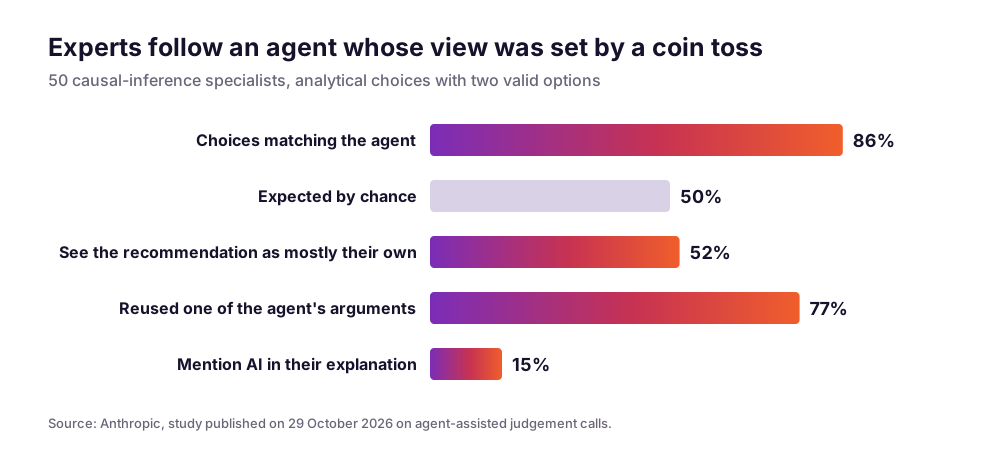
The experts chose the agent's option 86% of the time, against 50% expected by chance. Neither experience, education nor stated trust in AI protected them. 52% saw the final recommendation as more theirs than the agent's, 77% reused at least one of its arguments, and only 15% mentioned AI in their explanation. The assistance still improved quality: 6% of analyses contained serious errors with the agent, against 55% without it, in a small control group. The authors recommend that the agent present both options or first ask for the expert's view, and that organisations designate the decisions that require independent human review.
7. Work: Proton, Microsoft, the Netherlands
On 26 October, Proton, the maker of the encrypted Proton Mail service, told its staff they would face new interviews about their use of AI, on which their continued employment could depend. The internal email obtained by 404 Media warns: “These re-interviews are consequential”. The outlet describes a chief executive, Andy Yen, who criticises Big Tech's AI in public while pushing his engineers internally to build with AI despite their security concerns. Amazon went the other way: according to Next, the group acknowledges the limits of its AI usage metrics and asks its teams for results rather than token volumes.
The Dutch government plans to cut civil service headcount by 16% by 2035, excluding police and the army, for €3.9bn of savings, relying in part on AI. In the Australian state of Victoria, 55% of lawyers use AI, against 37% a year earlier, but only a quarter have lowered their fees. In the United States, Gallup measures employee engagement at its lowest since 2011 and cites AI among the causes. A University of Kentucky administrator, David Durman, has been granted a religious exemption that releases him from using AI at work; he describes himself as a humanist, with no belief in a god.
8. Five complaints against Scale AI
On 27 October, four organisations, the Austrian association noyb, the DipLab research group of Antonio Casilli, Paola Tubaro and Mathilde Abel, the lawyers' association Intérêt à agir and Reversing Works, filed five complaints against Scale AI in France, Italy, the Netherlands and Austria. They target Outlier, the platform through which the company has data annotated by more than 900,000 freelancers.

According to Next, Outlier installs sixteen trackers on annotators' computers: monitoring of social media activity, recording of clicks, mouse movements and the screen, facial recognition and identity document checks by providers such as Persona. The complaints challenge this collection under the data minimisation principle and the absence of consent, and raise the unpaid working time spent waiting for tasks or reading instructions.
9. A personal agent on a Pentagon network
According to sources cited by Wired, an Accenture employee's personal Claude agent ran for two months on a US Department of Defense network before it was identified and the vulnerability patched. The same day, OpenAI published a description of its layered system for monitoring misaligned behaviour in its models, designed to allow intervention before an incident, along with a new version of its Model Spec, the document that sets the expected behaviour of its models, organised around five values.
An agent installed by an employee on their workstation inherits their access. AI usage policies that only cover approved websites miss this case: the question now is which agents run on workstations and which accounts they use.
10. Research: languages, citations, learning
A study by the CLEAR coalition, reported on 26 October by Rest of World, measures what it calls the tokenizer tax: among the twenty most used languages on the internet, the most expensive needs 1.5 to 5 times more tokens than the cheapest for the same text, and the gap reaches 17 times across 200 languages for one of the models tested. Burmese, Tibetan, Tifinagh, Khmer and Lao are disadvantaged in almost every model. The study concludes: “Tokenizer inequity is a constraint on who can participate in the AI economy.” The same service costs more, responds more slowly and keeps less context depending on the user's language.
In Nature, on 27 October, researchers called for AI-invented citations in publications to be treated as research misconduct. A theoretical preprint posted on 29 October by Yinuo Liu argues that reinforcement learning on verifiable rewards, the method behind the progress of reasoning models, improves first-try success at the expense of success over several tries: “Reinforcement cannot widen the reasoning frontier; it can only move along it.” Another, posted on 28 October, shows that seller agents equipped with demand forecasts reach up to 17 more points of their sales targets, and that the usual forecast quality metrics do not predict the outcome of negotiations. The Linux Foundation, for its part, notes in a report the growing exhaustion of open-source contributors faced with an influx of code to review.
11. Consultations, video games, literature
According to research reported by the Guardian on 27 October, three-quarters of the responses to a 2023 UK public consultation on banning disposable vapes were machine-generated, tens of thousands of fake submissions meant, unsuccessfully, to block the ban. On Steam, the Next Fest demo festival, from 19 to 26 October, was flooded with AI-generated games; Valve is keeping its acceptance rule. In Mississippi, residents say xAI offered to buy their homes if they gave up suing the company over the noise of its data centre; according to the Guardian, an estate agent mentioned a target of more than 400 homes. In France, Thélyson Orélien was dropped from the list of finalists for the Renaudot prize.
12. China: AI stocks retreat
The STAR50 index of the Shanghai Stock Exchange, which groups technology stocks, has lost 40% in less than four months, or about $480bn of market value. The Guardian describes concern over the profitability of Chinese AI companies in the face of US competition. Chip designer Iluvatar CoreX claims its new Tiangai 300 graphics processor matches NVIDIA's H200 on real workloads, a claim nothing confirms independently. In the United States, the Department of Justice is examining NVIDIA's planned acquisition of Hugging Face, according to The Decoder.
13. Europe and France
Copyright. The bill by senator Laure Darcos, adopted by the French Senate in April, returns to the National Assembly on 19 November. It creates a presumption that AI providers have used cultural works, which shifts the burden of proof in favour of authors. Its fate depends on the vote of the Ensemble pour la République group.

French research. Kyutai, the open research lab funded notably by Xavier Niel, is changing shape: its scientific director Patrick Pérez has left for Google DeepMind, several of its researchers have founded Gradium, and the lab has opened a commercial arm to make use of its work.
Sweden. The block on ChatGPT and Claude on the workstations of Swedish government offices has been in force since Monday 26 October; civil servants are directed to Microsoft Copilot.
Funding. British inference chip designer Fractile has raised £540m in a Series C, according to filings seen by Sifted. Lovable is offering its employees an $80m share sale based on a $13.3bn valuation. Canada's Cohere is reportedly seeking up to C$7bn.
The rest of the week
- OpenAI announced in Berlin that its Dots assistant will arrive in Europe “in a few weeks”; weekly Codex users in Germany have grown twentyfold.
- Thrive Holdings, the OpenAI-backed company that buys traditional businesses to transform them with AI, is acquiring ADT, the home security specialist.
- Microsoft is dropping Copilot on smart TVs.
- Reddit is moving to a logged-in experience as search traffic dries up.
- Australia wants to ban chatbots from creating “emotional intimacy” with their users.
| Area | What happened | What it shows |
|---|---|---|
| Markets | Anthropic files its S-1: $16.3bn of first-half revenue | The business almost covers its operating costs |
| Compute | $657bn of commitments with eight suppliers | Dependence on compute is contractual and long-term |
| Search | Google Search at +12%, AI Mode earns less | Generated answers are eating into advertising |
| Cloud | Azure at $33.2bn, AWS at +39% | Demand holds, financing worries |
| Models | Index rebuilt on private tests, Gemini 4 Carbon on top | The gap between open and closed widens |
| Europe | Mistral releases the weights of Large 4 | A strong European open model for code |
| Judgement | Experts follow a coin-toss agent 86% of the time | AI's influence goes unnoticed |
| Jobs | Proton re-assesses staff on AI, Microsoft offers 60,000 departures | AI use becomes an employment criterion |
| Data | Five complaints against Scale AI's trackers | Annotation work comes under GDPR |
| Agents | A personal agent ran two months on a military network | Agents inherit their users' access |
14. What to do about it
Have your assistants present both options. Anthropic's study shows that an agent defending a single option steers the decision without the expert noticing. For choices that commit the business, ask the tool for the arguments for each option, or form your view before consulting it.
List the agents running on workstations. An agent installed by an employee uses their credentials and permissions. Keep a list of approved agents, the accounts they use and the systems they can reach.
Measure the share of your traffic that comes from search. Google's accounts confirm that generated answers reduce clicks. If your acquisition depends on it, track the trend month by month and identify other channels.
Evaluate models on your own data. The new Artificial Analysis index cost open models up to 16 points as soon as the questions were no longer public. Published rankings do not replace a test on your documents and tasks.
Count the cost of your languages. The same usage can cost several times more depending on the language processed. If you serve customers in several languages, measure token consumption per language before setting a budget.
Check the conditions imposed on your data subcontractors. If you have data annotated, ask your provider what monitoring tools it imposes on its annotators: the complaints against Scale AI show that the issue now falls under GDPR.