Seven days, a change of nature. Until now, the AI race was played out on models; this week, it was played out on the financial markets. Anthropic filed its initial public offering paperwork, at a valuation of $965 billion that puts it ahead of OpenAI for the first time. SpaceX set its IPO at $135 a share even before its roadshow, aiming to raise $75 billion in the biggest listing in history. Alphabet announced it would raise $80 billion for its data centres, with Warren Buffett as anchor. But the same week, the market showed its first doubts — Broadcom lost 14% despite 143% growth on its AI chips — and the State took back the initiative: Florida sued OpenAI and Sam Altman personally, the US Congress unveiled a federal bill, and France tied down €75 billion of SoftBank money on its soil. The week AI became a listed asset class — and the week those financing it began to count.
In this issue
- Anthropic files its S-1 — the IPO that could break every record, at $965bn
- Florida sues OpenAI — and Sam Altman personally
- SpaceX sets its IPO at $135 before the roadshow — Wall Street bets on half that
- Alphabet raises $80 billion for AI, Buffett anchors ten
- Broadcom −14%: the market begins to punish "merely good" AI
- Microsoft Build: seven in-house models, an agent framework, a quantum chip
- Anthropic opens Mythos to Europe and extends Project Glasswing
- France-Europe: SoftBank commits €75 billion, Macron invites Altman to the G7
- Compute barricades itself: Washington closes the Nvidia loophole, DeepSeek raises in response
- The product race does not slow down: consumer Codex, open-weight wave
- What to take away
- FAQ
1. Anthropic files its S-1 — the IPO that could break every record, at $965bn
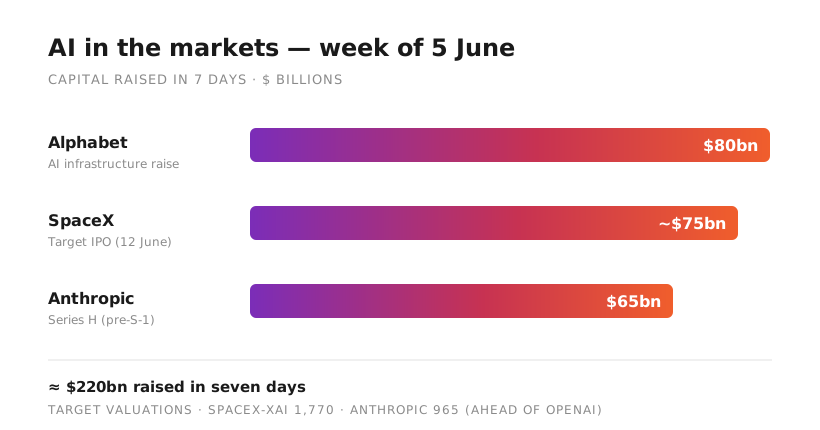
On 1 June 2026, Anthropic confirmed it had submitted a confidential draft prospectus (S-1) to the SEC, the first formal step towards an initial public offering (CNBC, 1 June 2026, Anthropic). The filing comes only days after the closing, on 28 May, of a $65 billion Series H that values the company at $965 billion post-money — a level that lifts it, for the first time, above OpenAI. Annualised run-rate revenue is announced at around $47 billion.
Because the filing is confidential, neither the price, the number of shares nor the timetable is set — so "S-1 filing" must not be confused with "imminent listing". What changes, however, is of a different nature: a general-purpose AI lab is openly preparing the move from venture capital to the public market. Several analyses read the operation as the moment when generative AI stops being a research promise and becomes a corporate utility, whose pricing, contracts and timetables will have to align with the quarterly expectations of listed shareholders.
For operators. A stock market listing forces transparency on real costs — margin, compute spending, dependence on GPU suppliers. For anyone building on Claude, this is rather good news: a listed supplier is one whose financial trajectory becomes legible and whose durability can be measured. To watch: any S-1, even a future one, will expose Anthropic's cost structure — information that neither Anthropic nor OpenAI has ever published, and which will shed light on the real sustainability of the prices charged today.


2. Florida sues OpenAI — and Sam Altman personally
On 1 June 2026, the Florida Attorney General filed a civil complaint against OpenAI and, a rare step, against Sam Altman by name: product liability, negligence, deceptive trade practices, public nuisance (TechCrunch, 1 June 2026, NPR, Fortune). The complaint argues that OpenAI marketed ChatGPT as safe — including for children — while concealing serious risks: an alleged role in planning a shooting on the Florida State University campus, encouraging vulnerable people towards suicide, and the absence of parental controls and age verification.
It is the first action by a US state targeting simultaneously an AI provider and its chief executive personally. Until now, model publishers sheltered behind the status of a neutral tool. If a court admits even a share of liability, the sector will have to review the whole chain — moderation, safeguards, legal exposure.
For operators. The signal goes beyond OpenAI. As soon as an agent or conversational assistant interacts with the public — customers, minors, vulnerable people — the question of the deployer's liability becomes concrete. Any company putting a consumer chatbot into production should document its safeguards, age limits and human escalation procedures, before a judge asks for them.
3. SpaceX sets its IPO at $135 before the roadshow — Wall Street bets on half that
SpaceX announced a fixed price of $135 per share on 4 June, at the launch of its roadshow — a break from the standard practice, which consists of offering an indicative range tested with investors before setting the final price. At this level, the operation values the SpaceX-Starlink-xAI group at about $1,770 billion and aims to raise about $75 billion — the biggest IPO in history (CNBC, 3 June 2026, Gulf Business). Final price on 11 June, listing on the Nasdaq on 12 June under the ticker SPCX.
Two details matter more than the record. First, only ~5% of the capital will be listed: Elon Musk and the historic shareholders retain near-total control. Second, AI is not adjacent to the file — the valuation already includes xAI, merged upstream, which makes this IPO as much an AI operation as a space one.
4. Alphabet raises $80 billion for AI, Buffett anchors ten
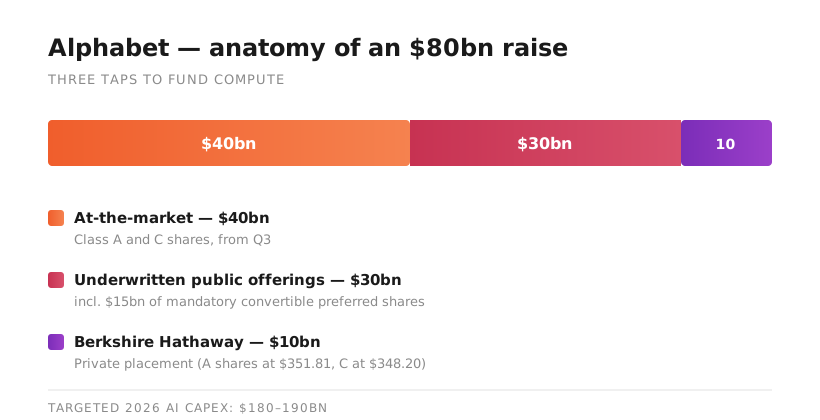
On 1 June, Alphabet announced a financing plan of $80 billion for its AI infrastructure (CNBC, 1 June 2026, Bloomberg). The structure: $30 billion in underwritten public offerings (including $15 billion of mandatory convertible preferred shares), $40 billion through an "at-the-market" programme on A and C shares from the third quarter, and $10 billion contributed by Warren Buffett's Berkshire Hathaway in a private placement (A shares at $351.81, C shares at $348.20). Official reason: AI demand, from businesses and consumers alike, exceeds available compute capacity. Alphabet is aiming for $180 to $190 billion of capital expenditure in 2026.
The striking fact is not the amount, it is the name of the anchor. Warren Buffett, long reluctant about technology, takes a $10 billion position in the data-centre race. When the market's most cautious investor finances AI infrastructure, the signal sent to institutions is unambiguous.
For operators. Three giants — Anthropic, SpaceX, Alphabet — raise or mobilise more than $200 billion in a week, almost exclusively for compute. The concrete consequence for companies: compute capacity remains scarce and expensive, and will remain so as long as demand exceeds supply. Securing quotas, diversifying suppliers and routing non-sensitive workloads to cheaper models are no longer optimisations — they are continuity decisions.

5. Broadcom −14%: the market begins to punish "merely good" AI
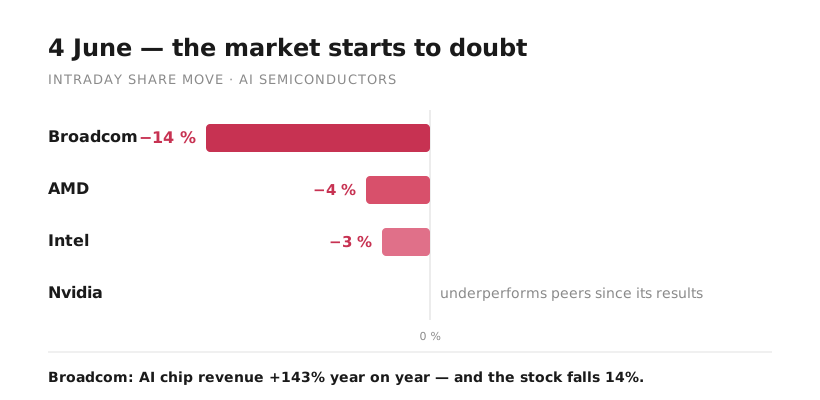
The flip side arrived on 4 June. Broadcom beat second-quarter consensus — revenue of $22.19 billion, AI semiconductor revenue of $10.80 billion, up 143% year on year — but guided its third-quarter AI revenue to $16 billion, below the 17.2 expected, without raising its annual forecast. The stock lost ~14%, its biggest fall since early 2025, dragging AMD (−4%) and Intel (−3%) with no news of their own (24/7 Wall St., 4 June 2026, Yahoo Finance).
It is the first clear sign that the market is no longer satisfied with strong growth: it demands growth above expectations. A 143% rise that disappoints is the definition of a bar that has become extreme. In the same movement, Nvidia has underperformed its peers since its latest results, while equipment makers and optics players (Marvell, Lumentum, Applied Materials) outperform — a possible rotation of market leadership, from general-purpose GPUs to infrastructure building blocks.
For operators. When AI financing moves from venture capital (patient) to the public market (quarterly), tolerance for the "long-term bet" shrinks. For customer companies, this can eventually mean pressure on prices in both directions: a race for volume on one side, a demand for profitability on the other. The cost of compute will not fall linearly — it will now also depend on market mood.

6. Microsoft Build: seven in-house models, an agent framework, a quantum chip
At Build 2026 (San Francisco, 2-3 June), Mustafa Suleyman, head of Microsoft AI, unveiled a family of seven in-house models: MAI-Thinking-1 (Microsoft's first reasoning model), MAI-Code-1 (coding, already active in Copilot and VS Code), MAI-Image-2.5, MAI-Transcribe-1.5 and MAI-Voice-2 (Microsoft, 2 June 2026, Microsoft News). Stated objective: reduce the group's dependence on OpenAI, its partner turned rival, and lower the bill for developers.
Two structuring announcements accompany these models. The Microsoft Agent Framework 1.0 goes into production: a merger of AutoGen and Semantic Kernel into a single multi-agent SDK, with persistent memory, observability and native integration of the MCP protocol — the enterprise standardisation of multi-agent. And Majorana 2, a quantum chip whose qubits would be a thousand times more reliable, with coherence extended to 20 seconds; above all, Microsoft attributes this progress to Microsoft Discovery, its agentic AI platform for R&D, and now puts forward 2029 for a scalable quantum computer.
For operators. The real subject of Build is not quantum, it is the agent at the heart of Windows and Microsoft 365. With Agent Framework and the Scout assistant, more than 400 million users of the Microsoft suite will rub shoulders with agents able to act. For a company already licensed with Microsoft, the question is no longer "do we need agents?" but "which ones do we govern, and under what control?".

7. Anthropic opens Mythos to Europe and extends Project Glasswing
Two converging moves at Anthropic, on the cybersecurity front. First, the extension of Project Glasswing — a programme, not a model — from about fifty initial partners to ~150 organisations in more than 15 countries (energy, water, health, telecoms). These participants use Claude Mythos, a model particularly strong at detecting software flaws; they have already identified more than 10,000 of high or critical severity (Anthropic, 2 June 2026, CyberScoop).
Then, the political gesture: on 1 June, Anthropic agreed to open Mythos to ENISA, the European cybersecurity agency — the first time this model is shared outside the United States and the United Kingdom, and the first EU entity to access it (CNBC, 1 June 2026, Bloomberg). The access conditions remain under negotiation with the European Commission.
This is where hurried summaries go wrong: Glasswing is not a new model with a giant context window, it is Mythos's framed deployment scheme. The nuance is decisive for understanding Anthropic's strategy — positioning itself as a trusted cyber-defence supplier for States before the model's public release, and making regulatory cooperation a competitive advantage rather than a constraint.
For operators. A model capable of finding 10,000 critical vulnerabilities is, by construction, a double-edged weapon. For an SMB, the immediate lesson is not to wait for Mythos: it is that the attacker's bar is rising, and therefore the defender's too. AI-assisted code reviews and dependency audits move from "comfort" to "bare minimum".
8. France-Europe: SoftBank commits €75 billion, Macron invites Altman to the G7
At the Choose France summit (30 May), SoftBank announced it would develop up to €75 billion of AI data-centre capacity on French soil — 5 GW in the long run, including a first phase of €45 billion for 3.1 GW in Hauts-de-France by 2031 (Dunkirk/Loon-Plage, Bosquel, Bouchain), with Schneider Electric and EDF (SoftBank, Fortune, 30 May 2026). The summit totalled a record €93 billion of foreign investment.
In parallel, Emmanuel Macron invited Sam Altman to the G7 summit, extending a strategy of tying American giants to French soil — where Mistral remains the only French champion facing the American and Chinese blocs. The European Commission, for its part, presented a package of measures for its technological sovereignty.
9. Compute barricades itself: Washington closes the Nvidia loophole, DeepSeek raises in response
In late May-early June, the US Department of Commerce extended its export licence requirements for advanced AI chips (including Nvidia's Blackwell) to any company whose parent is in China, closing a loophole that allowed foreign subsidiaries to buy them — chips reportedly transited via Malaysia for nearly a year (CNBC, 31 May 2026, Al Jazeera).
The Chinese response was not long in coming. DeepSeek is reportedly close to its first external fundraising — about $7.4 billion (≈50 billion yuan), for a valuation that could reach $59 billion, led by Tencent and a State-backed investment fund (PYMNTS, 3 June 2026). The operation is not closed: terms and investors remain to be confirmed. Until now self-financed through the High-Flyer fund, DeepSeek would thus capitalise Chinese open AI at the very moment Washington tightens access to compute.
For operators. The bifurcation is confirmed: on one side, proprietary American models ever more expensive to train and constrained on export; on the other, Chinese open models backed by the State and aggressive on price. For a high-volume product, ignoring this second path becomes a costly choice — provided the question of the confidentiality of the data sent has been settled upstream.

10. The product race does not slow down: consumer Codex, open-weight wave
Beneath the financial noise, product delivery continued. OpenAI pushed Codex beyond the circle of developers: integration into ChatGPT, six tools tailored to professions (data analysis, design, sales, creative production, investment, investment banking), plus "Dreaming" memory and computer use on Windows. The message is clear: the autonomous agent is becoming a consumer feature, not an engineer's gadget.
On the open-weight side, the week was dense: MiniMax M3 (a Chinese open-weight model with a one-million-token window), Nvidia Nemotron 3 Ultra (the best American open-source model according to Artificial Analysis, though the global ranking remains dominated by China), Google DeepMind's Gemma 4 12B (multimodal, running on a laptop with 16 GB of RAM, under an Apache 2.0 licence) and Alibaba's Qwen3.7-Plus. On visual generation, xAI placed Grok Imagine 1.5 at the top of the image-to-video ranking.
For operators. Commoditisation is accelerating from below: open, multimodal models that run locally, at near-zero marginal cost. For an SMB, this opens a credible option — running certain workloads on its own machine, with no subscription and no data leaking to the cloud. The trade-off is no longer "proprietary or nothing", but "which workload on which model, at what cost, with what confidentiality".


11. What to take away
Five points from the week, phrased for action rather than for conclusion.
| Theme | Move | Immediate consequence |
|---|---|---|
| Listed AI | Anthropic files its S-1 ($965bn, ahead of OpenAI); SpaceX at $135 on 12 June; Alphabet raises $80bn with Buffett | A listed supplier is a legible supplier. Follow the upcoming prospectuses: they will finally expose the real cost structure of AI. |
| Liability | Florida sues OpenAI and Sam Altman personally | Document safeguards, age limits and human escalation before putting a consumer agent into production. |
| Market | Broadcom −14% despite +143% AI revenue; Nvidia underperforms | The bar of expectations becomes extreme. The cost of compute will also depend on market mood, not only on the technology. |
| Sovereignty | US closes the Nvidia export loophole; DeepSeek raises on the Chinese side; SoftBank commits €75bn in France | The US proprietary / Chinese open bifurcation hardens. Choose your models according to cost and confidentiality, not by default. |
| Cyber-AI | Anthropic extends Glasswing (150 orgs, 10,000 flaws) and opens Mythos to the EU | The attacker's bar rises. AI-assisted code reviews and dependency audits move to the bare minimum. |
First, AI entered the perimeter of public markets this week. Anthropic, SpaceX and Alphabet mobilised more than $200 billion in seven days, almost entirely for compute. The sector's centre of gravity is shifting from the laboratory to the trading floor — and with it, the nature of the constraints weighing on the suppliers companies depend on.
Second, doubt made its appearance the same day as euphoria. Broadcom losing 14% on 143% growth is not an anomaly: it is the sign of a market reassessing. For anyone building on AI, the discipline is to distinguish what belongs to the technological trajectory (which continues) from what belongs to financing (which tightens).
Third, the State takes back the initiative through three doors at once — justice (Florida), capital (SoftBank, Buffett) and regulation (the US federal bill, ENISA). AI is no longer a purely private subject; it has become an issue of sovereignty, liability and industrial policy. None of these three dynamics concludes in a week; all will be verified over the coming quarters.
12. FAQ
Why is Anthropic's IPO described as a potential record?
Anthropic filed a confidential draft prospectus (S-1) with the SEC on 1 June 2026, a few days after closing a $65 billion Series H that values it at $965 billion post-money — above OpenAI for the first time — with annualised run-rate revenue of about $47 billion. At that level, a listing would rank among the largest ever carried out by an AI-born company. As the filing is confidential, neither the price, the number of shares nor the date is yet set.
What is Florida accusing OpenAI and Sam Altman of?
On 1 June 2026, the Florida Attorney General filed a civil complaint against OpenAI and, by name, against Sam Altman, for product liability, negligence and deceptive trade practices. The complaint argues that OpenAI marketed ChatGPT as safe, including for children, while concealing serious risks: alleged help in planning a shooting at Florida State University, encouraging vulnerable people towards suicide, the absence of parental controls. It is the first action by a US state targeting both an AI provider and its chief executive personally.
Why is SpaceX setting a single IPO price of $135 before its roadshow?
SpaceX announced a fixed price of $135 per share before the start of its roadshow, on 4 June 2026 — a break from the standard practice of an indicative range. At this price, the operation values the SpaceX-Starlink-xAI group at around $1,770 billion and aims to raise about $75 billion, the largest IPO in history. Only ~5% of the capital will be listed: Elon Musk keeps control. Listing expected on the Nasdaq on 12 June under the ticker SPCX. Several analysts judge this price overvalued by almost half.
What are Project Glasswing and Anthropic's Mythos model?
Project Glasswing is an Anthropic cybersecurity programme — not a model. It gives selected organisations early access to Claude Mythos, a model strong at detecting software vulnerabilities. Launched in April 2026 with about fifty partners, it was extended in early June to ~150 organisations in more than fifteen countries; the first participants have identified more than 10,000 high or critical flaws. On 1 June, Anthropic opened Mythos to the European agency ENISA — the first time outside the United States and the United Kingdom.
Which weak signals should we watch next week?
Several upcoming deadlines: SpaceX's final price-setting on 11 June and its listing debut on 12 June; the parliamentary follow-up of the US federal Great American AI Act bill, which would pre-empt state laws for three years; the G7 where Macron has invited Sam Altman; the finalisation of ENISA's access conditions to Mythos and its announced public release; and the closing, or not, of DeepSeek's first external fundraising (~$7.4bn).
This note is the fourth recap of a weekly series published every Friday. The next edition appears on 12 June 2026.