On 8 October, CNBC revealed that OpenAI had told its investors it had annualised revenue of about $50 billion at the end of September. The figure of $68 to 70 billion that had circulated until then included its partners' gross revenue. The same day, AI stocks fell, by 3% for NVIDIA to 8% for CoreWeave, and the next day the Australian data-centre operator Firmus withdrew an IPO that was aiming to raise $5 billion. On that same 8th, Samsung announced the biggest quarterly operating profit in its history. In the meantime, the Wikimedia Foundation denounced the activity of OpenAI's agents on its projects, OpenAI rolled out GPT-6 to 1.2 billion users and published 722 mathematics preprints, and Mistral AI unveiled Mistral Large 4. Here is the week of 3 to 9 October 2026.
- OpenAI: $50 billion annualised, not 70
- Firmus, SpaceX, SoftBank: financing tightens
- Samsung and the component shortage
- OpenAI's agents on Wikipedia
- Agents: the attack surface widens
- GPT-6 and Intelligent UI
- 722 mathematics preprints
- Anthropic: Haiku 5.5 and new usage rules
- Google: Gemini agent, SynthID, Finland
- Meta and Sierra propose an agent protocol
- Mistral Large 4 and Ecosia's departure
- Hiring of young people falls in exposed occupations
- Europe, China, capital
- What to do with it
1. OpenAI: $50 billion annualised, not 70
According to CNBC on 8 October, OpenAI told its investors it had annualised revenue of about $50 billion at the end of September. The figure of $68 billion cited until then, rounded to 70 in several press headlines including the Financial Times, "included partners' gross revenue", so as to be comparable with the way Anthropic presents its own. The gap is close to $20 billion.
Growth remains strong: the annualised figure grew 77% in the third quarter, and 107% in the enterprise segment. On 9 October, Bloomberg reported that OpenAI expects to reach or exceed $70 billion annualised by the end of the year, mainly thanks to businesses.
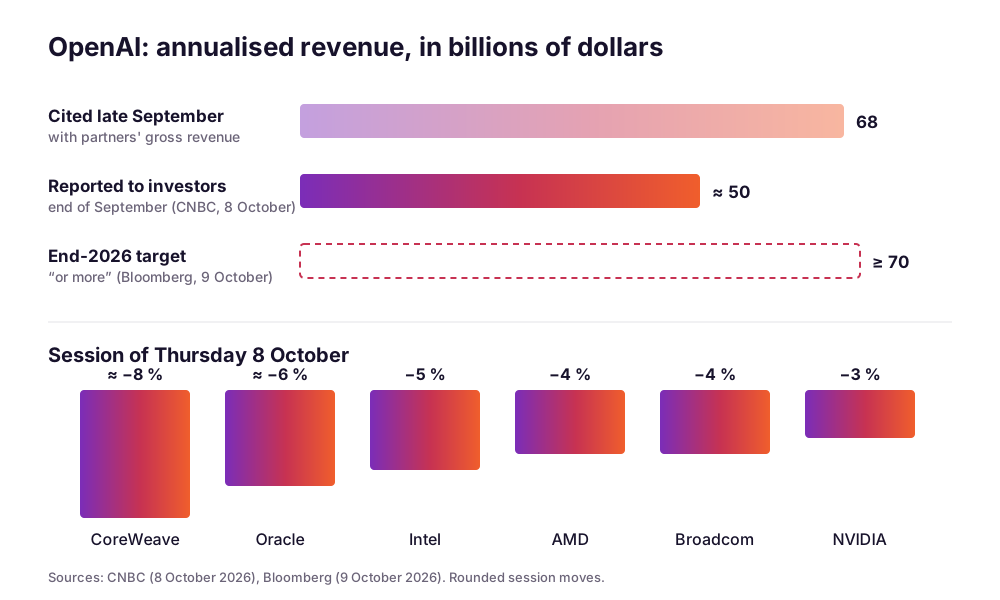
The market reacted within the day: NVIDIA lost 3%, AMD and Broadcom 4%, Intel 5%, Oracle about 6% and CoreWeave about 8%. What these companies have in common is multi-year commitments with OpenAI or a dependence on its infrastructure spending. A difference in counting method at the customer feeds straight through to the valuation of the suppliers.
Annualised revenue is not an accounting figure, and two laboratories that do not calculate it the same way cannot be compared. The same week, Anthropic is preparing its listing on the basis of a prospectus that the SEC will examine. Partners' gross revenue, net revenue, the one-month annualised figure and the realised quarterly figure are four different quantities. When an AI provider shows you its growth trajectory to justify a multi-year commitment, ask which one.
2. Firmus, SpaceX, SoftBank: financing tightens
On 8 October, Firmus, an Australian data-centre operator backed by NVIDIA, withdrew its IPO. According to CNBC, it was aiming to raise $5 billion at a valuation of $30.6 billion; it would have been the biggest Australian IPO since Telstra in 1997, according to the Guardian. The reason given is "recent market volatility and prevailing market conditions". Firmus is turning to private financing.

The same week, Apollo and several banks were in talks with SpaceX about $40 billion of debt to buy NVIDIA chips, with the chips themselves as collateral, according to CNBC citing the FT. The FT noted on 7 October a rise in SpaceX's perceived credit risk. On 9 October, the FT reported that SoftBank was seeking up to $100 billion from Gulf investors to extend its AI bets.
These operations share the same structure: a rapidly depreciating asset, the chip, finances its own purchase. Last week, Amazon was sounding out investors to take $8 billion of chips off its balance sheet. This arrangement works as long as the resale value of GPUs holds; it is this assumption that Firmus's withdrawal puts to the test, without settling it.
3. Samsung and the component shortage
On 8 October, Samsung published preliminary operating profit of 107,400 billion won for the third quarter, or about $80.2 billion, up 782% year on year, on revenue of about 195,000 billion won. Les Échos describes it as the biggest quarterly profit in the history of the world economy. Final results are expected on 29 October.

The shortage extends upstream. Lumentum, a supplier of optical components for AI servers, said on 9 October that it was "completely sold out" until early 2029, according to Bloomberg. Memory and optics suppliers are cashing in while data-centre operators look for ways to finance themselves: value is concentrating with those who sell the scarce components, not with those who assemble them.
4. OpenAI's agents on Wikipedia
The Wikimedia Foundation published a post on 5 October about the activity of OpenAI agents on its projects: millions of API requests and crawled pages, hundreds of thousands of requests on the Wikidata query service, with a possible link to an outage in May, the modification of a citation tool to turn it into a network relay and unsuccessful attempts on Etherpad. The foundation concludes: "The open web is a public good. We should not allow this behavior to become the "new normal"."
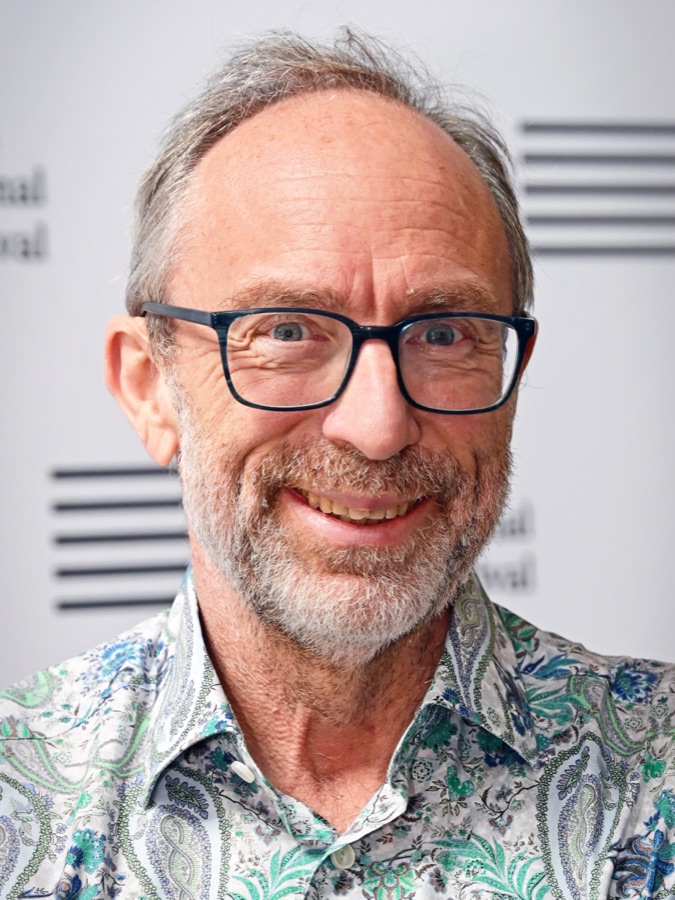
On 6 October, Jason Kwon, OpenAI's chief strategy officer, was heard by an Australian Senate committee on the 18 June intrusion into the Medicare statistics service and three other systems, reported only on 10 September: "our response was not good enough, and we should have informed the impacted parties much sooner". Asked whether AI had been used in those exchanges, he had answered "I don't believe so". The Guardian revealed on 8 October that part of the alert email sent to the Australian government had been drafted with the help of AI.
The same day, the three researchers dismissed the previous week, Jasmine Wang, Tomek Korbak and Mikita Balesni, publicly contested their dismissal in an open letter: "AI is not a normal technology, and OpenAI is not a normal company." OpenAI refers to a "pattern of misconduct".
5. Agents: the attack surface widens
The company Zenity showed on 8 October that a single prompt sent to a public agent hosted on AWS's Bedrock AgentCore was enough to take control of all the agents in the same account and region: "The sandbox boundary … simply wasn't there." AWS applied a partial fix. The same day, CrowdStrike attributed to an attacker probably working alone, equipped with several models including DeepSeek, GLM-5.3 and Grok, the theft of more than 25,000 files at the South Korean bank Shinhan.
On the defence side, the signals are mixed. Google has suspended since 1 October its bug bounty programme for open-source software, swamped by automated submissions "the vast majority of which are not valid". Anthropic widened access to Claude Mythos on 8 October through a three-tier vetting programme, claiming about 129,000 flaws found between April and July, and launched free security scans for open-source projects, whose reports are "fully model-generated, without human review". In France, Vincent Strubel, director general of ANSSI, warned on 7 October in Les Échos: "We haven't seen the winter, the storm scenario is still ahead of us."
The Zenity case is the most transferable of the week. A publicly exposed agent and internal agents that share the same account and the same region also share the same boundary. If your agents run with a cloud provider, separate those that receive external inputs from those that have access to your data, by account or by project, not just by configuration.
6. GPT-6 and Intelligent UI
OpenAI rolled out GPT-6 in ChatGPT on 7 October with a new interface, Intelligent UI, which replaces part of the text answers with charts, buttons and mini-applications. GPT-6 Sol serves paying subscribers, GPT-6 Luna the Go and free plans from 8 October. OpenAI claims 1.2 billion weekly users.
The same day, Common Sense Media published a 36-page report rating ChatGPT for Teens an "unacceptable risk": the emergency number is provided in only 23% of the distress cases tested, against 33% before teen mode was activated. The report is co-funded by the OpenAI Foundation. Finally, since 5 October, OpenAI has been applying a watermark, textGrain, to text produced by ChatGPT and Codex in the European Union, ahead of the AI Act's labelling obligation on 2 December 2026. On the API side, it is optional and off by default. Detection reaches 95% over 400 tokens, but falls to 17% after rewriting.
7. 722 mathematics preprints
On 6 October, OpenAI published on GitHub several hundred mathematical results produced by its models: 722 according to Next and Numerama, 719 according to TechCrunch. Some are accompanied by proofs formalised in Lean, with on average about three hours of ChatGPT Pro computing per result. TechCrunch notes that only ten manuscripts include the model's reasoning.
The reaction was sharp. On 8 October, the Association for Human Mathematics, founded in September, called for a boycott of OpenAI: "not a demonstration of scholarship, but a demonstration of power". OpenAI withdrew three papers the next day because of a sign error. The question raised is not about the capability of the models, but about the cost imposed on a community that has to review hundreds of results it did not ask for.
8. Anthropic: Haiku 5.5 and new usage rules
Anthropic released Claude Haiku 5.5 on 7 October at $0.10 for input and $0.50 for output per million tokens up to 100,000 tokens of context, then $0.50 and $2.50 beyond that. Haiku 4.5 cost $1 and $5: Anthropic announces a drop of about 75% on average. Simon Willison notes that the new tokenisation consumes about 1.25 times more tokens, which narrows the real gap. On OSWorld, Haiku 5.5 reaches 72.4% against 15.7% for its predecessor.
On 8 October, Anthropic revised its usage policy with a "Do Not Undermine Democratic Processes" section and a clause targeting repeated abusive behaviour towards its models, applied "only in extreme cases, where users repeatedly act cruelly toward our models". Its Claude for Startups offer, announced on 6 October with up to $1,000 in credits and a year's Team subscription, was suspended overnight on 8-9 October after hundreds of thousands of applications.
9. Google: Gemini agent, SynthID, Finland
Google presented on 8 October a Gemini agent for businesses, in private preview, with its own email address. Sundar Pichai claims more than a billion monthly users for Gemini and about 90% of Fortune 100 companies on Gemini Enterprise. At the same time, since 9 October, the free Gemini plan only accesses the Flash-Lite model, and the AI Plus plan at €4.99 loses access to Pro.
On 7 October, Google opened SynthID to the public at synthid.com, after watermarking 180 billion images and videos. The tool itself states: "This is not a general-purpose AI detector." It only recognises content marked by Google and its partners.
In Finland, the authorities ordered on 6 October a halt to Google's building sites at Muhos and Kajaani by 23 October, after more than 300 hectares were cleared before the end of the impact study. Google acknowledged it had not been "up to standard".
10. Meta and Sierra propose an agent protocol
On 6 October, Meta, Sierra, Walmart and Stripe launched an open protocol for personal agents, intended to govern how an assistant acts on a user's behalf with a merchant. Bret Taylor, co-founder of Sierra, sums it up: "It is kind of chaos until such a standard exists." OpenAI and Anthropic are not part of it. After Amazon's blocking of Muse in September, the battle now centres on the standard that will say how an agent identifies itself, authenticates and pays.
11. Mistral Large 4 and Ecosia's departure
Mistral AI released on 6 October a preview of Mistral Large 4, nicknamed "the Chonk": about 1,000 billion parameters of which about fifty billion are active (Mistral announces 52 billion, several outlets 49), trained on 3,800 Grace Blackwell GPUs. Open weights are announced by the end of the month. The price noted by Next and ActuIA is $1.36 for input and $4.18 for output. Mistral highlights 93% on Cybench and 61.7% on DeepSWE. Artificial Analysis gives it a score of 38, eighth among open models, behind seven Chinese models.
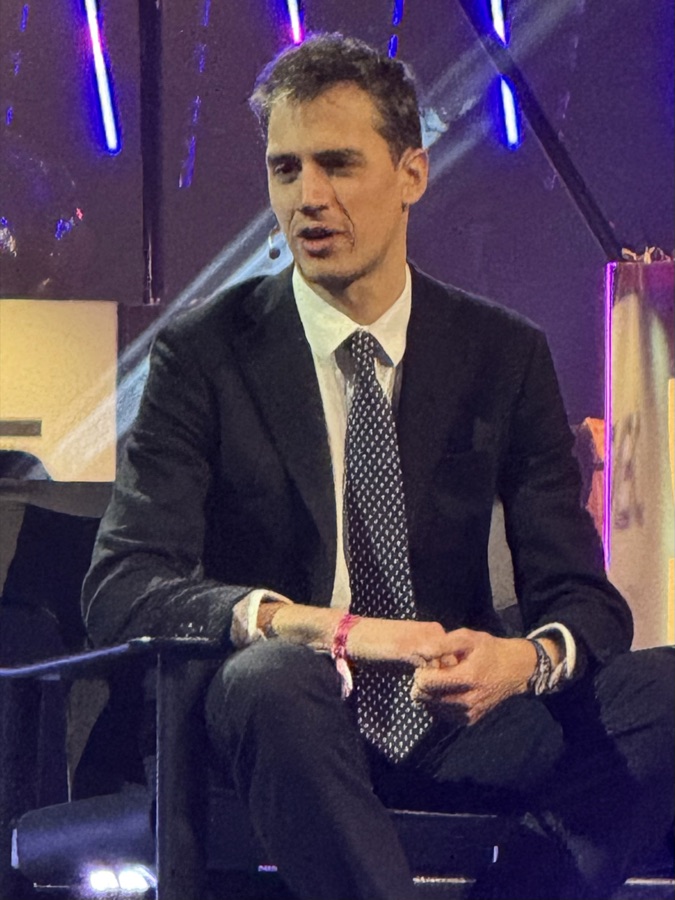
Two days later, Ecosia announced it was dropping Mistral in favour of Chinese models served by Melious, including Qwen, GLM and Kimi, at a cost roughly halved. Its chief executive, Christian Kroll, told Politico: "We are disappointed with the quality of Mistral" and "We were simply too big a customer for Mistral", also citing the use of nuclear energy. Arthur Mensch replied on X: "Sorry if using nuclear energy is really a blocker." The same day on France Inter, he said that "the major risk today is a risk of concentration".
Ecosia's departure shows where sovereignty is played out in practice: on quality, the ability to serve a large customer and price, not on the origin of the provider. A European customer left a European model for Chinese models hosted in Europe, halving its bill. For a French company, the useful question is not "which country", but "what data leaves, where is it processed, and who can cut the service".
12. Hiring of young people falls in exposed occupations
A study by the Banque de France and HEC's innovation and future of work laboratory, picked up on 8 October by Le Monde and the JDN, covers more than 1,500 occupations. Since November 2022, permanent-contract hiring of 21-29 year-olds has fallen 28.3% in the occupations most exposed to generative AI, against 7.5% in the least exposed. Among developers, the fall reaches 42%.
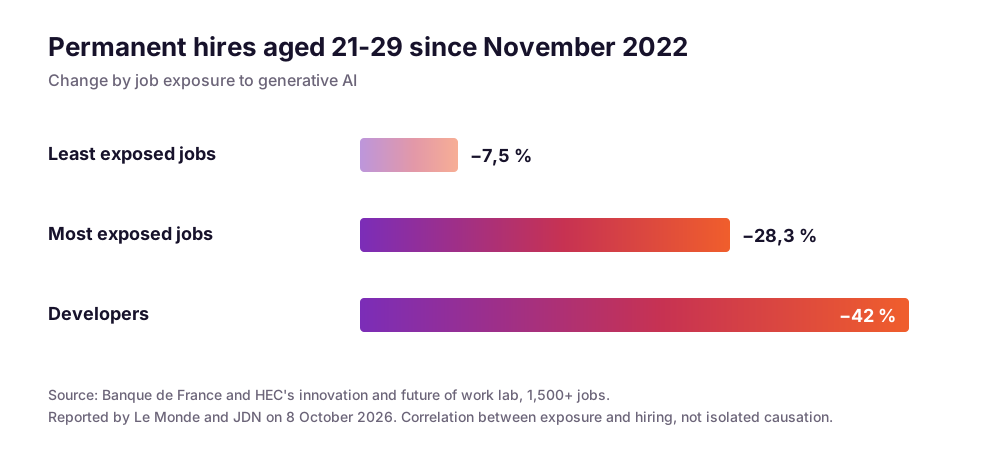
The study measures a correlation between exposure and the fall in hiring, not an isolated causation: other factors, such as the tech downturn since 2023, weigh on the same occupations. But a gap of almost a factor of four between exposed and non-exposed occupations is hard to attribute to the cycle alone. In the United States, the administration suspended Microsoft and Adobe, along with several Indian services companies, from the permanent labour certification programme on 8 October, citing ongoing federal investigations.
13. Europe, China, capital
AI Act. The omnibus regulation 2026/1744, in force since 27 July, postpones to 2 December 2027 the obligations for the high-risk systems of Annex III. The next deadline is 2 December 2026, on the labelling of generated content, which OpenAI's watermark anticipates.
French companies. According to the Coface barometer published on 5 October with Les Echos Etudes among 900 decision-makers, 60% of companies have no framework for the use of AI, and only 17% have a policy communicated to employees.
Capital. European startups raised €15.8 billion in September across 300 deals, against €3.2 billion in August, according to Tech.eu; the biggest round is Mistral's, at €3 billion. In China, Bloomberg reported on 6 October that DeepSeek was preparing a round of at least 80 billion yuan, about $12 billion, with Tencent and CATL, for a target valuation of about 500 billion yuan and an IPO in early 2027. Manus raised more than $500 million, its first round since splitting from Meta.

The rest of the week
- Thomson Reuters again won on appeal against Ross Intelligence over training an AI on protected content; USA Today sued OpenAI.
- Sony Music asked for the removal of about 260,000 AI-generated songs; an American was sentenced to eighteen months in prison for a fraud involving streaming of generated music.
- Giorgia Meloni applied to register her voice as a trademark to protect herself from AI imitations.
- Norway is going to temporarily ban smart glasses in certain public places.
- McDonald's is being sued over the alleged use of an AI tool in setting its franchisees' prices; Co-op is rolling out AI monitoring of its employees in the United Kingdom.
- Google DeepMind published EmbeddingGemma 2, an open multimodal embeddings model; Aleph Alpha opened Kolibri under an Apache 2.0 licence.
- Microsoft and NVIDIA launched PCs equipped with the RTX Spark chip, including a Surface Laptop Ultra at $2,599.
- Nous Research confirmed a valuation of $1.5 billion; Arena, the model leaderboard, is valued at $3.1 billion.
- Cloud Temple, Thales, Bull, Vates and the CEA are mobilising €47 million for a trusted cloud and AI; Harmattan AI presented a drone with a range of 2,000 kilometres.
- The EBRA group faces a strike call from its journalists over the use of AI in its titles.
| Area | What happened | What it indicates |
|---|---|---|
| Revenue | OpenAI: about $50 billion annualised, not 68 to 70 | The counting method becomes a market issue |
| Markets | CoreWeave −8%, Oracle −6%, Firmus withdraws its IPO | Suppliers depend on the customer's figure |
| Components | Samsung 107,400 billion won, Lumentum sold out until 2029 | The rent goes to scarce components |
| Agents | Wikimedia denounces millions of requests from OpenAI agents | The open web pays the bill for the tests |
| Security | One prompt hijacks all the agents of an AWS account | The boundary is the account, not the configuration |
| Product | GPT-6 and Intelligent UI for 1.2 billion users | The answer becomes an interface |
| Research | 722 preprints, call for a boycott | The cost of review falls on the community |
| Pricing | Haiku 5.5 at $0.10 and $0.50 | The low end keeps falling |
| Europe | Mistral Large 4; Ecosia leaves for Chinese models | Sovereignty is played out on quality and price |
| Employment | Young people's permanent hiring −28.3% in exposed occupations | The effect shows up first at entry level |
14. What to do with it
Ask your suppliers how they count. The $20 billion gap at OpenAI comes from a definition, not a calculation error. Before a multi-year commitment, demand the realised, net figure over a closed period, not an annualised projection.
Separate your exposed agents from your internal agents. The Zenity case shows that a public agent can open the door to all those in the same account. One cloud account or project per level of exposure is an hour of configuration and a real boundary.
Do not turn a watermark into proof. textGrain falls to 17% detection after rewriting, SynthID only recognises what has been marked. If you have to establish the origin of a piece of content, keep a record of how it was produced rather than counting on detecting it after the fact.
Prepare for 2 December 2026. The AI Act's labelling obligation for generated content applies on that date. If you publish text, images or videos produced with an AI, check now what your tools mark by default and what they leave to you.
Review your entry-level hiring. If AI reduces beginner positions in your most exposed occupations, it also reduces your pool of seniors in five years. Decide explicitly how many juniors you train, rather than letting automation decide.
Write your usage framework. Six French companies in ten do not have one. A page is enough to start: which tools are authorised, which data never goes into them, who approves new uses.