On 17 April 2026, Elon Musk posted on X that Universal High Income — generous federal cheques — was the solution to AI-driven unemployment. Ten days earlier, the UK Investment Ministry had announced it was considering universal income for the same reason. And behind these announcements stands Thomas Piketty, who has been proposing something else for a decade: a universal endowment of €120,000 at the age of 25, financed by capital taxation. The same concept, two radically opposed political projects. Decryption.
1. The Musk position: Universal High Income
The April 2026 message is direct: “Universal HIGH INCOME via checks issued by the Federal government is the best way to deal with unemployment caused by AI. AI/robotics will produce goods & services far in excess of the increase in the money supply, so there will not be inflation.” (X source).
The thesis rests on three points.
First point: AI and robotics will produce goods and services in such quantity that they absorb the money creation needed to finance the income. The argument is anti-inflationary: printing money is not inflationary if real supply grows faster than demand. In Musk's logic, AI productivity makes possible what was previously impossible.
Second point: the word is “High”, not “Basic”. Musk is not talking about a subsistence minimum. He is talking about generous incomes allowing people to live comfortably without compulsory work (Fox Business). Work becomes optional. Money might even “lose its meaning” in the long run.
Third, implicit point: the state distributes, but the value stays with those who create it. In Musk's scheme there is no question of redistributing ownership of data centres or AI models. The owners of AI capital remain the owners of AI capital. The state merely circulates enough money for consumers to keep consuming.
Sam Altman (OpenAI) shares the vision and funded a major experiment, which we discuss below.
2. The Piketty position: a universal capital endowment
Piketty has not published a specific recent position on AI and universal income. However, his consistent proposal since Capital and Ideology (2019) is of a completely different nature from Musk's.
Central proposal: a one-off universal endowment of €120,000 paid to every 25-year-old, financed by an annual progressive tax on property. This tax would free up around 5% of French GDP (Major Prépa, summary of Piketty's work).
The idea is not new: Piketty presents it as the revival of a proposal by Thomas Paine in 1795. It is not a monthly income to cover day-to-day needs. It is a starting capital that gives every citizen the material means to start a business, buy a home, train, or refuse a poorly paid job.
He has also come out in favour of a monthly universal income, but always conditional on an ambitious redistributive tax system: “I am in favour of universal income, but on condition that it is financed by a real tax revolution” (Dailymotion, interview).
The difference in logic from Musk is structural: for Piketty, emancipation comes from access to capital, not from income alone. Giving a monthly cheque to someone who remains a tenant, dependent on the labour market and the financial system, does not change their position in the economic structure. Giving them €120,000 to buy a work tool or a home does.
3. What the two positions really say
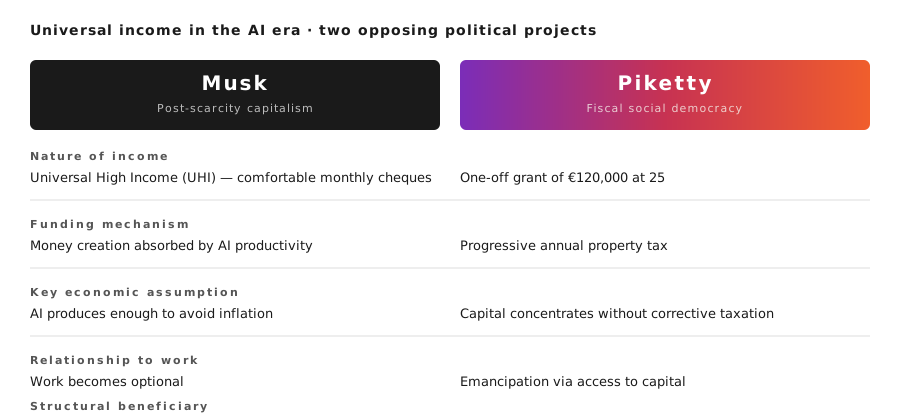
Summary of published positions: X, Fox Business (Musk, April 2026); Major Prépa, Capital and Ideology (Piketty).
What the comparison reveals: the two do not share the same reading of the problem.
For Musk, the problem is technical: AI displaces jobs, and the lost purchasing power must be compensated so that the economy does not collapse. The solution is a monetary flow.
For Piketty, the problem is structural: capital concentrates and reproduces inequalities from generation to generation. The solution is to redistribute part of the capital itself, not just its fruits.
Musk's universal income is a consumption subsidy compatible with the concentration of capital. Piketty's is a break in the transmission of capital. Both use the same word; they do not describe the same world.
4. What the 122 UBI experiments really show
Between 2017 and 2025, 122 basic income pilots were run in the United States, across 33 states plus Washington DC, for a total of $481.4 million paid to 40,921 recipients (The Daily Economy).
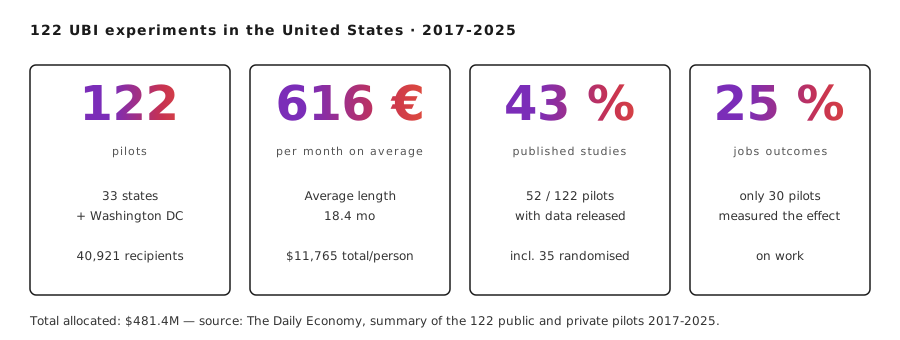
Source: The Daily Economy, comprehensive summary of public and private pilots between 2017 and 2025.
The average paid: $616 per month over 18.4 months. That is $11,765 per recipient. Far from Musk's “Universal High Income”, and well below an income that would allow anyone to live without working.
More embarrassing for the debate: only 52 of the 122 pilots have published their results, and only 30 measured the impact on employment. The most ambitious study, the OpenResearch Unconditional Income Study funded by Sam Altman, paid $1,000 a month for three years to 1,000 people in Texas and Illinois, with a control group of 2,000 receiving $50. The published working papers conclude that the experiment “was not a magic bullet for most economic and social problems” (First Movers).
In practical terms: close to half a billion dollars has been spent on testing, and we know less than we had hoped. The political debate rests largely on intuitions and ideologies, not on robust evidence.
5. The real issue: who captures the value created by AI
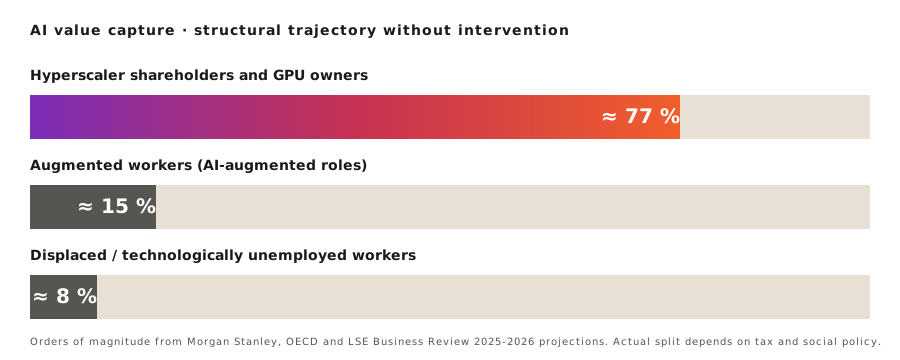
Orders of magnitude from Morgan Stanley, OECD, LSE Business Review 2025-2026.
This is where the blind spot of both positions appears. Musk and Piketty debate how to redistribute. They do not debate who captures the value in the first place.
Converging projections (Morgan Stanley on employment, the OECD on productivity, the LSE on the social contract) suggest that, absent intervention, around 75 to 80% of the value created by AI will concentrate with the owners of AI capital: hyperscaler shareholders, GPU owners, holders of proprietary models. The remaining 20-25% is split between workers who know how to use AI (augmented) and the rest (displaced).
Musk's solution does not correct this primary capture. It takes part of the profits through taxation and pays them back as cheques, but leaves the ownership structure intact. The owner of the data centre remains the owner of the data centre; he just pays a tax.
Piketty's solution attacks the primary capture: if taxation of property is progressive enough, concentration no longer automatically reproduces inequalities in the next generation. The endowment at 25 dilutes transmission.
6. The unspoken issue that will shape the next two years
The United Kingdom is studying a universal income (Fortune, February 2026). Ireland made permanent in 2026 its basic income for the arts, initially a three-year pilot. France and Germany remain on the sidelines.
Experience shows that the debate will become politicised along two fault lines.
Line 1: conditionality. Should the income be truly universal (everyone, unconditionally) or targeted at people displaced by AI? The first option costs 3 to 5 times more; the second creates an eligibility bureaucracy and formidable threshold effects.
Line 2: ownership. Should we correct the redistribution of the fruits (Musk) or attack the ownership structure (Piketty)? This is where the libertarian and social-democratic lines truly part ways.
A third option is emerging, little discussed: the partial socialisation of AI profits. Some economists propose a sovereign wealth fund holding public shares in the hyperscalers, which would pay a citizen dividend. It is an intermediate path between Musk and Piketty, visible in some European Parliament debates in late 2025.
Conclusion
Musk and Piketty are not talking about the same thing, even when they use the same word. Musk proposes to let an AI capitalism run and to shower the population with enough money that it does not revolt. Piketty proposes to change the rules of ownership so that concentration does not reproduce itself. The first option is a shock absorber; the second is a reform.
What makes the debate urgent is no longer the hypothesis of a hypothetical AI. It is an observed statistic: 8% of net jobs lost in a year in a major European market. The two positions will clash at the ballot box in the coming elections, in Europe as in the United States. There will be no technical consensus. There will be a political battle over who captures the surplus created by machines for which humans are no longer, structurally, the main input.
The question to ask today is not “for or against universal income”. It is: “which one”.