Contents
- What happened at Uber
- The uncomfortable sentence: the COO cannot measure the return
- Uber is not alone: Microsoft pulls the plug on Claude Code
- The mechanics: why token-based pricing makes AI unpredictable
- The trap: encouraging usage without steering it
- The market signal: everyone is switching to usage-based billing
- How to frame an AI budget before it explodes
- Frequently asked questions
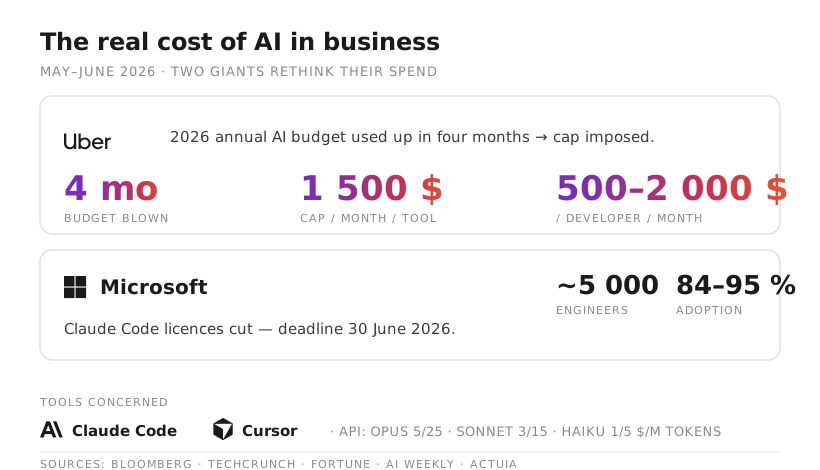
Uber has used up its entire 2026 AI budget in four months. Not on a failed project, not on a faulty supplier: on tools that its own engineers love — Claude Code and Cursor. The company's response comes down to one figure: a cap of $1,500 a month per tool, now imposed on every employee. And one sentence, signed by the chief operating officer: the link between this spending and the value created "isn't there yet".
This is not an isolated management accident. Three weeks earlier, Microsoft had announced the cancellation of most of its internal Claude Code licences, for the same reason. A sector survey puts 85% of companies above their AI cost forecasts. What is happening at Uber is not a budgeting error: it is the first visible symptom of a change in the nature of software. Agentic AI has turned a fixed cost — the licence — into a variable cost that follows usage, and that almost no finance department yet knows how to steer.
This article describes what actually happened, why the mechanism is structural rather than cyclical, and how an executive can frame their AI spending before discovering it overdrawn.
What happened at Uber
In early June 2026, Uber introduced a monthly cap of $1,500 per employee and per tool for agentic coding. Claude Code (Anthropic) and Cursor are counted separately: consumption on one does not eat into the budget of the other (Bloomberg, TechCrunch). Each employee has an internal dashboard tracking their consumption, and overruns remain possible, case by case.
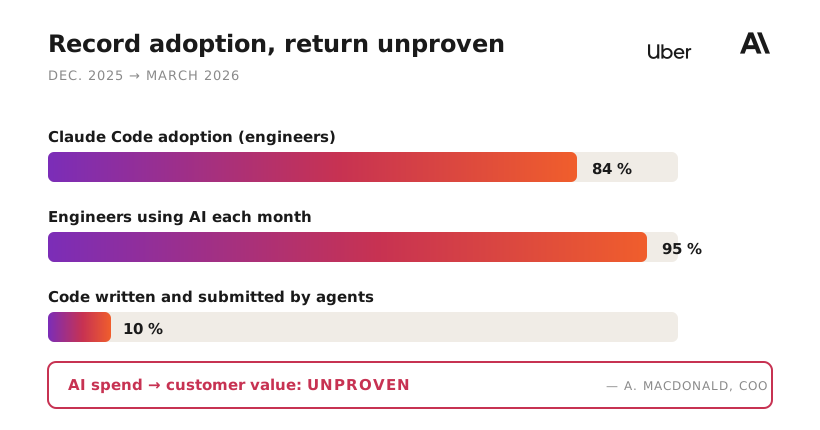
The measure responds to an internal revelation in April 2026: Uber had consumed its full annual AI budget in four months (ActuIA). Adoption of Claude Code there rose from 32% to 84% of the engineers concerned between December 2025 and March 2026, at a monthly cost per developer of between $500 and $2,000 (AI Weekly). Today, around 10% of Uber's code is written and submitted by agents, according to CEO Dara Khosrowshahi.
The irony is instructive: Uber itself sells an "Agentic AI Solutions" offering to third-party clients (ActuIA). A company that sells agentic AI has just discovered, in its own accounts, that the bill for agentic AI is hard to hold down. If an organisation of this size, with these resources and this data culture, is caught off guard, the assumption that an SMB escapes spontaneously is a weak one.
The uncomfortable sentence: the COO cannot measure the return
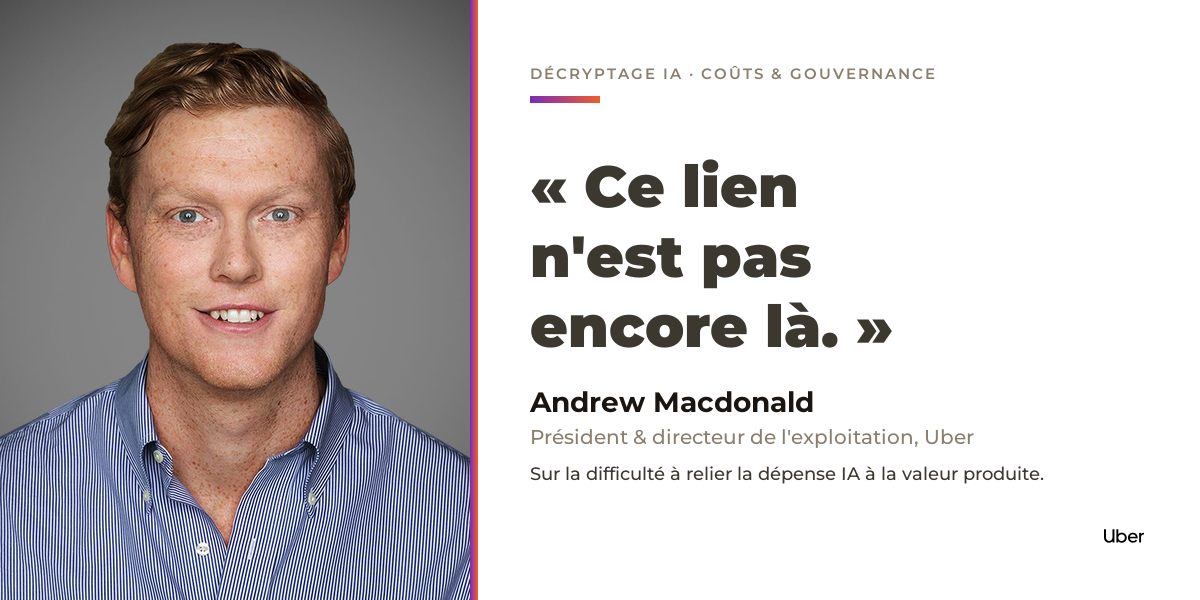
Andrew Macdonald, president and chief operating officer of Uber, publicly acknowledged the difficulty of linking AI spending to the value produced (Fortune):
"That link isn't there yet. It is very hard to draw a line between one of these statistics and 'OK, now we are actually producing 25% more useful features for our users'."Andrew Macdonald — President & COO of Uber, Fortune, May 2026
He adds the logical consequence: "If you cannot draw a direct line to the number of useful features you deliver to your users, that trade-off becomes harder to justify" (Fortune). For the record, Uber's R&D reached $951 million in the first quarter of 2026, up 17% year on year.
Uber is not alone: Microsoft pulls the plug on Claude Code
A few days before Uber, Microsoft began cancelling the majority of its internal Claude Code licences within its Experiences & Devices division — the team responsible for Windows, Microsoft 365, Outlook, Teams and Surface — with a deadline of 30 June 2026 (AI Weekly). The pilot, launched in December 2025 with around 5,000 engineers, had reached an adoption rate of 84 to 95% of the cohort in April 2026 — before using up its budget because of per-token billing.
The finding goes beyond these two names. As early as 22 May 2026, Fortune was headlining that "AI costs more than paying human employees" on certain tasks, pointing precisely to the token-and-agent billing model (Fortune). Axios, for its part, speaks of "AI sticker shock" hitting American finance departments (Axios).
| Company | What was observed | Reaction | Deadline |
|---|---|---|---|
| Uber | Annual AI budget exhausted in 4 months | Cap of $1,500/month/tool | June 2026 |
| Microsoft (Experiences & Devices) | Budget consumed, ~5,000 engineers, 84–95% adoption | Claude Code licences cancelled | 30 June 2026 |
| Market (Mavvrik survey) | 85% of companies above their AI cost forecasts | Gross margin down by 6+ points for 84% | 2025–2026 |
Sources: Bloomberg, AI Weekly, Fortune, Axios
The mechanics: why token-based pricing makes AI unpredictable
For thirty years, enterprise software was bought at a fixed cost: a licence, a per-seat subscription, an amount known in advance and independent of the intensity of use. A developer who used their IDE eight hours a day cost no more than one who opened it for an hour. Agentic AI breaks that contract. Billing is per token — the unit of text processed by the model — and therefore proportional to actual usage. The better the tool, the more it is used; the more it is used, the more it consumes; the more it consumes, the more it costs.
The usual counter-argument is that tokens are getting cheaper. That is true: Gartner expects inference to be 90% cheaper by 2030. But the same March 2026 analysis adds the decisive factor: agentic models consume 5 to 30 times more tokens per task than conventional text generation, because they reason in several steps, read and re-read context, and self-correct. The fall in the unit price is more than offset by the explosion in volume.
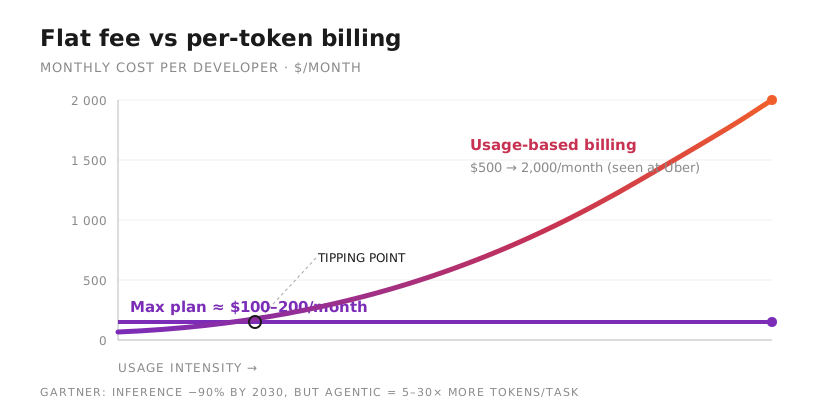
The unit orders of magnitude confirm it. In mid-2026, Anthropic's API charges $5 per million input tokens and $25 for output for Claude Opus; $3 and $15 for Sonnet; $1 and $5 for Haiku (AI Weekly). Taken in isolation, these prices look trivial. Applied to an agent that processes millions of tokens a day, across hundreds of developers, they produce the $500 to $2,000 monthly bills observed at Uber.
The trap: encouraging usage without steering it
Uber's mistake is not technical, it is managerial, and it is common. To succeed in an AI transformation, the legitimate reflex is to push adoption: train, encourage, remove obstacles. Uber did this wholeheartedly — to the point of ranking teams by consumption. But in the absence of a value metric, the incentive to adopt becomes an incentive to spend. You get exactly what you measure: record adoption, and a record bill, with no proof of return.
The market bears out this diagnosis. According to a survey cited by ActuIA, 40% of companies have not met their AI-related cost-reduction targets — and yet 83% of chief financial officers plan to increase their AI budget by more than 15% over two years (ActuIA). More is being spent on a tool whose return has not been demonstrated: the classic profile of an investment driven by fear of missing the train, not by measurement.
The market signal: everyone is switching to usage-based billing
The movement is not marginal; on the vendor side it is structural. As of 1 June 2026, GitHub Copilot has moved to usage-based billing, and Cursor has once again changed its team price list (CloudZero, Finout). As early as summer 2025, Cursor had had to apologise publicly and refund customers after surprise overruns — one developer reported $350 of overbilling in a single week.
The same fact, read from the user's side, points to a way of steering. One developer calculated that eight months of intensive daily use of Claude Code represented around 10 billion tokens — more than $15,000 at API prices, but $100 a month on an unlimited plan (the Max plan). The gap between usage-based billing and a flat plan can reach a factor of several dozen depending on intensity. The right reflex is therefore not to flee AI, but to choose the right pricing model for the right usage profile.
| Pricing model | Logic | Suited when… | Risk |
|---|---|---|---|
| Fixed plan (per seat) | Amount known in advance | Intensive, regular use | Low — predictable |
| Usage-based billing (token) | Proportional to consumption | Low, occasional or pilot use | High without a cap |
| Cap per user | Free use below a threshold | Wide deployment with controlled risk | Controlled |
How to frame an AI budget before it explodes
The Uber case is not an argument against AI — it is an instruction manual by the negative. Here is what it teaches, transferable to an organisation of any size.
1. Measure the result, never the consumption. Uber's dashboard tracked tokens and adoption. The right indicator tracks what the company delivers: features put into production, tickets resolved, shortened lead times, defects avoided. If the only figure that is rising is the bill, the transformation has failed whatever the adoption rate.
2. Cap per head, from day one. A visible cap per user, like Uber's $1,500, does not forbid use: it makes it conscious. Introduced after the fact, it is a painful corrective; set up from the outset, it is a framework. The cap must come with a consumption dashboard accessible to everyone.
3. Choose the pricing model according to the usage profile. For intensive, regular use, the fixed plan protects against overruns. For occasional use or a pilot, usage-based billing avoids paying for unused capacity. Mixing the two across teams is often the optimum — but it has to be decided, not endured.
4. Frame the pilot before framing the deployment. The healthy sequence is the reverse of Uber's: a restricted scope, a value metric defined in advance, a capped budget, a decision to scale up taken on the results — not on enthusiasm. That is precisely the work of an upstream AI audit: determining where AI creates measurable value, and at what sustainable cost.
The Uber-Microsoft sequence of May-June 2026 marks the end of an illusion: that of an AI whose cost would be signed once and for all. Agentic software is paid for by use, and use has to be governed. The organisations that succeed in their transition will not be those that spend the most, nor those that adopt the fastest — they will be those that, before deploying, have defined what they measure and what they cap. The question is no longer "how much does AI cost", but "do we know how to link what it costs to what it brings us". Uber, for now, answers no.
Frequently asked questions
Why did Uber's AI budget blow up so fast?
Uber encouraged mass adoption of coding agents (Claude Code, Cursor) by setting up an internal leaderboard rewarding the heaviest-consuming teams. Adoption of Claude Code rose from 32% to 84% of the engineers concerned between December 2025 and March 2026, at a monthly cost per developer of between $500 and $2,000. Combined with usage-based (per-token) billing, this adoption consumed the entire annual 2026 AI budget in four months.
What does the $1,500 cap actually change?
Uber set a monthly cap of $1,500 per employee and per tool — Claude Code and Cursor are counted separately. Each employee has an internal dashboard tracking their consumption, and overruns are authorised case by case. The aim is not to ban AI but to turn open-ended spending into governed spending, with a visible threshold per head.
Why is the cost of AI rising while the price of tokens is falling?
The unit price of a token is falling — Gartner expects inference to be 90% cheaper by 2030. But agentic models consume 5 to 30 times more tokens per task than conventional text generation, because they reason in several steps, read context and self-correct. The fall in the unit price is more than offset by the explosion in the volume consumed. The result: the bill goes up despite cheaper tokens.
Has Microsoft really given up on Claude Code?
Microsoft is cancelling most of its internal Claude Code licences in its Experiences & Devices division (Windows, Microsoft 365, Outlook, Teams, Surface), with a deadline of 30 June 2026. The pilot, launched in December 2025 with around 5,000 engineers, had reached an adoption rate of 84 to 95% in April 2026 — and used up its annual budget because of per-token billing. The case confirms that Uber is not an exception.
How can an SMB avoid the same overrun?
By setting the framework before deploying: set a cap per user, track consumption in real time, choose fixed-cost plans when usage is predictable rather than usage-based billing, and above all define a value metric (features shipped, tickets resolved, time saved) rather than rewarding raw consumption. Uber's trap is not that it used AI; it is that it measured usage instead of measuring results.