On 7 May 2026, the European Council and Parliament confirmed the application deadline of the AI Act for the high-risk systems listed in Annex III: 2 August 2026. The announced simplification does not move the date, it clarifies the technical standards. For a company that develops or uses an AI tool in recruitment, credit, education or essential services, that is twelve weeks away. This guide gives you the operational method to classify your systems, produce the required documents and avoid the penalty of €15 million or 3% of worldwide turnover.
1. The AI Act on one page: who produces it, who enforces it
The AI Act is Regulation (EU) 2024/1689, adopted on 13 June 2024 and in force since 1 August 2024. It is the world's first text to regulate artificial intelligence horizontally. The text covers all AI systems placed on the market or used in the Union, whatever the country of establishment of the company — an American developer or a Japanese SaaS publisher serving European customers is concerned.
 European
Union
 European
Commission
 European
AI Office
 CE
CEmarking
Three figures drive the implementation.



Photo credits: Ursula von der Leyen — Wikimedia Commons (official portrait 2024). Roberto Viola — Ars Electronica Gala 2018, photo Tom Mesic / Vog.Photo (CC BY-NC-ND 2.0). Lucilla Sioli — European Digital Innovation Hubs Network, annual summit 2024 (European Commission).
2. Four risk levels, only one category that causes problems
The AI Act does not subject all AI systems to the same rules. It classifies them into four levels according to their potential impact on fundamental rights and safety.
The level that triggers most compliance projects this year is level 2, high risk. Not because it is complex in itself, but because it covers use cases that are very widespread in French SMBs and mid-caps: any recruitment tool, customer scoring, HR decision support or automated filtering potentially falls within it.
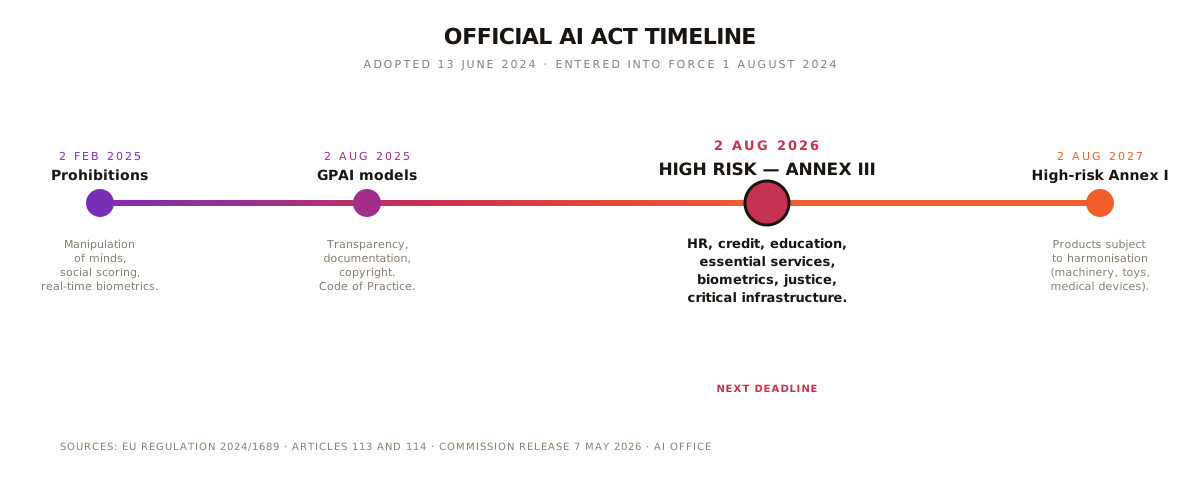
Sources: Regulation (EU) 2024/1689, Articles 113 and 114. Commission press release 7 May 2026. AI Office.
3. The eight Annex III categories, with concrete French SMB examples
Article 6 of the AI Act refers to Annex III for the exhaustive list of high-risk cases. Eight categories, and the vast majority of affected SMBs fall into two of them: employment and essential services.
- Non-prohibited biometrics. Remote biometric identification (outside real-time public space), sensitive biometric categorisation, emotion recognition. SMB example: a video-interview platform that detects the candidate's emotions. Concerns: HR tech, edtech.
- Critical infrastructure. Safety components in the management of road networks, water, gas, heating, electricity, critical digital networks. SMB example: a start-up selling a network optimisation system to a water utility. Concerns: industry, utilities, smart grid.
- Education and vocational training. Access to institutions, evaluation of results, assignment of orientation, detection of behaviour during exams. SMB example: a B2B edtech that scores students for business schools. Concerns: edtech, continuing education.
- Employment and workers management. Recruitment, CV filtering, evaluation during interviews, task allocation, performance evaluation, promotion or dismissal decisions. SMB example: an ATS (Applicant Tracking System) that automatically pre-sorts applications. Concerns: all sectors with an AI recruitment tool.
- Access to essential services. Assessment of eligibility for social benefits, credit scoring of natural persons, life/health insurance scoring, triage in emergency services. SMB example: a fintech that calculates a repayment score for a small consumer loan. Concerns: fintech, insurtech, health.
- Law enforcement. Assessment of the risk of reoffending, profiling, analysis of evidence, polygraphs. Concerns almost exclusively suppliers to law enforcement.
- Migration, asylum and border control. Assessment of the risk posed by a visa applicant, examination of asylum applications, identity verification. Concerns very few private SMBs.
- Administration of justice and democratic processes. Assisting a judge in fact-finding, influencing elections, moderating political opinions. Concerns B2B legaltech and editorial platforms.
For a French SMB or mid-cap, the probability of being concerned is concentrated in categories 4 (employment) and 5 (essential services). If you use an ATS, a customer scoring tool, a credit or insurance decision-support solution, or a candidate assessment platform, you must classify.
4. The classification test in five questions
Article 6 of the AI Act and its Article 6(3) introduce a simple logic: falling into Annex III is not always enough to be high risk. If the system only performs a procedural task, improves earlier human work, or prepares an assessment without replacing it, the 6(3) exception may apply. Here is the decision tree to follow.
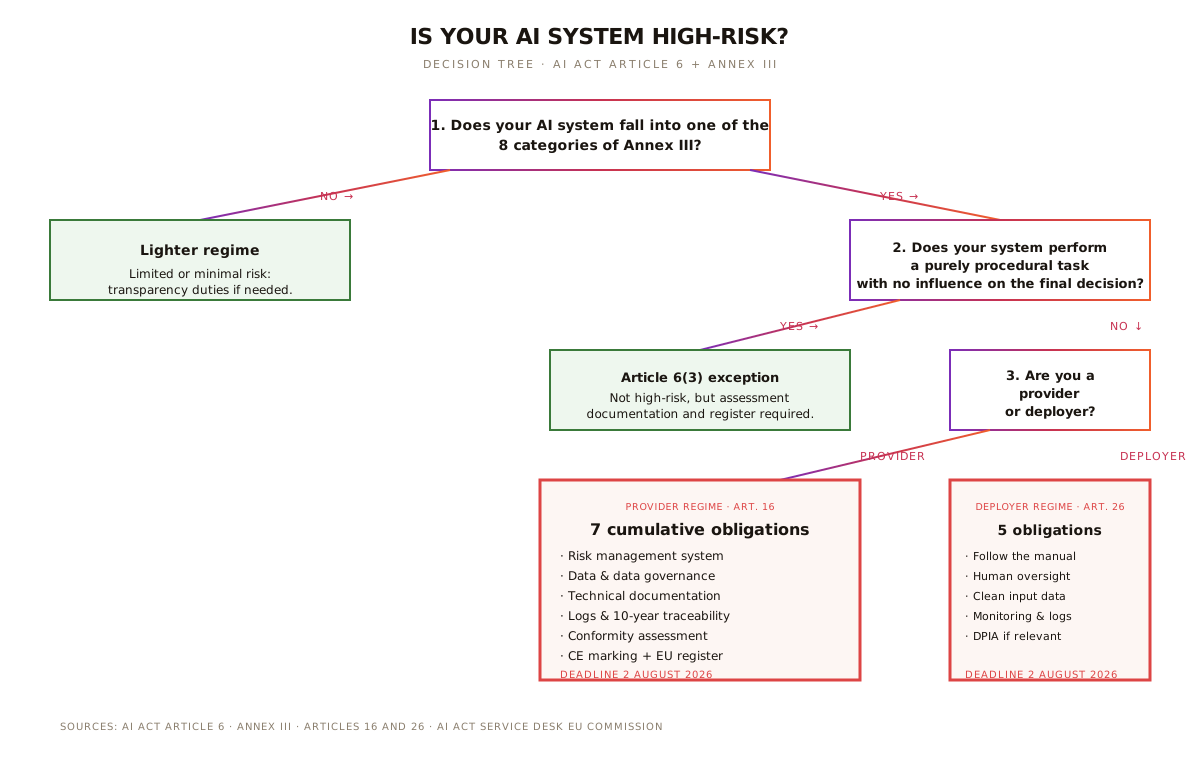
Logic derived from Articles 6, 16 and 26 of Regulation (EU) 2024/1689. Reference: European Commission AI Act Service Desk.
The five questions, in order, are as follows:
- Does your AI system fall into one of the 8 Annex III categories? Take the list from section 3 and compare it with your real use cases, not with the provider's marketing brochure.
- Does the system perform a purely procedural task with no influence on the final decision? Example: an OCR that reads a CV to fill in a form without scoring the candidate: 6(3) exception. An OCR that reads a CV and calculates a compatibility score: high risk.
- Are you a provider or a deployer? The provider develops or places on the market under its own name. The deployer uses an existing system in its activity. The distinction determines which article applies: 16 or 26.
- Have you substantially customised the provider's system? If so, you may switch to provider under Article 25. Substantially customising means changing the intended purpose or retraining the model, not simply configuring thresholds.
- Is the system already in production on 2 August 2026, or will it be put into service afterwards? High-risk systems placed on the market before 2 August 2026 benefit from Article 111 (transition period of 2-6 years depending on the case). Systems put into service afterwards are immediately subject to the full regime.
5. Who is not concerned (and why)
Many companies panic, believing they fall under high risk when they do not. Four typical cases fall outside the regime.
Purely office use of generative AI. A salesperson using ChatGPT to write emails, an accountant asking Claude to check an Excel formula, a marketer asking Gemini to suggest hooks: none of these cases falls under Annex III. It is productivity use. The only duty is transparency if generated content is published without substantial human editing.
Research, internal prototyping, R&D. Systems under development, not placed on the market or used in production, fall outside the scope. Article 2(8). The switch happens at the moment of commissioning or marketing.
Article 6(3) exception. Even within an Annex III category, if the system performs a determined procedural task (data extraction, translation, simple classification without assessment) without posing a significant risk to fundamental rights, it leaves the high-risk regime. Documenting this assessment remains mandatory.
AI systems for military, defence and national security use. Article 2(3). Outside the scope of the AI Act, subject to other regimes.
6. Provider or deployer: the distinction that changes everything
The most frequent error in May 2026 among SMBs: believing you are a deployer when you actually have provider status. The consequence is massive: Article 16 (provider) imposes seven heavy cumulative obligations, Article 26 (deployer) imposes five much lighter ones.
You are a provider under the AI Act if:
- You develop an AI system and place it on the market under your name or brand (typical case: a SaaS publisher).
- You substantially customise a purchased AI system by changing its intended purpose (Article 25). Example: you buy a general-purpose model and retrain it on your HR data to decide internal promotions: you switch to provider.
- You put into service an AI system developed under your brand, even if it is used only internally.
You are a deployer if:
- You use, in the course of your activity, an AI system developed by a third party, without changing its intended purpose.
- Typical SMB case: you pay a subscription to a market ATS (Workable, Greenhouse, Welcome to the Jungle ATS, etc.) to pre-sort your applications.
7. The provider's seven obligations (Article 16)
A provider of a high-risk AI system must produce and maintain seven cumulative deliverables before 2 August 2026.
- Continuous risk management system (Article 9) — identification, assessment and mitigation of risks over the whole life cycle. A living document, updated with every substantial change.
- Data and data governance (Article 10) — training, validation and test sets must be relevant, representative, and free of documentable errors and biases. A strong requirement for HR and credit uses.
- Technical documentation (Article 11 + Annex IV) — description of the system, architecture, data, performance, metrics. Kept for 10 years, accessible to the authorities.
- Record-keeping (Article 12) — automatic traceability of operations throughout the lifetime. Kept for at least 6 months (or longer under sectoral rules).
- Transparency and information for the user (Article 13) — clear instructions for use, performance scope, known limits, expected human oversight.
- Effective human oversight (Article 14) — the system must be designed so that a human can interrupt it, question its outputs, and understand its limits.
- Accuracy, robustness and cybersecurity (Article 15) — documented accuracy levels, robustness to unexpected inputs, protection against adversarial attacks.
To these seven substantive obligations are added three administrative obligations: conformity assessment (Article 43), affixing the CE marking (Article 48), registration in the EU database of high-risk systems (Article 49). The CE marking is the AI equivalent of what already exists for toys, medical devices and machinery: a declaration of conformity affixed to the product or its documentation.
8. The deployer's five obligations (Article 26)
The deployer regime is lighter but far from null. For an SMB using a third-party tool in a high-risk category, here are the five obligations to assume.
- Technical and organisational measures to comply with the provider's instructions for use. In practice: read the instructions, integrate them into your processes, train your teams.
- Human oversight assigned to a natural person with the necessary competence, training and authority. Not just a line in the contract: an identified, trained human, able to interrupt or challenge AI decisions.
- Relevance and quality of input data — the deployer remains responsible for the cleanliness and representativeness of the data it feeds the system. Biased CV data: the responsibility comes back to you.
- Log retention — at least 6 months, unless a stricter sectoral rule applies (HR, financial sector, health).
- Fundamental rights impact assessment (FRIA) — mandatory for public bodies and certain regulated sectors, recommended in all other cases. Complements (and does not replace) the GDPR DPIA.
9. The operational method in four sprints
The compliance programme fits into four sprints of two weeks each, to be completed before 2 August 2026. Target: an SMB of 30 to 250 employees with one or two potentially high-risk AI systems.
Sprint 1 (weeks 1-2): inventory and qualification
- Inventory of all AI tools in service: SaaS, business modules, internal scripts, agents.
- Classification of each tool according to the decision tree (section 4).
- Qualification of legal status for each high-risk tool: provider, deployer, or both depending on use.
- Deliverable: classification table with, for each tool, status, Annex III category, justification.
Sprint 2 (weeks 3-4): documentation and reading the instructions
- For each tool under the deployer regime: retrieval of provider instructions, critical reading, identification of conditions of use not respected.
- For each tool under the provider regime: launch of the technical documentation (Annex IV) or request to a service provider.
- Human oversight policy: who oversees, on which triggers, how it is traced.
- Deliverable: documentation pack per tool + the company's human oversight policy.
Sprint 3 (weeks 5-6): governance, data, logs
- Setting up log collection on high-risk tools (often a simple activation on the SaaS side).
- Review of input data (quality, documentable biases, representativeness).
- FRIA (Fundamental Rights Impact Assessment) if applicable.
- Training of human supervisors.
- Deliverable: data governance policy + FRIA + training plan.
Sprint 4 (weeks 7-8): finalisation and register
- For providers: conformity assessment (by yourself or by a third-party body depending on the case), affixing the CE marking, registration in the EU database.
- For deployers: internal signing of the AI policy, communication to the works council (CSE), documentation of use cases.
- Setting up the annual review process.
- Deliverable: complete compliance file ready for a national authority audit (in France, the CNIL, reinforced by AI Office competences).
For an SMB with a single high-risk system (the most frequent case), the programme can be compressed to 6 weeks with an internal pair (an IT director or DPO + an internal or external lawyer). For a multi-system mid-cap, allow 12 to 16 weeks.
10. Penalties: what you actually risk
The AI Act distinguishes three scales of penalties, codified in Article 99.
| Breach | Penalty | Criterion |
|---|---|---|
| Prohibited practice (Level 1) | Up to €35M or 7% of worldwide annual turnover | Higher amount |
| Violation of high-risk obligations | Up to €15M or 3% of worldwide annual turnover | Higher amount |
| Incorrect information to the authorities | Up to €7.5M or 1% of worldwide annual turnover | Higher amount |
For SMBs and start-ups, reductions are provided for but do not remove the penalty. The realistic scenario for a French SMB on 2 August 2026 is not a €15M fine, but:
- A formal notice from the competent authority with a compliance deadline of 60 to 90 days.
- A forced audit on site or on documents (the authorities start with the most visible HR tools).
- In case of persistent breach or proven harm to a candidate or customer: civil legal action (the customer cites AI Act non-compliance as proof of fault), in parallel with the administrative penalty.
- The most probable concrete impact: an SMB of 10 to 50 employees receiving an administrative fine between €20,000 and €200,000, plus the forced shutdown of the system concerned until compliance.
11. Official resources and points of support
Three public sources let you verify your obligations without a law firm:
- AI Act Service Desk of the European Commission (ai-act-service-desk.ec.europa.eu) — official portal, knowledge base structured by article. Answers questions in under 15 working days.
- Regulation (EU) 2024/1689 consolidated on artificialintelligenceact.eu — full text with article-by-article commentary, free.
- European AI Office (digital-strategy.ec.europa.eu) — official publications, harmonised standards, GPAI Codes of Practice.
On the French side, the CNIL published in April 2026 a practical sheet on how the AI Act and the GDPR fit together, and runs monthly webinars for SMBs. The DGE (Direction générale des entreprises) maintains a practical guide aimed at mid-caps and large industrial groups.
12. Conclusion: two decisions, one deliverable, one deadline
The high-risk AI Act does not demand a giant project. It demands two decisions and one deliverable.
First decision: classify each AI system in service or in the pipeline using the tree in section 4. Many SMB uses fall under the limited regime or the 6(3) exception. The classification work takes a day for an SMB with five AI tools.
Second decision: for each confirmed high-risk tool, identify whether you are a provider or a deployer. Most SMBs using SaaS are deployers, and the Article 26 regime is markedly lighter than Article 16.
The deliverable: a compliance file (classification + instructions + oversight policy + logs + FRIA if applicable) ready for 2 August 2026. Not a 200-page book. An operational, up-to-date file that can be shown to the authority in case of an audit.
The window closes on 2 August 2026. What is at stake is not the theoretical €15M fine (unlikely for an SMB), but the operational risk of a system shut down mid-commercial season, and the loss of customer trust if a case becomes public.