58% of French business leaders see AI as a matter of medium-term survival. Yet 57% have no defined strategy. MIT estimates that 95% of AI pilots fail to produce a measurable P&L impact. Between the wish to get started and the risk of wasting three successive budgets, a structured AI audit makes the difference. Not a marketing audit to justify a six-month engagement: an audit that identifies the real pain points, quantifies the lost time, maps the workflows that can be automated and triggers measurable gains. Here is how to run it.
1. Why an audit before buying ChatGPT licences
The temptation is simple: subscribe the team to Claude Team or ChatGPT Enterprise, train them quickly, and see what happens. The 2025 figures say clearly what happens: nothing measurable, in 95% of cases.
The MIT study "The GenAI Divide: State of AI in Business 2025" analysed 52 executive interviews, 153 surveys of managers and 300 public AI deployments (Fortune). The finding: more than 80% of organisations have deployed ChatGPT or Copilot, 40% report a formal deployment, but only 5% of integrated systems produce significant value.
For its part, RAND Corporation estimates that more than 80% of AI projects fail, twice the failure rate of traditional IT projects. And 42% of companies abandoned most of their AI initiatives in 2025, against 17% in 2024. The curve is rising, and not in the right direction.
The explanation is clear: AI does not transform what nobody has decided to transform. Buying licences without knowing where the pain points are produces scattered individual use, not organisational value. The audit exists precisely to get out of that scattering.
2. The five blockages that sink 95% of projects
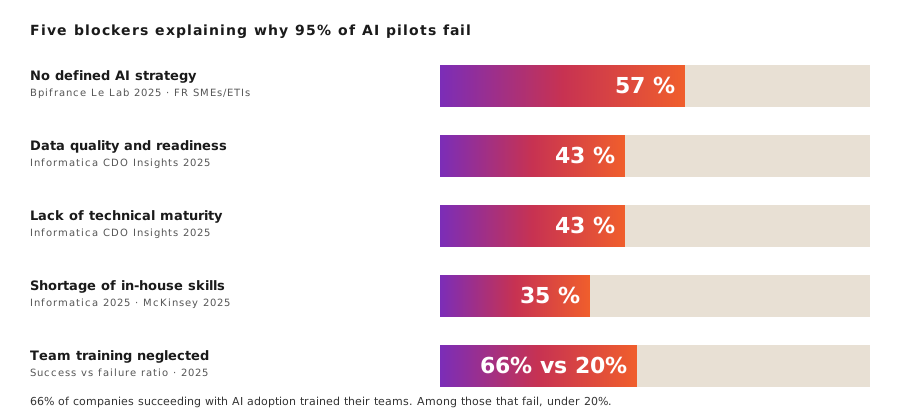
Sources: Bpifrance Le Lab 2025, Informatica CDO Insights 2025, McKinsey via Duperrin 2025.
The hierarchy of obstacles is revealing. The top three causes of failure are organisational, not technical. That is good news: it means a well-run audit can remove most of the brakes without a single extra euro of software investment.
The lack of strategy is the first blockage. 57% of business leaders have formulated no clear vision of what they expect from AI (Bpifrance Le Lab 2025). Without a course, each department experiments on its own, data stays siloed, and the value produced does not add up.
Data quality (43%) and the lack of technical maturity (43%) are the challenges most reported by IT directors. In practice: data scattered across tools, heterogeneous formats, unusable history. An AI plugged into dirty data produces dirty answers.
The skills shortage (35%) concerns technical profiles as much as internal "AI champions" able to translate a business need into an AI use case.
Neglected training is the strongest statistical differentiator. 66% of companies that succeed in adoption trained their teams. Among those that fail, that rate falls below 20%. Without support, the tools stay under-used and teams go back to their habits.
3. The three hidden costs the audit must reveal
An audit is only worth something if it quantifies. Three real costs are rarely measured in an SMB, and they are what justify the AI investment.
3.1. The time lost today
Every function in the company accumulates hours on low-value tasks: sorting emails, meeting minutes, chasing cold prospects, qualifying leads, document research, checking contracts, translating documents. The audit must put a number on those hours.
A typical example in an SMB of 40 employees:
- Each salesperson spends 6 h/week writing follow-ups and minutes — that is 1 FTE across a sales team of 8
- The marketing team produces 20 h/week of content (posts, newsletters, product sheets) — 50% of the time can be cut with a well-framed AI
- Customer support answers 200 tickets/week manually, 60% of which are repetitive questions
Converting these hours into full payroll cost (salary + charges + tools) gives a figure that can be compared directly with the cost of an AI deployment. In most cases, break-even is reached in 3 to 6 months, not 24.
3.2. The competitive risk if your competitors go first
This cost does not appear in your income statement, but it is real. A competitor that automates lead qualification produces 3 times as many qualified quotes for the same sales budget. A competitor that generates its marketing content at scale occupies more of the conversation in its market. A competitor that deploys a 24/7 support assistant captures requests you let slip overnight.
The maths is simple. If a direct competitor cuts its sales time per lead handled by 15%, within six months it can absorb 15% of your pipeline without increasing headcount. The audit must map the competitors that have already started their AI shift and identify the 2 or 3 processes where you are falling behind.
3.3. The missed opportunities
Every week in which you do not deploy AI, you are not processing data that could reveal opportunities: under-served customer segments, products to adjust, untapped margin leaks. A CRM not exploited by AI is a mine whose subscription you pay without ever going down it.
4. What an AI audit concretely identifies
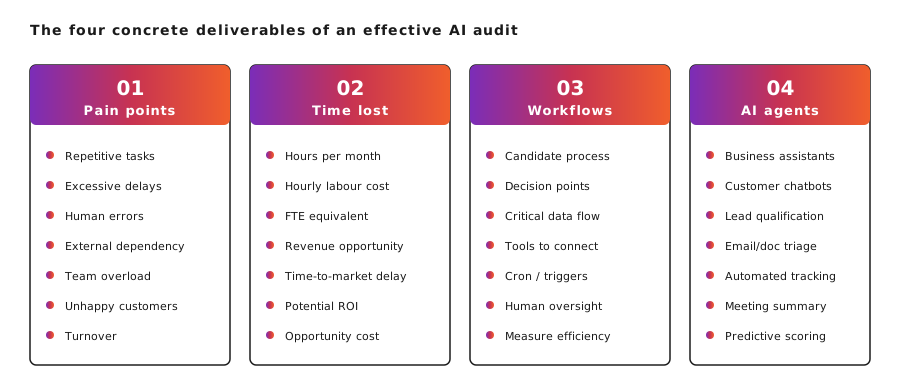
Analysis framework: Bpifrance Diagnostic Data IA, McKinsey Digital methodologies, RAND Corporation work.
An audit without these four deliverables is a generic consulting report — useless. An audit that produces them is an operational document on which a manager can decide in an hour.
Qualified pain points. Not a list of complaints, but a map of friction points with their frequency, their impact on customers, and their human cost in wear and turnover.
Quantified lost time. In hours per month, per function, with the associated loaded payroll cost. Translated into recoverable FTE equivalents.
Automatable workflows. The processes that are candidates for AI or orchestration (n8n, Zapier, Make, OpenClaw, custom agents). Each workflow documented with input, steps, connected tools and the human supervision required.
AI agents to deploy. The cases where a chatbot, a specialised business assistant or an autonomous agent does better than rigid automation. A clear distinction between deterministic cases (workflow) and adaptive cases (agent).
5. The five-step methodology
A useful AI audit for an SMB of 20 to 200 employees is completed in 3 to 5 days of actual work, not three months.
Step 1 — Strategic framing (0.5 day). Interview with the manager, 12-24 month vision, budget constraints, business priorities. Come out with 3 concrete objectives that the audit must serve.
Step 2 — Field immersion (1.5 days). Short interviews with 5 to 8 key staff: sales, marketing, support, operations, data. Direct observation of daily tools. Identification of recurring frustrations.
Step 3 — Objective measurement (1 day). Collection of quantitative data: time spent per task, volumes handled, error rates, response times. Where data is missing, measurement over 2-3 representative days.
Step 4 — Prioritisation (0.5 day). An impact vs effort matrix, with each identified use case positioned. Ranking into four clear categories (see below).
Step 5 — Presentation and action plan (0.5 day). A document of 10 to 15 pages, a 90-day action plan, budget and expected ROI per use case, and trade-offs for management to decide.
6. The prioritisation matrix: what to launch, what to avoid
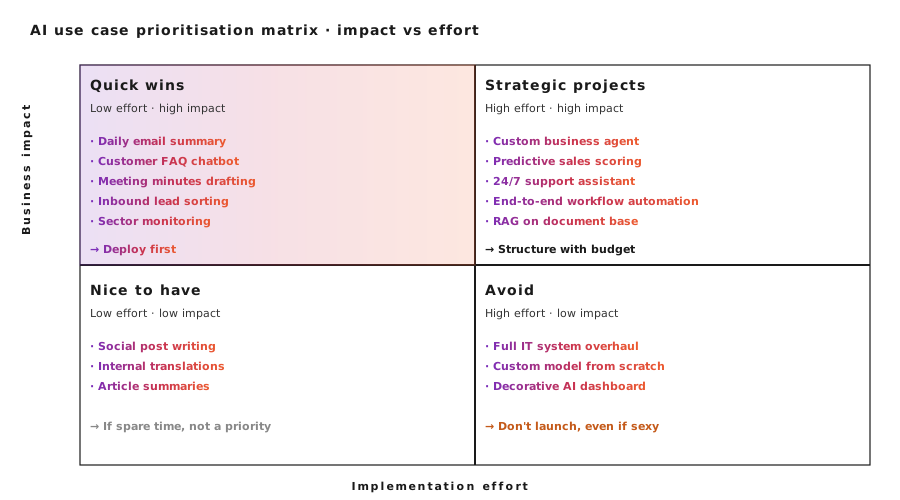
An adaptation of the classic "effort/impact matrix" to the specifics of AI projects, based on field feedback from 2024-2026.
Quick Wins quadrant: email summaries, FAQ chatbot, meeting minutes, lead sorting, monitoring. These cases free up time from the first month. This is where to start, not only for the ROI but also to acculturate the teams.
Strategic Projects quadrant: bespoke business agent, predictive scoring, 24/7 support assistant, end-to-end automation, RAG on a document base. These are the projects that move the company. They require a budget, a decision, a sequencing. But they are what creates competitive advantage.
Nice to have quadrant: writing social posts, internal translations, article summaries. To launch if there is spare time, without making them a priority.
To Avoid quadrant: a complete IT system overhaul "for AI", a custom model from scratch, a decorative AI dashboard. These projects are visually attractive but destroy budget without producing value. MIT study: buying specialised solutions succeeds 67% of the time, against a third of that rate for in-house builds.
7. Productivity and competitiveness gains: what you should project
A good audit does not stop at identifying. It quantifies the expected gains, line by line.
Quantifiable productivity. On quick-win cases, the typical gain measured over the first 12 months is between 14 and 40% of time freed on the tasks concerned, according to cross-referenced MIT, Harvard and Microsoft syntheses. For a salesperson who spent 6 h/week on minutes, that means between 50 minutes and 2h30 recovered per week — reinvested in active selling.
Time-based competitiveness. A reduction in time-to-quote, time-to-answer for customers, time-to-content. A salesperson who sends a quote in 2 hours instead of 24 wins some of the deals that are decided on who answers first.
Absorption capacity. The ability to handle 2x or 3x the volume without hiring, which preserves margin in a growth phase or allows you to take on a tender without under-sizing the team.
Standardised quality. Less variance in the quality of team deliverables, less rework, less customer dissatisfaction. AI does not make people better, it makes them consistent.
8. The KPIs to track after the audit
An audit that does not translate into a dashboard is a library report. Six indicators at minimum to put in place as soon as the first use cases launch.
- Adoption: percentage of staff active on the AI tools deployed, by department
- Volume handled: number of tickets, emails, documents and leads handled with AI assistance
- Time freed: hours saved per week per function, cumulated monthly
- Quality of AI deliverables: rate of human review required, rate of correction, customer quality feedback
- 6-month ROI: cumulative costs (licences, training, services) vs value produced (time recovered + deals won)
- Team satisfaction: quarterly qualitative feedback on mental load, quality of work, and sense of purpose in the task
9. When an AI audit is critical, and when it is pointless
The audit is critical if you are in any of these cases: you have between 20 and 200 employees, you see your competitors moving on AI, you feel a pressure on margin that you cannot absorb through hiring, and your teams accumulate documentable repetitive hours.
The audit is pointless if you already have a defined AI strategy with selected use cases, a credible internal AI champion, and first ROI measurements available. In that case, you do not need a diagnosis, you need to execute.
The audit is premature if you are in the middle of a crisis (restructuring, short-term cash strain, the departure of a manager). AI is not a solution to an organisational or financial emergency. Settle the crisis, then return to AI.
Conclusion
An AI audit is not there to justify a budget. It is there to avoid a wasted budget. The statistical difference between the 5% of companies that draw measurable value from AI and the 95% that draw none is not technological, it is methodological.
The question to ask is therefore not "should we invest in AI?". It is "in what exactly, for what measurable gain, with which success indicators, at what total cost?". A well-run audit answers these four questions in under a week, with enough confidence to trigger the first three use cases without a rethink and without tinkering.
In 2026, the real divide is not between companies that use AI and those that do not. It is between those that know what to do with it, and the rest. The audit is the fastest shortcut from the second camp to the first.