In June 2025, a team at MIT Media Lab connected EEG electrodes to 54 students while they wrote essays with or without ChatGPT. The AI users showed the weakest brain connectivity of the three groups tested. More troubling still: after the sessions, they remembered little of what they had written. Nine months later, the studies converge. AI does not make you stupid. Poorly framed AI erodes certain abilities, like a muscle you stop using. Here is what is actually being measured in 2026, and the rules of use that hold up.
1. What MRI and EEG show
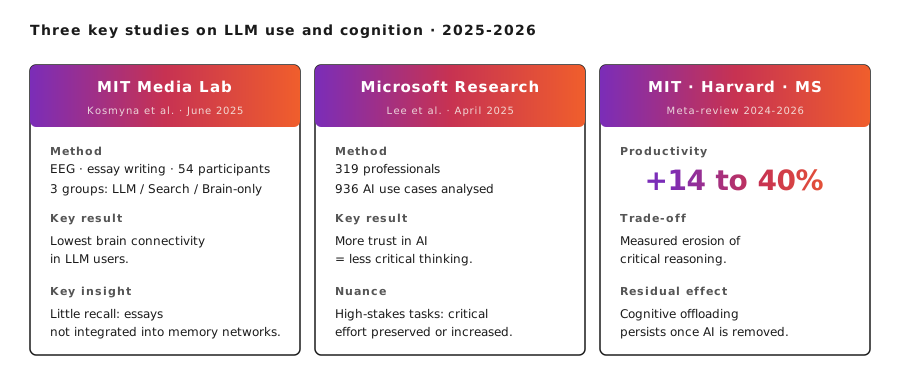
The major reference study is Your Brain on ChatGPT: Accumulation of Cognitive Debt when Using an AI Assistant for Essay Writing Task, published by Nataliya Kosmyna and her team at MIT Media Lab in June 2025 (arXiv 2506.08872).
54 participants were split into three groups: LLM (ChatGPT), search engine, and brain only. Each wrote three essays in their assigned condition. In a fourth session, the conditions were reversed. The researchers measured brain activity by electroencephalogram throughout the exercise.
The results are clear-cut. The "brain only" participants activated the most extensive and most connected neural networks. Search engine users show intermediate activation. ChatGPT users show the weakest connectivity.
In session 4, when the ChatGPT users had to write without AI, their alpha and theta waves remained weaker than those of the other two groups. Clinical translation: their memory networks had bypassed the initial writing. Kosmyna puts it plainly: "the task was performed, efficiently and comfortably", but the users "simply did not integrate that content into their memory networks".
Sources: MIT Media Lab, Microsoft Research, Time.com coverage, June 2025.
Microsoft Research completed the picture in April 2025 with a study of 319 professionals, covering 936 real-world uses of AI. The key finding: the higher the trust in AI, the less critical thinking users deploy. Conversely, the higher the self-confidence, the more critical thinking stays engaged.
An important nuance, which saves the argument from easy alarmism: on high-stakes tasks, professionals maintain or strengthen their critical effort when using AI. It is on routine tasks, under time pressure, that the erosion is strongest. In other words, it is not AI that erodes thinking, it is the unreflective use of AI.
2. The real difference from the calculator and GPS
One argument comes up often: "every generation fears its new tool". People feared that the calculator would damage mental arithmetic, that GPS would damage the sense of direction, that Google would damage memory. And we got through it.
The argument is partly true and deeply misleading.
Analytical framework consolidated from work on distributed cognition and cognitive offloading.
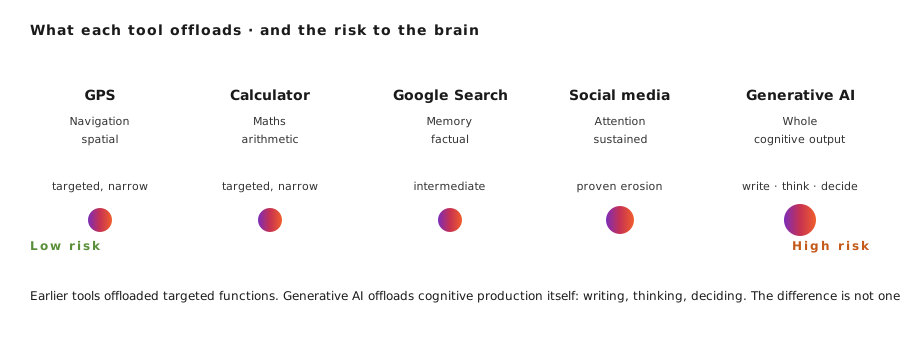
GPS offloads spatial orientation. The calculator offloads arithmetic. Google Search offloads factual memory. These three tools have one thing in common: they offload a targeted, narrow and auxiliary cognitive function. You still reach your destination knowing what you are going to do there. You multiply without knowing how to set out a division, but you still know what the result represents. You look up a date on Wikipedia, but you remain able to build an argument with it.
Generative AI, for its part, offloads cognitive production itself. It does not help you write: it writes. It does not help you decide: it recommends. It does not help you reason: it produces a ready-to-read line of reasoning. The field of offloading shifts from an auxiliary function to the central function. This is not a change of scale, it is a qualitative leap.
As long as we remain aware of that leap, use stays healthy. As soon as we forget it — which convenience makes easy — the muscle atrophies.
3. The work/personal framework: the line that saves or destroys
In a professional setting, AI fulfils the same function as a specialised tool: drafting a standardised report, summarising a long document, launching a creative brief, translating. Use is framed by the nature of the deliverable: there is a recipient, a quality expectation, a hierarchical review. AI is an office calculator, productive and justified.
In the personal sphere, the framework collapses. People ask Claude to write a letter to a loved one, a love message, a reply in a family dispute, a message of condolence, a political stance on a social network. The social, emotional or ethical function — which should be precisely the moment when you think for yourself — is outsourced. This is where cognitive erosion is compounded by relational erosion.
The boundary between the two spheres is porous, and that is the problem. You use a tool at work, you form the habit, you reuse it at home. It is precisely this porosity that needs to be ring-fenced.
Three rules that hold up in real life.
- Rule 1 — AI at the office, not in the intimate sphere. Never use AI to reply to a loved one, to settle a family dispute, or to word a personal commitment. No delegating your inner voice.
- Rule 2 — Wake up and go to bed without AI. The first thought of the day and the last should remain purely your own. It is a simple safeguard against the colonisation of attention.
- Rule 3 — Pivotal decisions in silence. A life choice (moving, a break-up, an important professional commitment) is made without AI assistance. AI can summarise facts; it must not steer values.
4. Comparison with documented addictions
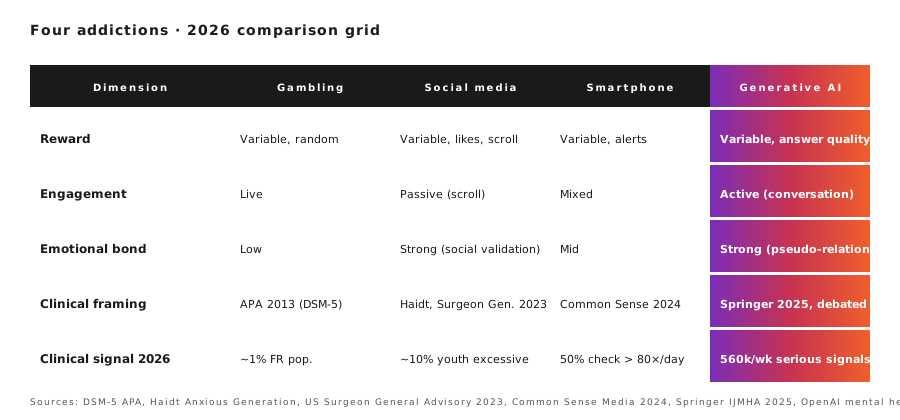
Contemporary addiction science has a robust clinical framework for three types of behavioural dependence: gambling (codified in the DSM-5 since 2013), social media (documented by Jean Twenge, Jonathan Haidt and the US Surgeon General in 2023) and intensive smartphone use (Common Sense Media 2024). Since 2025, a fourth field has opened: addiction to generative AI, studied notably by Springer in the International Journal of Mental Health and Addiction.
Sources: DSM-5 APA, The Anxious Generation Haidt 2024, US Surgeon General Advisory 2023, Common Sense Media 2024, Springer IJMHA 2025, OpenAI mental health disclosure 2025.
The neurological mechanisms converge. Like gambling and social media, generative AI runs on a variable reward pattern: not every exchange is equally satisfying. Sometimes Claude produces a remarkable answer, sometimes a flat one. This unpredictability is exactly what feeds the dopamine loop of a slot machine.
AI adds four mechanics of its own, identified by a CHI 2025 study (Dark Addiction Patterns of AI Chatbots): non-deterministic responses, immediate and visual display, push notifications, and empathetic responses that agree with the user. The last of these is specific: social media validates you through likes, AI validates you through a conversation that flatters your framing.
Field data are now quantified. OpenAI published in 2025 that 560,000 ChatGPT users a week show signs of psychosis, mania or suicidal ideation, and that 2.4 to 2.7 million display a problematic emotional attachment or acute distress (OpenAI, figures published in its mental health safety report). These orders of magnitude are comparable to those of problem gambling in the population.
The difference from social media: AI creates a deeper pseudo-relationship because it simulates a singular conversation, the memory of the dialogue, and personalisation to your style. For some profiles, this makes it more captivating than passive scrolling.
5. Attention span: the available data
The field is thinner than for social media, but the first signals converge. Gloria Mark's work (UC Irvine) on attentional fragmentation — established for smartphones since the 2010s — is being adapted to AI use. First results published in 2025: intensive use of generative AI over a working day reduces the average duration of concentration on a single task by around 15 to 20% among heavy users.
The mechanism is twofold. Cognitive offloading on the task ("if I can always ask Claude, I do not need to hold the thread") and compulsive consultation (like checking a smartphone, but with relevant content every time it is opened, which reinforces the loop).
Over a 24-month horizon, objective measurement tools (eye-tracking, task-switching analysis) should produce more precise data on this fragmentation. For now, we are working with self-reported and behavioural data.
6. What a manager can put in place right now
The subject is not theoretical. It translates into practical decisions for a company deploying AI at scale.
An internal AI charter. A short document (2 pages) that defines authorised uses, risky uses, and no-AI zones (sensitive internal communication, HR interviews, individual decisions about employees). The charter works less as a rule than as a signal: it shows that the use of AI is the subject of collective thought.
Explicit no-AI zones. At least three contexts should remain AI-free: annual reviews, recruitment decisions, and moments of conflict resolution. This is not a moral prohibition, it is a protection of the human bonds on which the organisation is founded.
Systematic human review. Any AI deliverable of more than 500 words intended for a client, a partner or a public body must be read and signed off by a human. Not a formality: taking responsibility for the substance.
Quarterly flash training. Short sessions (1 hour) with recent concrete cases (deepfake fraud, costly hallucinations, documented dependence). The aim is not technical mastery but the reflex of vigilance.
A healthy-use indicator. For particularly exposed teams (marketing, legal, communications), a quarterly check on the ratio of AI to total output, with a ceiling beyond which questions are asked (indicatively: 60% for writing tasks).
7. What a parent or teacher can do
For teenagers and young adults, school is where cognitive effects take hold fastest. The MIT study involved university students. The effects in adolescence — a period of maturation of the prefrontal networks — are likely to be even more pronounced.
- Homework without AI by default. AI comes in only once the pupil has produced a version of their work themselves. It corrects or deepens; it does not produce.
- A dialogue about uses. No blanket ban, which pushes use underground. Rather, a conversation about what each person notices in their own thinking when they use Claude or ChatGPT.
- Long reading preserved. Daily reading time without a screen, without AI, without notifications. This is not a retro whim: it safeguards the neural circuits that AI does not train.
Conclusion
AI does not make you stupid. Unframed use of AI erodes certain abilities, like a muscle you stop using. The 2025-2026 literature is stable enough on this point that doubt is no longer warranted: there are effects, they are measurable, and they are reversible if use is structured.
The real question is not "for or against AI". It is "within what framework". The work/personal boundary is the first lever, the easiest to maintain, and the one that best protects the cognitive abilities we think we are most at risk of losing.
A company that deploys AI without thinking about its cognitive effects is itself manufacturing, within three years, a collective that is less able to think. A company that deploys it with clear rules — a charter, no-AI zones, human review — gets the 14 to 40% productivity gain without paying the cognitive debt. Both outcomes are open. The only companies that will choose the second are those that have read the studies seriously before subscribing en masse.