The French government has put €200 million on the table to push artificial intelligence into French businesses. Announced on 1 July 2025 and run by Bpifrance and the Directorate-General for Enterprise, the Osez l'IA plan changed shape on 1 January 2026. Here is what it really contains, what you get as an SMB director, and what the official line leaves out.
1. The plan in brief
Osez l'IA is a national plan launched on 1 July 2025 by the Ministry of the Economy, run by Bpifrance (source) and overseen by the Directorate-General for Enterprise (DGE source). Its official goal: to raise the rate of AI adoption in French businesses from a low level today to 100% of large groups, 80% of SMBs and mid-caps and 50% of micro-enterprises by 2030.
The stated budget is around €200 million for the operational phase (L'Usine Digitale). It breaks down into four operational building blocks that you can activate separately or together.
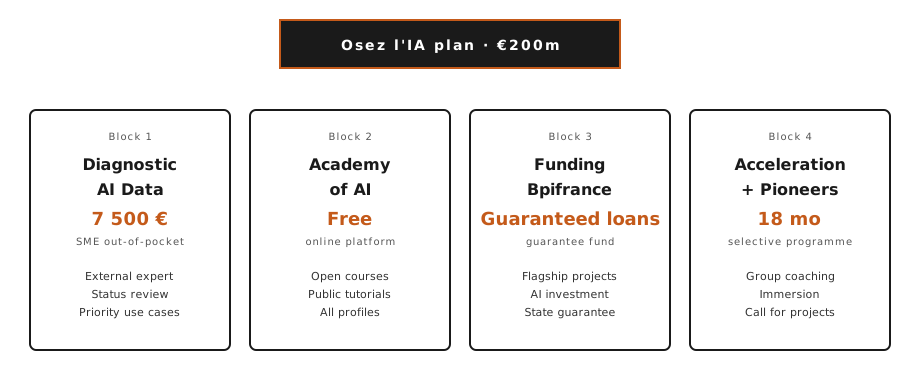
Sources: Bpifrance, DGE, economie.gouv.fr. Each block can be activated independently.
2. Block 1 — The AI Data diagnostic
This is the most concrete and most immediately usable element of the plan. An external expert, commissioned by Bpifrance, comes to take stock of your company from three angles: technical (data, systems, infrastructure), operational (processes, flows, friction points) and strategic (where AI can create concrete value).
The deliverable is a map of AI use cases applicable to your business, prioritised by impact and feasibility. It is equivalent to what a specialist consultancy would charge between €15,000 and €30,000 for on the market.
The real cost in 2026
The diagnostic is billed at €10,000 excluding VAT. The State's contribution changed on 1 January 2026. It used to be 40% (your share: €6,000). It has fallen to 25% (source). You therefore now pay €7,500 excluding VAT, against €6,000 before 2026.
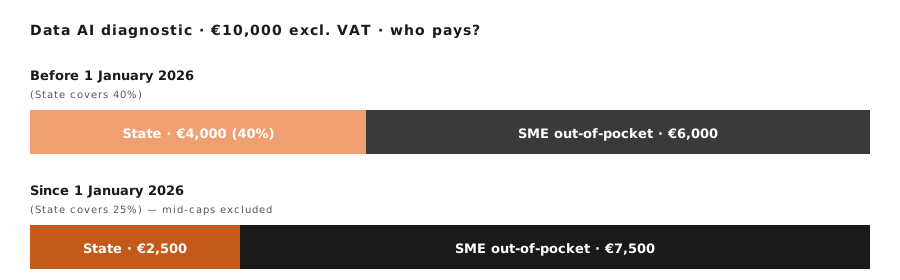
Source: pricing tiers published by Bpifrance, confirmed by the plan's regional contacts.
Another silent change: mid-caps (intermediate-sized enterprises, between 250 and 4,999 employees) have no longer been eligible for funding since 1 January 2026. Only SMBs in the strict sense remain so.
What you concretely get
- A team of external experts for 5 to 10 days of work
- A map of prioritised use cases
- An estimate of the return on investment for each case
- Leads for additional funding (research tax credit, OPCO training funds, the plan's upcoming blocks)
What you do not get
The diagnostic delivers no tool, no prototype, no code. It is strategic and operational audit work. If you want to move on to implementation, you need an external provider or an in-house team, and you pay for it. The plan only funds the analysis, not the build.
3. Block 2 — The AI Academy
Launched at the end of 2025, the AI Academy is a free, public online training platform (Ministry of the Economy source). It brings together content tailored to several profiles: directors, employees, apprentices, job seekers, micro-entrepreneurs.
The aim is collective upskilling. The content covers the technical basics, business uses, risks (bias, hallucinations, GDPR compliance), and implementation frameworks.
What it is worth: a decent self-training resource for staff with no AI culture. It does not replace a bespoke training programme, but it provides a shared foundation. Being free is its main argument.
Limit: like any platform of this kind, it suffers from the classic problem of self-training — low completion rates without internal support. You cannot just push the link to your teams and wait.
4. Block 3 — Project financing
For SMBs that take action after the diagnostic, the plan provides two financing mechanisms run by Bpifrance.
State-guaranteed loans. Bpifrance grants loans to SMBs carrying a structuring AI project, with a State guarantee that reduces the bank's risk. This eases access to credit and makes it possible to fund projects that traditional banks often refuse, for lack of collateral or financial track record on AI.
Guarantee fund. A dedicated fund covers part of the defaults. It does not erase the debt, but it compensates the bank if the project fails. In practice, it is what unblocks files stuck at the credit committee.
What you need to understand: these mechanisms are not grants. They are loans, which you repay with interest. They make financing more accessible, they do not make it free.
5. Block 4 — The accelerator programme and the “Pionniers de l'IA” (AI Pioneers) call for projects
The plan provides for an 18-month accelerator programme for companies that come out of the diagnostic with potentially high-impact projects. It combines group coaching, specialist technical training and immersion in companies already advanced in AI.
Access is selective: you have to apply, with an already structured project and a minimum of operational maturity. It is not for companies discovering the subject.
The “Pionniers de l'IA” call for projects targets the top of the pile: technological breakthrough projects in priority sectors (industry, health, ecological transition, security). Selection is highly competitive, the funding more substantial, and the level of requirement equivalent to that of a fundraising round.
6. Stated objectives and market reality
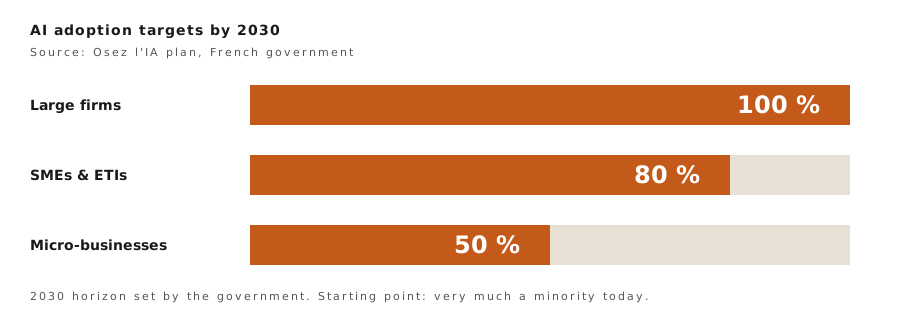
Source: Osez l'IA plan, French government. Current starting point very much a minority.
The gap is considerable. Reaching 80% of SMBs in four years assumes a pace of diffusion that France has never achieved on any comparable digital subject. The plan bets on a combined effect of training, demonstration, financial incentive and competitive pressure. The open question is whether €200 million is enough to trigger this mass movement.
7. Summary table
| Block | What you get | Cost to the SMB | When to activate |
|---|---|---|---|
| AI Data diagnostic | Map of prioritised use cases | €7,500 excl. VAT (after 25% aid) | Starting point if you are unsure about strategy |
| AI Academy | Online training, all profiles | Free | In parallel with the diagnostic, to bring teams up to speed |
| Bpifrance financing | Guaranteed loans + guarantee fund | Repaid loans (no grant) | After the diagnostic, to fund implementation |
| Accelerator & Pioneers | 18-month programme, coaching, immersion | Application, selection | If you have a structured, ambitious project |
8. What the plan does not say
The cut in State contribution. Going from 40% to 25% in January 2026 means the SMB's share rises from €6,000 to €7,500 for the same diagnostic. That is not trivial for a 30-person SMB. This change was barely communicated.
The exclusion of mid-caps from funding. Companies with between 250 and 4,999 employees can still buy the diagnostic, but they pay full price. Yet some of the most mature AI topics are found precisely in mid-caps. The State is now targeting the segment that is furthest behind, not the best performing one.
The scope of approved experts. The experts who carry out the diagnostics are accredited by Bpifrance. Quality varies from one firm to another. Asking for the list of diagnostics the assigned expert has already carried out in your sector is legitimate and recommended.
The link with the sale of services. Several accredited firms also bill for integration. A diagnostic can become a commercial entry point. Not illegitimate, but worth bearing in mind: the diagnostic must remain a neutral deliverable, not a salesperson in disguise.
9. Who it is worth it for
The plan is useful in three concrete situations.
You run an SMB of 20 to 250 employees, you sense the AI stakes but do not know where to start. The AI Data diagnostic is a good trigger. For €7,500, you get a structured view and a basis for internal discussion. Likely return: high if you launch at least one project afterwards.
You have already identified a structuring AI project and are looking to fund it. State-guaranteed loans via Bpifrance unblock files that banks refuse. The interest rate remains standard, but accessibility changes.
You are carrying a breakthrough project in a priority sector (industry, health, transition). Applying to “Pionniers de l'IA” is worth the time spent even if you are not selected: the process gives the project structure.
The plan is less useful if you are already an SMB advanced in AI, with a defined strategy and an in-house team. The diagnostic will reveal little that is new and the Academy is too general for your level.
Conclusion
Osez l'IA is a useful plan but not a generous one. The diagnostic subsidised at 25% remains an interesting curtain-raiser, the Academy is a decent free resource, and the Bpifrance loans unlock financing that would otherwise be impossible. But none of these blocks builds AI in your business. They prepare you for it.
What the plan reveals between the lines is that the government has admitted AI would not arrive in French businesses on its own. It had to push, fund, train, support. The question that remains open is that of speed: €200 million over four years, to reach 80% of SMBs, comes to about €50 million a year across a base of roughly 140,000 SMBs. That is a little under €400 per SMB per year. You will decide for yourself whether that is enough to trigger a transformation.