Google has seen its click-through rate for the first position fall by 46% when an AI Overview appears. Zero-click searches rose from 56% to 69% in 12 months. Meanwhile, ChatGPT and Perplexity send qualified traffic to the sites they cite. Three acronyms structure the new discipline: SEO, AEO, GEO. They are neither three buzzwords nor three modes of the same work. They are three distinct practices with three different purposes. Here is what changes in concrete terms.
1. The three acronyms in one line
- SEO — Search Engine Optimization: appearing in an engine's list of results, essentially Google
- AEO — Answer Engine Optimization: capturing the direct answer (featured snippet, People Also Ask, voice, AI Overviews)
- GEO — Generative Engine Optimization: being cited as a source in the answers generated by ChatGPT, Perplexity, Claude
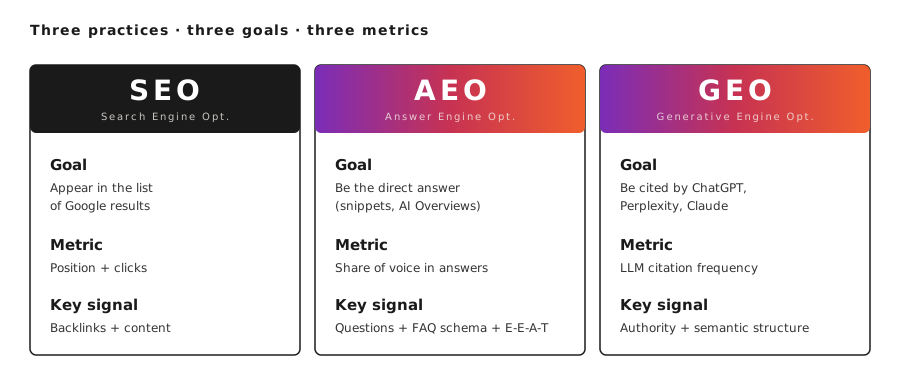
Synthesis of Jasper, Profound, Stackmatix.
The key to what follows: SEO optimises for a ranking (position 1 to 10). AEO optimises for an extraction (your answer at the top of the page, with no click). GEO optimises for a citation (your name in an LLM's answer). The three indicators are not the same.
2. What has really changed with AI Overviews
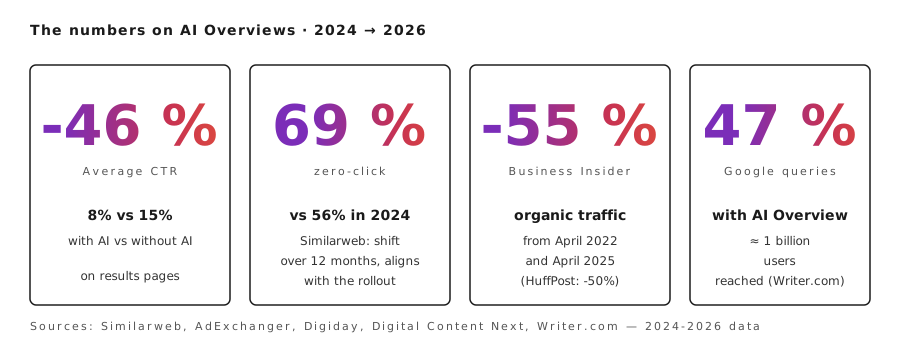
Sources: Similarweb, AdExchanger, Digiday, Digital Content Next.
The figures that matter for a publisher or an SMB investing in content:
- Between 30 and 47% of Google queries now display an AI Overview
- On those queries, the click-through rate drops by 34 to 46% depending on the measurements (Dataslayer)
- The national (US) zero-click rate rose from 56% to 69% between May 2024 and May 2025
- Long-established publishers such as Business Insider (-55%) and HuffPost (-50%) lost half of their organic traffic in three years
The factual conclusion: a good SEO ranking no longer guarantees traffic. If your answer is absorbed by an AI Overview or a generated answer, the reader no longer needs to click. The traffic disappears, even if you remain the cited source.
3. Each AI engine has its preferred sources
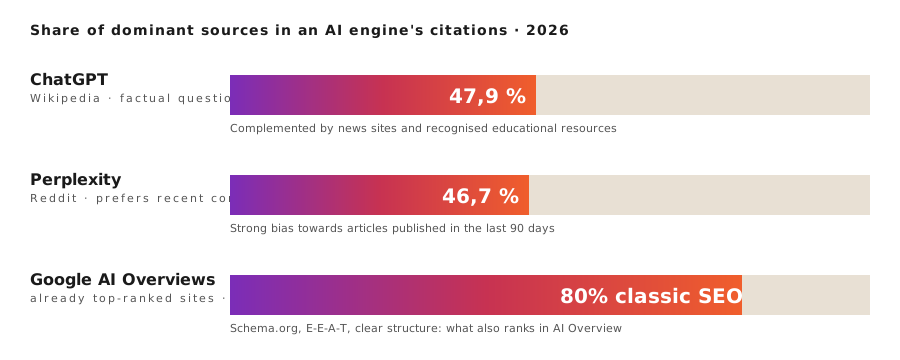
Aggregated 2025-2026 data: Frase.io, Digital Bloom, Writer.com GEO Research.
ChatGPT relies on Wikipedia for 47.9% of its factual answers, supplemented by news sites and educational resources. To appear there, you have two options: have a Wikipedia page (difficult, with strict editorial constraints) or produce content that the models absorb when they are fine-tuned on public data.
Perplexity cites Reddit heavily (46.7% of dominant sources) and prefers content published in the last 90 days. Here the lever is different: a presence on the Reddit communities relevant to your sector, and regular publication of dated, timestamped content.
Google AI Overviews works differently. It re-ranks the pages that already perform well in classic SEO, favouring E-E-A-T signals (Experience, Expertise, Authoritativeness, Trustworthiness), structured data markup (schema.org) and the clarity of answers. Around 80% of AI Overviews citations come from the top 10 organic results for the same term.
4. Concrete AEO techniques
AEO aims to capture the direct answer, typically in an AI Overview or a featured snippet. The techniques that work in 2026.
Structure the content as questions and answers. Each section opens with a question phrased the way a user would type it into Google. The first sentence that follows answers it on its own, in under 40 words if possible. Google extracts these blocks for its snippets and Overviews.
Add FAQ schema. FAQPage structured data markup doubles the chances of extraction. The embedded JSON-LD must exactly reflect what is written in the visible content.
Work on named entities. Google reads your content as a graph of relationships between entities (people, brands, places, concepts). Citing the right entities and linking them to each other through internal links helps the engine identify you as an authoritative source on a subject.
Date and source. AI Overviews prefer content with an explicit publication date, an update date, and verifiable external citations. An article that cites three authoritative sources is extracted more often than a generic one.
5. Concrete GEO techniques
GEO aims to be cited by LLMs when a user asks a question. Different logic, different techniques.
Build documentary authority on your subject. LLMs cite what they find robust, contextualised and in depth. Publishing 20 in-depth articles on a precise subject builds an authority that the models absorb. Publishing 200 diluted generic articles does nothing.
Identify the author and document their expertise. Signed content, with a bio, affiliations and links to the author's other publications, is citable. Anonymous content is not, or hardly. This is E-E-A-T applied to LLMs.
Inherited structure. Models digest content better when it has hierarchical headings (H2, H3), short paragraphs, lists, summary tables and concluding boxes. These elements serve as chunks that are indexed and reused.
Think "citable" rather than "readable". The ideal sentence to be cited by an LLM is self-contained, factual, dated and attributable. A sentence that begins "as we said above" is not citable. A sentence that begins "according to the OECD in March 2026, the AI adoption rate among SMBs reaches X%" is citable.
Cross-platform visibility. Reddit, LinkedIn, Wikipedia, GitHub, YouTube with a transcript: LLMs absorb your content when it exists in several places. Publishing only on your own site limits how much the models capture of you.
6. Can you measure your GEO and your AEO?
The practical question that is stalling marketing teams in 2026.
AEO: partially measurable via Google Search Console (impressions on featured snippets, position 0). Specialised tools such as Semrush and Ahrefs now track AI Overview appearances.
GEO: harder. There is no official API at OpenAI or Anthropic for measuring citations. The emerging tools (Scrunch, Profound, Writer.com GEO, Frase) query the LLMs with standard prompts and count how often your brand or URL appears. The data is indicative, not exhaustive.
The real KPI to watch in 2026 is the ratio of SEO impressions to actual traffic. If your impressions rise but your traffic falls, you are present in the answers but people no longer click. That is the symptom of an AI Overview absorption to be worked on through AEO and GEO.
7. Operational strategy for 2026
Step 1: audit your existing content. Identify the 20 articles that generated the most traffic in 2023-2024 and measure their 2025-2026 trajectory. Drops of 30% or more are often due to an AI Overview absorption. These are the articles to rework first.
Step 2: rewrite in Q&A + 40-word format. Each section starts with the question. The answer fits in under 40 words in the first sentence. The rest of the section goes deeper.
Step 3: deploy FAQ schema. On high-stakes articles, a FAQPage JSON-LD block with 3-5 questions and answers duplicates the signals for Google.
Step 4: sign your articles with an identifiable author. Name, photo, bio, LinkedIn link, institutional affiliation if relevant. LLMs and AI Overviews favour signed content.
Step 5: test your citations in ChatGPT, Perplexity and Google AI Overview. Ask the 10 questions that matter for your business. Look at who is cited. That is your baseline. Reassess every quarter.
Conclusion
AEO and GEO are not successors to SEO. They are extensions that address a problem SEO no longer covered: how to exist when the engine no longer sends the user to you but summarises the answer on the results page, or cites your content in a ChatGPT conversation with no link back.
The underlying work stays the same: authority, clarity, usefulness, signature. What changes is the geometry of the deliverable. Content designed for 2018 SEO does not surface well in an AI Overview or an LLM citation. Content designed for all three at once does.
The discipline is no more complex. It is more demanding on editorial precision. Teams that publish 50 poorly structured articles per quarter will lose out to those that publish 10 perfectly designed to be absorbed, cited and extracted.