Anthropic has launched three consumer-facing products under the Claude brand. Three interfaces, three trades, three business models. The names are close; the use cases are not. This article sets out the scope of each, where they overlap, and the question nobody dares ask: are two of them redundant?
1. Three products, three categories
In April 2026, Anthropic no longer sells an AI assistant. The company sells an assistant, a development agent and an autonomous office agent. Three surfaces, three engines, three audiences.
Claude (available at claude.ai) is the conversational interface. You ask a question, you get an answer. You attach a document, it reads it. You start a Project, you pour context into it, it remembers. It is the founding product, the one through which most users discover Anthropic.
Claude Code is the developers' tool. Available as a terminal CLI, as IDE extensions (VS Code, JetBrains) and, since 14 April 2026, as a redesigned desktop application, it reads your codebase, runs commands, opens files, fixes, tests and commits. It lives in your development environment.
Claude Cowork is the newcomer, made generally available on 9 April 2026. It is an autonomous agent for non-developer knowledge workers. You give it a goal — summarise your emails, prepare a meeting, enrich a CRM — and it carries it out on its own, via native connectors (Microsoft 365, Gmail, Google Drive, Zoom, DocuSign).
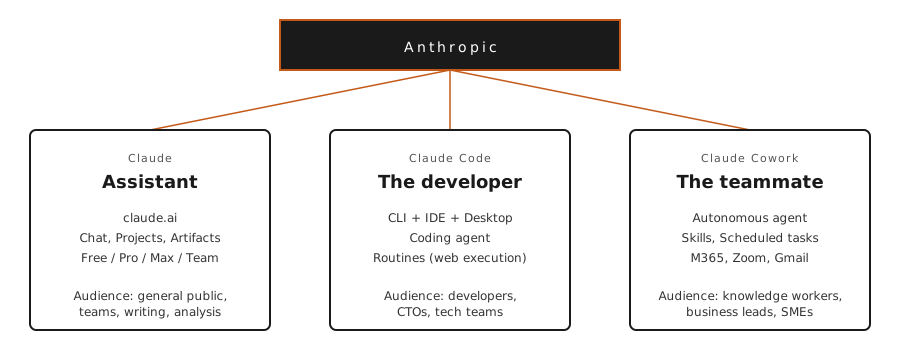
Each product relies on the same models (Opus 4.7, Sonnet 4.6, Haiku 4.5). The difference lies in the interaction surface, the connected tools and the target audience.
2. Claude — the assistant
Claude is a multimodal conversational assistant. Text, images, PDFs, spreadsheets, code. A context of 200,000 tokens on the Pro and Team plans, up to 1 million on Enterprise. It runs on the Opus 4.7, Sonnet 4.6 and Haiku 4.5 models.
Key features
Projects. Persistent workspaces where you pour in documents, notes and a knowledge base. Claude keeps the context between conversations. Useful for following a client file, an internal project or a monitoring topic.
Artifacts. A side panel where Claude generates editable deliverables in real time: code, structured documents, HTML pages, Mermaid diagrams. You see the result being built next to the chat.
Skills and Connectors. Since January 2026, Claude can plug into your third-party tools via official connectors (Gmail, Google Drive, Notion, Linear, Asana). Skills let you extend its capabilities with reusable procedures.
Claude Design. A spin-off product announced on 17 April 2026 (source). Specialised in generating visual materials: slides, prototypes, mockups, exportable to Canva.
Typical use cases
- Writing (emails, notes, summaries, reports)
- Analysis of long documents (contracts, studies, financial data)
- Structured research with sources
- Brainstorming and strategic thinking
- Translation and rewording
Limits
Claude is reactive. It waits for your prompt. It triggers nothing, schedules nothing, does not run in the background. To process 200 emails, you have to copy them to it. To enrich a CRM, you have to export, ask, and re-import. Its agency is contained within the conversation.
3. Claude Code — the developer's agent
Claude Code was born as a terminal CLI in February 2025. In April 2026, it has become a complete ecosystem: command line, IDE extensions, a redesigned desktop application, and Routines (asynchronous cloud execution).
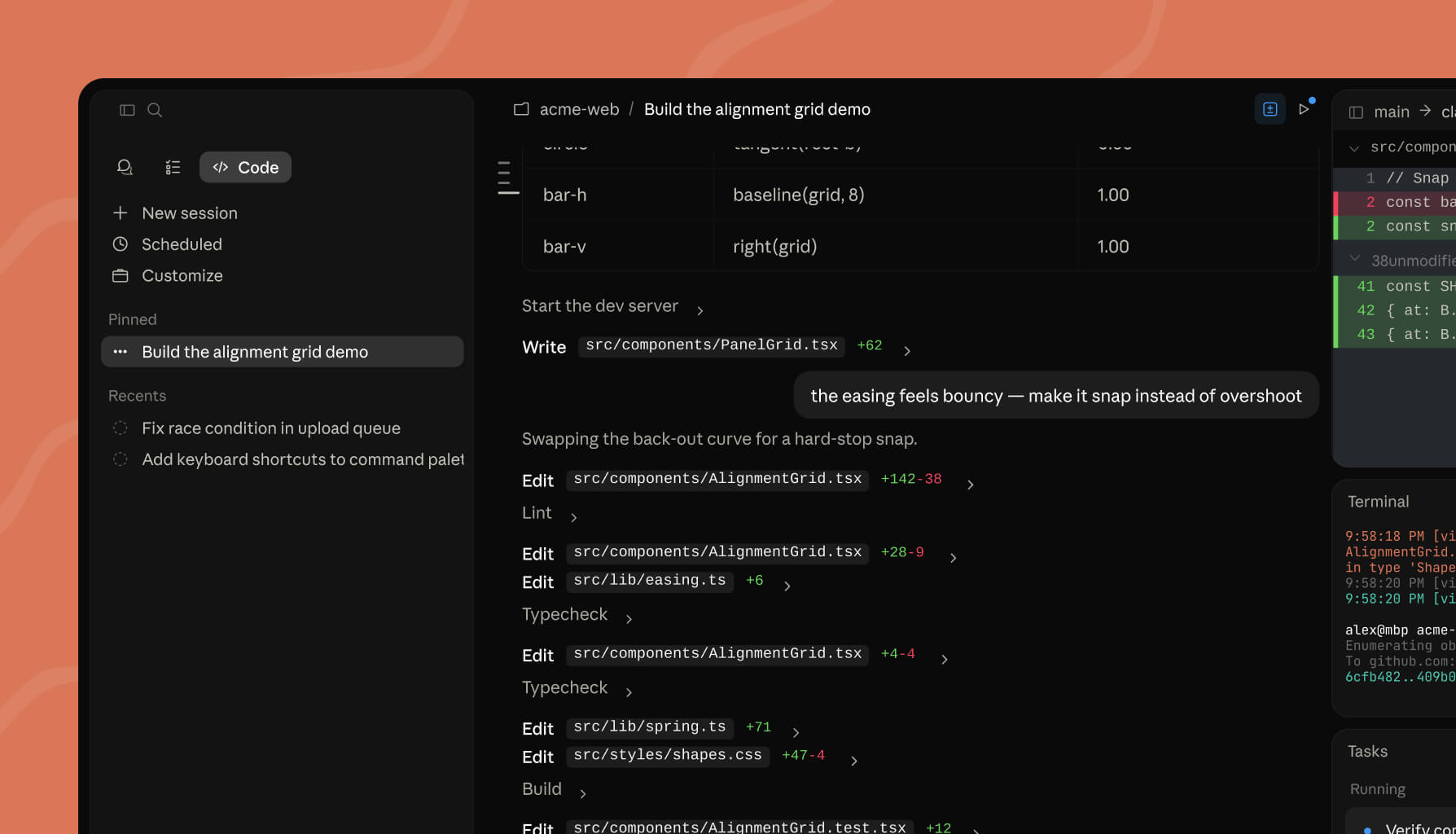
Source: anthropic.com/product/claude-code. Parallel sessions, integrated diff viewer, terminal, HTML and PDF preview in the same window.
What sets it apart from an IDE copilot
GitHub Copilot and Cursor autocomplete. They suggest the next line, rewrite a selected block, answer in a chat. Claude Code does something else: it executes plans. You tell it "add OAuth authentication", it reads the project, decides on the steps, creates files, modifies existing ones, runs the tests, fixes the errors, and presents you with a diff to approve.
The difference is conceptual: the copilot completes the code you write, Claude Code writes entire features that you supervise.
Routines: execution away from your machine
Announced in preview in early April 2026, Routines move Claude Code's execution onto Anthropic's web infrastructure. A routine packages a prompt, a git repository and connectors into a single configuration that can be triggered by cron, by webhook or by a GitHub event. The typical case: running a nightly bug triage at 2 a.m., without leaving your laptop open.
Typical use cases
- Bug fixes from a specification ("the form returns a 500 error, fix it")
- Adding planned features ("add a /api/metrics endpoint with auth")
- Cross-cutting refactoring ("migrate the tests from Jest to Vitest")
- Automated code review via Routines on every pull request
- Generation and maintenance of technical documentation
Limits
Claude Code only works with Anthropic models. Access is via an API key or a Claude Pro/Max subscription. There is no native support for GPT, Mistral, Gemini or local models. This dependency is structural, not configurable. The real cost depends on the model chosen: an active developer consumes between $50 and $300 a month in API usage on a regular basis, depending on whether they run on Haiku or Opus.
4. Claude Cowork — the autonomous office agent
Claude Cowork is the product Anthropic is pushing most aggressively in 2026. Launched in preview in January, made generally available on 9 April, and integrated into Microsoft 365 Copilot Wave 3 on the same day under the name Copilot Cowork (source). An investment of $100 million launched the Claude Partner Network to build an ecosystem around the product.
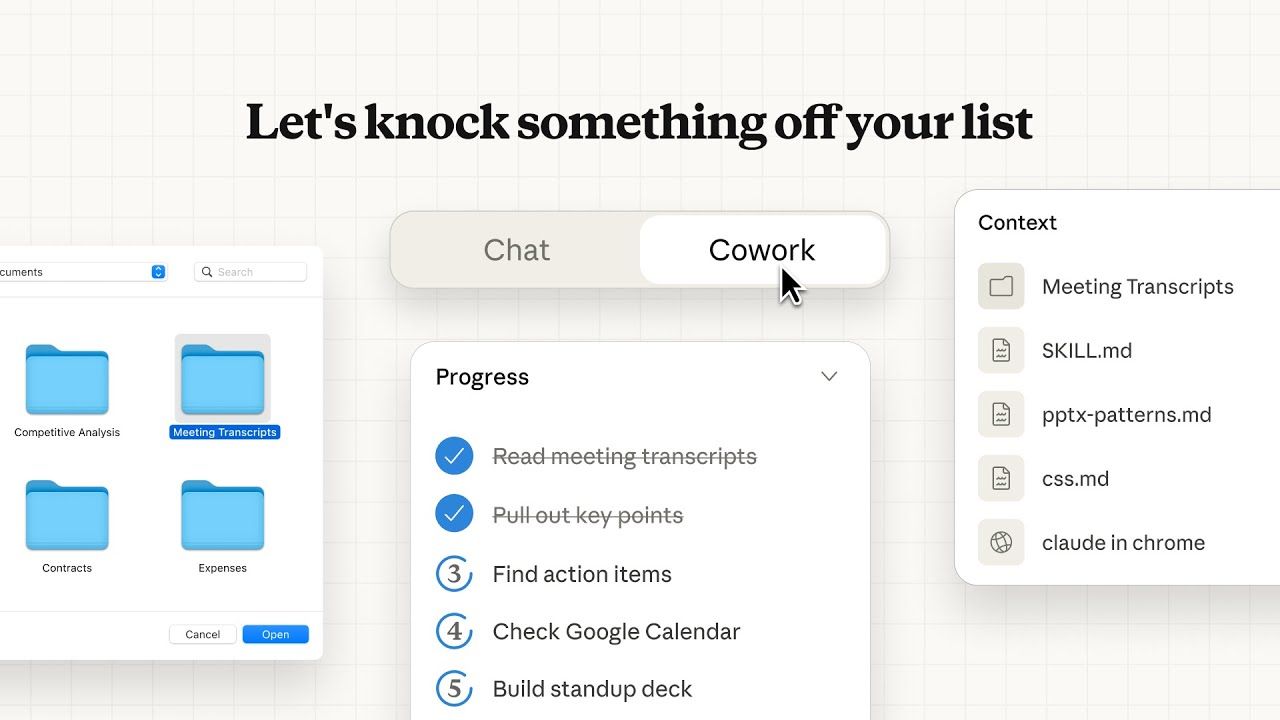
Source: anthropic.com/product/claude-cowork. The agent receives a goal, acts on local files and connected applications, and delivers a finished result.
What changes compared with Claude
Claude answers. Claude Cowork does. The same request — "prepare the weekly summary of client accounts" — produces two radically different responses.
Claude tells you how to do the summary, or does it if you paste the emails. Claude Cowork opens Gmail, reads the past week, extracts the accounts mentioned, cross-references them with your connected CRM, drafts a document in Google Drive, and posts the result to Slack. On its own. In the background.
Specific capabilities
Reusable skills. Complex procedures that you define once and that Cowork re-executes on demand. "Qualify a lead", "prepare meeting minutes", "generate a business report". Shared across an organisation.
Scheduled tasks. Cron or calendar triggering. A weekly routine can run without intervention.
Enterprise governance. RBAC (role-based access control), OpenTelemetry for monitoring, audit trails. Claude Cowork is designed to pass IT department filters.
Native connectors. Microsoft 365 (Outlook, Teams, OneDrive, SharePoint), Google Workspace (Gmail, Drive, Calendar, Docs), Zoom, DocuSign, FactSet, as well as an MCP (Model Context Protocol) mechanism to plug in third-party tools.
Typical use cases
- Automatic mailbox sorting and summarising
- Meeting preparation (file, agenda, participants)
- Post-meeting minutes with action extraction
- CRM enrichment and updating
- End-to-end follow-up of client files
- Automated, delivered industry monitoring
Limits
Cowork is only effective within the scopes where connectors exist. A proprietary business tool that is not connected remains out of reach. Autonomy is bounded by the permissions granted — which is a strength for compliance and a constraint for advanced users who want to go beyond the framework. The cost is significant: billing per active user, starting from the Claude Team and Enterprise plans.
5. Summary comparison
| Criterion | Claude | Claude Code | Claude Cowork |
|---|---|---|---|
| Purpose | Answer, analyse, write | Write and modify code | Carry out office tasks |
| Target users | General public, teams | Developers, CTOs | Knowledge workers, business leadership |
| Surface | Web, mobile, desktop | CLI, IDE, desktop, cloud Routines | Web, M365 Copilot, third-party integrations |
| Agency | Reactive (in the chat) | Agentic on code | Agentic on business tools |
| Connectors | Gmail, Drive, Notion, Linear | Git, GitHub, terminal, IDE | M365, Google Workspace, Zoom, DocuSign, MCP |
| Pricing | Free / Pro ($20/month) / Max / Team / Enterprise | Included in Pro/Max or API pay-as-you-go | Team / Enterprise, per active user |
| Strength | Versatility, long context | Fine-grained supervision of the code produced | Autonomy, enterprise compliance |
| Limit | No background execution | Anthropic dependency, API cost | Scope limited to connectors |
6. Where the products overlap (and where it causes problems)
The blurriest boundary is the one between Claude and Claude Cowork. A Pro user with Gmail and Drive connectors can already do much of what Cowork promises, in a conversational interface. The difference comes down to two things: autonomy (Cowork decides the steps, Claude suggests them) and scheduling (Cowork runs on cron, Claude waits for your prompt).
The other overlap is between Claude Code and Claude Cowork on data tasks. An analyst who wants to process a CSV and generate a report can go through Claude Code (create a script, run it) or through Claude Cowork (ask for the report, let the agent handle it). The choice depends on the profile: a technical profile prefers explicit control of the code, a business profile prefers the agent's implicit execution.
7. Current limits that nobody mentions
Reliability of autonomous agents. Cowork and Claude Code execute without continuous supervision. Error rates on multi-step tasks remain above 10%, according to public feedback from early enterprise users. An agent that gets it wrong one time in ten on a customer-sorting task can do damage.
Permissions governance. Giving an agent access to your emails, your Drive and your CRM is a heavy decision. Companies deploying Cowork must redesign their permissions policies, not simply add a user.
Model dependency. Claude Code and Cowork are captive to the Anthropic ecosystem. If Anthropic changes its pricing, modifies its terms of use or suffers an outage, everything goes down at once. The Anthropic incident of 9 January 2026 has already shown that the risk is real.
Opaque real cost. The advertised plans do not reflect the real consumption of a team that uses Cowork or Code intensively. Billing by usage, by active user and by advanced feature creates a grid that few buyers decipher before signing.
8. Conclusion: which tool for which need
The answer fits in three sentences.
You need an assistant to write, analyse and think, with your documents to hand: Claude. It is the entry point, the most versatile, the cheapest, and sufficient for 70% of individual uses.
You write code or manage a team that does: Claude Code. The productivity gain on routine tasks (bugs, refactors, tests) alone justifies the investment. Routines open up a CI/CD use that will grow in the coming months.
You have an office team that spends its days on Outlook, Teams and Drive, and wants to delegate repetitive work to an autonomous agent: Claude Cowork. The product is still young and its reliability imperfect, but it is the only native Anthropic offer that explicitly targets this scope.
Outlook: the boundary between the three products will blur. Claude gains agency capabilities with every release. Claude Cowork will integrate light coding features to extend its scope. Claude Code will become more accessible to non-developers via Routines and templates. Within 12 to 18 months, what we call three products today will probably be perceived as three modes of one assistant — conversational, developer, autonomous — billed according to intensity of use.
In the meantime, the practical rule: one tool per trade, not three subscriptions for the same user.