These are not agents. They are harnesses that orchestrate several. Gemini CLI, Claude Code and Codex share the same architecture — a runtime that loops between reasoning, tools and sub-agents until it delivers a result — but their philosophies diverge on openness, billing, sovereignty and product trajectory. In May 2026, choosing one amounts to choosing an ecosystem. An analysis of the three, without the marketing gloss.
1. What exactly is an agent harness
The industry changed its vocabulary in 2025-2026. We no longer talk about a model, or even an isolated agent, but about an agent harness. It is the architecture that turns a language model into a system capable of carrying out a task from start to finish.
An agent harness embeds nine building blocks: model interface, tool registry, context manager, planning module, execution engine, persistent memory, feedback loop, safety guardrails, and an orchestration layer. It is this last layer that delegates to specialised sub-agents: one sub-agent to explore the code, another to validate security, a third to review quality, and so on (MindStudio, April 2026).
Anthropic describes Claude Code as an "agentic coding system" (anthropic.com). Google describes Gemini CLI as an "open-source AI agent" but documents a ReAct loop with sub-agents and skills (github.com/google-gemini/gemini-cli). OpenAI describes Codex as an "agentic coding tool" with plugins, skills, computer use and multiple application surfaces. Three labels, the same technical reality: a harness that orchestrates.



Official logos: Google, Anthropic, OpenAI. All three provide a harness that orchestrates the same loop (reason, call tools, delegate to sub-agents, iterate).
2. Three distinct strategic bets
Gemini CLI is the open-source bet. Source code published under the Apache 2.0 licence, a generous free tier, the Gemini 3 model with a million tokens of context by default. Announced in June 2025, version 0.41 in May 2026 (geminicli.com/docs/changelogs). Google's bet: to become the default harness of millions of developers by winning on price and transparency.
Claude Code is the integrated bet. Terminal CLI, VS Code and JetBrains extensions, a redesigned desktop application, a web application, asynchronous cloud Routines. Natively managed sub-agents, lifecycle hooks, memory structured by project. Included in Claude Pro ($20/month), Max, Team and Enterprise subscriptions. Anthropic's bet: to capture the dev vertical with the most complete harness in the industry.
Codex CLI is the bet on going beyond. GPT-5.5 by default, GPT-5.5 Pro for heavy tasks, native computer use (browsing, clicks, screenshots), a plugin system to package skills, application integrations and MCP servers. GPT-5.5 was released on 24 April 2026 (openai.com). OpenAI's bet: to make code and office work converge in a single harness that knows how to use a computer.
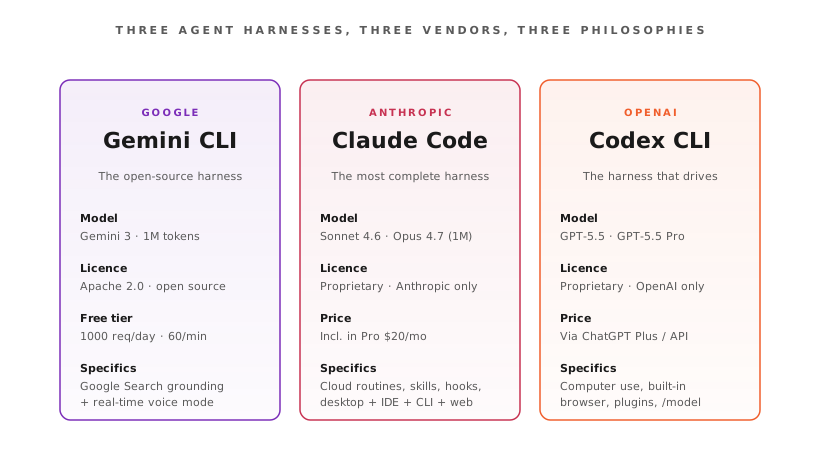
All three follow a ReAct (Reason + Act) loop with shell access, file reading/writing, command execution and sub-agents. The difference lies in the model, the openness, the billing, the surface and the publisher's culture.
3. Gemini CLI — the open-source harness
Gemini CLI is the only one of the three published as open source. The code is on GitHub, the licence is Apache 2.0, and the community actively contributes to releases (a near-weekly cadence according to the version log). For a team sensitive to software sovereignty or auditability, it is a weighty argument.
Model and context
The default model is Gemini 3, with a one-million-token context window. This window is usable in the terminal, which changes the nature of the tasks that are possible: ingesting an entire repository in a single conversation, cross-analysing a hundred files without chunking, semantic search without external embeddings.
Free tier and pricing
With a personal Google account, Gemini CLI offers a substantial free tier: 60 requests per minute and 1,000 requests per day. For an individual developer on mid-sized projects, that is enough to last a full week without paying. Beyond that, you switch to the Gemini API, billed per token like all the competitors.
Tools and sub-agents
Gemini CLI natively embeds grounding via Google Search: the harness can consult the web during execution without a key or external configuration. It also has file operations, shell commands and web page retrieval. MCP (Model Context Protocol) support has been built in since late 2025, which makes it possible to plug in third-party servers (databases, business APIs, telemetry tools). The /agents and /skills commands let you inspect, reload and install third-party sub-agents and skills.
What's new in 2026
Version 0.41 (May 2026) introduces a Real-time Voice Mode with a cloud or local backend, improvements to Skills (/skills install, /skills reload commands), a native pull request creation sub-agent (pr-creator) and an /agents refresh command to refresh configurations.
Typical use cases
- Onboarding onto a large codebase (a million tokens digests an entire repo)
- Experimenting without a tight budget thanks to the free tier
- Code audit with built-in web search
- Integration into an internal pipeline — the source code can be inspected and modified
- Open-source projects, academic research, prototypes
Limits
Open source brings transparency but not product maturity. The ecosystem of third-party extensions, hooks and skills is still embryonic compared with Claude Code. Gemini 3's reasoning quality on long coding tasks remains a notch behind Sonnet 4.6 and GPT-5.5 on public benchmarks, even if the gap is narrowing. For complex production codebases, several teams report a higher error rate than with the other two.
4. Claude Code — the most complete harness
Claude Code is arguably the most mature harness in the category in May 2026. The Code w/ Claude SF conference, held in early May, confirmed the trajectory: a redesigned desktop application, parallel sessions, Routines (cloud execution), a user-level skills ecosystem, lifecycle hooks, persistent memory, natively orchestrated sub-agents.
Models
Claude Code runs exclusively on Anthropic models: Sonnet 4.6 by default, Opus 4.7 (one million tokens of context) for heavy tasks, Haiku 4.5 for economical loops and fast sub-agents. No GPT support, no Gemini, no Mistral, no local model. This dependence is structural.
Surfaces
Claude Code covers more surfaces than its competitors: terminal CLI, VS Code extension, JetBrains extension, Mac and Windows desktop application, web application (claude.ai/code) and asynchronous cloud Routines. This redundancy is deliberate — advanced tech profiles live in the terminal, leads go through the desktop, hybrid profiles combine the two.
Integrated pricing
A particularity with heavy consequences: Claude Code is included in Claude Pro ($20/month), Max, Team and Enterprise subscriptions. No separate per-token billing for these users. In May 2026, Anthropic doubled the rate limits on these plans (see the public changelog) and removed the peak-hours reduction on Pro and Max. In practice, a serious developer can work all day without hitting the limit.
Ecosystem and sub-agents
Where Claude Code widens the gap: shareable user-level skills, lifecycle hooks (PreToolUse, PostToolUse, SessionStart, SessionEnd, Stop), delegable specialised sub-agents (architect, security-reviewer, build-error-resolver, e2e-runner...), third-party MCP servers, memory structured by project. It is the harness that takes multi-agent orchestration furthest internally — at the cost of a real learning curve.
Typical use cases
- Supervised cross-cutting multi-file refactoring (for example a Jest to Vitest migration)
- Automated pull requests with code review via Routines
- Overnight bug triage on a cron schedule
- Development governed by quality hooks (formatter, linter, automatic tests)
- Delegated specialised sub-agents (architect, security-reviewer, build-error-resolver)
Limits
Total dependence on Anthropic. Opaque pricing for intensive API usage (between $50 and $300 a month depending on the model and the intensity). The learning curve of the skills/hooks/sub-agents ecosystem takes several hours before it becomes productive. The Anthropic incident of 9 January 2026 was a reminder that a platform outage blocks all the tooling at once.
5. Codex — the harness that drives the computer
Codex has been through two major overhauls since its birth in 2021. The latest version, powered by GPT-5.5, shifts the product's centre of gravity: it is no longer only about writing code, but about using a computer. This is the main philosophical difference from Gemini CLI and Claude Code.
Models
Codex runs on GPT-5.5 by default, with access to GPT-5.5 Pro for complex tasks and the option of falling back to GPT-5.4 or GPT-5.3-Codex via the /model command. The /model command also lets you adjust the reasoning level — an explicit dial that neither Gemini CLI nor Claude Code exposes as clearly.
Computer use and built-in browser
The Codex application can now drive a built-in browser. The harness sees what is displayed, clicks, types, navigates, reproduces a visual bug and checks a local fix. In practice, you can ask "reproduce the login form bug" and Codex opens your development server, simulates the sequence, and identifies the visual problem. This capability has no direct equivalent in the other two (openai.com/index/introducing-gpt-5-2-codex).
Plugins, skills and MCP
In 2026 Codex introduced a plugin system: installed bundles that package skills, application integrations and MCP configurations. Available in the application, the CLI and the IDE extensions. It is OpenAI's answer to Claude Code's skills/hooks/sub-agents ecosystem.
Surfaces
Desktop application, terminal CLI, IDE extensions, iOS and Android applications for tracking long tasks launched in the cloud. Surface parity with Claude Code is almost reached, with the exception of Routines, which remain an Anthropic specificity.
Typical use cases
- Visual debugging of a web application with the built-in browser
- Generation of complex documents (slides, spreadsheets) coupled with code
- Adjustable reasoning modes for cost / quality trade-offs
- Hybrid workflows spanning several applications via plugins
- Assisted development on a Microsoft / Azure DevOps stack via native integrations
Limits
No open source. Pricing tied to ChatGPT Plus, Pro, Business or Enterprise subscriptions or to the OpenAI API. The free tier is limited and more restrictive than Gemini CLI's. The maturity of the plugin ecosystem is recent and remains to be proven over time. The built-in browser is powerful but multiplies the data-leak vectors to be monitored in a business setting.
6. Summary comparison
| Criterion | Gemini CLI | Claude Code | Codex |
|---|---|---|---|
| Publisher | Anthropic | OpenAI | |
| Default model | Gemini 3 (1M tokens) | Sonnet 4.6 (200k) / Opus 4.7 (1M) | GPT-5.5 / GPT-5.5 Pro |
| Open source | Yes (Apache 2.0) | No | No |
| Free tier | 1,000 req/day, 60 req/min | Included in Pro ($20/month) | Limited via ChatGPT |
| Surfaces | CLI, IDE extensions | CLI, IDE, desktop, web, cloud Routines | CLI, IDE, desktop, mobile |
| Competing models | Gemini only | Anthropic only | OpenAI only |
| Native sub-agents | Yes (/agents command) | Yes (most mature, user-level agents) | Yes (via plugins) |
| MCP support | Yes | Yes (most mature) | Yes (via plugins) |
| Specificity | Generous free tier + Google Search grounding | Cloud Routines, skills/hooks/sub-agents ecosystem | Computer use, built-in browser |
| Target | Individual developers, open-source projects | Tech teams, fine-grained supervision | Hybrid developers, visual workflows |
| Strength | Transparency, massive context, price | Product maturity, ecosystem, sub-agents | Versatility, computer use |
| Limit | Product maturity, code reasoning | Anthropic dependence, learning curve | No open source, limited free tier |
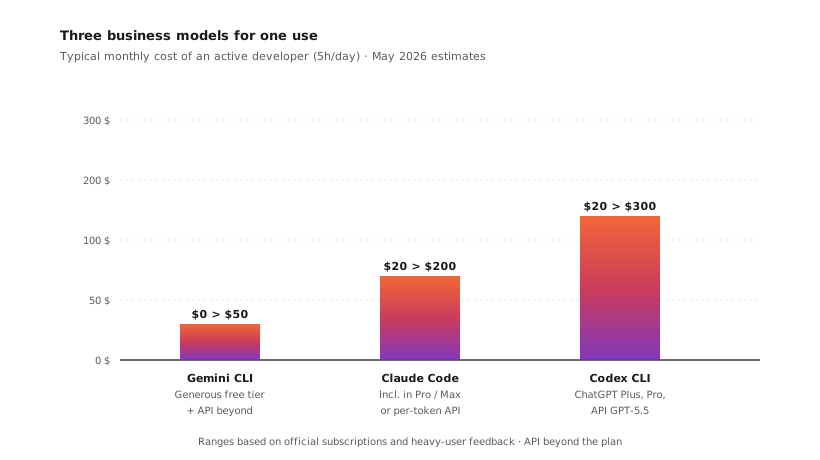
Gemini CLI bets on the free tier as a loss leader. Claude Code builds the harness into a Claude subscription. Codex modulates billing through ChatGPT subscriptions and the OpenAI API.
7. Cross-harness: getting several harnesses to talk to each other
A strong trend of 2026: using several harnesses at the same time via crossed sub-agents. Several open-source projects (sub-agents-skills, fleet-harness, awesome-cli-coding-agents) show that you can have Claude Code write the backend, Codex the tests and Gemini CLI the documentation in a single workflow. Each harness remains the orchestrator of its own sub-agents, but a higher orchestration layer makes them cooperate.
This approach is not marginal: Anthropic, OpenAI and Google deliberately leave their harnesses open to invocation from outside through common protocols (MCP, HTTP API, sub-process). For an advanced team, the question is no longer "which harness should we choose?" but "how do we get them to work together?" (awesome-cli-coding-agents).
8. Where the harnesses overlap (and where the choice becomes political)
On everyday tasks — fixing a bug, adding an endpoint, refactoring a module — the three harnesses produce comparable results. Public benchmarks (SWE-bench, HumanEval, MBPP) place them within a range of a few points. For 80% of an expert developer's tasks, the choice is not decided on raw generation quality.
The choice is decided on three axes that marketing communications avoid.
Ecosystem commitment. Adopting a harness means committing to a publisher's vertical. Claude Code ties you to Anthropic for your criteria, your skills, your hooks, your sub-agents, your structured memory. Codex ties you to OpenAI for your plugins and application workflows. Gemini CLI ties you less because the code is open, but the model remains proprietary and billed.
Data governance. All three harnesses read your files, run shell commands, and can access your secrets. Retention policies, API keys and storage zones differ. For a team under GDPR or SecNumCloud constraints, the answer is not the same depending on the harness.
Product trajectory. Anthropic published its Routines in April 2026, which moves Claude Code towards automated workflows. OpenAI invested in computer use, which moves Codex towards application control. Google invested in open source and voice multimodality, which moves Gemini CLI towards mainstream use. Choosing a harness in May 2026 amounts to betting on one of these three trajectories.
9. Common limits that nobody mentions
Hallucinations on legacy code. All three harnesses excel on modern, well-structured codebases. On poorly documented legacy code, on old frameworks or niche languages, the hallucination rate remains above 10%. No publisher publicly communicates a precise figure.
Dependence on connectivity. None of the three runs locally. A network outage, a publisher outage, a change in terms of use, and the tool disappears. The Anthropic incident of 9 January 2026 and the recurring OpenAI API outages are a reminder that the operational risk is real.
Unclear real cost. Pricing announcements mask significant variability. A project that opens fifty files per session costs ten times more than a project that opens five. Without observability of the tokens consumed, a team's monthly budget is impenetrable.
Supply chain security. All three harnesses can install packages, modify CI/CD configs and write to secrets. Without upstream controls (sandbox, hooks, human reviews), a poorly designed prompt can introduce a vulnerability. The official guides mention the subject; few teams really deal with it.
10. Conclusion: which harness for which need
The answer comes down to three scenarios.
You develop alone, your projects are varied, your budget is tight, you want transparency: Gemini CLI. The generous free tier, the open source and the one-million-token window cover the vast majority of individual needs. Product maturity is progressing fast.
You are in a team, you value fine-grained supervision, you want to integrate the harness into your internal workflows (CI/CD, overnight reviews, automatic quality) with specialised sub-agents: Claude Code. It is the most mature harness for advanced tech uses in May 2026, and the richness of the skills / hooks / sub-agents / Routines ecosystem justifies the commitment.
You work on products with a complex UI, you need computer use and the built-in browser, you are already invested in the OpenAI ecosystem: Codex. The ability to drive a browser, to handle hybrid workflows via plugins, and to switch between reasoning levels justifies the choice.
Outlook: the boundary between the three is going to blur. Gemini CLI is gaining product maturity. Claude Code is integrating experimental computer use capabilities. Codex is building up its plugin ecosystem. Over a 12-month horizon, the choice will be decided less on features than on publisher culture, sovereignty and billing. Three philosophies, three bets. None has won yet.