On 12 May 2026, Arthur Mensch, co-founder and chief executive of Mistral AI, was heard by the National Assembly's commission of inquiry on digital vulnerabilities. One sentence made every headline: he “does not rule out” a rise in AI-related unemployment. The rest deserves to be read. Six points worth taking away, half of which were not picked up by the press.
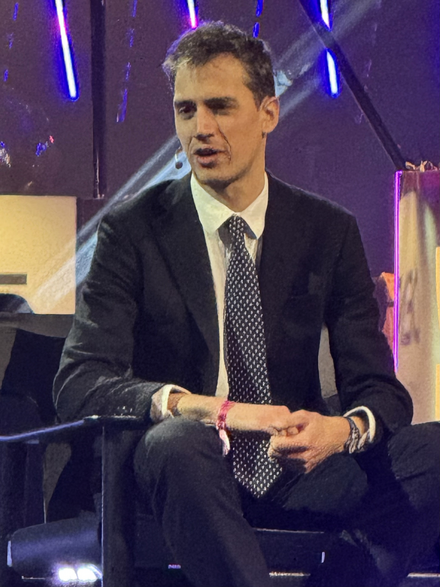
 Mistral AI — valued at €11.7 billion (Sept. 2025)
Portrait: Wikimedia Commons. Logo: Mistral AI (since 2025).
1. The framework, often ignored in the coverage
The commission of inquiry was created on 3 February 2026 by the National Assembly, for a period of six months. Its full title: commission of inquiry into the structural dependencies and systemic vulnerabilities of the digital sector and the risks to France's independence. 27 deputies, chaired by Philippe Latombe (Democrat group), with Cyrielle Chatelain (Ecologists-NUPES) as rapporteur (National Assembly page).
Its purpose: to assess the dependence of the French administration and companies on non-European digital solutions (cloud, AI, software) and the state of sovereign alternatives. Arthur Mensch was heard as the representative of the only leading European player on frontier models. He was accompanied by Audrey Herblin-Stoop, Mistral's director of public affairs. The same session heard Fabrice Coquio, CEO of Digital Realty. A separate hearing before the Senate economic affairs committee is scheduled for 22 May (Senate page).
Official National Assembly video, broadcast on LCP and YouTube.
2. The sentence that made the headlines — and what it really means
LCP headlined: “The head of Mistral AI does not rule out a rise in unemployment” (LCP report, 12/05/2026). It is the only sentence from the hearing repeated on a loop in the French press within 24 hours.
The context is more precise. Mensch says in the session: “You are in a situation where some jobs almost disappear”. He takes the example of his own engineers — they “no longer write lines of code”. He concludes that “it is not ruled out that you will have, in certain fields, an increase in unemployment”.
What the sentence says, read in context: Mensch is not predicting mass unemployment. He observes that the developer's job, which he practises at Mistral, already no longer consists of writing code. And that this logic will extend to other jobs, without net job creation automatically compensating. The LCP headline is not wrong, but it shrinks the point.
3. The real message: the shift of value from labour to capital
The most interesting moment of the hearing went unmentioned in the general press. Mensch delivers the formula:
“A shift of value from labour to capital, a capital that is for the moment largely not European capital.”Arthur Mensch — Commission of inquiry, 12 May 2026
It is an economic reading, not a moral observation. AI productivity shifts the value created by hours worked towards that created by assets — models, infrastructure, GPUs. And this capital is concentrated at Anthropic, OpenAI, Microsoft, Google, NVIDIA, SpaceX. France and Europe receive the productivity (the time savings in companies), but not the rent (the margins that go to the owners of the systems).
This is exactly the question the commission was set up to address: dependence. And it is the most solid sentence of the hearing. It is not in the headlines because it is less clickable. Yet it is the only one that justifies the commission's work.
4. Energy as the next shortage
The second subject addressed and little picked up: Mensch warns about the electricity demand created by AI, and its inflationary effect. Quote: “Conflicts of use and therefore inflation” in a world where “there is not enough electricity”.
The point is wired into recent news. On 6 May, Anthropic announced it would lease the whole Colossus 1 data centre from SpaceX — 300+ megawatts of power, 220,000 NVIDIA GPUs — to cope with its own capacity shortage (see our decryption of the SpaceX–Anthropic deal). In the United States, Microsoft has signed to restart the Three Mile Island nuclear plant, and Amazon has bought a campus powered by Talen Energy. The race for gigawatts is the sector's news, but it is rarely framed before a national parliament as a risk of general inflation.
Mensch arrives with a macro reading, at a moment when French parliamentarians have not yet integrated this dimension into their analytical grid. It is a service rendered to public debate, even if it is also a service rendered to Mistral (which is preparing its own data centres at Bruyères-le-Châtel for Q2 2026 and in Sweden for 2027).
5. The reversal on the AI Act
Mensch described European regulation in the session as “heavy”. The phrase deserves to be re-read in light of the last two years of positioning.
In 2024-2025, Mistral was one of the most vocal opponents of the AI Act, arguing for lighter obligations on open-weight models and straining the French position in the final negotiations. To the point that several MEPs accused Mistral, at the time of the February 2024 Microsoft deal, of having lobbied to serve the interests of its American partner (Sifted, Fortune Europe).
In 2026, Mistral on the contrary claims the “AI Act compliant” label as a commercial argument on its enterprise products. The political discourse moves from “this regulation will kill us” to “this regulation is the competitive advantage we offer the European market”, without the public position in the session acknowledging this shift.
On 11 May 2026 — the day before the hearing — the European Commission opened a formal dialogue with OpenAI and Anthropic. OpenAI agreed to give the European AI Office access to GPT-5.5-Cyber. Anthropic is resisting with its “Mythos” model (CNBC). The AI Act is beginning to produce concrete effects on the American frontier labs. Mistral is positioning itself in this window.
6. The real state of Mistral in 2026
The hearing dwelt little on the figures. The press did not either. Yet these figures are the context that makes the whole position Mensch set out readable.
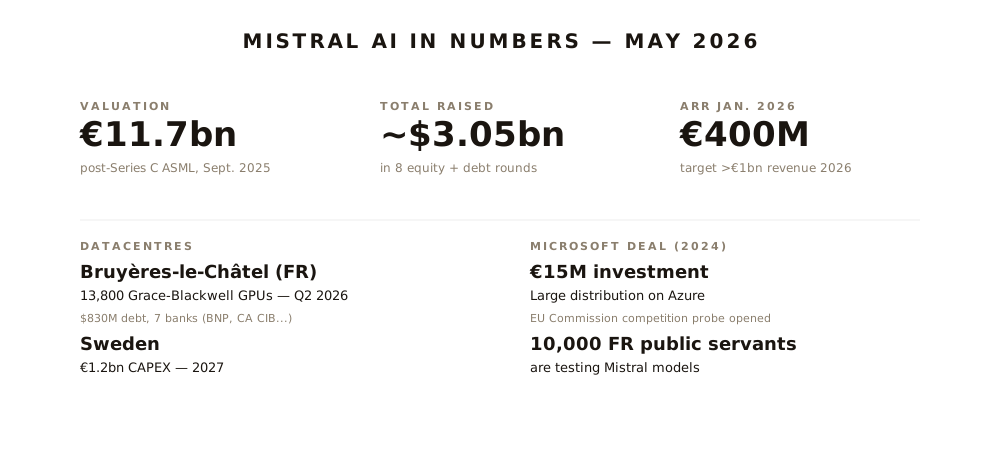
Sources: Bpifrance Presse (Sept. 2025), Usine Digitale (ASML €1.3 billion), Maddyness, Crunchbase, Siècle Digital (target >€1 billion revenue 2026), TechCrunch (Microsoft).
Mistral raised €1.7 billion in a Series C in September 2025, led by ASML (€1.3 billion), bringing the post-money valuation to €11.7 billion — France's first decacorn. ARR at €16 million at the end of 2024, around €400 million announced at Davos in January 2026, with a Mensch target of “exceeding €1 billion in revenue in 2026”. Total raised since creation: about $3.05 billion over eight rounds (equity + debt).
On the infrastructure side, Mistral announced in March 2026 an $830 million debt facility from seven banks (including BNP Paribas and Crédit Agricole CIB) for the Bruyères-le-Châtel data centre: 13,800 Grace-Blackwell GPUs, commissioning Q2 2026. A second €1.2 billion data centre is announced in Sweden for 2027 (Crunchbase News). Until these data centres run, Mistral's inference remains largely carried by Azure — a consequence of the February 2024 Microsoft deal.
On the product side, 10,000 French public servants are testing Mistral's models, and on 29 April 2026 the company launched Mistral Vibe, a terminal agent developed to compete directly with Claude Code (Anthropic) and Cursor (Anysphere) in the coding agent segment — the most profitable in AI in 2026, as we decrypted in our article on Colossus.
7. What he did not say
A hearing is also read through its silences. Mensch did not comment on:
- The February 2024 Microsoft deal. Still active. No public indication of the exit path. Mistral's Azure dependence remains structural until Bruyères-le-Châtel is commissioned.
- Anthropic's arrival in Paris and Munich. Announced in 2026 (Yahoo Finance). EMEA is Anthropic's fastest-growing region. Mistral will now lose deals in its own market.
- The capex gap with the Americans. Mistral has raised $3 billion cumulatively. Anthropic has committed ~$300 billion of compute over the decade. OpenAI raised $122 billion in the March 2026 round alone. European sovereignty over frontier models is played out at this order of magnitude.
- The competition inquiry opened by the European Commission following the Microsoft deal. Still open in 2026.
These are not oversights. They are editorial communication choices, legitimate in a parliamentary setting. For the decryption, they are structuring.
What Mensch attempted in the session was to position Mistral as the voice of French and European digital sovereignty. The discourse is solid on the analysis (value shift, energy shortage, US/EU capital asymmetry). It is less so on the structure: Mistral remains, in May 2026, a player whose inference depends largely on an American hyperscaler, whose capex gap with the leaders is widening, and whose enterprise base will feel the weight of Anthropic's arrival in France.
The hearing is worth less for what was said in it than for what it reveals about Mistral's positioning in 2026: a gap between the political discourse of sovereignty and the operational reality of a company chasing three American giants. The sentence on unemployment made the headlines. The rest — capital, energy, the AI Act, structures — is what tells the real state of the file.