Contents
- The Choose France 2026 figures: what is confirmed, what is a promise
- Why France and not Germany or Italy?
- What Masa Son says — and what he does not say
- The warning nobody heard: Mensch, 12 May 2026
- Schneider Electric: when the installer says it will not work
- The lesson China will not give twice
- What France gets back, what SoftBank gets back
- Mistral: does a counterweight exist?
- Towards a new Messmer plan?
- Frequently asked questions
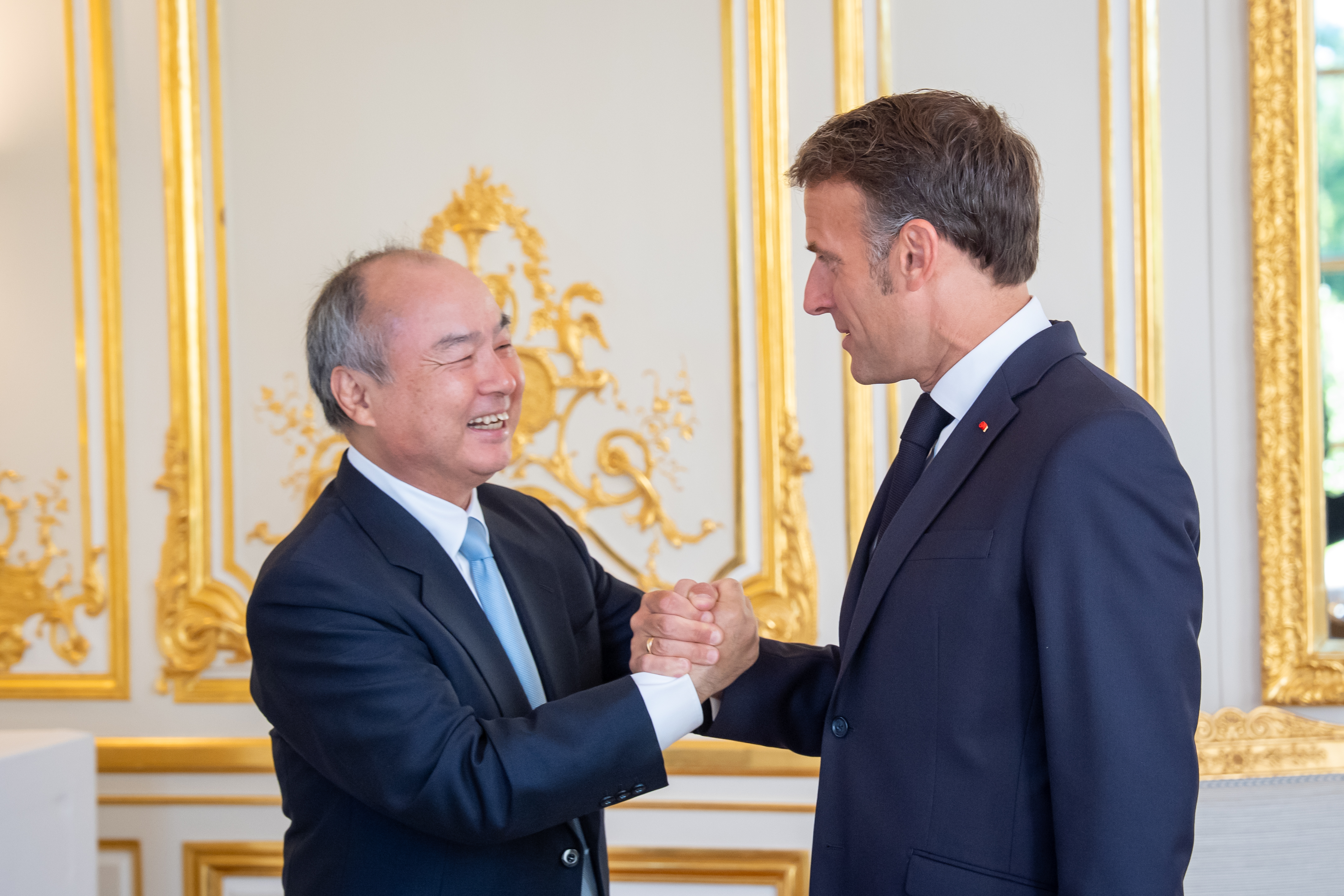
Versailles, 2 June 2026. Emmanuel Macron announces €93 billion of foreign investment at the Choose France summit. Masayoshi Son, founder of SoftBank, is the star of the day. The cameras, the applause, the statements about France as the "centre of Europe for AI". This figure deserves to be read coldly — because behind it hides a question that nobody asked at Versailles: who owns what in the end?
Three weeks before this announcement, Arthur Mensch, chief executive of Mistral AI, warned French parliamentarians of a structural electricity shortage and a shift of value towards capital "that is for the moment largely not European capital". Choose France has just accelerated exactly what he described as a risk. Schneider Electric, an industrial partner in the operation, confirms that "the energy currently available on the grid will not be enough". And China does not sell its infrastructure to foreign investors — it builds it for itself.
This is not an article about the attractiveness of France. It is a cold geopolitical reading of a transaction whose real terms have not been debated.
The Choose France 2026 figures: what is confirmed, what is a promise
The 9th edition of Choose France, on 1 June 2026 at Versailles, displayed a record amount: €93 billion of announced investment, 71 projects and 15,600 jobs (Bpifrance). A year earlier, the 8th edition on 19 May 2025 displayed €40.8 billion, 53 projects and more than 13,000 jobs (Direction générale des Entreprises). In twelve months, the displayed amount has more than doubled.
But the headline figure masks a narrower reality. Of the €93 billion put forward, only €45 billion are firm commitments — and they correspond to SoftBank's phase 1 alone (ActuIA). The rest aggregates conditional ceilings and multi-year plans of heterogeneous status: a single player accounts for nearly half of the total volume, and that half only becomes effective if the first tranche is executed in full.
The detail of SoftBank's commitment illustrates this mechanism. The maximum envelope of €75 billion for 5 GW (SoftBank press release) splits into two: €45 billion firm for a 3.1 GW phase 1 in the Hauts-de-France by 2031, plus €30 billion conditional for the ramp-up to 5 GW (ActuIA). Three sites carry phase 1: Dunkirk/Loon-Plage, Le Bosquel south of Amiens, and Bouchain, with an industrial partnership forged with Schneider Electric at the Port of Dunkirk for the local production of enclosures and power modules.
The gap between the announcement and the firm commitment is not an accounting detail, it is the heart of the matter. An "up to €75 billion" over five years, 40% of it conditional, is not read as a cheque cashed but as an open option. To measure what an announcement of this kind is worth, you need a quantified, earlier precedent. SoftBank provides one, and it has a name: Stargate.
Announced in January 2025 by OpenAI, Oracle and SoftBank, Stargate aimed for $500 billion over about 10 GW (OpenAI). Eighteen months after the announcement, the flagship campus in Abilene, Texas has two buildings operational since September 2025, with the remaining six expected in mid-2026, for a final target of more than 450,000 NVIDIA GB200 GPUs. SoftBank has also finalised a $41 billion investment in OpenAI, and co-invested $1 billion with OpenAI in SB Energy for the project's energy infrastructure (Wikipedia).
SoftBank's official press release, incidentally, puts forward no precise job figure: it mentions "thousands of highly skilled jobs" (SoftBank press release). The volumes of construction and permanent jobs circulating in some outlets are, at this stage, confirmed by no official source. Only the Bosquel site, developed with Sesterce for 1 GW, is associated with an order of magnitude — around 400 long-term jobs (DCmag).
Beyond SoftBank, the 2026 edition stacks commitments of very different natures and horizons: Nebius is building a 240 MW infrastructure on the former Bridgestone site in Béthune for €8 billion, Ardian (Verne platform) plans up to €5 billion for an HPC campus in the Île-de-France, Salesforce commits $2 billion by 2030, Databricks more than $300 million by 2029 with 40,000 people trained, and Foxconn injects €120 million in Angers in partnership with Bull (L'Usine Digitale). Adding these lines up under a single total of €93 billion amounts to putting a firm cheque to 2031 and the training of 40,000 people on the same footing.
Proof that announcements move forward — but slowly and by revisions — comes from the 2025 projects. Brookfield, which announced €10 billion last year, has raised its commitment to €20 billion by 2030, including €15 billion via Data4 and a 1 GW mega AI data centre in Cambrai (E-Valley), with works possible from 2026, plus €5 billion of energy infrastructure (Brookfield). The Campus AI backed by MGX, Bpifrance, NVIDIA and Mistral is developing a site at Fouju (Seine-et-Marne), with the first phase of three buildings expected in 2028 and construction in the second half of 2026 (Gulf Today).
| Player | Announcement | Actual status | Horizon |
|---|---|---|---|
| SoftBank (Hauts-de-France) | Up to €75bn / 5 GW | €45bn firm (3.1 GW) + €30bn conditional | 2031 |
| Stargate (precedent, Abilene TX) | $500bn / ~10 GW | 2 buildings live out of 8 | mid-2026 (campus) |
| Brookfield / Data4 (Cambrai) | €20bn (raised from 10) | 1 GW, works from 2026 | 2030 |
| Campus AI / MGX-Mistral (Fouju) | ~€8.5bn (2025) | Construction H2 2026 | 2028 (1st phase) |
| Nebius (Béthune) | €8bn / 240 MW | Bridgestone site | — |
| Ardian / Verne (Île-de-France) | Up to €5bn | HPC campus | — |
Sources: SoftBank, OpenAI, Brookfield, L'Usine Digitale, Gulf Today
Placed in the longer term, the 2026 record loses some of its magic. Since 2018, Choose France has accumulated around €87.8 billion of investment and more than 163,000 jobs (Campus France, figure prior to 2026). In other words, a single edition now displays more than seven cumulative years of the scheme. It is not that France has suddenly multiplied its attractiveness tenfold: it is the order of magnitude of AI infrastructure that has changed scale. The right reading reflex is not to compare 93 with 40.8, but to separate what is signed from what is hoped for.
Why France and not Germany or Italy?
The official answer is well known: the most reliable electricity grid in Europe, industrial land available in the Hauts-de-France, an engineering talent base, coordinated government support for strategic projects. Junior Minister for Industry Roland Lescure stated that the investment is a "testament to President Macron's ambition to position France as a leading destination across the whole AI value chain", adding that the commitment "creates jobs, strengthens our digital infrastructure and contributes to our goal of digital sovereignty" (Les Echos, 31 May 2026).
The structural answer is more precise: France has nuclear power. An industrial-scale AI data centre consumes between 50 and 100 MW per campus. SoftBank is announcing 5 GW in total — the equivalent of about three EPR2 reactors. France can offer this power at a competitive, low-carbon cost, and with a reliability that neither Germany (gas-coal mix post-2022) nor Italy (a less stable grid) can offer at the same price. The State-EDF agreement sets a nuclear reference price of around €70/MWh over 2026-2040, against €42/MWh under the former ARENH mechanism (SFEN), with a French grid carbon intensity of around 20 grams of CO₂ per kWh in 2025 — one of the lowest in Europe, against a European average of around 250 gCO₂/kWh (RTE, eco2mix).
The direct diplomatic relationship between Macron and Son played a not insignificant role. Macron travelled to Japan in early 2026 and met Son one-to-one (Les Echos, 31 May 2026). Son himself stated: “I was very impressed that Emmanuel Macron personally commits to ensuring the economic success of France, even though our investments have so far been concentrated mainly in the United States, as well as in Japan and Asia.” (CNBC, 1 June 2026). This is not a standard corporate process: it is economic diplomacy at head-of-state level, which short-circuits the usual prospecting steps.
The question that was not asked: who pays for the grid upgrade when demand explodes? SoftBank has signed a partnership with EDF for the Bouchain site — a former thermal power station made available by the public energy company (Les Echos, 31 May 2026). RTE has identified a risk of saturation of the transmission grid in the Île-de-France and in the Marseille region, and the RTE 2025 scenario projects that the consumption of dedicated data centres could be multiplied by 4 to 8 by 2035 compared with 2024 (RTE). The grid connections needed to activate the planned 5 GW were not publicly confirmed by EDF or RTE at the date of the announcement. The transmission infrastructure remains to be built — and this cost is not in the calculation of the €75 billion.
What Masa Son says — and what he does not say
Masayoshi Son's public statements at the Choose France summit and in his interview with CNBC in June 2026 deserve to be read precisely. Son has a well-honed rhetoric — he has already sold 50-year visions to government leaders, with mixed results.
"I think it's like more than 10x, probably 50x bigger than the dot-com bubble."Masayoshi Son — CNBC, June 2026
On Europe, Son is just as direct: "There is no choice. The United States is moving fast, China is moving fast, Europe, Japan, Asia must also move fast, so as not to be left behind." This wording is revealing. Europe is not described as an autonomous strategic player — it is described as a player that must keep pace with the one set by the first two.
"We are already doing it in the United States, we are expanding a lot in the United States, so we have the momentum that allows us to make France the centre of Europe, and Europe needs this kind of AI technology."Masayoshi Son — Choose France, June 2026
Reading this sentence coldly: "we have the momentum" — it is SoftBank that has the momentum, not France. France is the terrain onto which this momentum extends. "Europe needs this kind of AI technology" — a need supplied by SoftBank, owner of the infrastructure.
On China, Son is explicit: "Only China is on the heels of the Americans." This is not a neutral geopolitical analysis — it is the observation of an investor who has significant positions in OpenAI (more than 20% of SoftBank's NAV) and who is structurally excluded from the Chinese AI market. His real regret, as several observers have put it, is to remain on the doorstep of the Chinese AI ecosystem.
Son's praise of Macron ("I am very impressed") is an investor's speech, not a strategic diagnosis. He says what needs to be said for a head of state to keep opening doors. Macron is described as "personally committed" — which, translated into business terms, means that the regulatory and political risk is low. For an investor deploying €45 billion over five years in a foreign country, this is the most important due diligence point.
The warning nobody heard: Mensch, 12 May 2026
Three weeks before Choose France, on 12 May 2026, Arthur Mensch was heard by the National Assembly's commission of inquiry on structural dependencies and systemic vulnerabilities in the digital sector. This commission, created on 3 February 2026, is specifically mandated to assess the risks to France's independence — not for an investor conference in Las Vegas, not for an AI summit in Geneva. Before French parliamentarians, on a specifically French question.
"A shift of the value of labour towards capital, a capital that is for the moment largely not European capital."Arthur Mensch — Commission of inquiry, National Assembly, 12 May 2026
On energy, Mensch is just as direct. He warns about the electricity demand created by AI and its inflationary effect, citing "conflicts of use and therefore inflation" in a world where "there is not enough electricity". This wording, delivered before parliamentarians tasked with assessing French digital vulnerabilities, applies word for word to the situation that Choose France has just accelerated.
What Mensch describes is exactly the mechanism SoftBank activates. France provides the energy, the land, the stability. SoftBank owns the assets, bills the compute to the European companies that will use these data centres, and captures the margin. Value shifts from the work of French engineers to the capital of the Japanese investor. The commission of inquiry had the right question — Choose France did not have the debate.
Mensch quantifies the mechanism precisely in his hearing: "To create 1 GW of data centre, you are going to invest $50 billion over 5 years. So that costs you $10 billion a year. With $10 billion of data centre a year, you can make roughly $20 billion of revenue in tokens." The ratio is 1 to 2 — for every euro invested in infrastructure, two euros of revenue can be generated. This is the rent that SoftBank will capture. The economist Matthias Baccino put it directly: it is Japanese capital, American hardware, and it will not directly enrich France. The underlying question: the savings of the French could have financed this infrastructure — and captured that x2. They did not.
For the full detail of the Mensch hearing — capital, energy, AI Act, structures — see our decryption of the Mensch hearing published on 13 May 2026.
Mistral itself is building at Bruyères-le-Châtel — Mensch therefore knows from direct experience what it means to connect several gigawatts to the French grid. This warning is not theoretical.
Schneider Electric: when the installer says it will not work
Schneider Electric is SoftBank's reference industrial partner for the electrical infrastructure of the data centres at the Dunkirk site. The company "will help with the design and supply of all the necessary equipment", according to statements by Olivier Blum, chief executive of Schneider Electric, the day after the SoftBank announcement. It supplies medium and low voltage distribution, UPS, PDUs and its EcoStruxure platform for real-time energy management of data centres — in partnership with Nvidia for control (Usine Digitale).
Yoann Bersihand, head of the AI Hub at Schneider Electric France, put the diagnosis unambiguously: “The energy currently available on the grid will not be enough.” (Usine Digitale). This is not a marginal caution. It is the main installation partner saying publicly that the grid is not sized to absorb the announced demand.
For the Hauts-de-France, this observation is concrete. The region already hosts a significant concentration of data centres. Adding 3.1 GW in phase 1 — on sites at Dunkirk (Loon-Plage), Bosquel and Bouchain — requires connections to the electricity transmission grid managed by RTE (Les Echos, 31 May 2026). These connections take several years — the average connection time in France is around five years, against one to three years in the United States (IA Insider énergie, Usine Digitale) —, require significant infrastructure investment, and may conflict with other regional industrial uses. The grid question is not a technical detail. It directly conditions the feasibility of tranche 2 (an additional €30 billion) and the credibility of the 2031 timetable for tranche 1. That this constraint is absent from the official Choose France discourse says something about the nature of the event: it is a promotion forum, not a feasibility assessment.
The lesson China will not give twice
The comparison with China is inevitable — and Son himself makes it. He acknowledges that China is the only player able to "keep up with the Americans" on AI (CNBC, 1 June 2026). What he does not say: China made this possible precisely by refusing to do what France has just done.
Chinese closure is not a posture, it is an architecture. First lock, legal: the 2024 "Negative List" (published on 6 September 2024 by MOFCOM and the NDRC, in force on 1 November 2024) reduces the sectors closed to foreign capital from 31 to 29 — Beijing lifts, in passing, all restrictions on manufacturing. China is therefore opening up, but selectively: on factories, not on brains. The April 2024 VATS pilot even authorises foreign ownership in data centres, cloud and data processing in Beijing, Shanghai, Hainan and Shenzhen — but explicitly excludes online publishing, internet audiovisual and, de facto, generative AI services, classified under ideological security.
The contrast with Choose France is mechanical. Where France signs €45 billion on the basis of a relationship between two heads of state, with no public condition on the ownership of the assets, Beijing locks in the other direction: at the end of April 2026, China's economic planning body quietly ordered Moonshot AI, StepFun and ByteDance to refuse any American capital in their fundraisings without explicit government authorisation. You do not "let the market decide" on what is judged strategic: you direct it.
Second lock, financial: who finances, then, if not foreign capital? The State and the domestic champions, in a closed circuit. The Chinese AI boom is now largely anchored by public money — public entities took part in more than 140 AI deals in 2025 (PitchBook data), with the biggest rounds anchored by state capital with domestic private co-investors in companies designated "national champions". The Zhipu AI case is documented line by line: Alibaba and Tencent injected $342 million in 2023, then $412 million in 2024, before Shanghai state funds brought in $140 million in July 2025 to prepare the IPO, alongside public assets from Beijing, Chengdu, Tianjin and Hangzhou. Robotics, same pattern: Unitree's Series C (June 2025) is led by China Mobile — a state-owned operator — alongside Tencent, Alibaba and Geely, for nearly 700 million yuan and a post-money valuation exceeding 12 billion yuan.
Third lock, temporal: continuity. Where France stacks up plans that do not survive the next reshuffle, Beijing executes a course set almost a decade ago. The New Generation AI Development Plan, issued by the State Council on 20 July 2017, sets a three-stage trajectory — 2020, 2025, 2030 — with a quantified target that has not moved: making China the world's AI innovation centre by 2030, with a core AI industry of 1 trillion yuan and related industries of 10 trillion yuan, or ~$150 billion in Western terms. A target set in 2017, financed in 2024-2026, protected by a negative list the same year. It is not luck: it is a capital-regulation-objective chain held over eight years.
That leaves the profile of those who allocate the capital. The founders of Chinese gems are not financiers: Zhipu AI was founded in 2019 at the Tsinghua science park by Tang Jie and Li Juanzi, two computer science professors from the Knowledge Engineering Group — Tang Jie is an IEEE/ACM/AAAI Fellow and heads Tsinghua's Foundation Model Research Center. Liang Wenfeng is a quant who built his war chest before financing an AGI lab. When the capital allocator is himself able to judge a technical breakthrough, he finances the breakthrough; when he reads a balance sheet first, he finances what can be resold. This reading of the dominant profile of decision-makers is a structural hypothesis, not a finding documented by a single source — but the Chinese bundle (researchers in charge, a State that anchors, a market closed on the strategic) outlines a system, where Choose France signs only a transaction.
What France gets back, what SoftBank gets back
The balance sheet of the operation, seen from the French side, comprises skilled jobs — development, energy systems engineering, robotics, operations, maintenance, manufacturing — partnerships with regional universities, tax revenue on activities deployed in France, and AI infrastructure physically present on national territory.
What SoftBank gets back: ownership of the strategic assets (the data centres, the equipment, the network connections), the margin on the compute billed to the European and global companies that will use this infrastructure, the potential capital gain on resale of these assets, and a dominant position in the European AI infrastructure market for the coming decade.
[ANALYSIS] This is precisely the imbalance that the economist Matthias Baccino sums up: Japanese capital, American hardware (Nvidia GPUs), French energy. Three contributions, a single geography of captured value — and it is not France. The paradox is that the French resource mobilised, cheap nuclear electricity, is itself an inherited public asset, financed by the savings and taxes of previous generations. France is therefore not bringing fresh capital that it could put to work: it is making available an already amortised heritage so that a third party can extract the rent of the coming decade from it.
"The countries that build the infrastructure of this transformation will shape the future of technology, industry and society."Masayoshi Son — SoftBank official press release, May 2026
This quote is accurate — and that is precisely the problem. SoftBank builds the infrastructure. SoftBank will shape the future. France hosts the construction, but will not shape the future in the sense that Son means it: by owning the assets and capturing the rent.
Nuclear power could have been a bargaining chip. France has a structural advantage that few countries can offer at the required scale. This advantage could have justified conditions: co-ownership of a fraction of the assets, preferential access rights for French companies, training and skills transfer obligations, a buy-back clause in the event of resale. None of these conditions is mentioned in the official communications.
Mistral: does a counterweight exist?
Mistral AI is the only European company operating a frontier AI model comparable — in its ambitions, if not in its scale — to the big American labs. In June 2026, the company displays real industrial customers: Airbus, BMW, CMA CGM, EDF, BNP Paribas. It is preparing its data centre at Bruyères-le-Châtel (13,800 Grace-Blackwell GPUs, commissioning Q2 2026). It has announced an ambition of 1 GW of compute capacity by 2030.
Let us start with the only figure that matters for comparing two trajectories: the capital mobilised. In September 2025, Mistral raised €1.7 billion in a Series C, bringing its valuation to €11.7 billion (about $13.8 billion), with ASML as lead investor for €1.3 billion and nearly 11% of the capital (CNBC). The previous round valued the company at €5.8 billion, after a €600 million raise in 2024 (Mistral AI). Cumulatively, equity and debt combined, Mistral's rounds approach $3.9 billion since its creation — an order of magnitude, aggregated by third-party databases (Clay).
Put this total opposite Anthropic. On 28 May 2026, Anthropic closed a $65 billion Series H at a post-money valuation of $965 billion (CNBC), about 105 days after a $30 billion Series G at $380 billion (Anthropic). OpenAI, for its part, is said to be valued at around $852 billion after a round of about $122 billion closed in late March 2026 with SoftBank's backing (Axios). A single American round — Anthropic's $30 billion Series G — weighs nearly eight times the entirety of the capital raised by Mistral in five years.
The gap is therefore not cyclical, it is structural. It is not measured as a percentage but as an order of magnitude: a factor of 50 to 70 between Mistral's valuation and those of Anthropic or OpenAI. No catch-up through product innovation bridges such a funding differential, because the frontier AI race is above all a race for capital — and so for compute, and so for energy. This is precisely the terrain on which SoftBank is investing €45 billion firm in France.
Mistral has understood this and is building up its infrastructure. In March 2026, the company raised $830 million in debt financing from seven European banks — Bpifrance, BNP Paribas, Crédit Agricole CIB, HSBC, La Banque Postale, MUFG and Natixis CIB — its first debt financing and the biggest deal of its kind for a European AI company (CNBC). The funds serve the Bruyères-le-Châtel data centre, south of Paris, operated by Eclairion: 13,800 Nvidia GB300 GPUs and 44 MW of capacity, with commissioning expected in the second half of 2026 (Data Center Dynamics).
The long-term ambition has a name: Mistral Compute, a €4 billion investment in data centres in France and Sweden, launched in June 2025 and led by co-founder Timothée Lacroix. Objective: 1 GW of compute capacity by 2030, with an intermediate step of 200 MW at the end of 2027 (Maddyness).
| Player | Capital / Capex announced | Target capacity | Source |
|---|---|---|---|
| Mistral (infra) | €4bn (Mistral Compute) | 1 GW by 2030 | Maddyness |
| SoftBank (France) | €45bn firm (up to €75bn) | 3.1 GW then 5 GW | Choose France 2026 |
| US hyperscalers | ~$700bn (2025-2026) | Stargate project ~$500bn | Futurum Group |
The table says the essential. Mistral's €4 billion of infrastructure weighs little against the aggregate AI capex of the American hyperscalers, which approaches $700 billion for 2025-2026, in parallel with the Stargate project and its $500 billion ambition (Futurum Group). The infrastructure investment gap exceeds a factor of 100. Mistral's 1 GW in 2030 faces the 5 GW that SoftBank projects in France alone.
But the counterweight is not played out on the terrain where Mistral has already lost. It is played out on sovereign use. In late May 2026, Mistral launched its industrial AI platform with Airbus, BMW, EDF and CMA CGM as launch customers (France 24). Airbus signed a five-year contract on neural surrogate models covering defence, space and helicopters; CMA CGM has been a customer for over a year. To this base are added Stellantis, a partner since 2024 on vehicle engineering and fleet data, and ASML cited among the industrial partners (Manufacturing Digital).
This is the real line of defence: a European model, hosted on European soil, integrated into the critical systems of the defence, automotive and maritime industries. Mistral will not win the gigawatt race; it can win the race for the strategic data that these sectors refuse to entrust to an American supplier. The question posed by Choose France remains whole: France finances SoftBank's data centres with its energy, but it is in the Airbus and CMA CGM contracts, not in the €45 billion at Loon-Plage, that its AI sovereignty is at stake.
Towards a new Messmer plan?
On 6 March 1974, Prime Minister Pierre Messmer announced on television the nuclear power programme that would structure French energy for half a century (INA). The government decision of the previous day already recorded 13,000 MW to be fully committed before the end of 1975, i.e. the first thirteen reactors (Wikipedia). The target pace: six to seven reactors started per year, a commitment of 50,000 MW between 1974 and 1980, about 55 reactors of 900 MWe (SFEN).
The financing is not budgetary: it is carried by EDF, a public company, which builds the fleet that today provides around 70% of French electricity (SFEN). The installed capacity resulting from the programme is estimated at around €83 billion in 2010 value — an order of magnitude we cite with reservations, the original figure having been established in francs and the conversions remaining debated.
What makes the parallel relevant for AI is not the amount, it is the model: a State decision, a public operator able to carry the debt over forty years, a sovereignty objective openly stated. SoftBank is investing up to €75 billion in France on the same logic of heavy, long-term infrastructure — but with none of these three ingredients on the French side.
The Messmer fleet has aged. Its average age reaches around 40 years, the originally planned lifespan of the reactors (Connaissance des énergies). The bill for extension is already committed: the "Grand carénage" programme to renovate the EDF power stations is costed at €100.8 billion between 2014 and 2035 (Actu-Environnement). In November 2025, the Cour des comptes judged the extension from 40 to 60 years "inevitable" and "advantageous", at an estimated cost of €51/MWh, very competitive against any new capacity (Cour des comptes / AFP).
The fragility was demonstrated in cold weather. In the depths of winter 2021-2022, EDF shut down or kept shut about a dozen reactors for stress corrosion; in 2022, between corrosion and maintenance, up to half of the 56 reactors were at times shut down simultaneously (SFEN). French electricity production fell to 445.2 TWh, down about 15% on the 2014-2021 average (RTE). Consequence: for the first time since 1980 — 42 years — France became a net importer of electricity, with a balance of −16.5 TWh (Euractiv).
This is the Choose France paradox. The argument sold to SoftBank is that of a low-carbon, reliable and cheap electricity grid — precisely the asset that winter 2022 showed to be vulnerable. The energy promise offered to data centres rests on a fleet whose upkeep the State must itself finance to the tune of €100 billion.
The relaunch follows the same grammar as Messmer, much more slowly. On 10 February 2022 in Belfort, Emmanuel Macron announced six EPR2s, with an option to study eight further reactors by the end of the 2040s (France 24). Three pairs on three sites — Penly, then Gravelines, then Bugey or Tricastin — for a first commissioning targeted around 2035 (GoodPlanet). EDF now puts the programme at €72.8 billion, against an initial estimate of about €50 billion in 2022 (World Nuclear News).
The gap with 1974 comes down to one word: execution. Construction of the Flamanville EPR began in December 2007 for a commissioning planned in 2012 (Optima Énergie). The reactor was only connected to the grid on 21 December 2024 — about twelve years late, and the first start-up of a French reactor in 25 years (Connaissance des énergies / AFP). On the budget side, the slippage is dizzying: €3.3 billion announced, reassessed to about €13.2 billion by EDF, up to €23.7 billion in 2023 economic conditions according to the Cour des comptes — a multiplying factor of four to seven (Hello Watt).
Who could carry it? The Messmer model points to its candidates. The Caisse des dépôts as long-term financial arm, regulated Livret A savings as a resource that can be directed towards strategic infrastructure, Bpifrance as investment counter. All three exist, are public, and have already co-financed heavy infrastructure. Capital is not the obstacle.
The obstacle is threefold, and this is what Choose France reveals by omission. First, time: Flamanville showed that a major French State project takes twelve years and quadruples its budget — a timetable incompatible with a compute market that redraws itself every eighteen months. Second, debt: the State is already financing €100 billion of Grand carénage and €72.8 billion of EPR2s; adding a third massive envelope for data centres is politically untenable. Finally, the openly accepted trade-off: it is simpler to let foreign capital carry the risk and the capex, even if it means recovering only the substrate — energy, land, jobs — and ceding ownership of the asset. SoftBank is not filling a French lack of money. It is filling a lack of will to repeat Messmer.
Versailles produced a figure, images and handshakes. The question Mensch raised on 12 May — who owns what in the end? — was not answered on 2 June. French energy is very real, the investment is very real, the announced jobs could be real. But the assets, the margin and the capital gain will be on SoftBank's balance sheet. This is not inevitable — it is the result of a negotiation whose terms have not been made public.
Frequently asked questions
How much is SoftBank really investing in France, and over what timescale?
SoftBank is committing up to €75 billion, structured in two tranches. Tranche 1 is firm: €45 billion for 3.1 GW of data centre capacity in the Hauts-de-France (sites at Dunkirk/Loon-Plage, Bosquel, Bouchain), delivered by 2031. Tranche 2 — a further €30 billion to reach 5 GW — is conditional on the full execution of tranche 1. The €75 billion figure regularly cited in the press is the maximum envelope, not the amount committed to date.
Why does SoftBank choose France rather than Germany or the United Kingdom?
Three converging factors according to official communications: energy (the most reliable electricity grid in Europe, competitive tariffs linked to the nuclear fleet), industrial land available in the Hauts-de-France, and the direct diplomatic relationship between Macron and Masayoshi Son, initiated during Macron's official visit to Japan. The nuclear advantage is the dominant structural factor: AI data centres consume between 50 and 100 MW per campus, and France offers low-carbon electricity significantly cheaper than its European neighbours.
What does France concretely get back from this investment?
Skilled jobs (development, energy systems engineering, robotics, operations, maintenance), tax revenue, and AI infrastructure on its territory. What France does not get back: ownership of the assets, the margin on the compute sold to the companies that will use these data centres, and the capital gain if SoftBank resells this infrastructure. SoftBank will own the strategic assets. France provides the substrate — energy, land, regulatory stability.
Did Mensch anticipate Choose France in his hearing on 12 May 2026?
Not explicitly. But the warnings he gave to the commission of inquiry on digital vulnerabilities — electricity shortage, conflicts of use, inflation, shift of the value of labour towards non-European capital — apply precisely to the type of investment that Choose France was going to announce three weeks later. The 12 May hearing described the structural risk; the 2 June announcement accelerates its materialisation.
Can Mistral AI rebalance the balance of power against SoftBank?
By 2030, hardly on equal terms. Mistral is aiming for 1 GW of compute capacity by 2030 — SoftBank is announcing 5 GW in France alone. The capex gap is an order of magnitude. The real question is not technical but political: can France set conditions of use, access or co-ownership on infrastructure financed by foreign capital on its soil? This is the debate that Choose France 2026 did not have.