It took two weeks. That is how long it took for the American administration to bar Anthropic from giving worldwide access to its Mythos and Fable 5 models, and for Asian laboratories to release their equivalents. Sakana AI in Tokyo, Zhipu and 360 in Beijing: three responses within a few days, all sold on the argument that American models can no longer offer. The measure meant to preserve a lead is producing the opposite. An AI Decryption of a boomerang effect that had been foreseen.
1. The facts: three alternatives in one week
The order barring Anthropic from worldwide access to Mythos and Fable 5, on national security grounds, dates from mid-June. The Asian response was almost immediate (TechCrunch).
- Sakana AI (Tokyo) published Fugu, an orchestration model presented as matching Fable 5 on key benchmarks. The company claims the release is "entirely coincidental" — while promoting, on its website, "frontier capability without the risk of export controls".
- Zhipu (Z.ai), often described as the Chinese Anthropic, released GLM-5.2 as open-weight. Researchers cited by the Wall Street Journal believe it matches Mythos on certain vulnerability-research tasks, even though it still lags on general uses.
- 360 Security (Beijing) unveiled, at the ISC AI 2026 conference, Tulongfeng, an automated vulnerability discovery tool positioned against Mythos, accompanied by a defensive component, Yitianzhen.
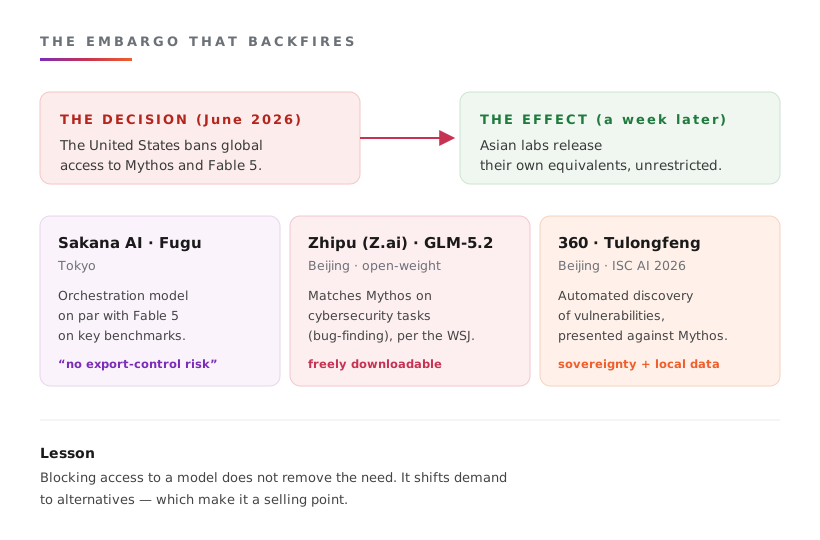
Sources: TechCrunch, Wall Street Journal (via The Verge), ISC AI 2026.
2. The selling point: "no export-control risk"
This is the point that should command attention. When a customer is refused access to an American model, they do not give up on AI: they look for a provider without that constraint. The embargo turns a relative technical weakness (Asian models often remain behind on general uses) into a commercial strength (they, at least, are available). Guaranteed availability becomes as powerful an argument as performance.
3. Why containment backfires
The American strategy rests on a bet: maintain a lead durable enough for the rest of the world to depend on American models. That bet assumed the lead would be long. Yet the gap is narrowing, particularly in specific areas such as cybersecurity, where a Chinese open model already claims parity.
As a result, the embargo produces two effects contrary to its intent. It accelerates the release of alternatives, by creating captive demand ready to adopt them. And it legitimises those alternatives, by giving them a clear narrative: "we, at least, will not cut off your access". This is the classic limit of any technological containment: it works as long as the lead is massive, and backfires as soon as it becomes catchable.
This dynamic echoes what we observed in the hardware arena: export restrictions often accelerate the autonomy of those they target.
4. What it changes for a company
For a European company, the lesson is not to pick a side, but to understand that the model market is now fragmenting along two axes, not one. The first, familiar, is performance. The second, new, is the access regime: is a model available unconditionally, where is the data hosted, can access be suspended by a political decision?
In practical terms, evaluating a model in 2026 is no longer just a matter of comparing benchmarks. It also means looking at the provider's jurisdiction, its dependence on government authorisations, and the portability of your solution to an alternative. A slightly less performant model that is durably available and compliant with your data constraints may be the best choice.
Frequently asked questions
Which Asian alternatives to Mythos have appeared?
Sakana AI (Tokyo) with Fugu, at the level of Fable 5 on key benchmarks; Zhipu (Z.ai) with GLM-5.2 as open-weight, presented as matching Mythos in cybersecurity; and 360 Security (Beijing) with Tulongfeng for vulnerability discovery.
Why do we speak of an embargo that backfires?
Because the American ban, meant to preserve a lead, has created a pull for Asian alternatives, which sell precisely on what American models can no longer offer: no export-control risk, local data, multilingual support.
What does this mean for a European company?
That the market is fragmenting by geography and access regime, not only by performance. This strengthens the case for not depending on a single provider and for evaluating models on their lasting availability and data location.
Conclusion
The episode is a textbook case of technology policy. In seeking to deprive the world of its best models, the United States has handed Asian laboratories both a market and an argument. Containment does not create the vacuum it imagines: it creates a demand that others are quick to satisfy.
For the rest of the world, the lesson is broader than the Sino-American rivalry. In a market where access to the best models can close for political reasons, real resilience comes not from aligning with a camp, but from the ability not to depend irreversibly on any single provider.