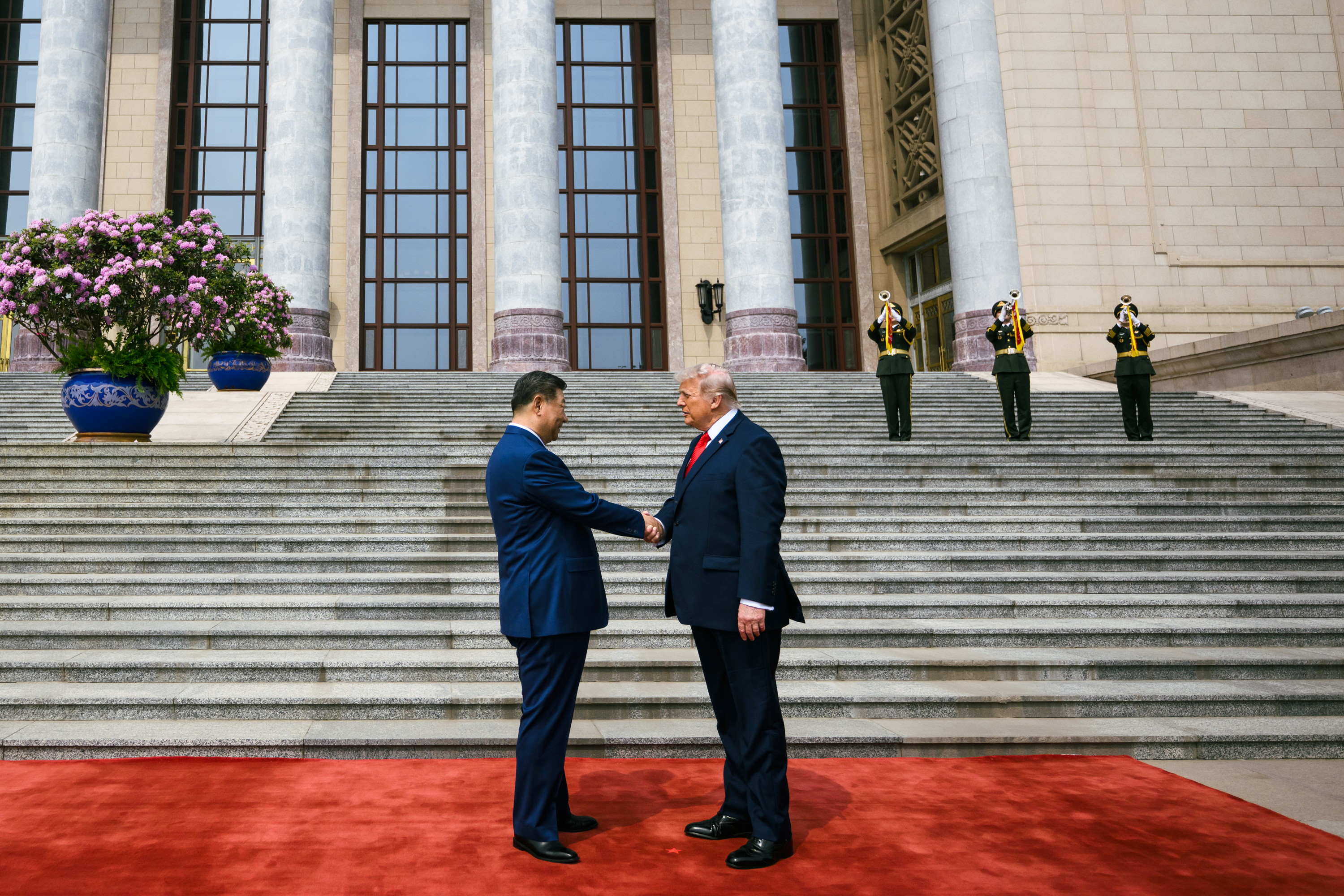
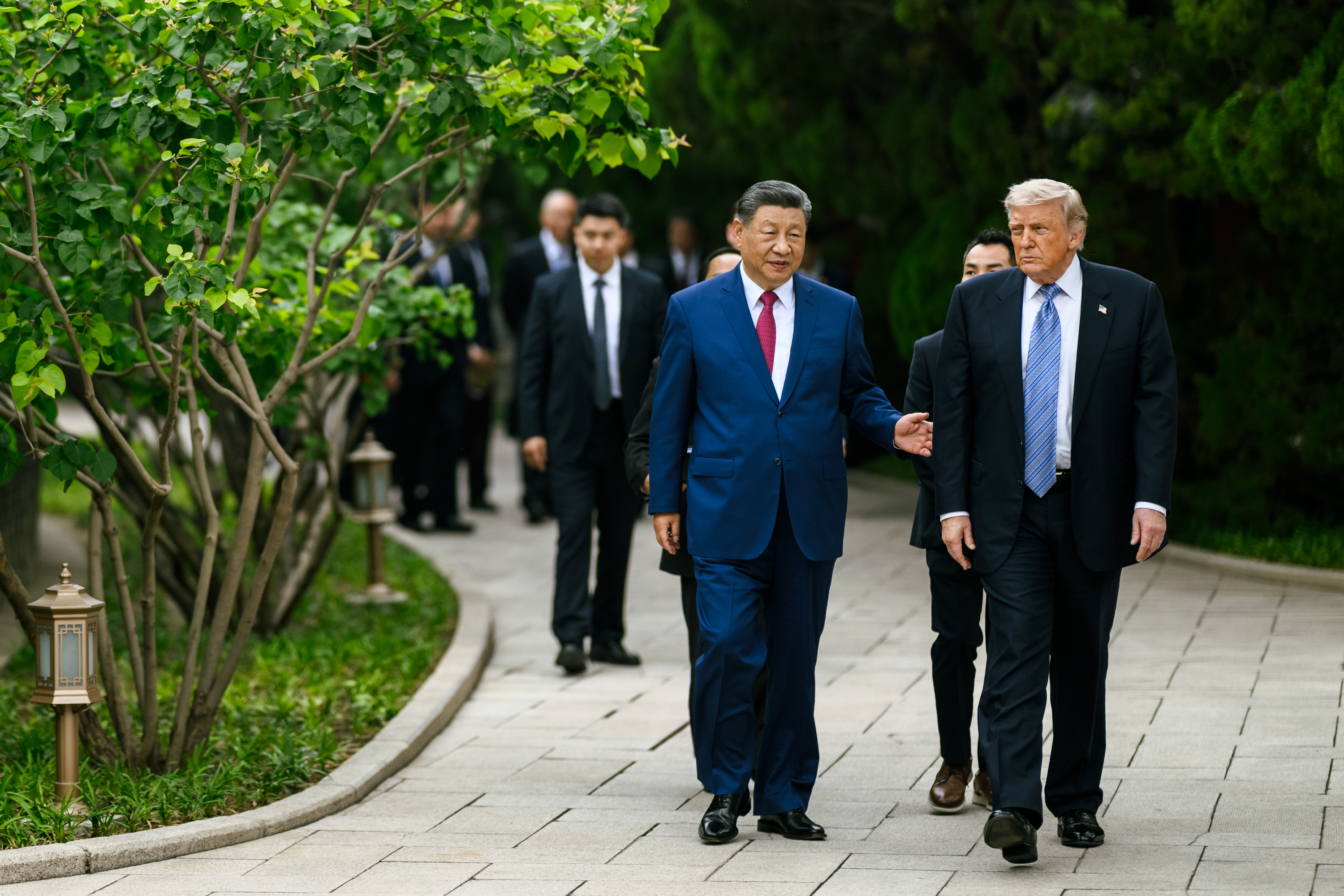
For five years, the American doctrine of technological containment was built on a simple premise: depriving China of access to the most advanced chips would slow its catch-up in artificial intelligence. On 14 May 2026, beneath the gilding of the Temple of Heaven in Beijing, that premise wavered. Not because Donald Trump obtained a diplomatic breakthrough. On the contrary: because Xi Jinping politely declined to buy the 750,000 Nvidia H200 chips that the American administration had officially authorised. The first bilateral summit of the Trump-2 era on Chinese soil, the first American presidential trip since 2017, the Beijing 2026 meeting produced no substantive agreement. But it revealed a tipping point that markets and chancelleries are still digesting.
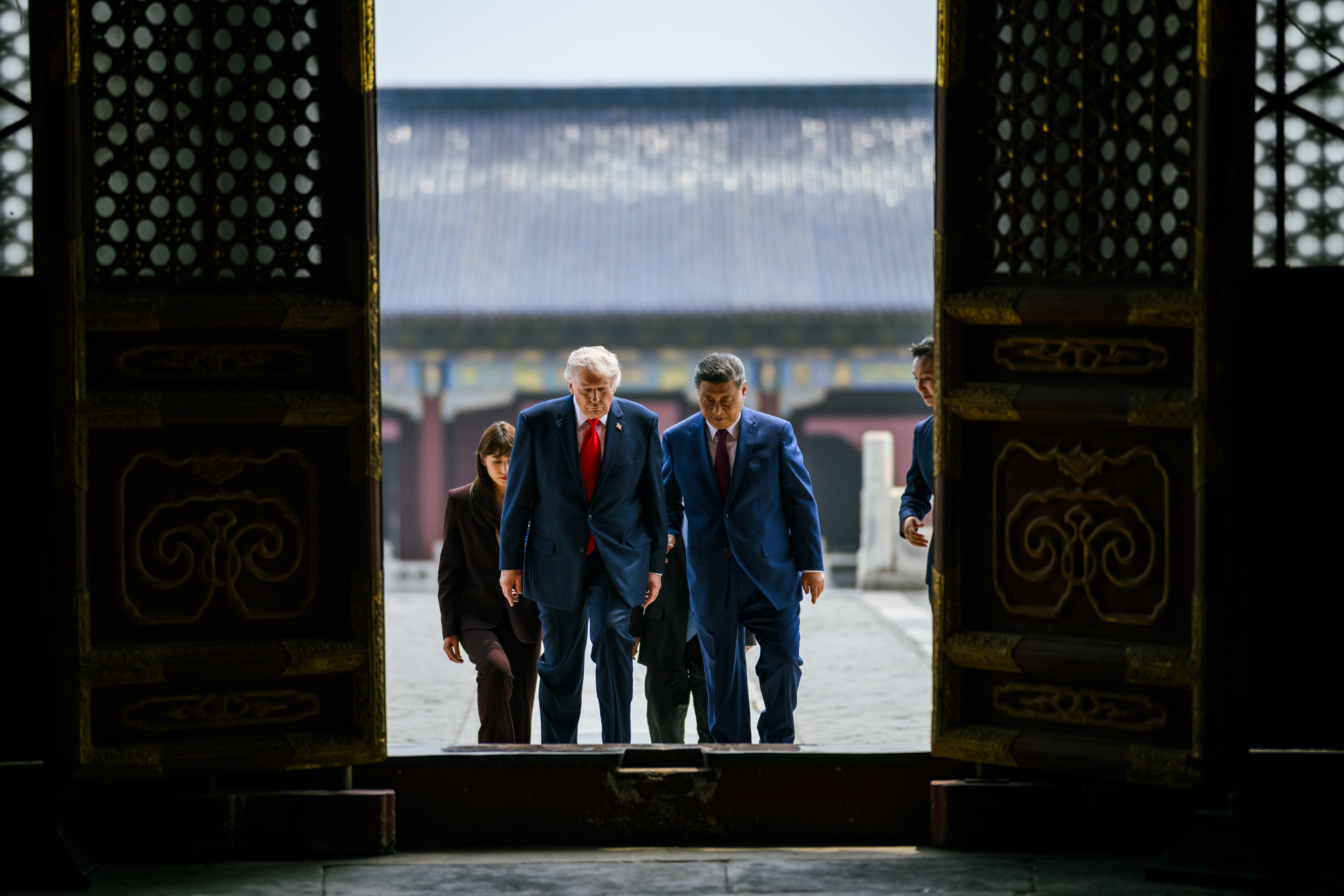
Wikimedia Commons · Donald Trump visit to China, May 2026
1. The inverted asymmetry
To understand the scale of the reversal, we need to return to the framework. In January 2026, the US Department of Commerce formalised an unprecedented architecture: Nvidia can now sell its H200 chip in China, provided that transactions physically pass through American soil and that the US Treasury takes 25% of the revenue. Ten major Chinese companies are approved — Alibaba, Tencent, ByteDance, JD.com, and six others. Each buyer can acquire up to 75,000 H200s, which brings the aggregate ceiling to 750,000 units, a volume capable of absorbing several tens of billions of dollars of revenue for Nvidia.
Everything was in place. Licences were issued as early as December 2025. Commerce Secretary Howard Lutnick confirmed to the House, in April 2026, that not a single chip had been shipped. With good reason: Beijing had quietly instructed its own companies to defer any order.
The Beijing summit opens in the midst of this paradox. Donald Trump arrives at the head of a heavyweight delegation — Jensen Huang (Nvidia), Elon Musk (Tesla, xAI, SpaceX), Tim Cook (Apple), Kelly Ortberg (Boeing), accompanied by a dozen American business leaders. Chinese Premier Li Qiang receives them. Xi Jinping repeats to them the consecrated formula: “China will open up further”. But the expected orders do not arrive.

Sources: CNBC · SCMP · Tom’s Hardware.
What happened in Beijing is therefore not a renegotiation. It is the public staging of a finding: the American doctrine of containment through supply has reached its limits, because China has decided to turn its disadvantage into a strategy.
2. Beijing’s calculation: pay now, win later
Three readings overlap to explain the Chinese refusal. The first, the most solid, is strategic. Chinese decision-makers have judged that the short-term cost — losing 12 to 18 months of frontier AI performance — is lower than the long-term benefit: becoming independent of the American bottleneck. This is exactly the reading of the Center for Strategic and International Studies, which speaks of a “grand bargain for China”. CSIS analysts note that Beijing “appears prepared to absorb short-term pain in exchange for durable insulation from American chokepoints on chip technology”.
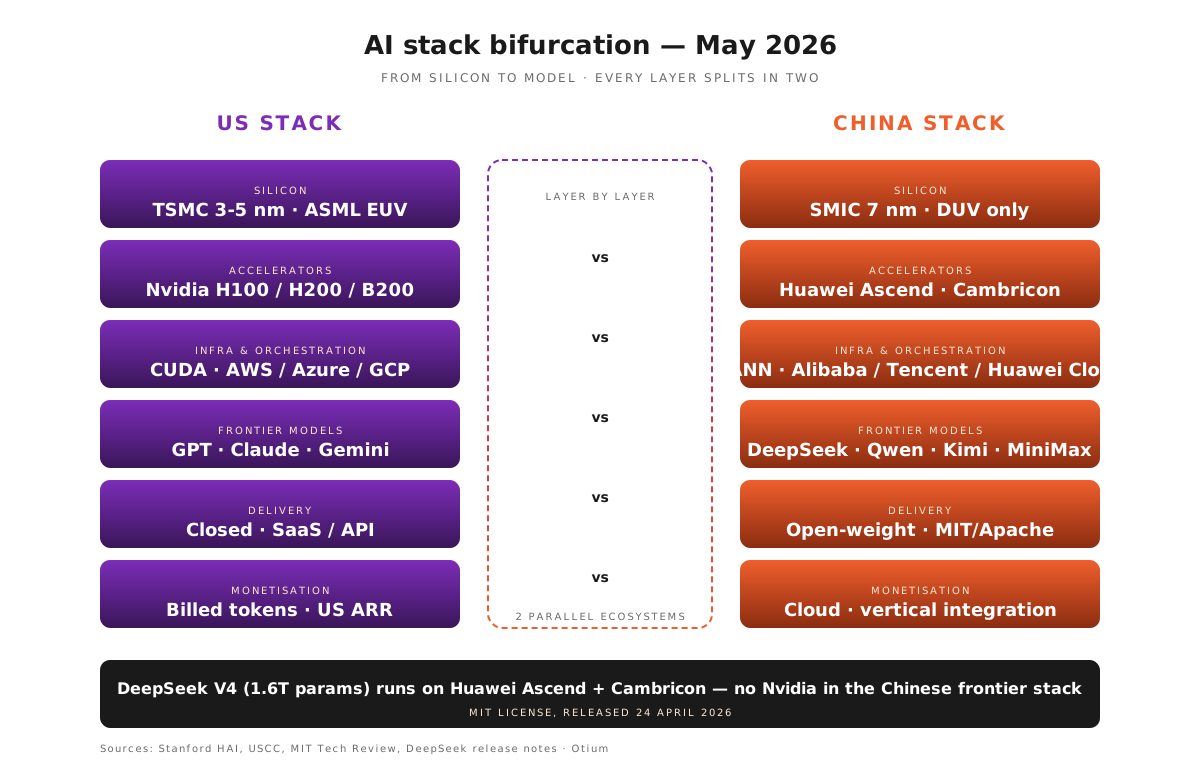
This strategy has a face: Huawei and Cambricon. Huawei’s Ascend chips and Cambricon’s chips, long mocked as inferior copies, now run DeepSeek V4 — a frontier model with 1.6 trillion parameters and a one-million-token context window, released under the MIT License on 24 April 2026. This is no longer promotional R&D. It is deployment at scale, on 100% domestic infrastructure. The sequence is instructive: DeepSeek R1 had been trained on Nvidia; V4 no longer is.
The second reading, complementary, is tactical. Keeping the unmet H200 demand in reserve gives Beijing leverage for the next negotiating cycle. As long as Beijing has not ordered, Washington is under pressure — political, media, market. Nvidia’s stock lost nearly $170 billion of market capitalisation within hours when the market realised that zero chips had been ordered. The silent threat is often worth more than the blow struck.
The third reading, the least documented but worth mentioning, concerns security. Several Beijing analysts have publicly raised the fear that chips routed through American soil might contain mechanisms for surveillance or remote deactivation. This concern is largely speculative, but it plays a political role: it legitimises the refusal in the eyes of domestic opinion.
3. The Jensen Huang gamble
Wikimedia Commons · Pronoia · CC0
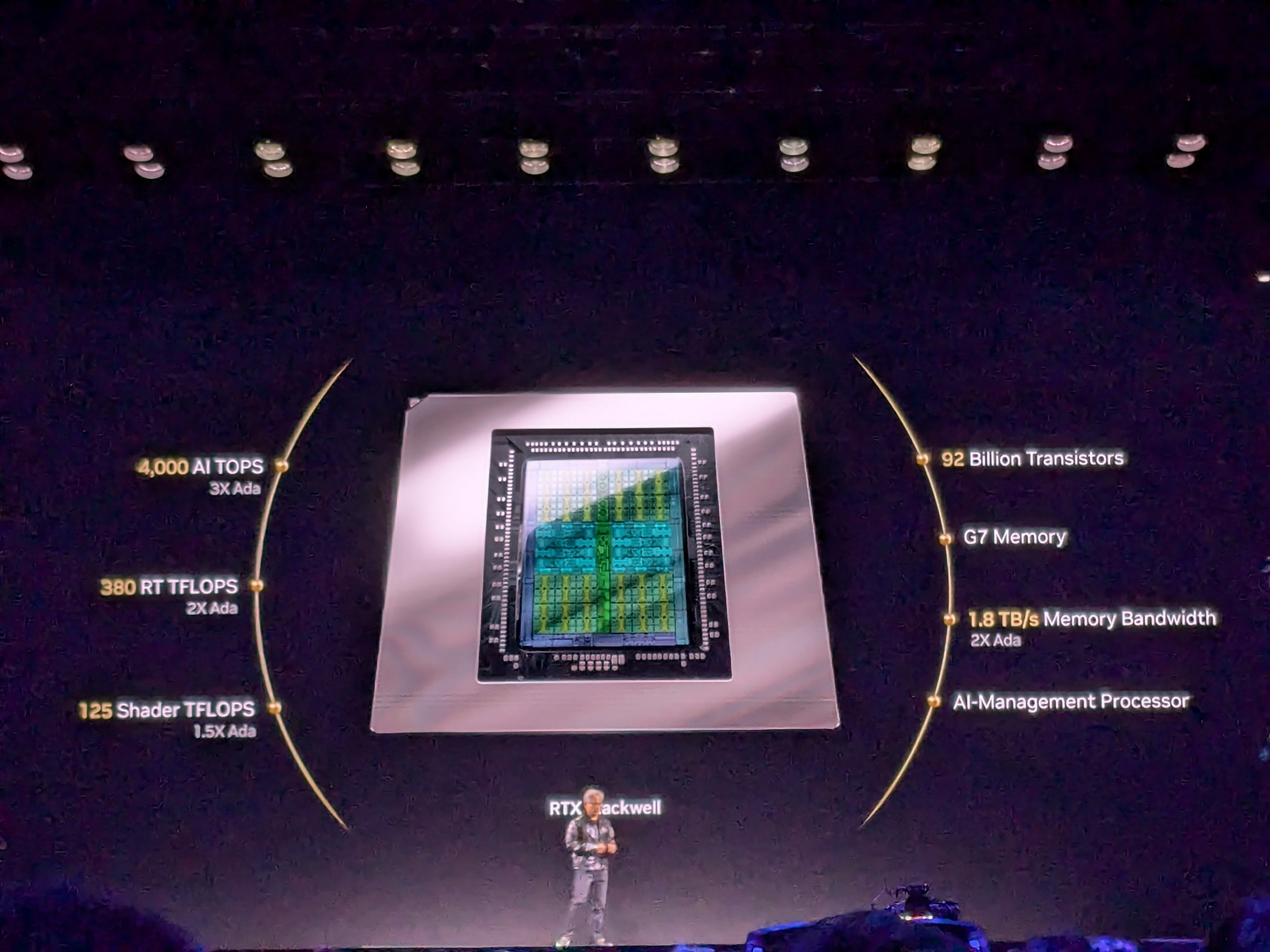
The addition of Jensen Huang to the delegation is the clearest signal of the importance AI policy took on the summit agenda. According to CNBC, his name was added at the last moment. He hoped to obtain an unblocking of H200 purchases. He leaves with nothing. According to figures released by Nvidia, China now represents only 5% of the company’s revenue — against about 13% historically — and Nvidia’s market share in advanced AI accelerators in China has, in its own words, “fallen to zero”.
This is an unprecedented situation. During the 2010s, Nvidia built its hyper-dominance thanks to a continuously expanding Chinese market. In 2026, that same market is closed to it not by American decision, but by Chinese decision. The pressure on valuation is measurable: while the stock gained 4% on the announcement of the licences, it lost 3% when the absence of deliveries was made public — nearly $170 billion of market capitalisation wiped out within hours.
4. AI safety: a protocol without commitment
The only visible product of the summit on the AI front is a protocol — not a treaty — on the safety of frontier models. Announced by Treasury Secretary Scott Bessent, its scope is deliberately narrow: preventing the exploitation of the most powerful models by non-state actors — criminal groups, terrorists, organisations seeking to disrupt the financial system or to produce biological weapons.
The construction of this sentence deserves to be weighed. The dialogue is explicitly conditioned on a presumed asymmetry. If the gap narrows — and DeepSeek V4 suggests that it is narrowing — American willingness to cooperate will mechanically diminish. For a founder or an investor in the sector, the signal is clear: the window for a cooperative bilateral AI framework is open for 18 to 36 months at most.
What the protocol does not include deserves emphasis. No limitation on military uses. No constraint on compute. No mutual verification. No transparency on open-source. No framework on mass surveillance. In other words, everything that constitutes the strategic core of AI — defence, infrastructure, data — remains exclusively national, and exclusively unilateral. Global AI governance, as seen by Washington and Beijing, is not a joint project. It is a shared stage for diverging national policies.
5. The MATCH Act: the real front
While the cameras filmed the Temple of Heaven, the American Congress was advancing legislation that worries Beijing far more than controls on finished chips: the MATCH Act. Its aim is to tighten export controls on the equipment needed to manufacture chips — DUV lithography foremost — and it names Huawei, SMIC and YMTC. Above all, it requires the Netherlands (ASML) and Japan (Tokyo Electron) to align their own controls within 150 days, on pain of American retaliation across their entire supply chain. China’s Ministry of Foreign Affairs publicly attacked the text on the eve of the summit, calling it an “excessive extension of the concept of national security”.
This is where the real chip war of 2026-2027 is being fought. Cutting off equipment blocks production at the structural level. Cutting off finished chips blocks only consumption. Chips can be worked around — through strategic stockpiling, algorithmic optimisation, open-weight models distributed worldwide. Machines, by contrast, are irreplaceable over a decade. And that is why Beijing concentrated its diplomatic energy on the MATCH Act, and why US Trade Representative Jamieson Greer ultimately admitted that “export controls on chips were not a major topic at the summit”.
The Beijing summit was not the central arena. It was the media cover.
6. The bifurcation of stacks
Sources: Stanford HAI · USCC · MIT Tech Review.
This matrix summarises the real stakes. The United States dominates where innovation is concentrated in a few players (Nvidia, ASML, TSMC, OpenAI/Anthropic/Google). China dominates where physical dependence is massive (rare earths, refining). Both countries are engaged in a race in which each tries to reach autonomy where the other holds a bottleneck. The Beijing summit neither accelerated nor slowed this race. It simply made official the fact that it is now structural, non-negotiable, and lasting.
7. Taiwan, rare earths, Iran: the unresolved triangle
Wikimedia Commons · Donald Trump visit to China, May 2026
| Subject | Outcome as of 15 May 2026 | Strategic reading |
|---|---|---|
| Taiwan | No agreement. Xi: “mishandling Taiwan = great jeopardy”. Trump: “not settled” on arms sales. | Status quo — TSMC a silent beneficiary (ADR +4.5% on 14 May). |
| Rare earths | Chinese exports ~50% below pre-restriction levels. No quantified agreement. | Leverage retained by Beijing for the next rounds. |
| Iran | Major subject internally. No substantive public Chinese commitment. | A failed test of Chinese influence over Tehran. |
| Tariffs | Probable extension of the Busan ceasefire for a year. | An observation period, neither peace nor war. |
| AI safety | Non-binding protocol, non-state actors scope only. | First official channel, but without operational substance. |
| Reciprocal visit | Xi will visit the United States in autumn 2026. | Balanced symbolic framework, next meeting in the autumn. |
8. The discreet winners
Three players emerge strengthened without having negotiated.
TSMC first. Donald Trump’s rhetoric on Taiwan — accusing the island of having “stolen” the American chip industry and of having to “pay for its protection” — was followed by no action. On the contrary, the Taiwanese manufacturer saw its ADR rise 4.5% on the Thursday of the summit, and reaffirmed that the global semiconductor market would exceed $1,500 billion in 2030. As long as TSMC keeps its monopoly on the most advanced nodes, neither Washington nor Beijing can seriously destabilise it. The status quo is its best insurance policy.
Huawei and Cambricon next. The Chinese refusal to buy H200s turns their domestic market into a captive one. A national political order amounts to a launch pad for their ecosystem — developer training, framework optimisation, vertical integration. If the current trajectory is confirmed, Huawei Ascend will become the Chinese datacentre standard in 2027.
Europe finally, by default. The announced merger between Cohere (Canada) and Aleph Alpha (Germany), Mistral’s valuation at $14 billion with ASML leading the latest round, the emergence of an “AI middle power” narrative — all benefit mechanically from Washington-Beijing instability. But Europe has done nothing to deserve it, and the commercial window opened by this sovereignty premium is limited to 12 to 18 months. If Brussels, Berlin and Paris do not translate this opportunity into real infrastructure (sovereign datacentres, competitive models, supply chain), it will close.
9. Three scenarios at 12 months
| Scenario | Probability | Triggers | Consequences |
|---|---|---|---|
| Optimistic | ~20% | Xi’s visit to Washington in autumn 2026 unblocks H200, AI safety extension >10²⁶ FLOPS. | Nvidia / TSMC / ASML valuations +20 to +30%. |
| Realistic | ~55% | Stabilisation without agreement, symbolic H200 deliveries, MATCH Act passed. | Binary volatility on every regulatory announcement. |
| Pessimistic | ~25% | Taiwan incident or Chinese weaponisation of rare earths. | Declared decoupling, Nvidia -30 to -50%, EU AI Act accelerated. |
10. Five non-consensus insights for AI founders and investors
- The real blockage is no longer American supply, it is Chinese demand. The “US contains China” narrative has had its day. Building an investment thesis on the opposite hypothesis — “Beijing accepts its Nvidia dependence” — becomes highly risky.
- The 25% revenue share is a major fiscal precedent. For the first time, Washington levies a rent on the export of a private technology. If this model spreads (drones, satellites, biotech), it transforms American trade doctrine.
- Chinese open-weight is now the main threat to leading American labs — not chips. DeepSeek V4 proves that a sustained improvement trajectory is possible without Nvidia. Export controls become circumventable through the worldwide distribution of free weights.
- The myth of a global AI governance of the COP type is officially buried. Regulation will be national, by bloc, fragmented. Preparing a compliance strategy by jurisdiction is now an obligation, not an advantage.
- TSMC remains the silent pivot. Trump’s anti-Taiwan rhetoric is tactical, not strategic. Any investor exposed to advanced semiconductors should assume that the TSMC status quo holds — barring a major geopolitical incident — at least until 2028.
11. Strategic conclusion
The Beijing summit of 14-15 May 2026 confirmed one thing: the great technological competition between the United States and China is no longer a war of containment, it is a war of symmetrical sovereignty. Each seeks to reach autonomy where the other holds a bottleneck — Washington on frontier compute, Beijing on rare earths and volume production. Dialogue is now a diplomatic formality that accompanies, without slowing it, the deep bifurcation of the two ecosystems.
For AI entrepreneurs and investors, the operational signal is threefold: avoid binary bets on the opening of the Chinese market, value compute diversification and supply-chain resilience, and anticipate regulatory fragmentation as a structural cost, not as a one-off event.
The era of summits that change the trajectory is probably over. It is now between summits, in the committees of the American Congress, the offices of China’s Ministry of Industry and Information Technology, and the datacentres of Hsinchu, Veldhoven and Shenzhen, that the future of global artificial intelligence is being decided.
To go further on AI sovereignty and compute infrastructure: read our analyses DeepSeek V4: China no longer needs Nvidia and USA, Europe, China: AI shifts into its moment of fission.