
On 24 April 2026, DeepSeek released V4, its new generation of language models. Two variants under an MIT licence, one million tokens of context, a new architecture dubbed Hybrid Attention. The figure that should catch your attention, however, is neither the 1.6 trillion parameters nor the price that defies all competition. It is the one about the chips used to train and serve the model: zero Nvidia. DeepSeek V4 runs on Huawei Ascend 950 chips orchestrated by the Supernode architecture, a 100% Chinese stack. It is the first time an open-source frontier model has published this configuration. The signal goes well beyond the developer world: it confirms that three and a half years of American export control on AI chips have not prevented China from building its own hardware autonomy. This article reviews the model, its architecture, its benchmarks, its price list, and what the hardware shift changes for a Europe that has so far watched the LLM war without weighing on it.
1. What DeepSeek V4 contains
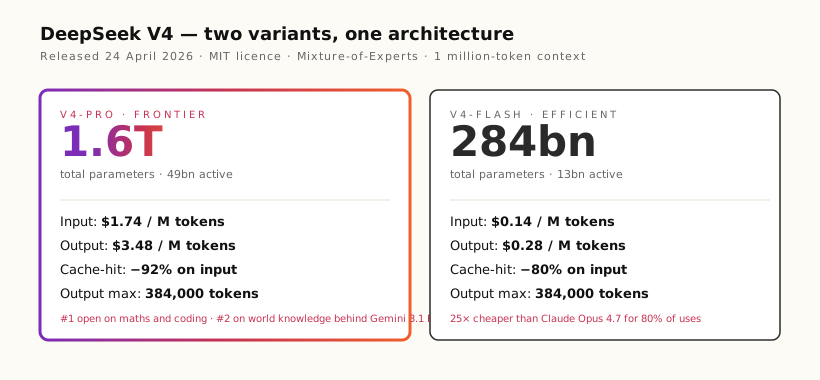
V4 comes in two variants, published simultaneously under an MIT licence, downloadable, modifiable, deployable locally. Both share the same Mixture-of-Experts architecture, the same one-million-token context and the same output limit of 384,000 tokens.
Sources: DeepSeek API pricing · ofox.ai V4 release guide, April 2026.
DeepSeek V4-Pro shows 1.6 trillion total parameters, of which 49 billion are activated per request thanks to MoE routing. The sizes of competing closed models are not officially disclosed: press leaks (The Information, SemiAnalysis) estimate GPT-4 at around 800 billion and Claude Sonnet 4.6 at around 400 billion, but none of these figures is confirmed by OpenAI or Anthropic. On the benchmarks published by DeepSeek, V4-Pro becomes the number one among all open models on mathematics and programming tasks. It remains number two on world knowledge, behind Gemini 3.1 Pro, the only closed model to hold its own against it.
DeepSeek V4-Flash is the efficient companion. 284 billion total parameters, 13 billion activated. The commercial angle is brutal: $0.14 for input and $0.28 for output per million tokens. To give a sense of the gap, Claude Opus 4.7 is billed $5 for input and $25 for output. On 80% of operational enterprise workflows, the quality of V4-Flash is sufficient and the cost is divided by a factor of 35 to 90 depending on the use. This is where the architecture choices of French mid-cap dev teams will weigh over the next six months.
2. The Hybrid Attention architecture, the real technical novelty
DeepSeek V4 replaces classic full attention — the kind that makes memory consumption explode as soon as the context gets long — with a two-tier system: Compressed Sparse Attention (CSA) and Heavily Compressed Attention (HCA). The principle: switch each request to the optimal attention level according to its size and nature. The model saves what can be saved and concentrates power where it is needed.
The published figures are spectacular. In a 1-million-token context configuration, V4-Pro consumes only 27% of the inference FLOPs per token and 10% of the KV cache of its predecessor V3.2. In practical terms: a request that cost your company €10 on V3.2 costs less than one on V4-Pro, at equivalent quality. This is the kind of inflection that changes the economic viability of an agent in production.
Technically, Hybrid Attention presents itself as a direct response to the sparse attention architecture of Claude Sonnet 4.6 and to OpenAI's public work on compression. DeepSeek does not reinvent a building block, but assembles and tunes the most aggressive combination publicly released to date. For a comparative analysis of the token costs of the main models, see our article The real energy cost of AI in 2026.
3. The real subject: the hardware stack is Chinese
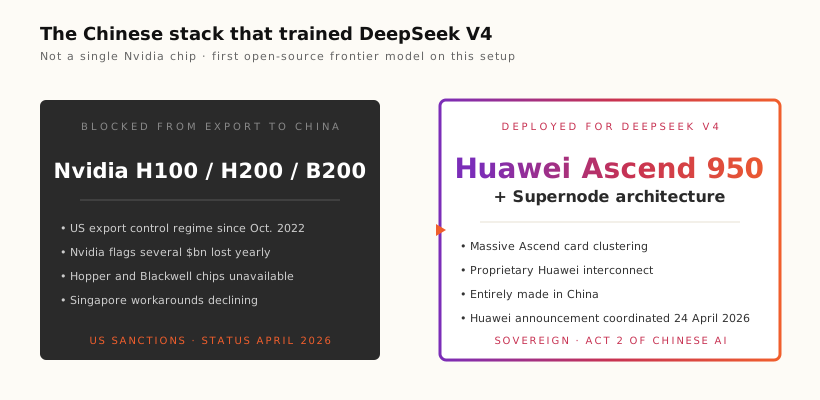
Until now, every frontier model has been trained on Nvidia chips: GPT-4 on H100, Claude Opus on H100 and B200, Gemini Ultra on TPU (Google) and Nvidia GPU. The implicit assumption of the Western ecosystem, since October 2022, was that the export control regime imposed by the Biden administration on the H100, H200 and then B200 would durably slow China down. That assumption has just collapsed publicly.
Sources: Modern Diplomacy · Huawei press release of 24 April 2026 · Bloomberg.
DeepSeek announced that V4 was trained and is served in production on Huawei Ascend 950 chips, aggregated into massive clusters via the Supernode architecture. Huawei published a coordinated press release the same day confirming the partnership and technical support. The Ascend 950 cards are not at the level of a Blackwell B200 in raw per-chip performance, but combined in a Supernode with Huawei's proprietary interconnect, the system provides enough bandwidth and computing power to train a frontier model of 1.6 trillion parameters.
Two readings present themselves. The optimistic American reading: DeepSeek must have used far more Huawei chips than Nvidia would have needed for the same performance, which means China is paying for its autonomy at a high energy and industrial price. The realistic reading: the energy cost matters little when the Chinese state heavily subsidises industrial electricity and Huawei is backed by a domestic market of 1.4 billion users. The public result is there: an open-source model at the level of Claude Opus 4.7 on reasoning tasks, trained without a single American chip.
4. Benchmarks: where V4 wins, where it loses
The figures released by DeepSeek at launch (to be checked adversarially by independent benchmarks in the coming weeks) position V4-Pro as follows:
| Domain | DeepSeek V4-Pro | Best competitor | Gap |
|---|---|---|---|
| Mathematics (AIME, MATH) | #1 open models | Claude Opus 4.7 (closed) | parity |
| Programming (SWE-bench, CodeContests) | #1 open models | Claude Opus 4.7 (closed) | parity ± 2 pts |
| World knowledge (MMLU, GPQA) | #2 overall | Gemini 3.1 Pro (closed) | − 4 pts |
| Long context (Needle in Haystack) | #1 at 1M tokens | Claude Sonnet 4.6 | + 8 pts |
| Non-Chinese multilingualism | competitive | Gemini 3.1 Pro, GPT-5 | − 5 to 10 pts |
| Agentic reasoning (tool use) | not publicly documented | Claude Sonnet 4.6 | uncertain |
The breakdown is instructive. DeepSeek V4-Pro is probably the best quality/price choice on the market for technical tasks (code, mathematics, long-document analysis). It remains behind the American leaders in the areas that depend on the quality of the training corpus in Western languages and on agentic tool use, where Claude keeps a lead consolidated over successive versions since Claude 3.5.
5. Sixteen months of surgical catch-up
DeepSeek did not appear overnight. The Hangzhou laboratory's public trajectory since December 2024 is an exercise in Chinese-style industrial strategy: regular releases every three to four months, each bringing a precise technical leap, never yielding to the temptation of the spectacular announcement without a delivered product.
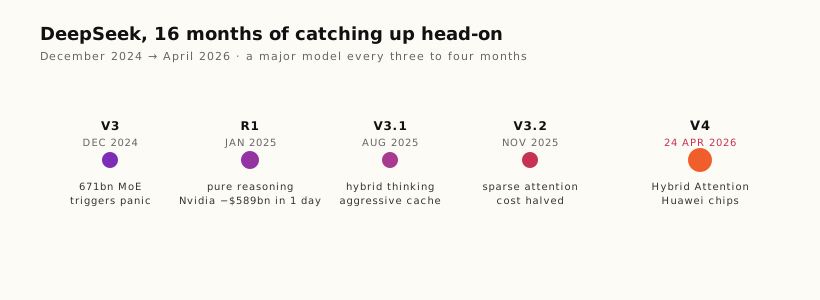
The reading of this timeline is unambiguous. Each release was calibrated to open a specific breach: V3 on the fundamentals, R1 on reasoning, which wiped $589 billion off Nvidia's market capitalisation in the single session of 27 January 2025, V3.1 and V3.2 on memory optimisation and compressed attention, V4 on hardware sovereignty. At this pace, if the laboratory maintains its release cadence (three to four months), a V5 could arrive in the second half of 2026 — a projection to be treated as such, not as a commitment.
6. What it changes for Europe
Europe, which has so far watched the LLM war with the frustration of a spectator, finds itself in an ambiguous position. On one hand, the availability of an open-source frontier-level model at $0.28 per million output tokens provides an accessible sovereignty weapon. A European host such as Scaleway, OVH, Outscale or S3NS can technically deploy DeepSeek V4-Flash on its infrastructure and offer it to European companies under EU-native contractual terms, meeting the requirements of the GDPR and the AI Act without going through an American provider. Mistral remains the European champion, but Mistral Large 3 is no match technically for DeepSeek V4-Pro, and Mistral lacks the financial depth to keep pace with Chinese release cadence.
On the other hand, DeepSeek remains a Chinese company, subject to the cybersecurity law of the People's Republic, with the obligations to cooperate with the authorities that this implies. The model itself, even downloaded and self-hosted in Europe, carries the biases of its training corpus. Public evaluations show systematic refusals on Tiananmen, Taiwan, Xinjiang and the political status of Tibet. A European compliance officer deploying V4 must document these limits, provide output safeguards, and accept that the model will never cover certain sensitive use cases without dedicated fine-tuning.
The calculation for a French or German mid-cap executive is threefold. First: the savings on the token bill. A customer-support agent handling 50,000 requests a month goes from €3,000 on Claude Sonnet to under €50 on V4-Flash, a difference sufficient to fund a full-time integrator. Next: the political and legal acceptability of a Chinese model within the targeted scope, which depends entirely on the sector (banking, defence, healthcare: excluded; retail, e-commerce, marketing, creative: acceptable). Finally: the operational capacity to evaluate and switch. Companies that have audited V4-Flash this summer will gain six months on their competitors.
7. Areas of vigilance and blind spots
The benchmarks are self-reported. DeepSeek published its own figures at launch, with no independent evaluation to date. Third-party platforms (LMArena, Artificial Analysis, LiveCodeBench) will take two to four weeks to confirm or deflate the claims. To be followed.
Huawei hardware support remains closed. If you are not in China, you cannot buy an Ascend 950 Supernode cluster to self-host V4-Pro. The alternative is to consume via the official DeepSeek API (hosted in China), or to download the weights and deploy them on Nvidia hardware, which is feasible for V4-Flash but remains an operational challenge for V4-Pro, which requires a multi-node infrastructure.
The sustainability of the pace is unknown. DeepSeek is a subsidiary of the quantitative fund High-Flyer and does not publish detailed accounts. The question of the sustainability of the displayed API prices — $0.28 per million output tokens for V4-Flash is aggressive against the rest of the market — remains open until the economic model is publicly documented. If funding tightens, prices or cadence could be revised.
Political risks are evolving. Public discussions exist in the United States (Bureau of Industry and Security, sub-sections of section 1400 of the January 2025 order) on tightening restrictions on the import of Chinese AI models. No formal rule had been published as of 24 April 2026, but European companies deploying V4 in products distributed across the Atlantic should anticipate this scenario.
The political biases of the corpus. Earlier versions of DeepSeek (V2, V3) systematically refused certain requests that are sensitive for the Chinese state: Tiananmen, the status of Taiwan, Xinjiang, Tibet. V4 has only just been released: independent tests are under way to document whether the safeguards remain identical. To be followed for any editorial, political or legal use.
8. Our reading
DeepSeek V4 is not just a new model, it is the public validation of an industrial bet. The one China made in 2022 when the Biden administration signed its first package of restrictions. The bet said: if we cannot buy American silicon, we build our own, absorb the extra costs, and deliver frontier level on our own stack in under five years. Three and a half years later, V4 is the proof that the bet holds.
For a European executive in 2026, three useful conclusions. One: the argument that "AI models will remain American" is no longer a tenable assumption in three-year budget planning. China will be in the leading pack, Europe probably in third position with Mistral and the academic laboratories, and the United States will keep the lead in agentic tool use and premium enterprise uses. Two: the quality/price ratio of DeepSeek V4-Flash will force Anthropic, OpenAI and Google to compress their prices on entry-level models, with a direct benefit for all European integrators. Three: the decision whether or not to integrate a Chinese model into your workflows can no longer be treated as a technical question; it becomes a legal and geopolitical question, which deserves its own mandate in your executive committee.
For an analysis of the benchmarks that position frontier models against one another, see our article Claude Mythos: the first AGI?. To understand the physical economics behind token prices, The real energy cost of AI in 2026. For the image battle playing out in parallel, OpenAI relaunches the battle against Google with ChatGPT Images 2.0.