

Between November 2025 and April 2026, the artificial intelligence industry saw, in succession, the public departure of one of its founding fathers, the opening of formal European investigations against Grok, the announcement of a vertical foundry worth $25 billion, the administrative exit ban on two Chinese founders, a weekly frontier cadence in April, and a fall in the cost of inference by a cumulative factor of a thousand in eighteen months. Put end to end, these news items tell something other than what each tells separately. The dominant paradigm is cracking in silence, while the official narrative keeps turning up the volume.
Contents
1. The timeline no outlet has put back together
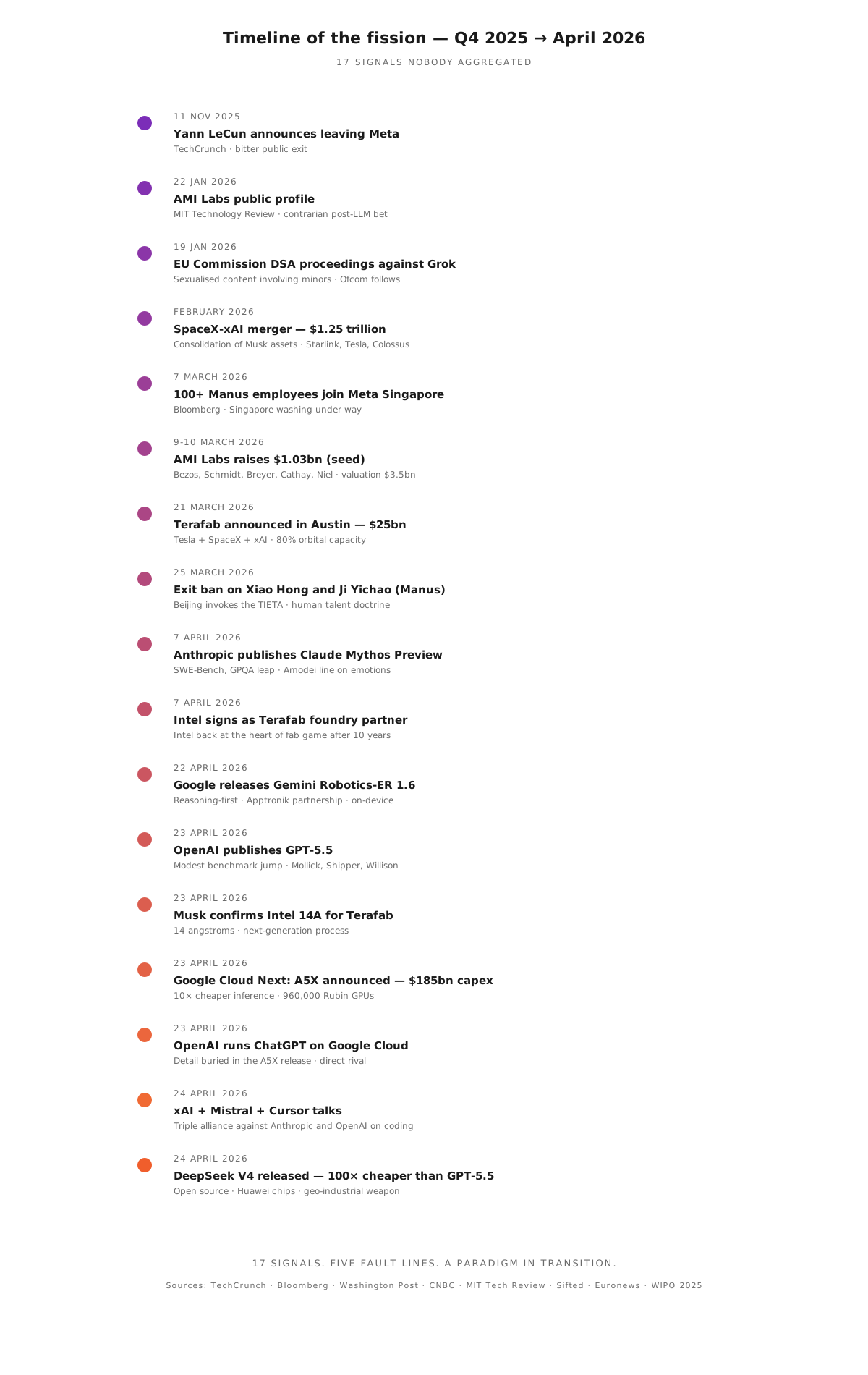
11 November 2025. TechCrunch publishes the news: Yann LeCun, Meta's chief AI scientist, is preparing to leave. CNBC confirms it on 19 November. Meta spent the year disbursing hundreds of millions to recruit or retain frontier researchers in the talent war launched by Mark Zuckerberg. It failed to retain the holder of a Turing Award and the father of convolutional deep learning. The exit is publicly bitter. LeCun tells The Decoder: "You certainly don't tell a researcher like me what to do."
22 January 2026. MIT Technology Review publishes the profile of AMI Labs, presented as LeCun's contrarian bet against LLMs. The company was officially founded in late 2025, with Alexandre LeBrun as CEO and LeCun as executive chair. The lab is still low-profile, with an office in Paris.
19 January 2026. The European Commission opens formal proceedings against X under the Digital Services Act, over Grok's generation of sexualised content involving women and minors. Ofcom follows in the United Kingdom. A RAND note published on 14 February describes the situation as a regulatory reckoning for Elon Musk. As of that date, selling Grok to a European bank, a health insurer or a public administration becomes a reputational risk that legal departments flag.
February 2026. SpaceX absorbs xAI in a merger valued at $1.25 trillion. The move consolidates Musk's assets: Starlink satellites, rockets, data centres, Grok models, the Colossus supercomputer in Memphis, and soon a foundry. At the time, the move is understood as a defensive repositioning. Six weeks later, the full ambition is revealed.
7 March 2026. Bloomberg reports that more than a hundred employees of Manus, an AI-agent start-up founded by the Chinese nationals Xiao Hong and Ji Yichao, were transferred to Meta's Singapore office in early March. Manus spent 2025 relocating out of mainland China.
9-10 March 2026. AMI Labs announces the closing of its seed at $1.03 billion, pre-money valuation $3.5 billion. One of the largest seed rounds ever closed anywhere in the world. Round co-leads: Cathay Innovation (France), Greycroft (USA), Hiro Capital (UK), HV Capital (Germany), Bezos Expeditions (USA). Personal investors: Eric Schmidt, Jim Breyer, Mark Cuban, Mark Leslie, Tim Berners-Lee, Xavier Niel.
21 March 2026. Elon Musk takes the stage at the former Seaholm power plant in Austin and announces Terafab. A Tesla + SpaceX + xAI joint venture to build a vertically integrated semiconductor foundry. $25 billion. 2 nm process targeted. 100,000 wafer starts per month. 1 terawatt of AI compute produced per year. The detail nobody picks up in the French press: Musk indicates that 80% of Terafab's capacity will be dedicated to AI satellites in orbit, against 20% for terrestrial applications.
25 March 2026. The Washington Post, CNBC and TechCrunch simultaneously report that Xiao Hong and Ji Yichao are banned from leaving mainland China. Beijing invokes the Regulations on Technology Import and Export Administration — the TIETA — to examine whether the intellectual property of the Manus AI agent was transferred to Singapore without the required authorisations.
7 April 2026. Anthropic publishes Claude Mythos Preview. A benchmark leap on SWE-Bench, GPQA, CyberGym. Dario Amodei utters the sentence that will fuel commentary for weeks: Claude could, in coming versions, feel something close to an emotion. The sentence is not trivial. It is load-bearing in the AGI narrative that justifies Anthropic's valuations. See our analysis Claude Mythos: the first AGI?.
7 April 2026. Intel officially signs as Terafab's main foundry partner. TechCrunch, Tom's Hardware and Bloomberg cover the news. For ten years, Intel had lost the fab race to TSMC. The return through Musk's door recomposes the semiconductor value chain.
22 April 2026. Google DeepMind releases Gemini Robotics-ER 1.6, a reasoning-first model with amplified embodied reasoning capabilities. The partnership with Apptronik for the Apollo humanoids is extended. An on-device version is released for robot deployments disconnected from the cloud.
23 April 2026. OpenAI publishes GPT-5.5. The benchmark leap is more modest than GPT-5 vs GPT-4 — noted by Ethan Mollick, Dan Shipper and Simon Willison. See our detailed GPT-5.5 test. The same day, Musk confirms in Austin the use of Intel's 14 angstrom process for Terafab.
23 April 2026. At Google Cloud Next 2026, Google and NVIDIA announce the A5X infrastructure powered by Vera Rubin NVL72 systems. The promise: 10 times cheaper per token in inference, 10 times more throughput per megawatt, scaling up to 80,000 Rubin GPUs per site and 960,000 GPUs in a multi-site cluster. Google's AI infrastructure investment plan: $185 billion. A detail slipped into the press release and ignored by the French press: OpenAI runs ChatGPT on Google Cloud GB200 and GB300 instances.
24 April 2026. Sifted, Euronews and Investing.com report that xAI has held exploratory talks with Mistral and Cursor for a triple alliance against Anthropic and OpenAI on coding and agents. The same day, DeepSeek V4 is released. On some tasks, the API pricing of the Chinese open-source model runs about a hundred times cheaper than GPT-5.5. See our DeepSeek V4 analysis.
Sources: TechCrunch · Bloomberg · Washington Post · CNBC · MIT Technology Review · Sifted · Euronews · WIPO 2025
This six-month timeline has never been aggregated by a single article. The specialist press treats each episode separately. It is the aggregation that produces meaning. The AI industry has entered a period of fission. The axes that have stabilised it since 2022 are breaking down into several irreducible trajectories.
2. LeCun's bet against scaling



LeCun did not leave Meta over a strategic disagreement. He left over a fundamental scientific disagreement about what intelligence is and how it is built. The distinction matters. A strategic disagreement is settled through governance or partnership. A scientific disagreement is settled through five to ten years of research and cannot be decided by the current holders of industrial power.
His thesis, defended publicly since 2022 and now capitalised at $1.03 billion: large language models do not reason, they predict. The sentence seems trivial. Its consequences are not.
Hallucinating is not a bug of LLMs. It is their normal mode of operation. When a model produces an answer that is false but grammatically plausible, it is doing exactly what it was trained to do: predict the most probable continuation of a given text, conditioned by its training distribution. No amount of scaling changes the nature of this prediction. No addition of Reinforcement Learning from Human Feedback produces causal reasoning. No integration of external tools gives the AI an internal model of the world.
For an artificial intelligence to reason in the strong sense, says LeCun, it must be able to mentally simulate trajectories: if I do X, then Y happens, then I can do Z. This simulation capacity presupposes a substrate other than text. An internal model of the physical world, where objects have persistent properties, where actions have predictable consequences, where causality works. Human language does not contain this substrate. It talks about it, evokes it, describes it. It does not embody it. An LLM trained on the world's text learns a linguistic map of the world, not the world itself.
Saining Xie, Chief Science Officer of AMI Labs, on world models and leaving the LLM paradigm · YouTube, March 2026
If the architecture keeps its promises, two things change.
First, the nature of the data. The human textual web, which we have almost exhausted for training frontier LLMs, becomes secondary. The real reserve becomes the planet's video stream, which is orders of magnitude larger than any available textual corpus. If LeCun is right, we have not begun to train seriously.
Second, the underlying economics. Frontier LLMs have become capex assets. The moat of the sector's leaders is now their ability to burn billions in compute to train ever larger models. The barrier to entry is measured in tens of billions. If V-JEPA allows smaller models, trained on more accessible video, to produce spatial and causal reasoning without a million GPUs, then the capex barrier disappears and the frontier market becomes open again.
The physical presence in Paris is an operational reality. The economic ownership is globalised.Otium · Q1 2026
This is what AMI Labs' investors understood. The cap table tells what the French communication around the raise left unsaid: the capital financing LeCun is mostly American. More precisely, it is the barons of American Big Tech betting through him against other American companies.
Bezos Expeditions invests. Schmidt, ex-CEO of Google, invests. Breyer, Facebook's first historic investor, invests. Cuban invests. Greycroft, one of the VC funds most exposed to the US frontier, invests. Berners-Lee takes part as an individual. On the European side, Cathay Innovation, HV Capital, Hiro Capital, Niel in a personal capacity. The European share is real. It is a minority.
This does not mean that AMI Labs' raise is not a major European event. It is, through its operational effects: recruitment in France, social charges in France, a Paris-Montreal-New York-Singapore ecosystem radiating around Paris. It means that the economic ownership of the venture is globalised and largely American. If AMI Labs succeeds, the valuation goes back mostly to American shareholders. If an acquisition offer arrives from Microsoft, Anthropic or Google in 36 months, the board examines it. If for tax or regulatory reasons it becomes advantageous to move the headquarters, LeCun cannot oppose it alone.
This tension must be named because it reveals a fact that neither the French business press nor Bercy wants to formulate: in 2026 there is no European investment vehicle able to write a $250 million cheque on a deep tech seed. Europe has no doctrine, no funds, no precedent. Niel puts in a fraction. Cathay Innovation puts in a fraction. The gap is filled with American capital. LeCun made this choice lucidly.
LeCun's bet is the critical wing of the dominant paradigm taking the form of a commercial company. It is financed by the very architects of that paradigm, as a hedge. It must be said plainly: this is neither a sovereign European act nor an American ideological reversal. It is portfolio diversification at billionaire scale.
3. Google's silent pivot

While the specialist press comments on every frontier LLM release, Google DeepMind advances on a terrain almost nobody talks about: embodied robotics. The progress is regular, silent, methodical.
March 2025, the first Gemini Robotics. The first vision-language-action model to integrate physical actions as a new output modality. The model can directly control robotic arms, bi-arm platforms such as ALOHA and Bi-arm Franka, and humanoids via the Apptronik partnership (Apollo humanoid). On 22 April 2026, Gemini Robotics-ER 1.6 is released. A reasoning-first model with extended spatial capabilities. An on-device version makes it possible to run the models locally on disconnected robots.
What is at stake is not a side product. It is an embodiment strategy that takes the AI battle out of the data centre and moves it into the physical world. And it is precisely there that the patent becomes binding again.
On LLMs, the software patent has become a weak instrument. Anthropic and OpenAI prefer trade secrecy. Google publishes its architectures (transformer, MoE) because the moat is elsewhere. China saturates filings, but 96% of Chinese patents are not internationalised and remain defensive. LLM intellectual property has become theatre.
In robotics, the equation changes. Sensors (LiDAR, depth), actuators (specialised motors, joints), 3D perception (SLAM algorithms, volumetric reconstruction), spatial planning (motion planning under constraints), human-robot interfaces. So many domains where the hardware patent makes sense again, where the cost of avoidance is high, and where Chinese competition is less developed than in pure software. Google is patenting Gemini Robotics and its extensions massively.
The other dimension of Google's bet is vertical integration from the top. Google owns the data centres (well before the LLM boom), it now owns the frontier models (Gemini), it advances on inference infrastructure with NVIDIA (A5X), it builds the embodied layer (Gemini Robotics + Apptronik), it is starting to articulate hardware partnerships with robot makers. No other player stacks as many layers. OpenAI rents Microsoft Azure and has no robot. Anthropic rents AWS and has no robot. Meta has data centres but neither a foundry nor a commercial robotics platform. Musk has almost everything, but Terafab is not in production before 2027.
The press long presented Google as behind OpenAI in the LLM race. That was a short reading. DeepMind was never designed to produce chatbots. The house was born to make AlphaGo, AlphaFold, GNoME — to model complex systems, not to serve dialogues. The 2022-2025 period when Google seemed to be running behind was for DeepMind a strategic parenthesis imposed by public pressure on LLMs. Gemini Robotics and A5X mark the return to the historical trajectory, which is that of an infrastructural and scientific player, not of a premium chatbot supplier.
If the next decade of AI goes through the embodied — industrial humanoids, self-driving cars, physical agents, predictive simulation of the world — Google already holds the building blocks nobody else has stacked. While everyone races on the disembodied LLM, one player is quietly preparing embodied AI. See our analysis The compute war: AI vs Gaming on the historical trajectory of compute.
4. Terafab and Musk's vertical exit


21 March 2026 in Austin. Musk takes the stage to announce what the press did not really understand: not a new factory, but a strategy of total exit from AI's current supply-chain model.
To grasp the radicalism of Terafab, one must recall the dominant structure of AI compute up to 2026. The whole chain rests on two critical players: NVIDIA for the design of frontier GPUs, TSMC for their manufacture in Taiwan. The entire ecosystem — OpenAI, Anthropic, Meta, Google, xAI itself via the Colossus supercomputer in Memphis, and even the Chinese hyperscalers until American sanctions deprived them of it — depends on these two links. This dependence is also a major geopolitical risk: if Taiwan falls under Chinese influence by invasion or diplomatic pressure, the global chain collapses within weeks.
Terafab explicitly says no to this structure.
The project brings together Tesla, SpaceX, xAI, and now Intel as main foundry partner (signed on 7 April 2026). $25 billion on the North Campus of Giga Texas, adjacent to Tesla's Austin plant. A 2-nanometre process on Intel's 14 angstrom technology, 100,000 wafer starts per month, a target capacity of 1 terawatt of AI compute per year. First products: Tesla AI5 chips for vehicles and Optimus humanoids, D3 chips for orbital AI satellites. Small production in 2026, volume in 2027.
The industrial aspect is only part of the story. Three simultaneous exits must be read together.
The structural exit first: Musk wants his own foundry so as no longer to depend on NVIDIA-TSMC. If Terafab keeps its 2027 promises, it is the first credible exit from this axis since its formation in the early 2000s. And it is financed by the one who already owns SpaceX, Tesla, Starlink and xAI merged into a single entity since February 2026.
The strategic exit next: Musk aims for the most extreme vertical integration attempted since Bell Labs or Standard Oil. Chip design (Tesla, xAI), manufacturing (Terafab/Intel), terrestrial data centres (Memphis), orbital satellites (Starlink), models (Grok, possibly Mistral via talks), products and applications (Tesla, Optimus, Cursor as a $60 billion option), distribution (X, Starlink). If the whole holds, it is a private geopolitical actor that surpasses several States in technological autonomy.
Terafab keynote of 21 March 2026 in Austin · full SpaceX/Tesla replay · YouTube
It is this third exit that makes Terafab structurally more radical than the first two. The other players seek to control the terrain. Musk seeks to change the plane of existence for AI compute. If the strategy holds, it raises a new geopolitical question for which no international legal framework exists.
And then there is Intel. For ten years, the American house lost the fab race. TSMC took process leadership with its 5 nm and then 3 nm generations. Samsung held on painfully. Intel was marginalised, until it had to admit that its own chips were now made by TSMC. Terafab changes the game: Intel returns through Musk's door, and 14 angstrom is its next-generation process. If Terafab keeps its 2027 promises, Intel returns to the centre of the game. If Terafab fails, Intel leaves behind its last credibility as a leading-edge foundry.
The bet is asymmetric for Intel: everything to gain, little to lose since the alternative was slow marginalisation. For Musk, the bet is gigantic: $25 billion committed, a tight 2027 schedule, multiple execution risks. The asymmetry for the sector is stronger still. If Terafab works, NVIDIA loses its monopoly, TSMC loses its most prestigious customer after Apple, Europe loses the only lever it had (ASML, whose EUV machines equip Intel as much as TSMC), and China sees the American supply chain repatriated beyond Taiwanese reach.
5. A5X and accelerated commoditisation

While Musk attempts the vertical exit, NVIDIA conducts an allied counter-attack. At Google Cloud Next 2026, on 23 April, Google and NVIDIA jointly announce the A5X infrastructure powered by Vera Rubin NVL72 rack-scale systems.
Google Cloud Next '26 Opening Keynote · Sundar Pichai announces A5X and the NVIDIA partnership · 22-23 April 2026
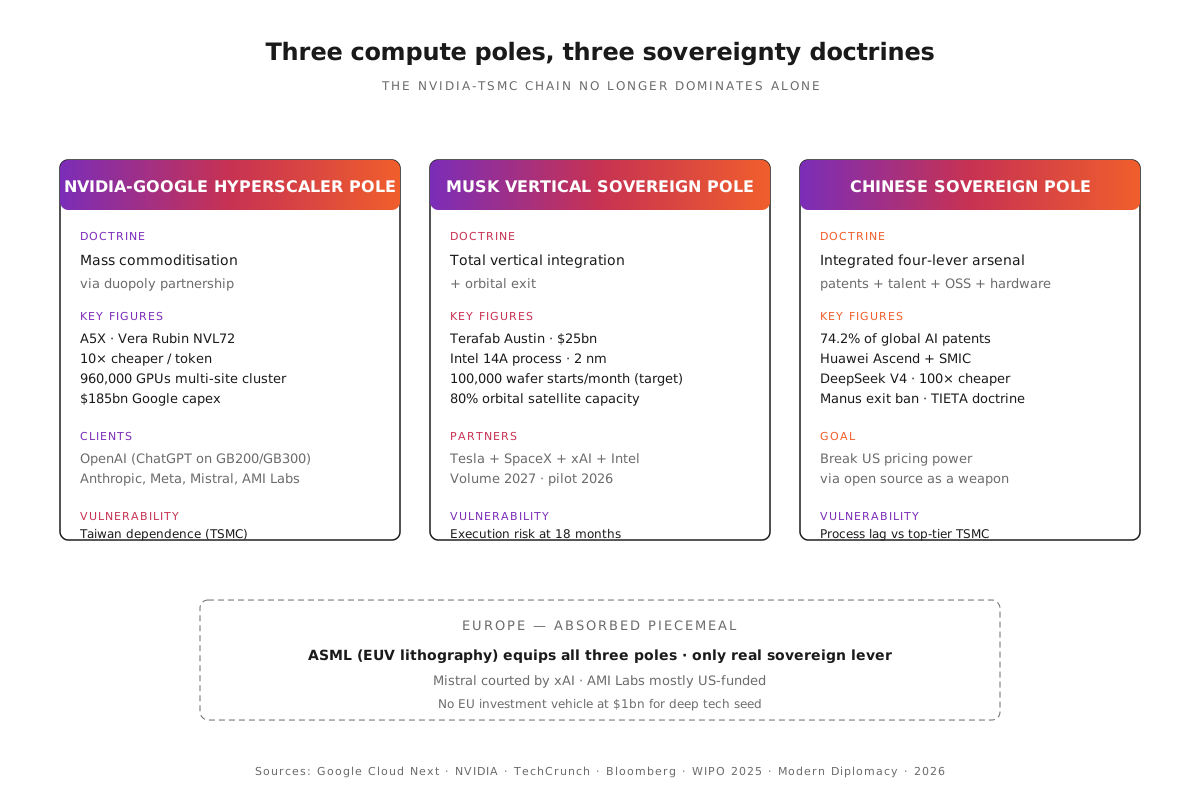
The figures deserve a pause. Ten times cheaper per token in inference than the previous generation. For the same budget, a customer can now process ten times more requests or run ten times more models. Ten times more token throughput per megawatt. The unit energy cost of inference also falls by an order of magnitude, with direct consequences for the profitability and carbon footprint of frontier LLMs. Scaling up to 80,000 Rubin GPUs per site and 960,000 in a multi-site cluster. Nearly a million GPUs orchestrated simultaneously. The first "AI factory" infrastructure at this scale. Compute becomes industrial as electricity became in the 20th century.
Google's investment plan for this infrastructure: $185 billion. At this level, it is no longer a commercial strategy, it is a national geostrategic project.
Sources: Google Cloud Next · NVIDIA Blog · TechCrunch · Bloomberg · Modern Diplomacy · WIPO 2025 · April 2026
Four consequences structure what follows.
The first: NVIDIA is not being dethroned. NVIDIA is absorbing Google in its wake. The hardware schism described above, where Musk + Intel set themselves up as an alternative to NVIDIA-TSMC, is subtler than a frontal opposition. NVIDIA remains unavoidable. It supplies Google via A5X. It supplies Musk's Colossus with its Hopper and Blackwell GPUs until Terafab is running. The only credible alternative to NVIDIA in 2026 is Terafab under construction, still far from volume production. And even Terafab will rely on transitional GPUs (perhaps from Tesla Dojo) before the in-house D3 chips are in series production.
The second, and the most underestimated element: OpenAI runs ChatGPT on Google Cloud GB200 and GB300 instances. Gemini's number one direct competitor pays Google to run its flagship product. Microsoft Azure, despite tens of billions invested in the OpenAI partnership, no longer has the capacity to absorb ChatGPT's global load alone. Google won OpenAI's inference contract, in parallel with its frontal competition via Gemini.
This gives Google a position nobody states clearly. It knows OpenAI's load patterns, it observes in real time what its enterprise customers consume, it can price as it sees fit, and in theory it can cut the service if the political situation requires. Google is now the infrastructure landlord of the entire LLM industry, including its direct competitors. It is exactly the role AWS played for general cloud between 2010 and 2020. Except that Google adds two layers AWS never had: its own frontier models (Gemini), and embodied robotics (Gemini Robotics). Three levels stacked simultaneously: infrastructure, model, physical application.
The third: the commoditisation of inference is accelerating dizzyingly. Stack the figures: DeepSeek V4, released on 24 April 2026, breaks prices by a factor of about a hundred on some tasks against GPT-5.5. A5X announces ten times cheaper than the previous NVIDIA generation. Over 18 months, stacking these orders of magnitude, the cost of inference falls by a cumulative factor of the order of a thousand since 2024. At this rate, inference will be worth zero. This is not a figure of speech. It is an arithmetic consequence of the current trajectory.
Inference will be worth zero. The moat shifts towards manufacturing, distribution, the vertical and proprietary data.AI Decryption · Otium
The fourth: if inference is commoditised, then the current valuations of OpenAI (around $500 billion) and Anthropic (above $350 billion) become indefensible on the basis of API revenue, which makes up most of their turnover. They hold only if one believes in a future qualitative leap — AGI announced within 24-48 months, which would unlock an immense rent. If this leap does not come, valuations are inflated by an order of magnitude. Half of American tech capitalisation in 2025-2026 is backed by an unproven scientific hypothesis, which the field's best researchers consider false.
No sitting CEO, no research director under stock options, no pension fund exposed to Anthropic can state this diagnosis publicly. LeCun can because he has a Turing Award, no financial dependence, and has just left. His voice becomes the canary, and the barons of American Big Tech follow him by putting a billion into hedging their portfolio.
6. The Chinese doctrine, a coherent assembly

25 March 2026. Xiao Hong and Ji Yichao are banned from leaving mainland China. Beijing invokes the TIETA to examine whether the intellectual property of the Manus AI agent was transferred to Singapore without the required government authorisations.
The affair deserves its mechanics being explained in detail, because it reveals a doctrine that Western media struggle to formulate.
Manus was founded in Shenzhen in 2023. Its product, an AI agent able to execute complex tasks autonomously via web and application interactions, had a spectacular growth trajectory in 2024-2025, reaching $100 million of ARR at the end of 2025. The company spent 2025 relocating out of mainland China in a coordinated move: progressive transfer of the head office to Singapore, replacement of historic Chinese investors with American VC funds, careful expatriation of intellectual property, hiring of key employees in Singapore. This Singapore washing, as CNBC called it, aimed to present Manus as a Singaporean company in order to make acceptable the acquisition by Meta announced at the end of 2025 for $2 billion.
In early March 2026, more than a hundred Manus employees had already joined Meta's Singapore office. The structure seemed complete. Beijing intervened afterwards. The operational response was the exit ban on the two founders. They are free to travel within mainland China, but cannot travel internationally. Integration with Meta's global teams is de facto paralysed. The two architects of the product cannot join the engineering teams supposed to integrate Manus into the Meta ecosystem. Without them, Meta bought a technical shell with employees but without the heads.
If the IP is in the head, then the head is as regulable as the IP.Implicit TIETA doctrine · Otium reading
This intervention reveals a doctrine that Western liberal regimes have not conceptually assimilated. In an era when AI know-how is concentrated in a few heads able to reproduce a model and make it evolve, the human becomes a national strategic asset. More important than the patent, more important than the company, more important even than the weights of an already trained model, which can be copied or stolen. Blocking Xiao Hong and Ji Yichao means keeping in China the operational capacity to redo what Meta has just bought.
American law considers know-how a portable property of the individual. European law too, with some nuances for trade secrets. China, by intervening administratively on freedom of movement in the name of controlling technology transfers, carries out a profound reversal.
The Manus affair is not isolated. It belongs to a coherent doctrine patiently assembled over five years, which stacks four complementary levers.
Legal volume
The WIPO 2024 figures are eloquent. China holds 74.2% of the world's AI patents. Its share of filings rose from 34.6% in 2014 to 49.1% in 2024. On GenAI, China filed about 38,000 patents between 2014 and 2023, six times more than the United States. The grant ratio of Chinese patents rose from 30% in 2019 to 55% in 2023, with double-digit growth for four consecutive years. These figures are regularly used to conclude that China now dominates the AI race. A short reading.
Only 4% of Chinese patents are filed in another jurisdiction, against 32% for American patents. It is an indicator of massively defensive, local filings. American patents generate more than 50% of global forward citations, against a much smaller share for Chinese patents. Japan shows 6.26 citations per patent, China far fewer. On quality as signalled by citations, the United States remains far ahead. Chinese volume is an instrument of defensive saturation, not proof of scientific leadership.
Human talent
The Manus affair is the most visible case, but it belongs to an older Chinese tradition of controlling transfers of strategic skills. The TIETA has existed since 2001, but its application to AI start-ups is recent. The signal is clear: as frontier LLMs become a geostrategic asset, the engineers who know how to build them become human resources regulated as such.
Open source as a weapon
DeepSeek V4, released on 24 April 2026 on Huawei Ascend chips, is not a community act, it is a strategic act. By open-sourcing models competitive with OpenAI and Anthropic at a derisory price, Beijing breaks American pricing power and accelerates the commoditisation of frontier inference. It is the most effective weapon against American companies whose moat rests on capex and API rent. Llama followed the same logic on the Meta side, but for different reasons. China has institutionalised this logic at State level.
Hardware sovereignty
DeepSeek V4 runs on Huawei. The Biden and then Trump sanctions on exports of NVIDIA GPUs forced China to develop an autonomous hardware stack. Huawei Ascend, SMIC for manufacturing, a proprietary software ecosystem. It is imperfect, it is behind the NVIDIA top end, but it is functional. And it frees China from a critical point of failure.
Put together, these four levers form the only coherent AI arsenal at global level. While French media present the Chinese strategy as a lag to be caught up, Beijing quietly assembles an integrated system that answers the underlying geopolitical question: how do you keep control of a strategic technology when its creators can leave, its models can be copied, and its infrastructure can be cut by external sanctions?
No Western government has this doctrine. Neither Washington, nor Brussels, nor Paris.
7. European absorption

Europe does not have one frontier AI player, it has two, and they are contradictory.
Mistral resists on the LLM frontier. Founded by Arthur Mensch, Guillaume Lample and Timothée Lacroix, the company has become the last independent European model at a global level competitive with OpenAI and Anthropic. Mistral Large 2, Mistral Small 3, and now the Vibe agent models for enterprise coding. Mistral has a clean European brand, a strong regulatory anchoring, stable relations with Bercy and the Élysée, and zero DSA baggage. That is also why Mistral is courted today.
April 2026. Sifted, Euronews, Investing.com and several other sources report that xAI has held exploratory talks with Mistral and Cursor for a triple alliance against Anthropic and OpenAI on coding and agents. The context is precise. Anthropic's Claude Code has reached a run rate of $2.5 billion with 300,000 business users. It has become the most profitable and dynamic enterprise AI segment. xAI is behind. Grok Code Fast 1 tops out at 70.8% on SWE-Bench Verified, and only on xAI's internal harness, not independent. Grok lacks simultaneous streaming + tool calls, lacks audio, lacks video. xAI itself documents that Grok is not a general flagship.
The strategic layout of the proposed alliance is clear. xAI/SpaceX brings massive compute (Colossus, and soon Terafab). Cursor brings the dev-facing product and the agent workflows, with a SpaceX option at $60 billion on Cursor signed earlier in the year. Mistral brings the frontier architecture and the inference know-how. Without Mistral, the bloc is an empty box on the model side, because Grok will not stand up to Claude Sonnet 4.6 on enterprise coding.
There is another dimension to this alliance that the French media have not formulated. Grok is under formal investigation by the European Commission under the DSA. The early 2026 revelations about Grok's generation of sexualised content involving minors triggered formal proceedings, followed by Ofcom in the United Kingdom. Several firms now consider Grok a major reputational risk in any regulated environment. A European bank cannot sign Grok. A health insurer cannot sign Grok. A public administration cannot sign Grok.
Mistral, with its legitimate brand, can. In a triple alliance, Mistral becomes the European front that xAI uses to sell in Europe what Grok can no longer sell. The compute stays in Memphis, the model can be co-trained, but the customer contract carries the Mistral stamp. Geographic whitewashing, in a new form. Nobody states this in France because Mistral is sacralised as a national champion. It is the probable operating mechanics of an alliance that would be signed.
The talent siphon has already begun. Devendra Chaplot, co-founder of Mistral, joined xAI in March 2026 as pretraining lead. Cursor has already begun training its models on Colossus. Without an official alliance, Musk is picking off Mistral's critical architects one by one. An alliance would formalise and accelerate what is being done quietly.
Mistral's bet is delicate. Refusing the alliance means staying under-capitalised against Anthropic (>$350bn) and OpenAI (~$500bn), and risking a technological ceiling. Accepting the alliance means becoming a building block of an American setup and losing real technological sovereignty, even if apparent political sovereignty is preserved.
At the other end of the European ecosystem, AMI Labs bets on the post-LLM. We have seen that its capital is mostly American. Bezos, Schmidt, Breyer, Cuban, Greycroft. The physical presence in Paris is real, the economic ownership is globalised and largely American.
The two European bets — resisting the frontier (Mistral) and betting on what comes after (AMI Labs) — have in common that they are structurally backed by American capital that ultimately decides. Europe is not merely watching, as a lazy analysis would have suggested. It is subtler and harsher: Europe is being absorbed in fragments into an American ecosystem that diversifies by financing contradictory bets. Mistral is absorbed by xAI/Musk. AMI Labs is financed by the US barons. Without European investment vehicles on the scale of several billions of seed, Europe can produce brains, but it cannot keep control of the companies that employ them.
Europe is scientifically present, economically absorbed.Otium · 2026 geopolitical reading
8. The quiet end of a paradigm
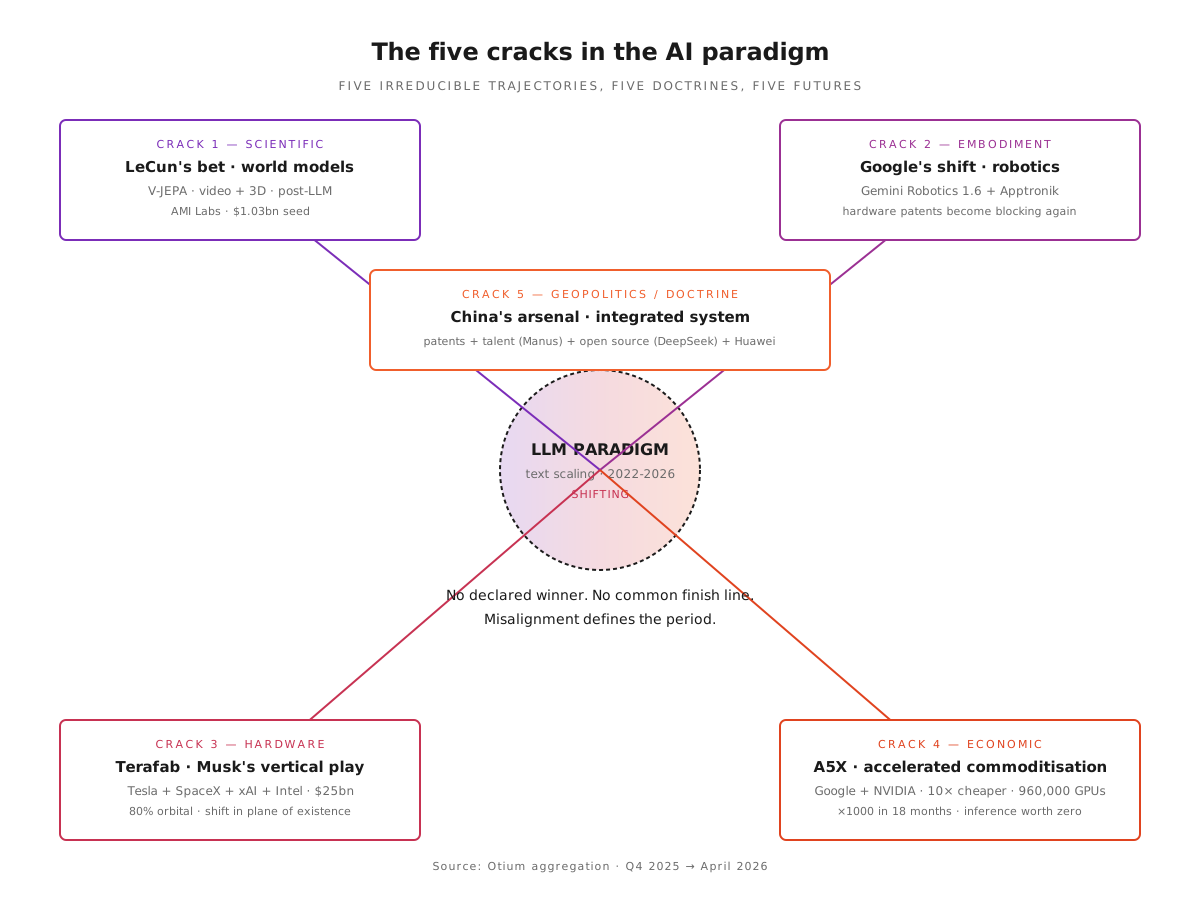
Otium synthesis · aggregation of Q1 2026 signals
The five fractures tell together more than each tells separately.
The dominant paradigm since 2022, the scaling of large language models trained on human text to reach general intelligence, reaches its peak of visibility at the precise moment its best observers begin to disengage from it. The cadence accelerates because the players in the race are bound by the valuations they have raised. The official narrative hardens because it cannot afford to bend before the next funding rounds. Behind the scenes, capital, founders and laboratories are reallocating towards what might come next.
LeCun leaves with a billion for the post-LLM. Bezos, Schmidt and Breyer follow him as a hedge. Google discreetly pivots towards embodied robotics while allying with NVIDIA to commoditise inference. Musk builds Terafab to have his own foundry and his own satellites. NVIDIA absorbs Google with A5X, which divides the cost of inference by ten. DeepSeek breaks prices by a factor of a hundred. Beijing detains the brains whose value is now measured in billions. Europe lets itself be absorbed in fragments for lack of investment vehicles on the right scale.
This is the signature of a paradigm transition under way, not the signature of a completed revolution. The collective admission that LLMs alone will not be enough to reach general intelligence is not yet public. It will be public in 12 to 24 months, in a form that cannot be predicted precisely today.
There is something we cannot settle in this file. The transition is legible in the flows — capital, talent, contracts — but it is not yet legible in the balance sheets. Nobody has published a quarter where API revenues stagnate. Nobody has shown that AMI Labs produces a model that works. Terafab has not started producing wafers. The diagnosis set out here may therefore be wrong. It may also be a year or two ahead of what the business press will name as obvious in its quarterly flash of 2027.
What seems more solid is the observable fact: the AI scientific community is no longer aligned on a single paradigm. The architects of LLMs are placing their hedges elsewhere. That is what is changing, and what deserves to be named now — before consolidation rewrites history in the winner's direction, whoever it is.
Five fractures, several trajectories, doctrines that no longer align. The rest will be decided outside, in the materiality of compute and the substance of researchers.