
OpenAI released GPT-5.5 on 23 April 2026, with API availability the next day. It is the first fully retrained model since GPT-4.5. It arrives in a densely packed month: Nano Banana 2 at Google, Claude Opus 4.7 at Anthropic, DeepSeek V4 as open source on the same day. The question we are already being asked at Otium: is it worth the price, and for which uses? This test gives an honest synthesis of the official benchmarks published by OpenAI, of the first independent reviewer feedback documented in the 48 hours following the release, and of a concrete selection grid between GPT-5.5, Claude Opus 4.7 and Gemini 3.1 Pro. We have not tested GPT-5.5 ourselves — every source is attributed.
1. What GPT-5.5 is
Three technical characteristics set GPT-5.5 apart from its predecessors.
Fully retrained base model. It is the first model in the GPT-5.x family retrained from scratch since GPT-4.5. The 5.1, 5.2, 5.3 and 5.4 updates were refinements (fine-tuning, post-training) on the same base. GPT-5.5 is a new base model, which explains both the leap in performance and the leap in price.
1-million-token context. Available in the API from 24 April. The practical interest: an agent can hold in memory a mid-sized codebase, its test suite, the associated documentation and a conversation history, all in a single session without truncation. This is technical parity with Claude Sonnet 4.6 and Gemini 3.1 Pro on this dimension.
Agentic orientation. OpenAI has publicly repositioned the model as a tool for "doing" rather than "answering". The official examples concern agentic code via Codex, operating software interfaces (computer use), analysis of long documents and early-stage scientific research. This is the axis on which the company differentiates itself from Claude Sonnet 4.6 (conversation) and Gemini 3.1 Pro (multimodal).
OpenAI's official presentation
Official OpenAI keynote · 23 April 2026
2. The official benchmarks published by OpenAI
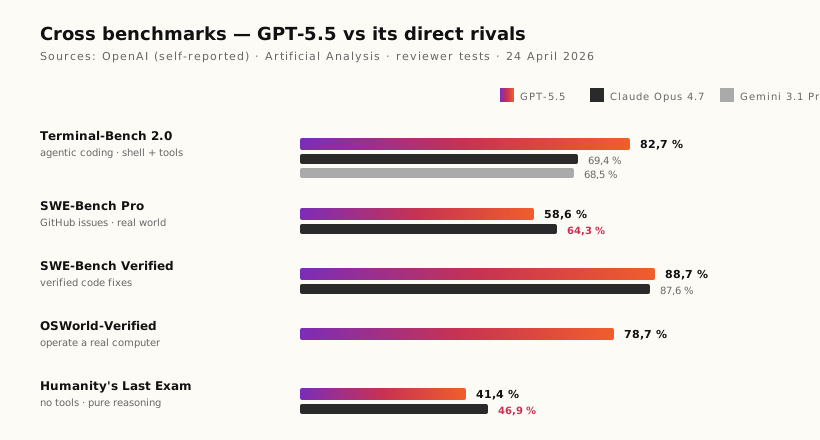
Sources: OpenAI · VentureBeat · MarkTechPost.
Terminal-Bench 2.0 — 82.7%. This is the most striking gain. Terminal-Bench tests a model's ability to plan, iterate and coordinate tools in a Unix shell, on real development tasks. GPT-5.5 surpasses its predecessor GPT-5.4 (75.1%), Claude Opus 4.7 (69.4%) and Gemini 3.1 Pro (68.5%). It is the benchmark OpenAI cites as the model's signature.
SWE-Bench Pro — 58.6%. This is where the model is behind Claude Opus 4.7, which scores 64.3%. SWE-Bench Pro evaluates the resolution of real multi-file GitHub issues, and it is the benchmark most product teams consider closest to the reality of industrial software development. Claude's lead holds on this ground for now.
SWE-Bench Verified — 88.7%. GPT-5.5 moves ahead of Claude (87.6%) on this variant, which verifies each fix individually. The gap is minor, but the signal is there: on small, targeted bugs with tests, GPT-5.5 has closed the gap.
OSWorld-Verified — 78.7%. This is the benchmark that measures an agent's ability to operate a real computer (mouse, keyboard, menus, window navigation) to accomplish a task. 78.7% is considered a public record to date. This is the computer use territory that OpenAI is pushing with Codex and that Anthropic offers through its own Computer Use.
GDPval — 84.9%. A proprietary OpenAI benchmark covering 44 knowledge work occupations (analysts, consultants, writers, lawyers, engineers). To be taken with the usual pinch of salt for an in-house benchmark, but the score is high and raises the question of the area of use the model is aimed at.
Humanity's Last Exam without tools — 41.4%. Claude Opus 4.7 remains ahead at 46.9%. HLE evaluates academic reasoning without access to tools. On pure knowledge and deduction, OpenAI has not closed the gap.
On the Artificial Analysis Intelligence Index — an independent aggregated metric — GPT-5.5 reaches 60 points, three ahead of Claude Opus 4.7 and Gemini 3.1 Pro (57 each). A score as an average, not to be taken as a final verdict, but as an indicator of direction.
3. Feedback from the first independent testers
Three professional reviewers published detailed tests in the 48 hours following the release. Their observations converge on some points and diverge on others.
He put GPT-5.5 Pro through several extended challenges. The model ran a simulation of a port city evolving over five thousand years in 20 minutes instead of 33 minutes on the previous generation. It generated an illustrated 101-page tabletop role-playing game from a single prompt. His verdict: "the jagged frontier continues to hold". Excellence demonstrated on some tasks, difficulties predictable only after the fact on others. Source: One Useful Thing, 23 April 2026.
He describes GPT-5.5 as "the first coding model with serious conceptual clarity". On a post-launch debugging scenario that GPT-5.4 had been unable to solve, GPT-5.5 identified the cause and the fix. On Every's internal benchmark for senior engineers, GPT-5.5 scores 62/100 against 33/100 for Claude Opus 4.7. To be read with the usual caution about in-house benchmarks. Source: Every's public feed, 23 April 2026.
He tested GPT-5.5 via a backdoor API in Codex before the API became publicly available. His classic pelican on a bicycle test (a vector drawing generated through SVG code) is a reference for comparing models on spatial understanding through code. He comments on it soberly without proclaiming a revolution. Source: simonwillison.net.
Two industry accounts were also shared. NVIDIA, which uses GPT-5.5 in Codex for its engineering teams, reports that debugging cycles that used to last several days now close in a few hours, and that experimentation campaigns that took weeks sometimes conclude overnight. OpenAI internally reports on teams that analysed six months of speaking requests to build a prioritisation framework, reviewed 24,771 K-1 forms totalling 71,637 pages to speed up a two-week tax process, and automated the generation of internal weekly reports, saving 5 to 10 hours a week. These communications should be taken for what they are: internal, with no external audit.
4. What the price really means
The API price displayed is $5 input and $30 output per million tokens. That is ×2 on the output price compared with GPT-5.4, which was at $2.50 / $15. The biggest price jump in the GPT-5.x series to date. Three readings present themselves.
The simple reading is that GPT-5.5 costs twice as much as it did six months ago. Teams consuming at high volume will see their bill double if they switch without optimisation.
The compound reading is that GPT-5.5 consumes, according to OpenAI, 72% fewer output tokens on Codex tasks equivalent to those run on GPT-5.4. If this figure is confirmed by the independent audits to come, the cost per task completed falls despite the doubling of the unit price. For Codex agentic workflows specifically, the trade-off favours GPT-5.5.
The contextual reading is that on the same day, 24 April 2026, the Chinese model DeepSeek V4-Flash was released at $0.28 per million output tokens — a ratio of one to a hundred with GPT-5.5 on nominal price. Part of the European SaaS market is going to do the maths. For 80% of tasks, the value for money is not obvious. See our DeepSeek V4 analysis for the detail.
5. GPT-5.5 against Claude Opus 4.7: two models, two workloads
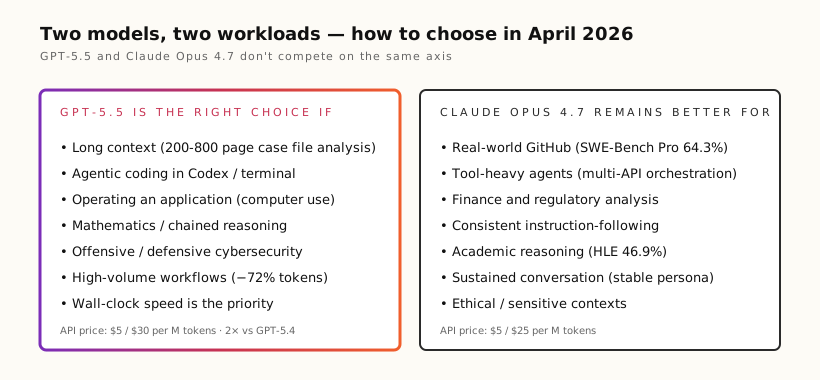
The market's first analysis is that GPT-5.5 and Claude Opus 4.7 are no longer in head-to-head competition. They have specialised in two distinct usage profiles.
GPT-5.5 prevails on tasks where an agent has to hold a long context, plan a sequence of actions in a terminal or a browser, work on large documents, produce code in agentic mode via Codex, or operate an application. This is the orientation OpenAI has openly embraced for three months.
Claude Opus 4.7 holds on the resolution of real GitHub issues (SWE-Bench Pro), on agents that must orchestrate several specialised APIs, on financial and legal workflows that depend on highly consistent instruction-following, and on pure academic reasoning without tools. This is the orientation Anthropic has openly embraced since the arrival of Claude 3.
In practice, for an SMB deploying one or two operational agents in 2026, the choice is not "the best model" — it is "the right model for the right workflow", or even a combination of both through intelligent routing (send Terminal-like work to GPT-5.5, send real GitHub resolution to Claude Opus 4.7). The right operational discipline in 2026 is model routing, not a binary choice.
6. The limits to keep in mind before a deployment
OpenAI's benchmarks are self-reported at this date. OpenAI publishes its own figures at launch. Third-party platforms (LM Arena, Artificial Analysis, SimpleBench, SEAL) will confirm or qualify them within two to four weeks. The very high scores on Terminal-Bench and OSWorld need to be independently revalidated.
The "jagged frontier" remains. Ethan Mollick's expression describes the phenomenon where a model excels at a complex task while failing at an apparently simpler one. This is true of all 2026 frontier models, GPT-5.5 included. Any production deployment requires a testing phase on the company's real prompts, not a generalisation from benchmarks.
OpenAI's internal productivity gain claims cannot be audited. The figures "5 to 10 hours saved per week" or "debugging from days to hours" are internal testimonies from OpenAI and NVIDIA. Useful as an indicator, not as a commitment.
The training corpus is not transparent. As with the other proprietary frontier models (Claude Opus 4.7, Gemini 3.1 Pro), OpenAI does not publicly document the composition of its training data. For use on copyright-protected content or in strong compliance contexts, the information asymmetry remains significant.
Compliance and the AI Act. GPT-5.5 is operated from the United States. Uses involving European personal data must go through an OpenAI DPA and, for sensitive cases, through the enterprise service with an extended contract. For European organisations subject to the AI Act's high-risk classification, integration requires an impact assessment.
7. Our reading
GPT-5.5 is a technical leap on agentic work. It does not replace Claude Opus 4.7 or Gemini 3.1 Pro on the uses where those models have built their advantages. It surpasses them on Terminal-Bench, OSWorld and the computer use tasks that define the next generation of operational agents.
Two practical conclusions for a team deploying AI in 2026.
One. If your main use is agentic (an agent that uses tools, holds a long context, operates an application, processes large files), GPT-5.5 deserves a test on your set of real prompts. The potential gain is significant. The condition is to adjust the prompts to exploit the million-token context without needlessly inflating the bill.
Two. If your main use is conversational, strict instruction-following, or fixing code in production, Claude Opus 4.7 remains a solid choice. Do not switch on the sole argument of the aggregated benchmark. Intelligent routing that sends the right model to the right task will give the best economic and qualitative result.
Benchmarks validate, they do not decide. The decision for your company goes through a test on your own prompts, your own context, your own results to be measured. GPT-5.5 is a good reason to run that test, not a sufficient reason to decide without it.
To complement this test: our analysis of the Chinese open-source model DeepSeek V4 released the same day, our file on Anthropic's Claude Mythos and the AGI question, and our review of Claude Design on the interface front.