On 29 June 2026, South Korean President Lee Jae-myung unveiled an investment plan of rare scale: more than €1,000 billion, public and private combined, over ten years, for semiconductors, AI and data centres. The figure impresses, but it masks the essential point. Korea is not "catching up" in the AI race by imitating Silicon Valley. It is playing a different card: turning its near-monopoly on a critical component into a lever of power. Here is what this plan really says, and why it concerns you even if you do not make chips.
1. The plan, in figures
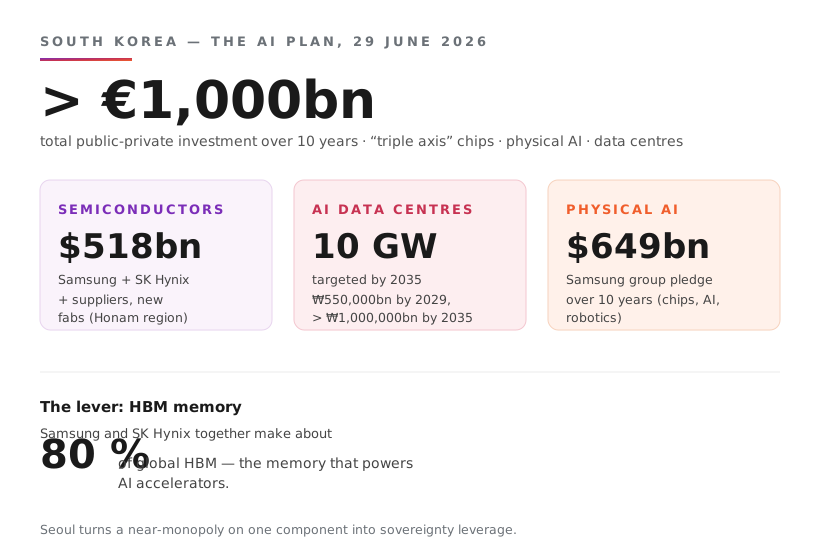
Lee Jae-myung presented the initiative as a "great leap forward" built around a "triple axis": semiconductors, physical AI and data centres (Al Jazeera). Three lines structure the scheme.
- Semiconductors. Samsung Electronics and SK Hynix, together with their suppliers, are investing about 800,000 billion won (nearly $518 billion) in new fabrication sites, located in the Honam region in the south-west, until now little industrialised.
- AI data centres. Korea is targeting 550,000 billion won of capacity by 2029, and beyond 1,000,000 billion won by 2035, for a target power of 10 gigawatts.
- Samsung commitment. The group alone carries a commitment of about 1,000,000 billion won, or nearly $649 billion over ten years, covering chips, AI and robotics.
Conversions vary depending on the sources and the scope used, but the order of magnitude is clear: the French press cites "more than €1,000 billion" for the whole public-private package (RTBF).
Sources: Al Jazeera, RTBF, Les Échos.
2. The "triple axis" and why it is coherent
The strength of the plan is not its amount, it is its coherence. Many countries announce billions for "AI" without specifying which part of the chain they are funding. Korea funds three links that reinforce one another: the chips that compute, the energy and data centres that house them, and the physical applications (robotics, industry) that create demand.
This is an industrialist's reasoning, not a laboratory's. Korea is not trying to produce the best language model. It is securing the layer on which all models run. When a country controls the manufacture of memory chips and the electrical capacity to run them, it becomes unavoidable, whichever laboratory wins the race for models.
3. The real lever: HBM memory
This is where the plan makes full sense. Korea starts from an advantage that no amount of money can buy quickly: real, already established dominance over a component with no immediate substitute. HBM is the physical bottleneck of the entire AI chain. By investing to deepen this lead rather than to spread itself thin, Seoul turns an industrial position into diplomatic bargaining power.
The logic echoes what we described regarding the compute war: value is shifting towards those who own the physical infrastructure. Korea does not have the models, but it has the part everyone is fighting over.
4. The AI race has become a race for infrastructure
The Korean announcement is part of a global wave. The United States now regulates access to its frontier models, Japan and China are bringing forward their own alternatives, and Europe is funding Mistral and its data centres. The centre of gravity of the competition has shifted: it is no longer only about who writes the best algorithm, but about who owns the factories, the chips and the gigawatts.
The figure of 10 gigawatts of data centres is, in this respect, as important as the one for chips. AI has become an energy problem as much as a software problem. A country that cannot power its data centres cannot deploy AI at scale, however good its engineers are.
5. What this says for Europe and for you
For Europe, the lesson is uncomfortable. Faced with commitments of this order, aiming for parity on every front is illusory. The real strategic question is not "how do we match Korea", but "on which link should we concentrate limited means in order to remain indispensable". Choosing a defensible specialty is better than a sprinkling of funds that dominates nothing.
For a company, even a small one, the signal is the same on a different scale. Dependence on a layer you do not control — a model, a cloud provider, an API — is a strategic risk, not a technical detail. Korea reminds you of a simple rule: sovereignty cannot be decreed, it is built where you own something others do not have. For a state, that is HBM. For an SMB, it is its data, its know-how, its customer relationships — the assets that no supplier can take back from you.
Frequently asked questions
How much is South Korea investing in AI?
The plan of 29 June 2026 represents more than €1,000 billion in public and private investment over ten years, built around a "triple axis": semiconductors, physical AI and data centres. The Samsung group carries a commitment of about $649 billion.
Why is HBM memory central to this plan?
Samsung and SK Hynix together produce about 80% of the world's HBM, the component that feeds AI accelerators. This near-monopoly on a critical part is the real lever: Korea is turning industrial dominance into geopolitical bargaining power.
What does this change for Europe?
The plan shows that the AI race is a race for infrastructure: chips, energy, data centres. Faced with commitments of this order, Europe has to choose where to concentrate its resources rather than aim for parity everywhere.
Conclusion
"The republic of chips" is not a turn of phrase. It is a strategy: anchoring a country's power to a component the whole world is demanding. Korea is not betting on the best model, it is betting that all models will need it. That is less spectacular than a new ChatGPT, and probably more durable.
For the rest of the world, the announcement closes one question and opens another. It confirms that the battle for AI is now fought in factories and electrical grids. And it puts to every state, as to every company, the only question that really matters: what do you own that others cannot take away from you?