Until now, the cost of AI could be read in the dizzying data centre spending of the tech giants — an abstract subject for most people. On 25 June 2026, it landed on a bill that everyone understands: that of a MacBook. Apple raised its prices by $100 to $300, directly blaming the memory shortage caused by AI. It is a small commercial event and a large economic signal: the cost of AI infrastructure has started to trickle down to the general public's wallet.
1. The facts: the itemised bill
Apple raised the price of its Macs and iPads by $100 to $300 depending on the model (CNN, Bloomberg). The MacBook Neo goes from $599 to $699, the 512 GB MacBook Air from $1,099 to $1,299, the 1 TB MacBook Pro from $1,699 to $1,999, and the 128 GB iPad Air from $599 to $749. The iPhone, Watch and AirPods are spared for now, but Apple hints that further rises could follow.
The market punished it: Apple's shares lost 6.12% the same day, their worst session in more than a year. The company's own wording sums it up: it "has never seen a component price rise so much, so fast".
2. The mechanism: why AI makes your Mac dearer
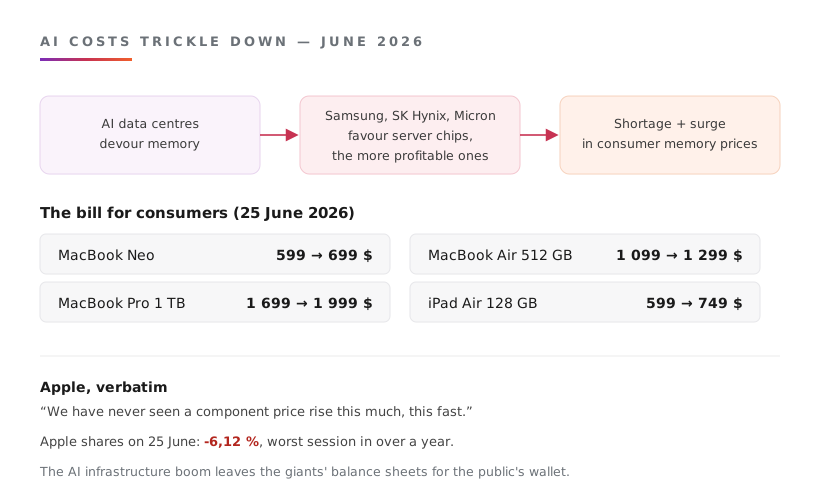
The chain is simple. AI data centres consume massive quantities of memory. The three big manufacturers — Samsung, SK Hynix, Micron — are steering their production towards server chips, which are far more profitable, at the expense of consumer components. Memory becomes scarce on the consumer side, its price climbs, and the increase is passed on to everything that contains it: computers, tablets and, according to analysts, soon phones.
3. The real signal: the constraint on AI is physical
It is the same thread as the one in the Korean semiconductor plan: HBM memory and consumer memory come out of the same factories, and the AI race creates a permanent trade-off between the two. The Apple increase is not an isolated accident; it is the visible consequence of a fight over a limited resource. As long as data centres take priority in production, the strain on consumer components will last.
4. What it changes when budgeting for AI
For a business, the episode widens the notion of what AI costs. We are used to thinking in terms of software subscriptions and token consumption. We now have to add pressure on hardware: fleet renewal, servers and storage, whose prices are becoming volatile.
Two useful reflexes. Anticipate hardware purchases that are sensitive to memory rather than postponing them in a rising market. And factor in the total cost, hardware included, in any return-on-investment calculation for an AI project — instead of looking only at the licence. Today's hidden cost is physical, and it will not fall until the appetite of data centres slows.
Frequently asked questions
Why did Apple raise its prices in June 2026?
On 25 June, Apple raised its Macs and iPads by $100 to $300, citing a shortage of memory and storage caused by demand from AI data centres, and describing a component price increase unprecedented in both scale and speed.
What is the link between AI and the price of a computer?
AI data centres consume enormous amounts of memory. Samsung, SK Hynix and Micron prioritise the more profitable server chips over the general public. The scarcity pushes up the price of memory, and therefore of computers and tablets.
What are the consequences for businesses?
The total cost of AI goes beyond subscriptions: it includes upward pressure on hardware. Fleet renewal and component volatility need to be built into the budget, bearing in mind that the underlying constraint on AI is physical.
Conclusion
Apple's price rise is a small fact that says something big. The cost of AI does not stay confined to the balance sheets of the hyperscalers: it spreads through the real economy, all the way to the bill of an individual who may never knowingly use a language model.
For anyone who wants to understand AI, the lesson is to stop seeing it as a purely software phenomenon. It is a heavy industry, hungry for materials and energy, whose strains are paid for in very tangible dollars. Budgeting for AI in 2026 also means budgeting for its physical share.