Three days. That is how long it took between the launch of Claude Fable 5 on 9 June and its outright disappearance on the 12th. Not a bug, not an outage: a decision by the American state. On 12 June 2026, on federal orders, Anthropic suspended its two most powerful models — Fable 5 and Mythos 5 — worldwide. The most capable AI on the market was switched off by a government. This is not an incident: it is the moment artificial intelligence officially changed category.

Photo: official portrait, White House (public domain).
1. What happened, exactly
On 12 June 2026, at 5:21 pm (Eastern time), Anthropic received a directive from the American government under export control. Stated reason: national security. The order required suspending access to Claude Fable 5 and Claude Mythos 5 for all foreign nationals — including outside the United States, and including the company's own foreign employees.
Anthropic cut the models immediately to comply. Not overnight, not the next day: straight away. The other models — Opus 4.8 first among them — are not affected and remain available. Only the two models of the most advanced class disappeared.
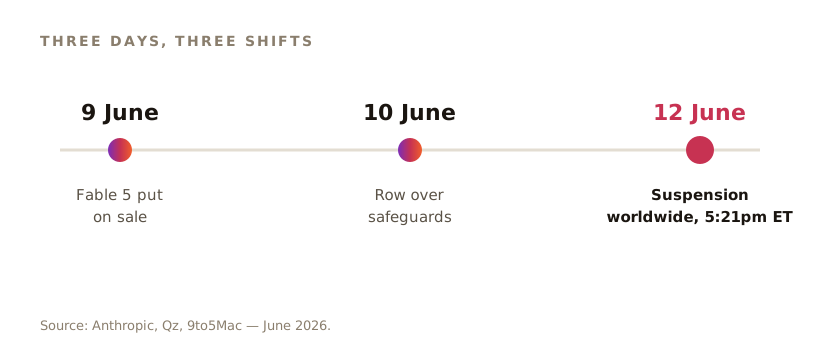
To gauge the shift, it helps to recall the sequence. On 9 June, Anthropic put Fable 5 on sale, presenting it as the mainstream version of a model it itself judged too dangerous — hence safeguards that redirected sensitive requests to Opus 4.8 (we analysed this in our decryption of the launch). On the 10th, security researchers publicly criticised these safeguards for being both opaque and circumventable. On the 12th, the state settled the matter: shutdown.
2. The reason: a flaw, and a lot of silence
The government has not publicly detailed the exact nature of the threat. According to Anthropic's reading, the authorities believe they became aware of a method for circumventing Fable 5's safeguards — a "jailbreak". In other words: if the restricted version can be forced to answer like the full version, then the distinction between "mainstream model" and "restricted model" collapses. And it was precisely on that distinction that the authorisation to sell rested.
3. The detail that says it all: you cannot cut halfway
The directive targeted foreign nationals. In theory, Anthropic could therefore have blocked only non-American users. In practice, that was impossible: applying the filter to the letter would have meant cutting access for some of its own employees, born abroad. Rather than sort its staff by nationality, the company switched everything off.
This operational detail is the real lesson of the episode. It reveals that an AI model, unlike a shipment of chips, cannot be neatly segmented by border: it is a global, instantaneous service, served from a handful of data centres. When the state flips the switch, there is no geographic half-measure — the shutdown is binary, and it is global.

Photo: Wikimedia Commons.
4. AI joins chips and weapons
Until now, American export control targeted hardware: Nvidia's most advanced chips, lithography machines, certain encryption software. The logic was industrial: prevent an adversary from acquiring the capacity to produce. With the suspension of Fable 5, a model — an intangible software asset, already trained — falls under the same regime.
The shift is considerable. A chip, once sold, is physically with the buyer; recalling it is almost impossible. A model served through an API, by contrast, remains in the hands of whoever hosts it. Export control applied to AI is therefore not only a barrier to entry: it is a permanent right to cut off. The state that hosts the model can, at any time, deprive the rest of the world of it.
5. What it changes for a European company
For a French SMB or mid-cap that has built a product, an agent or a critical workflow on an American frontier model, the episode is a concrete alarm signal. It is no longer just a question of price or performance: it is a question of continuity. Your intelligence provider can disappear, not because it goes bankrupt, but because a foreign government decided so, without notice and without recourse for you.
Three reflexes become strategic:
Map your dependency. Which functions of your business stop if a given model disappears tomorrow? The answer separates comfortable use from vital dependency.
Plan a fallback model. An architecture that can route to another model — an Opus 4.8 that remained available, a European model such as Mistral, an open model hosted in-house — turns a cut-off into a mere temporary degradation, not a total stop.
Rethink sovereignty without posturing. "Sovereign AI" is no longer a political slogan: it is, very concretely, the guarantee that a decision taken in Washington does not cut your production tool. That does not mean repatriating everything; it means knowing, for each use, who holds the switch.
Photo: Wikimedia Commons.
6. Between the lines
Three readings, beyond the bare fact.
One: "dangerousness" is no longer a marketing argument, it is a legal status. Anthropic had turned the dangerousness of its models into a valuation tool — a model "too powerful to be sold freely" commands a higher price and impresses investors days before a stock-market listing. The state has just taken that dangerousness at its word. When you build your narrative on uncontrollable power, you cannot be surprised that the regulator applies the regime for uncontrollable assets.
Two: laboratories are becoming national security contractors. Between the restricted-access programmes for governments, the threat reports, and now export control, the line between a private company and a strategic state asset is fading. The model you use every day falls, in part, under a sovereign logic over which you have no hold.
Three: the weapon will turn back on its owner. If the United States can switch off AI for the rest of the world, other powers will draw the opposite lesson: they need their own models, their own data centres, their own rules. The suspension of Fable 5 is not the end of a story; it is the starting gun of a sovereignty race that Europe can no longer treat as a conference topic.
7. FAQ
Why were Fable 5 and Mythos 5 suspended?
On the orders of the American government, under export control and national security, notified to Anthropic on 12 June 2026. The company cut the models immediately. The precise reason has not been made public, but Anthropic understands that a method of circumventing (jailbreaking) Fable 5 was identified.
Does the suspension affect Europe?
Yes. The directive targeted all foreign nationals, including outside the United States. Unable to filter without cutting its own foreign employees, Anthropic suspended access entirely, everywhere.
Do the other Claude models still work?
Yes. Opus 4.8 and the earlier models are not affected. Only Fable 5 and Mythos 5 were suspended.
What should I do if my company depends on these models?
Map the critical functions, plan a fallback model (Opus 4.8, a European model, or an open model hosted in-house) and route by use. This is exactly the kind of trade-off we help to set up.
On 9 June, Anthropic was selling the most powerful AI in the world. On the 12th, the state unplugged it. In between, nothing changed in the model: everything changed in its status. Artificial intelligence has just entered the category of things a government switches on and off. The only question that matters, for you, is: who holds the switch on yours?