On 9 June 2026, Anthropic put Claude Fable 5 online, the most powerful model ever made available to the general public — the same, under the hood, as Claude Mythos, the model Anthropic refused to commercialise in April because it was discovering thousands of cybersecurity flaws on its own. Between the two, an unprecedented mechanism: safeguards that intercept sensitive requests and redirect them to Opus 4.8, the previous model. The result: records on almost every public benchmark, a demonstration of responsibility praised even in the mainstream press… and a price exactly double that of Opus 4.8. The sequence deserves a close look, because it sketches the framework for the next eighteen months: a two-speed AI, and a bill that changes order of magnitude.
1. What Anthropic announced, exactly
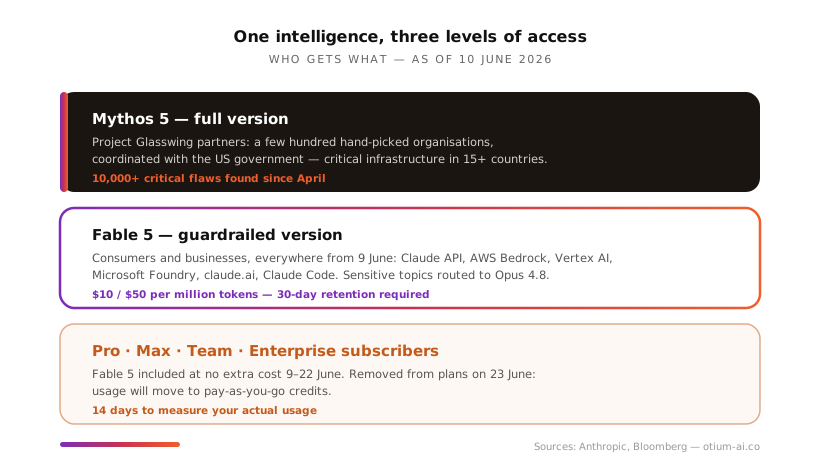
The official announcement covers two models. Claude Mythos 5 first: Anthropic's new internal frontier, described in the system card as "the most capable model we have ever trained". It is not on open sale: it remains reserved for partners in the Project Glasswing programme, the cyber-defence scheme set up with the US government and the major players in critical software. Claude Fable 5 second: the same model, fitted with additional safeguards, and available everywhere from day one — Claude API, AWS Bedrock, Vertex AI, Microsoft Foundry, claude.ai and Claude Code.
The semantic nuance is embraced by Anthropic right down to the etymology: fabula, "that which is told" in Latin, a cousin of the Greek mythos. The same root, two names: "the safeguards are what distinguishes the two models, which is why we gave them different names", the company writes. Anthropic's site now lists five model families: Mythos, Fable, Opus, Sonnet, Haiku. An entire class has just been added above what was, until Monday, the top of the range.
On specifications: a context window of one million tokens by default, 128,000 output tokens at most, adaptive reasoning that cannot be turned off, and an undated API identifier (claude-fable-5). The model is designed for long-running work: Anthropic presents it as able to "work autonomously for longer than any previous Claude model", for several days in a row in an agentic harness. The most widely repeated anecdote comes from Stripe, an early tester: a migration on a 50-million-line Ruby codebase, carried out in a day where an entire team would have taken more than two months.

Image: Anthropic, "Introducing Claude Fable 5" — YouTube, 9 June 2026.
2. The safeguard: an AI that hands over
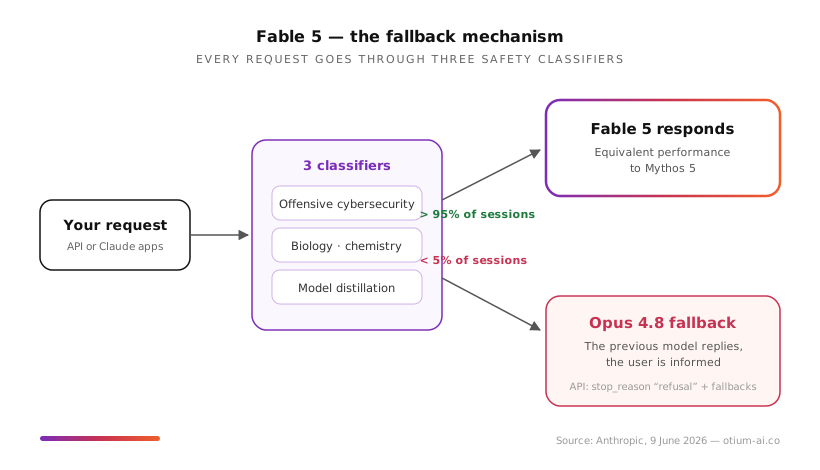
The heart of the launch is not a benchmark, it is a mechanism. Every request addressed to Fable 5 goes through three safety classifiers: offensive cybersecurity, biology-chemistry, and "distillation" (attempts to extract the model's capabilities to train a competitor). If a classifier triggers, the answer is not served by Fable 5 but by Opus 4.8, the previous model — and the user is informed. Anthropic puts the trigger rate at under 5% of sessions: for the remaining 95%, the company writes, "Fable 5's performance is effectively that of Mythos 5".
Source: Anthropic — official announcement and API documentation, 9 June 2026.
Technically, the fallback is visible in the API: a refusal returns a stop_reason: "refusal" status with a category (cyber, bio, reasoning_extraction), and a fallbacks parameter in beta allows the request to be replayed automatically on another model, with no charge if the refusal occurs before the first token. In consumer applications — claude.ai, Claude Code, Claude Cowork — the answer is simply labelled with the name of the model that responded.
Image: Anthropic, "Introducing Claude Fable 5" — YouTube, 9 June 2026.
This mechanism has a real cost in use, and early feedback already documents it. Rob T. Lee of the SANS Institute reports that perfectly legitimate cybersecurity tasks — incident response, forensics — trigger the fallback to Opus 4.8. Users report more comical false positives, even middle-school biology questions. Ethan Mollick, a professor at Wharton and one of the most closely followed testers, sums it up: the safeguards "trigger at the slightest mention of a security problem… and that happens far too often". Anthropic acknowledges the problem and says the classifiers are "deliberately broad today", to be refined.
3. The numbers: records almost everywhere
On raw performance, the consensus came quickly: Fable 5 takes the lead in almost every public ranking. The figures below come from the official system card (319 pages), which specifies an important point: Fable 5's scores are measured with its production safeguards active, fallback included.
| Benchmark | Fable 5 | Opus 4.8 | GPT-5.5 | Gemini 3.1 Pro |
|---|---|---|---|---|
| SWE-bench Verified (code) | 95.0% | 88.6% | — | 80.6% |
| SWE-bench Pro | 80.0% | 69.2% | 58.6% | 54.2% |
| Terminal-Bench 2.1 (agents) | 84.3% | 82.7% | 83.4% | 70.7% |
| FrontierCode Diamond (Cognition) | 29.3% | 13.4% | 5.7% | — |
| OSWorld-Verified (computer use) | 85.0% | 83.4% | 78.7% | 76.2% |
Source: Claude Fable 5 & Mythos 5 system card, table 8.1.A — anthropic.com, 9 June 2026. Average over 5 attempts.
Vertical benchmarks follow the same slope: the best score ever measured by Harvey (law, 93.4%), the first model to cross 90% on Hex's analytical benchmark, the best historical result on Hebbia's finance benchmark, and first place on CursorBench claimed by Michael Truell, Cursor's CEO. On the unrestricted version, the numbers climb further: Mythos 5 reaches 94.1% on GPQA Diamond — a PhD-level benchmark that Anthropic now declares "saturated" and will stop publishing.
Two demonstrations drew attention beyond the benchmarks. Fable 5 completed Pokémon FireRed on vision alone — raw screenshots, with no assistance harness, something no Claude had managed. And Mollick published the account of a nine-and-a-half-hour autonomous work session on a single instruction, the model itself orchestrating Sonnet sub-agents to collect 2,200 flights and train timetables. His line went round the networks: "last year, I was talking about working with a wizard; I am now closer to a patron. I no longer pilot: I command."

Illustration: Otium.
4. Two-speed AI becomes official
The structural novelty of 9 June is not performance: it is the segmentation of access. On one side, the full Mythos 5 for a few hundred hand-picked organisations — around 200 Glasswing partners in April, extended to 150 additional organisations in early June, in more than 15 countries, in coordination with the US government and, on the European side, ENISA. On the other, Fable 5 under safeguards for everyone. Between the two, a result that is already tangible: more than 10,000 critical vulnerabilities discovered by Glasswing partners with Mythos Preview since April.
Sources: Anthropic (9 June announcement), Bloomberg (2 June), Le Monde Informatique (9 June).
This architecture triggered the main controversy of the launch. The system card reveals "silent interventions" that limit the model's effectiveness on requests aimed at developing frontier LLMs — around 0.03% of traffic, with no notification to the user. Well-known voices in the AI community saw a red line in it: Jeremy Howard spoke of a "very dark day", Nathan Lambert of labs that "pull up the ladder behind them". On top comes a mandatory 30-day retention of all Mythos-class model traffic — a break from zero-retention policies — which Anthropic justifies on safety grounds and pairs with a commitment: this data is not used for training.
Fact, hypothesis, opinion: the mechanism and the figures above are documented by Anthropic itself. The scale of any rejection by researchers remains, for its part, anecdotal at this stage — no verifiable named defection as of 10 June. Our opinion: the precedent matters more than the percentage. A provider has just institutionalised the right to silently degrade certain requests; the question is no longer "whether" but "how far".
5. The commercial stroke: displayed virtue, doubled price
Let us sum up the sequence from Anthropic's point of view. April: the company announces it holds a model so powerful that it refuses to sell it — an unprecedented stance in the industry, massive media coverage. May: a raise of 65 billion dollars at a valuation of 965 billion, making Anthropic the most highly valued AI startup in the world, ahead of OpenAI. June: the same model reaches the market, "made safe", at double the price of the previous top of the range. Each step reinforces the next: April's restraint lends credibility to June's safety, which justifies the price.
Sources: Anthropic price list (9 June 2026), OpenAI and Google pricing pages.
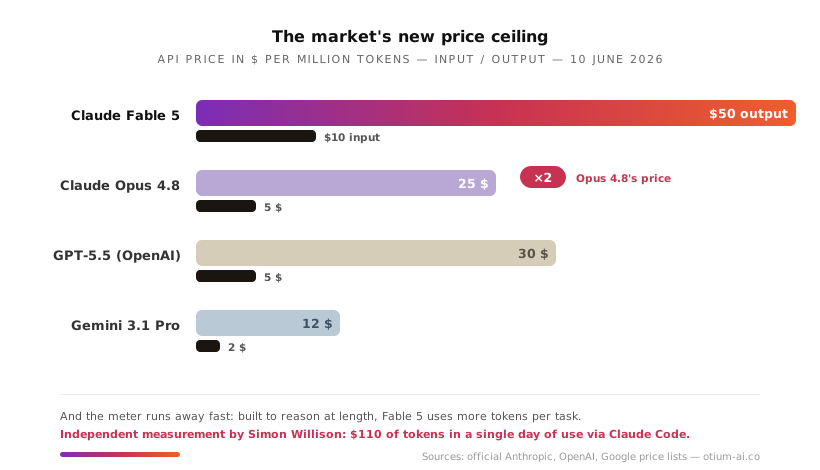
The numbers deserve to be set down coldly. Fable 5 costs $10 per million input tokens and $50 output — exactly twice Opus 4.8 ($5/$25), and "less than half" of what partners paid for Mythos Preview, according to Anthropic. The competition is far below: GPT-5.5 at $5/$30, Gemini 3.1 Pro at $2/$12. And the model's appetite widens the gap: designed to reason for a long time, it structurally consumes more tokens per task. Simon Willison, among the first independent testers, measured $110 of tokens in a single day of use via Claude Code, including one session at $99. His verdict fits in one sentence: "the right word for Fable is that it is big".
This switch mechanism to usage-based billing is not a detail of the price list: it confirms an underlying movement we were already documenting with the AI budget caps at Uber — AI tools are leaving the world of the predictable flat fee for that of the running meter. For an SMB, the consequence is direct: choosing the model becomes a budget decision, in the same way as choosing a hosting provider. Routing each task to the cheapest model that succeeds at it is no longer a comfort optimisation: at Fable 5's price, it is what separates a held budget from a four-figure drift per developer per month.
6. Summary comparison
| Claude Fable 5 | Claude Opus 4.8 | GPT-5.5 | Gemini 3.1 Pro | |
|---|---|---|---|---|
| API price (in / out, $/MTok) | 10 / 50 | 5 / 25 | 5 / 30 | 2 / 12 |
| Context | 1M tokens | 200k–1M | 400k | 1M |
| Code (SWE-bench Pro) | 80.0% | 69.2% | 58.6% | 54.2% |
| Long-duration autonomy | Several days | Hours | Hours | Hours |
| Particularity | Falls back to Opus 4.8 on sensitive topics, 30-day retention | Remains the default in subscriptions | Response expected (GPT-5.6 rumoured) | Best cost/performance ratio |
Data as of 10 June 2026. Benchmarks: Anthropic system card; prices: publishers' official pages.
7. Our reading
Three things are true at the same time, and that is what makes this launch interesting.
One: the capability leap is real. The benchmarks converge with independent field reports — Karpathy speaks of a "change of scale deserving a major version jump", and autonomous sessions of several hours are documented by third parties. For long, complex work — migrations, code audits, multi-document financial or legal analyses — there is objectively no equivalent on the market as of 10 June 2026.
Two: safety has become a product. Anthropic has turned a constraint (a model unsellable as it stood) into a commercial architecture: the dangerous version lends credibility to the restricted version, the government programme lends credibility to the company, and the whole justifies a price nobody else dares charge. It is remarkably well executed. It is also a precedent: access to the full capability of frontier models is now decided between a private lab and a government, organisation by organisation. For European companies, ENISA's presence in Glasswing is a door left ajar, not a guarantee.
Three: the bill becomes the subject. A model twice as expensive, that reasons for longer and therefore consumes more, and that leaves the subscriptions on 23 June: everything pushes towards a cost discipline that most organisations do not yet have. The fourteen days of the trial window are an opportunity to measure, not to get carried away: which tasks justify Fable 5, which run just as well on Opus 4.8, Sonnet or a model at $2 per million tokens. This routing work — the right model in the right place — is exactly what the switch to usage-based billing makes profitable from the first month.
The model judged too dangerous is online. The real question, for you, is not philosophical: it is to know, with figures in hand, what it would cost you — and what it would bring you.