19 May 2026, Google I/O. Koray Kavukcuoglu, CTO of Google DeepMind, announces Gemini Omni, a new family of generative video models. The same day, the YouTube team unveils Ask YouTube, a conversational search powered by Gemini that replaces the keyword approach. Two announcements, one and the same ground: YouTube. The first injects AI video creation into Shorts, for free. The second re-architects discovery across the whole catalogue. Read together, they outline the doctrine Google intends to apply to the next AI cycle: AI creation at the top of the funnel, AI discovery at the bottom, all on its own platform.
Sources: blog.google, 9to5Google, TechCrunch.
Contents
- What was really announced
- “Omni”: three readings of the name
- AI creation in YouTube Shorts, for free
- Ask YouTube: conversational discovery
- Google AI Plus / Pro / Ultra pricing and the compute-used turn
- The competitive map: Sora 2, Veo 3.1, Runway, Kling, Seedance
- SynthID, C2PA, the AI Act and the 2 December deadline
- What to take away
- FAQ
- Sources
1. What was really announced
The official announcement is signed by Koray Kavukcuoglu, CTO of Google DeepMind, on the Google blog (Introducing Gemini Omni). The official model page deepmind.google/models/gemini-omni sums up the positioning in one line: “Think of Gemini Omni like Nano Banana, but for video.” The capabilities described:
The marketing promise comes down to one line: anything in becomes a video. The real, technical novelty does not lie there. It lies in the shift from a one-shot generation model (Veo 3, first-generation Sora 2) to a model of conversational creation. You get a first clip, you ask for a change, the next clip keeps the same character, the same physics, the same set. This change of paradigm is, for video, what Claude Code has been for programming: an itinerant object, editable sentence by sentence, rather than a final deliverable.
The other important novelty is the Avatar function: the user can generate videos in which they appear themselves, with their voice. The deepfake issue is no longer an outside threat to be fought, it has become a feature sold by the maker. The SynthID + C2PA Content Credentials pairing is Google's answer to this tension: marking every video at two levels, the invisible statistical watermark (SynthID) and standardised provenance metadata (C2PA, backed by Adobe, Microsoft, the BBC and OpenAI).
Four examples published by DeepMind give a concrete idea of what the model can do:
Videos: Google DeepMind, May 2026.
Google YouTube channel. Presentation of the model, its capabilities and the philosophy of conversational creation.
The same capability seen from the creative tool side: the Flow agent orchestrates actions on the timeline.
For a third-party view, and a tour of the capabilities in a creator's hands (rather than on stage), the video below covers Omni's main functions in real use, with examples of video-to-video transformation and character consistency tests.
Hands-on and limits observed by Paul J Lipsky. To be compared with the official Google demos above.
To put Omni Flash in perspective against its most direct competitor on pure video quality, creator JSFILMZ pitted the two models against each other on the same prompts on the day of the announcement. A useful entry point before the ByteDance section further down.
Visual benchmark by JSFILMZ. The same prompts run through both models, on the day of the Omni announcement.
2. “Omni”: three readings of the name
For 48 hours before the announcement, the community wondered about Omni's exact status relative to Veo 3.1. The official DeepMind model page settles it in one sentence: Think of Gemini Omni like Nano Banana, but for video.
Reading 1 — the public face of Google's video stack (official). Nano Banana was the marketing name of a conversational image-editing experience built on Gemini Flash Image. Omni applies the same logic to video: a conversational layer on top of a video engine that remains, at least in part, the Veo lineage. The Gemini Video Generation page, incidentally, continues to show Veo 3.1 as the engine (gemini.google). This reading is the simplest and the one Google claims.
Reading 2 — a new Gemini-native model. The official wording “first model in the Omni family” implies that a family of new models is being launched, and not just an interface. This reading does not contradict the previous one: Omni Flash may rely on Veo on the video side while being a distinct model object, fine-tuned or with an architecture extended for conversation.
Reading 3 — a genuine omni model. The Omni family ultimately aims at unifying image + video + audio in the same architecture. This is consistent with the announcement that image and audio outputs are coming in later releases. If this ambition is confirmed, Omni is the archetype of Google's next generation of models: a single engine to train, optimise and serve — the strategic answer to the GPT-4o pattern on OpenAI's side.
3. AI creation in YouTube Shorts, for free
The most important sentence of the announcement is not in the main blog post. It is in the companion post from the YouTube team: Gemini Omni is free for Shorts creators, rolling out this week (9to5Google). Three immediate consequences.
First, it is a frontal attack on the amateur creation segment. OpenAI released the Sora app with Sora 2 in September 2025 and positioned it as a standalone social network. ByteDance is pushing Seedance into CapCut and TikTok. Google does not need to invent a social network: YouTube Shorts is already installed with several billion active YouTube users. Injecting Omni into it for free puts AI creation directly into the user's hands, with no friction, no additional sign-up.
Second, it is a data operation. Every video generated on Shorts produces, alongside the deliverable, a massive learning signal: prompt, version kept, versions rejected, successive edits, watch time, shares. The free offer is not a gift. It is the purchase of a video RLHF pipeline at scale, which no competitor has. OpenAI has the ChatGPT data. Google is heading towards conversational video data of the same magnitude.
Third, it is a question put to TikTok. ByteDance is today the player that best combines short-video distribution and AI capability — Seedance remains very competitive on pure quality (first qualitative evaluations). But ByteDance operates in a geopolitical context unfavourable to it in the United States, and its access to NVIDIA infrastructure remains capped. Google is entering in force on the only ground where TikTok could hope to remain untouchable.
4. Ask YouTube: conversational discovery
The other announcement of the day, on the YouTube side, is called Ask YouTube. An overhaul of search on the platform, powered by Gemini. The user no longer types keywords, they ask a complex question, and the engine assembles an answer made up of the most relevant videos across the entire YouTube catalogue (9to5Google).
Three points to remember.
Access is restricted. Ask YouTube is reserved for YouTube Premium subscribers aged over 18. Gradual rollout with no precise date communicated. It is a full-scale test whose audience is segmented: those who pay, and who are adults. A logic of cautious learning before generalisation.
It is not one more product, it is a rewrite of the contract. For twenty years, YouTube has run on an implicit deal: users search for keywords, the algorithm learns, creators optimise (title, thumbnail, keywords) to appear in that search. Ask YouTube short-circuits the creator layer. The machine assembles an answer by picking what it wants, where it wants. Creators lose control of their entry point.
It is the discovery counterpart of Omni on the creation side. Taken separately, Ask YouTube is a product improvement. Taken with Gemini Omni in Shorts, it outlines a platform where Google controls both ends of the funnel: AI helps create the video, AI helps find it. The whole ecosystem runs through Gemini models.
5. Plus / Pro / Ultra pricing and the compute-used turn
The other structuring announcement of I/O 2026, in parallel with Omni, concerns the pricing of Google AI subscriptions (blog.google — Google AI subscriptions, Engadget).
| Plan | Monthly price | Omni access | Target |
|---|---|---|---|
| YouTube Shorts | Free | Included | Mass-market creators, volume |
| Google AI Plus | $7.99 | Included (limited) | Equipped individuals, direct alternative to ChatGPT Plus |
| Google AI Pro | $19.99 | Included | Power users, solo professionals |
| Google AI Ultra (entry) | $100 | Included, extended quotas | Developers, tech leads, advanced creators |
| Google AI Ultra (top) | $200 (formerly $250) | Full access | Studios, video teams, sustained use |
Two moves to read at the same time. First, Plus at $7.99/month: Google undercuts ChatGPT Plus, established at $20/month for three years. The target is not the existing Pro user. It is the curious user who had never taken the plunge, and who now has an entry-level option with AI video access. Second, Ultra goes from $250 to $200 and a new "developer" tier appears at $100. Frankly: the initial Ultra pricing was too high, price elasticity was misjudged. The range is cleanly re-tiered.
The third element, more discreet, is introduced in the same announcement: a "compute-used limitation model" that modulates access according to the complexity of the prompt rather than a fixed daily message quota. It is the shift, for a consumer product, towards a metering logic close to that of the API. AI video generation is fifty to a hundred times more expensive, in compute, than a standard text answer. The pure flat-rate model no longer holds.
5. The competitive map
Gemini Omni lands in an already crowded market.
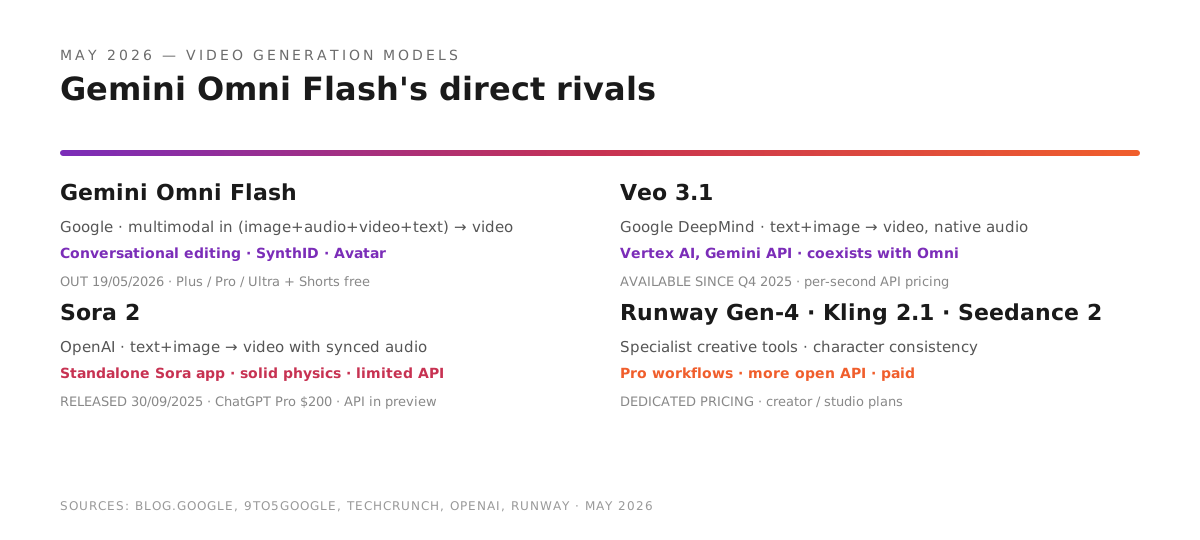
Sora 2 (OpenAI) remains the most visible direct competitor. Released on 30 September 2025, available through the Sora app and the API in preview, it set the codes of the segment: synchronised audio, careful physics, a standalone social app. Sora 2 keeps a lead on the pure quality of short shots in several independent qualitative comparisons, but struggles on long editing and multi-scene consistency, precisely the ground where Omni claims its advantage.
Veo 3.1 (Google DeepMind) remains active. The Gemini Video Generation page continues to show Veo 3.1 as the engine. For developers already on Vertex AI or the Gemini API in video mode, nothing changes immediately. Migration to Omni will happen, but Google has carefully avoided setting a sunset date.
Runway Gen-4, Kling 2.1 (Kuaishou), Seedance 2 (ByteDance) cover the professional creative niches. Runway has become a standard in advertising production and film post-production. Kling and Seedance dominate pure cinematic quality. None of the three has the same mass-market distribution capacity as Google on Shorts — but their APIs and workflow tools remain more mature for studio use cases.
The open-weights segment (HunyuanVideo, Wan 2.5, Mochi) is progressing fast but remains a notch behind on character consistency and duration. For enterprise use constrained by sovereignty or inference cost, these options become interesting again — especially if Gemini Omni Pro keeps limited API access to $100 plans and above.
Consolidation, over a twelve- to eighteen-month horizon, will probably resemble what happened for images in 2024-2025: two or three general-purpose frontier models (Omni, Sora's successor, perhaps Veo 4), a handful of vertical creative tools (Runway, Pika, ElevenLabs on the voice side), and an open-weights ecosystem that is useful but structurally behind.
6. SynthID, C2PA, the AI Act and the 2 December deadline
Google plays traceability on two levels. First, SynthID, an imperceptible statistical watermark applied to all videos generated by Omni, verifiable in the Gemini app. Second, the C2PA Content Credentials, standardised provenance metadata backed by the Coalition for Content Provenance and Authenticity (Adobe, Microsoft, the BBC, OpenAI, Sony, Intel) and embedded directly in the video file.
The motivation is not only ethical, it is regulatory. The European Commission's political agreement on the AI Act omnibus, concluded on 7 May 2026, confirmed the obligation to disclose AI content on 2 December 2026 (Commission press release, 7 May 2026, our 15 May recap). Marking with SynthID + C2PA from launch means getting into compliance before the rule takes effect, and incidentally putting pressure on competitors who do not do so systematically. Sora 2 uses a visible watermark. Kling and Seedance have uneven mechanisms. Over the next six months, the AI Act will shed light on who is behind.
Google also announces a two-layer safety arrangement: human red teaming carried out by specialised external teams, and automated red teaming, in line with its own Generative AI policies. The DeepMind page stresses that the Avatar editing capability is still being calibrated: the user can embody themselves in a video, but video-to-video editing that modifies someone else's voice remains locked in internal testing.
One question remains open: the robustness of SynthID and the persistence of C2PA Content Credentials. Does the statistical watermark survive aggressive re-encoding, an upscale, frame-by-frame editing? Does C2PA metadata withstand a generic export? No recent public evaluation quantifies the false-negative rate on transformed video. Verification tools exist. Guaranteed legal proof, no.
For operators affected by the AI Act, two decisions must be taken within six months. First, establish an internal traceability system for AI content in editorial or product pipelines, independent of the supplier's watermark. Second, formalise public disclosure — a text notice, C2PA metadata, an alert to the end user. Google's tooling is useful, but it is not legal proof on its own.
7. What to take away
| Theme | Move | Immediate consequence |
|---|---|---|
| Model | Gemini Omni Flash available 19/05/2026 | First model of an "omni" family. Video output, image and audio output to come. |
| Distribution | Free on YouTube Shorts & Create | Frontal attack on the amateur creator. Purchase of a video RLHF pipeline at scale. |
| Pricing | Plus $7.99 · Pro $19.99 · Ultra $100/200 | Undercuts ChatGPT Plus. Compute-used limitation introduces complexity-based billing. |
| Competition | Sora 2, Veo 3.1, Runway, Kling, Seedance | Two-tier race: general-purpose frontier models vs vertical creative tools. |
| Regulatory | Systematic SynthID, AI Act on 2/12/2026 | Anticipated compliance. Internal traceability remains to be built on the operator side. |
| Product ambiguity | Omni vs Veo 3.1 not clarified | Do not bet on the stability of the model name. Code against the API, not the brand. |
First, AI video creation is shifting from the single deliverable to conversation. It is the same movement that took code generation from one-shot to iterative dialogue. Any AI video startup that stays on a "prompt → result" workflow will have to update, fast.
Second, Google is replaying on video the same score as on search in the 2000s: capture amateur creation for free, accumulate the data, sell depth to the pros through subscriptions. YouTube distribution is the structural weapon that every competitor lacks.
Third, AI video compute is becoming a product-management variable. Dynamic quotas, complexity-based billing, variable latency. For anyone building an AI product on the video side, modelling the marginal cost and passing it correctly into the pricing grid becomes a product-design subject in its own right.
8. FAQ
What is Gemini Omni?
A new family of generative video models announced by Google on 19 May 2026 at Google I/O. The first model, Gemini Omni Flash, accepts text, images, audio and video as input. It outputs video that can be edited in natural language. Image and audio outputs are announced for later releases, which suggests a genuinely multimodal architecture.
What is the difference with Veo 3.1?
Google has not officially clarified the status of Veo 3.1 relative to Omni. Three readings coexist: commercial rebrand with Veo as the engine, new Gemini-native model, or genuine omni model generating image, video and audio. The Gemini Video Generation page continues to mention Veo 3.1, which argues for at least temporary coexistence.
How much does Gemini Omni cost?
Gemini Omni Flash is included, at no extra cost, in all paid Google AI subscriptions: Plus at $7.99/month, Pro at $19.99/month, Ultra at $100/month or $200/month depending on the tier. It is free in YouTube Shorts and YouTube Create. Developer and enterprise APIs arrive in the weeks following launch.
What should you know about the SynthID watermark?
SynthID is an imperceptible digital marking applied to all videos generated by Omni. It is verifiable in the Gemini app. Its robustness against re-encoding and heavy transformations is not publicly documented at this stage. For operators subject to the AI Act, SynthID is a useful support but not legal proof on its own: internal traceability remains to be built.
Should you migrate an existing product from Veo 3.1 to Omni?
Not in haste. Veo 3.1 remains active. No sunset date has been communicated. The recommendation is threefold: follow the release of the Omni developer API in the coming weeks, compare real cost and quality on a representative use case, and abstract your code behind an internal service layer so you can switch without touching the final product.
Which direct competitors should you watch?
Sora 2 (OpenAI) on quality and synchronised audio, Runway Gen-4 on studio workflows, Kling 2.1 and Seedance 2 on pure cinematic quality, and the open-weights ecosystem (HunyuanVideo, Wan 2.5, Mochi) for uses constrained by sovereignty or cost.
9. Sources
- Introducing Gemini Omni — Koray Kavukcuoglu, Google blog, 19 May 2026.
- Gemini Omni — DeepMind model page — capabilities, safety, the “like Nano Banana, but for video” comparison.
- 9to5Google — Omni rollout in YouTube Shorts and Ask YouTube.
- TechCrunch — overhaul of the Gemini app to take on ChatGPT and Claude.
- Engadget — new Google AI Ultra tier at $100 and top tier cut to $200.
- Everything new in our Google AI subscriptions — new Plus / Pro / Ultra pricing structure.
- BFMTV Tech — Ask YouTube and Gemini Omni at I/O 2026, French-language reading of the announcement.
- Les Numériques — French-language coverage of the multimodal model.
- European Commission — political agreement on the AI Act omnibus, 7 May 2026.
- AI & Analytics Diaries (Uttam) — first qualitative comparisons of Omni vs Seedance 2.
Otium's AI Decryption. For the week's announcements in summary format, see the AI Decryption section and our weekly recap published every Friday.