On 26 June 2026, OpenAI unveiled GPT-5.6 and its three variants, Sol, Terra and Luna. The event should have been just another product launch. It will go down as a political precedent: for the first time, a frontier model was not made available to the public on the day it was announced. At the White House's request, OpenAI reserved access for around twenty government-approved partners. The era of the "permissionless" release has just cracked, and the consequences go well beyond OpenAI.
1. The facts: what OpenAI announced, and what was held back
GPT-5.6 comes in three models: Sol, the most powerful, built for reasoning, long-horizon planning and agentic tasks; Terra, balanced; Luna, fast and economical. On paper, a classic step up the range.
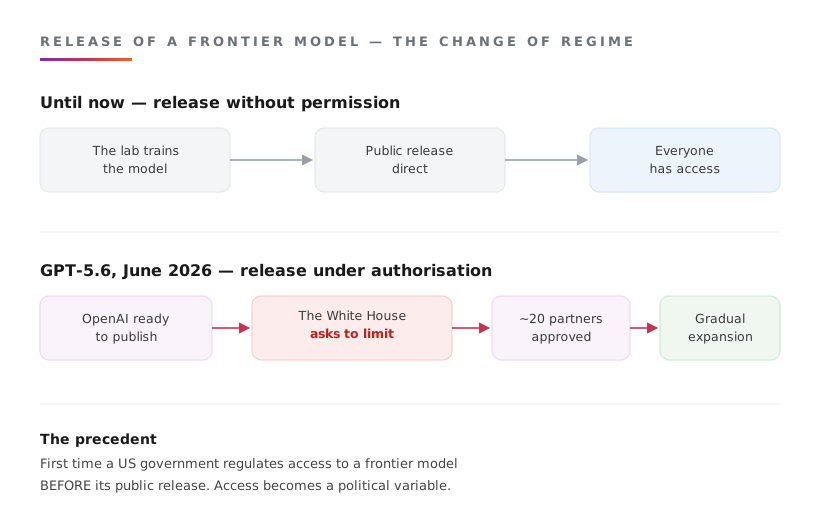
The unusual part lies elsewhere. The White House — through the Office of the National Cyber Director and the Office of Science and Technology Policy — asked OpenAI to reserve the release for a small group of government-approved partners while a framework for evaluating the safety of advanced models was put in place (CNBC). OpenAI agreed. Initial access is limited to around twenty companies, with a wider rollout announced "in the coming weeks" (Axios).
2. Why it is a precedent
The change of regime is subtle but profound. The dominant model since ChatGPT was the "permissionless" release: a lab trains a model, announces it, makes it available, and the market judges. GPT-5.6 inaugurates another model: the lab proposes, the state controls the timetable. Access to the technological frontier becomes a decision shared between the company and political power.
Sources: CNBC, Axios, VentureBeat.
3. The convergence with the Anthropic embargo
This move did not come out of nowhere. A few weeks earlier, the US administration had barred Anthropic from giving worldwide access to its Mythos and Fable 5 models, already citing national security. With GPT-5.6, the same logic applies this time upstream, to an American model, on American soil.
The common thread is clear: the US state now regards frontier models as strategic assets whose distribution must be controlled, in the same way as certain defence technologies. We analysed the export side of this doctrine in our piece on the Fable and Mythos models suspended by export controls; GPT-5.6 is its domestic side.
4. What it changes for businesses
The lesson is not reserved for geopolitics watchers. For any company building a product on a frontier model, the announcement introduces a new risk: the availability of a model may now depend on a political decision, not just on a supplier's roadmap.
In practice, three reflexes become prudent. Do not tie a critical product to a single model: plan for portability to another supplier. Monitor the access chain as much as the capabilities: a slightly less capable model that is available without conditions may be worth more than a superior model under restriction. Document your dependency: know precisely which functions of your product would stop working if access to a model were suspended.
It is the same principle that guides good AI governance internally: a tool's performance is worth nothing if you do not control access to it over the long term.
Frequently asked questions
What is GPT-5.6 and its Sol, Terra and Luna models?
GPT-5.6 is OpenAI's new family of models, unveiled on 26 June 2026: Sol, the most powerful (reasoning, agentic tasks); Terra, balanced; Luna, fast and economical.
Why was access to GPT-5.6 limited?
At the White House's request, OpenAI reserved initial access for around twenty approved partners, for national security reasons. It is the first time the US government has overseen the release of a frontier model before its public availability.
What are the consequences for companies that use these models?
Access to frontier models becomes a political variable. A company whose product depends on a frontier model is exposed to an availability risk that it does not control: diversifying suppliers and decoupling the product from a single model become strategic.
Conclusion
GPT-5.6 will be remembered less for its performance than for the way it was released. A major American lab agreed to submit the timing of its model to a government request. The signal sent to the rest of the industry is unambiguous: the AI frontier is no longer an open space, it is a regulated one.
For businesses, this is not a reason to panic, but a reason to plan. Frontier AI is now a resource whose access can be restricted overnight. Over time, controlling that dependency is worth as much as the race for the latest capabilities.