In January 2026, Renaissance made official the creation of a unit entirely dedicated to AI, under the leadership of Gabriel Attal, modelled on the Obama campaigns of 2008 and 2012. At the same time, the CNCCFP published its guidelines: every 2027 candidate will have to declare AI spending in the campaign account and justify the reproduction rights of every generated visual. Meanwhile, one French person in two says they use or are considering using generative AI to get political information — three in four among 18-24 year-olds. The question is no longer whether AI will play a role in the next presidential election. It is which strategy each candidate is already quietly deploying. A decryption.
1. What is already mandatory for a 2027 candidate
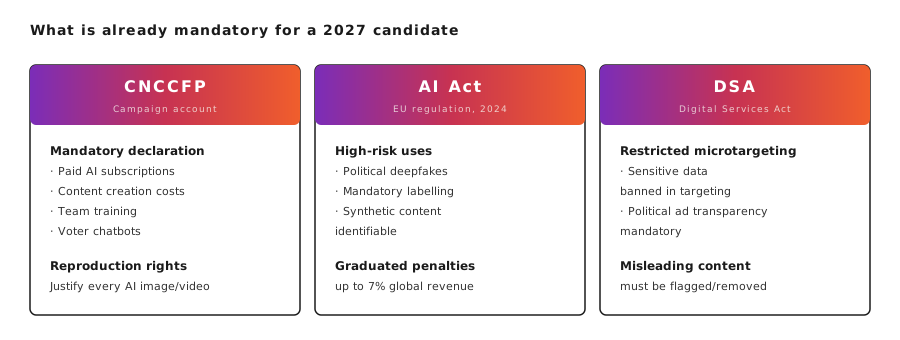
Before even discussing strategy, a candidate who enters the election without understanding the regulatory framework exposes themselves to financial penalties, rejection of their campaign account and criminal risk. Three regulations overlap.
Sources: Acteurs Publics, AI Act, European Commission — DSA.
The CNCCFP (the French commission overseeing campaign accounts and political financing) has published a note making clear that AI costs are campaign expenses in the same way as a communications agency. This includes subscriptions to Claude, ChatGPT, Midjourney or Veo, internal team training costs, the deployment of chatbots aimed at voters, and the fees of AI service providers. In parallel, every visual, photo or video generated by AI must be able to be backed by a justification of reproduction rights. A deepfake of an opponent is not permitted, and a style imitating a known photographer without permission even less so.
The AI Act, adopted in 2024 and rolled out gradually through 2026-2027, classifies uses linked to the democratic process among "high risks". The operational consequence: any synthetic content publicly distributed must be labelled as such. A campaign spot generated entirely by AI must say so explicitly. Penalties can reach 7% of the provider's worldwide revenue and also engage the liability of the candidate using it.
The Digital Services Act requires full transparency on political advertising distributed on the large platforms (Meta, X, TikTok, Google), prohibits microtargeting based on sensitive data (political opinions, sexual orientation, religion), and obliges platforms to flag and remove misleading content within a short deadline.
In other words, AI is not forbidden. It is regulated. Any candidate who deploys it without a dedicated legal compliance unit exposes themselves to litigation that can cost them the election.
2. The landscape of party AI teams in 2026
France is not ahead on integrating AI into political machines, but it is not lagging behind either.
Renaissance structured a dedicated AI unit under Gabriel Attal's authority in December 2025. Stated objective: build a platform that cross-references electoral data, INSEE statistics, field testimony and social networks to adapt the message to each catchment area, in real time (Orange Actu).
Les Républicains work with several external firms, with no publicly announced unified internal structure to date. Efforts remain fragmented by potential candidate.
The Rassemblement National has strong expertise in social networks and micro-influence campaigns, less in structured AI tools. The party has historically favoured activist networks on closed platforms (WhatsApp, Telegram, private networks) where AI poses control challenges.
La France Insoumise and the left-wing parties are developing decentralised open-source tools, often in-house within their think tanks. The movement remains in the background on micro-targeting, for reasons that are both political (distrust of electoral Big Data) and technical (fewer resources).
Result: as of April 2026, you can identify who is genuinely structuring their AI teams and who is bluffing. For a serious candidate, the signal is this: if you have not already recruited a permanent AI lead with an annual budget, you are six months behind.
3. The five strategic levers that move the needle
Consolidated analysis based on international cases: Obama 2012, Macron 2017-2022, Renaissance 2026, Harris 2024.
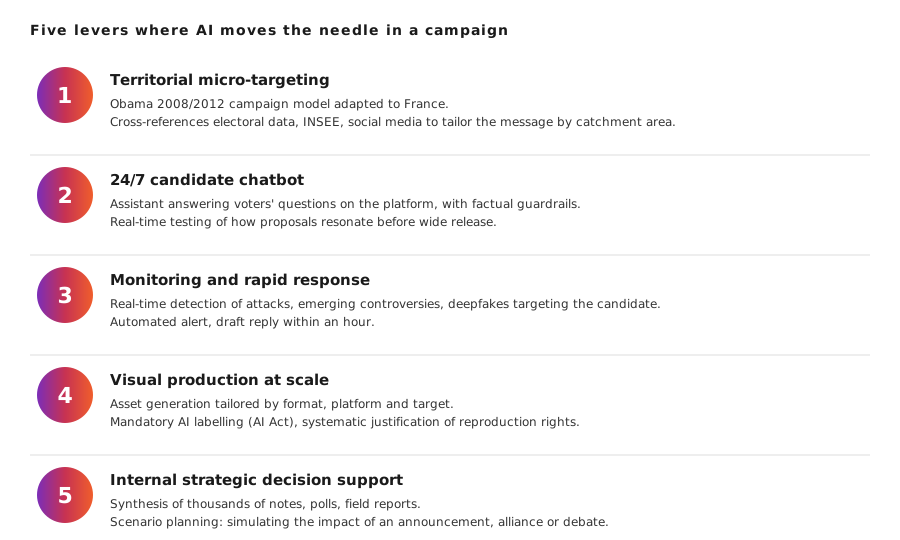
Lever 1 — territorial micro-targeting. This is the Obama 2008 revolution adapted to the French scale. Cross-referencing previous results by municipality, the age pyramid, commercial flows and concerns raised on social networks, to adapt the message. A candidate who talks about purchasing power in Hauts-de-France and ecology in the Lyon conurbation is not incoherent; they are precise.
Lever 2 — a 24/7 candidate chatbot. A conversational assistant that answers voters' questions about the platform, with strict factual guardrails. Beyond the gimmick, it is also a testing tool: which proposals generate recurring questions? Which are poorly understood? Anonymised conversation data feeds debate preparation.
Lever 3 — monitoring and responsiveness to opponents. Real-time detection of emerging controversies, deepfakes targeting the candidate, coordinated attacks on networks. AI enables a semantic analysis of network noise that turns the crisis team into a preventive unit. Draft response in under an hour, human validation, publication.
Lever 4 — visual production at scale. One visual per platform (Instagram stories, vertical TikTok, horizontal LinkedIn, newsletter), adapted to each target, with A/B variants. What used to require a team of graphic designers and a week now takes a day. Beware of the labelling and rights-justification obligations.
Lever 5 — support for internal strategic decision-making. Synthesis of thousands of notes, field reports, polls, activist feedback. Simulation of the impact of an announcement or an alliance. A campaign director who yesterday had 3 briefings a day can integrate 30 cross-checked sources.
4. The voter dimension: who already gets their information via AI?
Source: Ipsos, 2026.
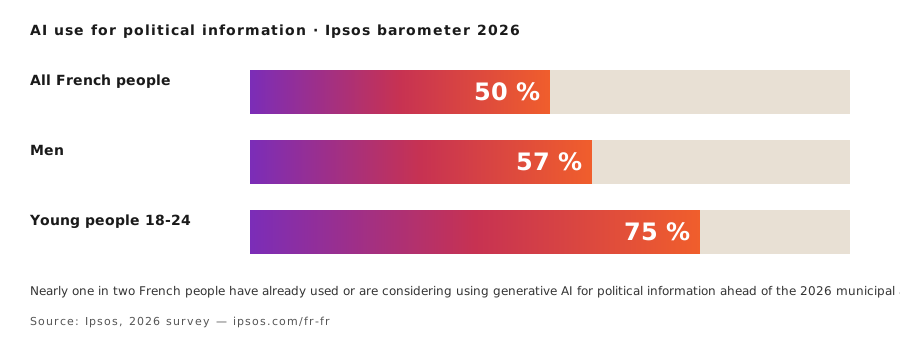
The Ipsos survey conducted in early 2026 establishes a major political fact: one French person in two has already used or plans to use generative AI to get political information before the 2027 presidential election. Among men, 57%. Among 18-24 year-olds — some of whom will vote for the first time in 2027 — 75%.
This datum transforms the terrain. The 2027 voter will not read a platform on the candidate's website. They will ask ChatGPT "what is X's position on pension reform". They will receive a neutral — or biased — summary generated by a foreign LLM that was not elected to play this role.
This opens a front that few teams have opened: GEO optimisation (see our article) applied to political platforms. How do you make sure ChatGPT cites your position correctly, in your wording, without distortion? That is an operational subject, not a philosophical one.
5. What we learned from 2024 — and what we still do not know
2024 was a global super-election year: more than 60 countries voted, including the United States, India and the United Kingdom. Predictions of an "AI apocalypse" did not materialise on the expected scale (Harvard Ash Center).
The most serious documented cases are limited.
- United States, January 2024: a fake voice message from Joe Biden asked New Hampshire voters not to vote in the Democratic primaries. The impact on the actual vote was marginal, but the media effect was major.
- Germany, 2024: the AfD used deepfakes of nostalgic scenes. The electoral impact remains debated.
- Russia: targeted operations against French, British, German and Italian figures identified in an FBI file.
The 2025-2026 academic consensus is cautious: no election has been tipped in a documented way by AI alone. But with deepfake quality progressing faster than detection tools, 2027 will not enjoy the same safety margin as 2024.
6. The reputational risks a candidate can no longer take
Producing a deepfake of an opponent. Even as a quotation, even as a caricature, even with a disclaimer. The AI Act prohibits it and the CNCCFP sanctions it by suspending reimbursement.
Generating a fake voter testimonial. The "ordinary citizen" who tells their story in a campaign clip must be a real citizen. A synthetic character or an actor credited as a voter tips the content into misleading advertising (DSA).
Using a cloned voice without consent. Reproducing the voice of a public figure, even a deceased one, requires the agreement of the rights holders. Without agreement, civil proceedings are automatic.
Launching ethnic, religious or political microtargeting. The DSA prohibits the use of sensitive data to target political ads. Meta, X and TikTok must detect these cases and block them.
Failing to label AI content. The watermark and the explicit mention "AI-generated content" are becoming mandatory. A candidate who broadcasts an AI spot without labelling exposes themselves to a fine and to the content being reclassified as misleading propaganda.
7. What must be structurally in place from 2026
For a candidate seriously aiming at 2027, the operational checklist is clear.
- A permanent AI lead, reporting to the campaign director, with a dedicated annual budget.
- A legal AI unit coordinated with the CNCCFP, which validates every synthetic production distributed.
- A territorial micro-targeting platform compliant with GDPR and the DSA.
- An infrastructure for monitoring and responding to opponents' deepfakes, with the ability to counter-attack in under an hour.
- A GEO strategy so that mainstream LLMs (ChatGPT, Claude, Perplexity, Google AI Overviews) correctly cite the candidate's positions.
- A public ethical commitment on the use of AI, also valid as a defensive communication tool against competitors.
Conclusion
The 2027 presidential election will not be the first AI election in France. It will be the first where a candidate who does not master the tool will not be able to go the distance. Not because AI wins. Because its absence loses: loss of agility, loss of precision, loss of reaction speed, loss of presence in the answers that voters now ask LLMs for.
The candidates who understood this in 2026 are already recruiting, contracting, structuring. Those who wait until spring 2027 to get started will discover that you cannot catch up in three months on an advantage built over eighteen.
The real public debate, the one that should mobilise editorialists and elected officials more, is not "will AI distort 2027". It is "who will make the densest use of it, and will that candidate be the one carrying the political project most aligned with the interest of the French, or simply the one who had the means to equip themselves first". The answer depends on the vigilance of the regulatory authorities — CNCCFP, Arcom, CNIL — and on voters' ability not to confuse form with substance.