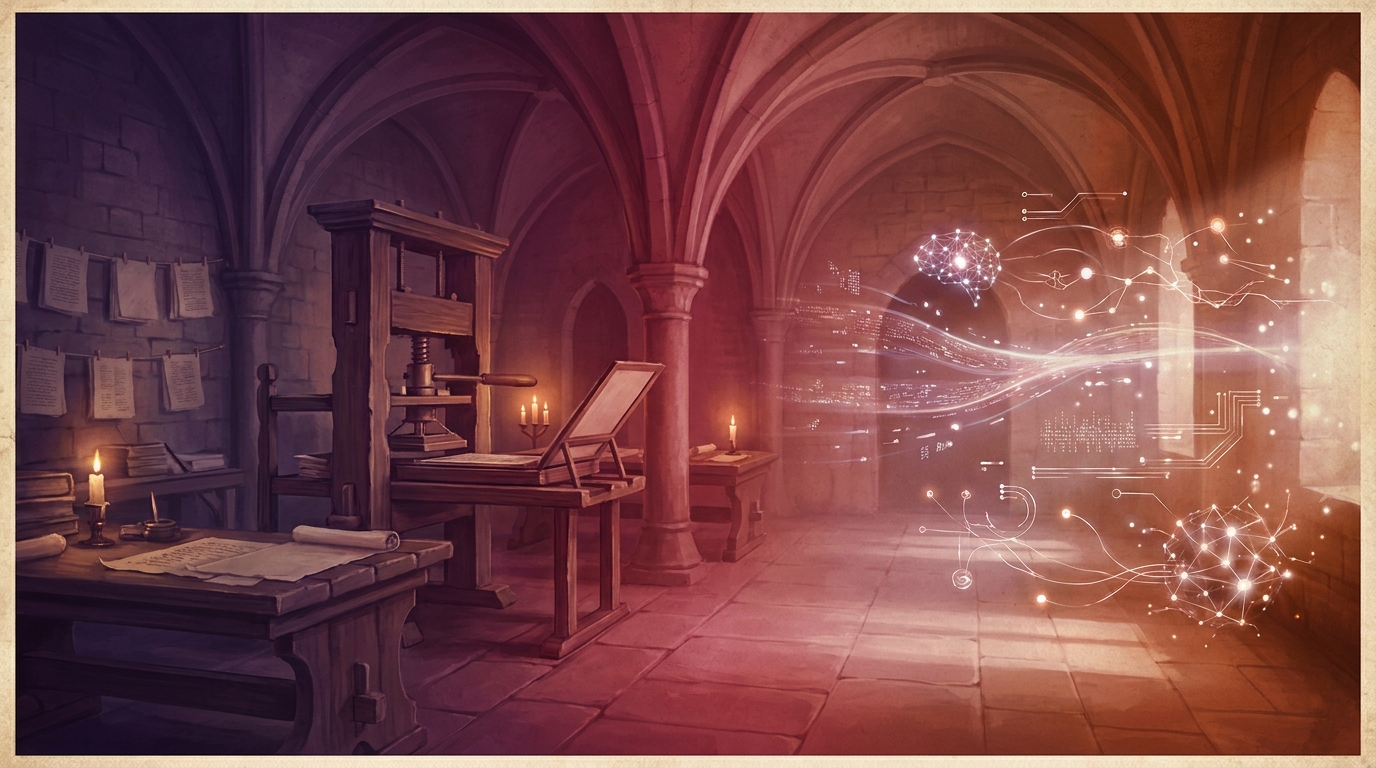
In 1455, a goldsmith from Mainz printed one hundred and eighty copies of the Latin Bible. Sixty-two years later, Martin Luther posted his ninety-five theses on the door of a chapel in Wittenberg; the Treaties of Westphalia, signed in 1648, closed one hundred and ninety-three years of political, theological and military recompositions of which modern institutions — the nation-state, the public school, the separation of powers — are the direct daughters. None of these institutions was in Gutenberg's mind, or in Luther's. They became necessary as responses to a rupture that nobody, in 1455, had known how to name.
The sword was then out of its scabbard for a hundred and fifty years. Three centuries later, in 1769, James Watt filed the patent for the improved steam engine; the industrial revolution, the rural exodus, the birth of the proletariat, the appearance of trade unions, of Marxism, of socialism, of social insurance and of the welfare state would flow from it over a further hundred and fifty years. Here again, none of the decisive political arrangements of the following century had been conceived at the time of the patent.
We are today four years from the public release of ChatGPT. The historical singularity of our era comes down to one sentence: the two ruptures that structured Western modernity — one cognitive, that of the printing press; the other industrial, that of steam — are taking place simultaneously under the effect of a single technology. Generative artificial intelligence is at once a change in access to knowledge and a change in the means of production. No Western society has digested these two ruptures at the same time. The useful question is not whether the recomposition will take place; it is which one, at what human cost, and on what timetable.


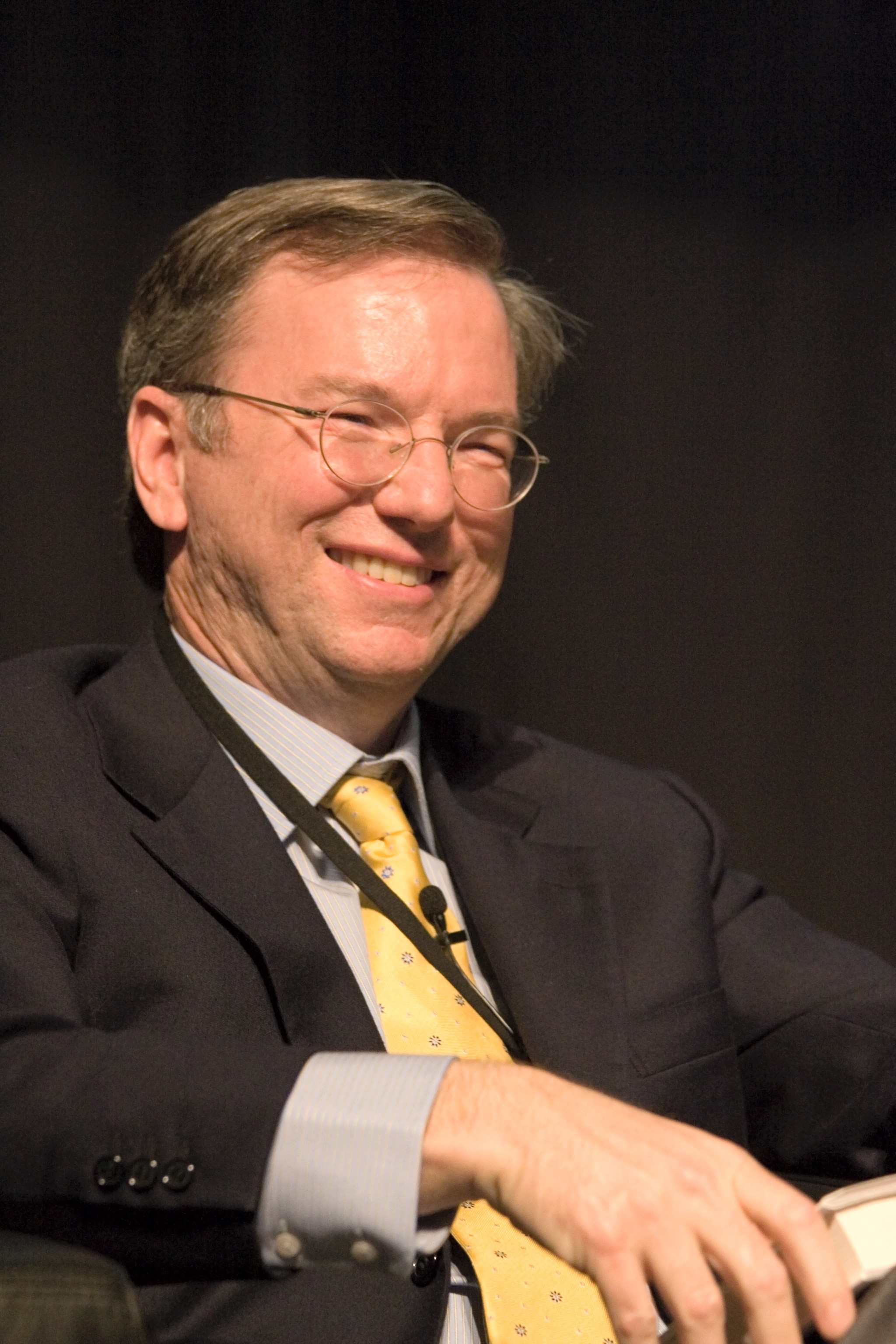

Portraits: Wikimedia Commons. Four players on the AI scene in May 2026, three of whom made the news this week for reasons that this report decodes.
1. What the printing press cost
The school-book history of printing is misleading because it is elliptical. It retains Gutenberg's invention, Renaissance humanism, the spread of knowledge. It passes over what separates the first from the second: a century and a half of sustained political violence, during which Europe lost a substantial part of its population and reconfigured all of its institutions inherited from the Middle Ages.
A few milestones are enough to re-set the chronology. The forty-two-line Bible appeared in Mainz around 1455; by 1500, some fifty European cities had a printing workshop; in the fifteenth century alone, nearly twenty million books were produced by presses. The historian Elizabeth Eisenstein, in The Printing Revolution in Early Modern Europe, establishes that the pamphlets of Luther and his followers ran to around six million copies between 1517 and 1525 — a volume without precedent in the history of texts. The Peasants' War set Germany ablaze in 1524-1525. The eight French wars of religion stretched over thirty-six years from 1562, punctuated by the St Bartholomew's Day massacre in 1572 and then the Edict of Nantes in 1598. The Thirty Years' War, opened in 1618 by the Defenestration of Prague, ravaged the Holy Roman Empire until 1648 and killed, according to the estimates consolidated by Geoffrey Parker in The Thirty Years' War, nearly a third of the population of the German territories.

Portrait: Lucas Cranach the Elder, 1528, Veste Coburg, Wikimedia Commons (public domain).
What these one hundred and ninety-three years put at stake is neither a technical theological quarrel nor a mere shift in doctrine. It is ownership of the monopoly on interpreting the world. Before Gutenberg, the Catholic Church held this monopoly through institution: alone entitled to read and comment on the sacred text, it interpreted on the believer's behalf what to believe, how to be saved, and who should govern. The printing press blew this mediation apart. Anyone who could read could now access the source directly, and do without the clergy.
The clergy did not let itself be dispossessed. It responded with the Council of Trent (1545-1563), the Index librorum prohibitorum promulgated in 1559, the strengthening of the Roman Inquisition, burnings at the stake, forced conversions, and, in the kingdom of France, the revocation of the Edict of Nantes in 1685, which drove out around two hundred thousand Protestants. Violence was not an accident of the rupture; it was its very modality.
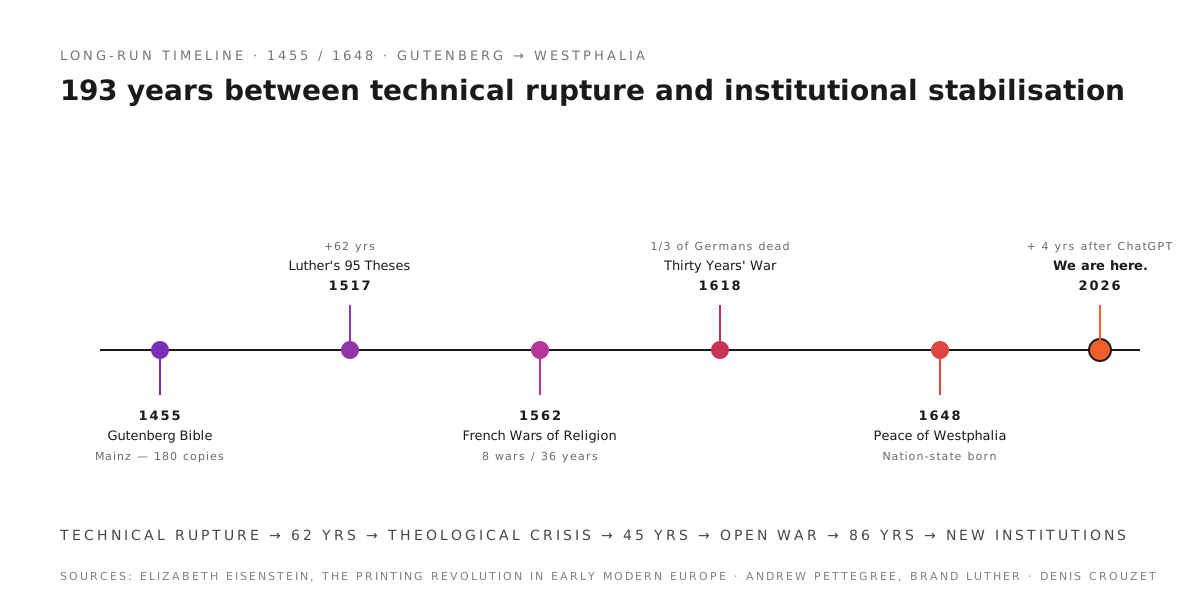
Sources: Eisenstein, The Printing Revolution in Early Modern Europe; Pettegree, Brand Luther; Parker, The Thirty Years' War; Crouzet, Les guerriers de Dieu.
The long consequence is more striking than the rupture itself. The modern institutions that we take for granted are all daughters of this period. The modern nation-state is formally set out at the Treaties of Westphalia in 1648, through the formula cuius regio, eius religio which establishes the principle of territorial sovereignty. The mass public school appears in Protestant territories to allow personal reading of the Bible — the first Protestant parish schools date from the 1530s. National languages become fixed in writing thanks to printed translations: Luther's German translation of the Bible, published in 1534, founds modern standard German. Modern international law is constituted around the same treaties. And the very idea of an individual conscience separate from religious authority, which Western political philosophy now holds as its founding axiom, is a direct consequence of free access to the sacred text.
None of these institutions was foreseeable in 1455. None had been conceived by Luther in 1517. They became necessary through an accumulation of attempts, failures, massacres and compromises. The lesson is clear and disquieting: the institutions of the after are not those of the before. It is the fundamental property of informational ruptures. It applies to ours.
2. What the steam engine cost
The second great rupture of Western modernity is not a rupture of information; it is a rupture of production. It begins in 1769 when James Watt files a patent for the improved steam engine — a device that separates the condenser from the cylinder and multiplies energy efficiency by three. The British textile industry first adopts this new order of magnitude, then metallurgy, then transport, then agriculture. In 1800, Great Britain produces ten times more pig iron than in 1750. In 1850, the United Kingdom accounts for half of the world's industrial production.
The social consequences are as documentable as the chronology. Work changes in nature: the independent craftsman becomes a wage-earning worker, the peasant becomes an urban proletarian. The British urban population rises from 17% in 1750 to 54% in 1851. Living conditions deteriorate in the first decades: life expectancy in Manchester in 1842 is seventeen years for workers, twenty-five for craftsmen, thirty-eight for property owners (Chadwick report, Report on the Sanitary Condition of the Labouring Population). The political consequence unfolds in waves: British Chartism from 1838, the European Revolutions of 1848, the publication of the Communist Manifesto the same year by Karl Marx and Friedrich Engels, the organisation of the Trade Unions, the first Bismarckian social laws from 1883, the rise of European socialism, then health insurance, pay-as-you-go pensions, the labour code.
The theorist who best dated these processes is the Hungarian historian Karl Polanyi, whose The Great Transformation (1944) remains the reference text. Polanyi shows that the industrial revolution imposed a "disembedding" of the economy: for the first time in history, the market ceases to be one social institution among others and becomes the organising principle of the whole society. Human labour, land and money are treated as ordinary commodities, which produces destructive social effects. The contemporary appearance of trade unionism, workers' parties and the welfare state is not a foreign political inheritance: it is, Polanyi writes, the "counter-movement" by which society protects itself from its own commodification. A hundred and fifty years were needed for the complete establishment of this counter-movement — between Watt's factory and the establishment of French Social Security in 1945.
Joseph Schumpeter, in Capitalism, Socialism and Democracy (1942), names the other side of the same phenomenon: "creative destruction". Every industrial innovation destroys the rent of established positions and opens up space for new ones. This takes place at considerable human cost, but in the long run produces the growth that makes society more prosperous. The necessary condition: that social protection institutions absorb the shock in the decades of transition. Without them, creative destruction produces revolution before prosperity.
3. The double rupture, or why 2026 resembles no precedent
If we accept these two historical precedents — the printing press as cognitive rupture, the steam engine as industrial rupture — the singularity of generative artificial intelligence appears clearly. It is, for the first time in Western history, both ruptures at once.
Cognitively, AI produces a collapse of the monopoly on interpreting the world, exactly like the printing press. Yesterday the monopoly was clerical, accumulated over fifteen centuries. Today it belongs to five laboratories — OpenAI, Anthropic, Google, Meta, xAI — formed in less than ten years, to which their Chinese equivalents are added. These five laboratories decide, through hidden instructions, non-public routing modes and silent moderation filters, what hundreds of millions of users are allowed to know about the world — and from what angle.
Industrially, AI produces a productivity rupture comparable to that of steam. The first serious assessments converge. Goldman Sachs establishes that up to three hundred million white-collar cognitive jobs are affected over a ten-year horizon in developed countries. The OECD estimates at thirty per cent the share of professional activities directly automatable by current models. Anthropic projects revenue of $10.9 billion in the second quarter of 2026 alone; the annual compute infrastructure capex of the hyperscalers exceeds five hundred billion dollars for the first time in 2026. These are orders of magnitude typical of a raw-material industrial revolution — except that the raw material here is cognitive labour itself.
To grasp what is at stake materially, we need to step outside generative models for a moment and look at where artificial intelligence is physically embodied, in bodies: industrial humanoid robotics. In 2025-2026, units are coming out of American and Chinese factories simultaneously at unprecedented speed. Tesla announces the deployment of Optimus Gen 3 in its Fremont and Giga Texas plants, the first large-scale integration of a general-purpose humanoid robot in a production environment, with a stated goal of one million units a year. UBTECH, in China, has just delivered a first industrial wave of its Walker S2 to the production lines of BYD, Geely, FAW-Volkswagen, Audi FAW, BAIC, Foxconn and SF Express, for around 800 million yuan of firm orders; the announced target is 5,000 units in 2026 and 10,000 in 2027. Figure AI, founded by Brett Adcock, live-streamed in May 2026 three units of its F.03 sorting 101,391 parcels in 81 hours without interruption, at a rate of 2.83 seconds per parcel — the performance of a trained human worker, with no break, no relief shift, no paid holiday.
The first large-scale integration of a general-purpose humanoid robot in an industrial production environment.
In the background, Chinese "dark" factories already produce without humans. The term designates sites where production runs twenty-four hours a day, with no lighting, no breaks and no relief. BYD operates several of these facilities in China and today produces more than a thousand electric vehicles a day, mainly using robotic arms, LIDAR sensors and AGVs. Xiaomi communicates about a dark factory that assembles "one smartphone per second". The difference from the classic automated factories of the twentieth century is that the machines now integrate vision and planning models boosted by generative AI, allowing them to handle variability without pre-programmed human intervention.
The essential lesson of these two parallel movements is that the current rupture does not follow the usual pattern of earlier industrial revolutions. In 1700, Cartwright's loom replaces the textile craftsman; administrative staff and the office remain human. In 1980, the desktop computer replaces archiving and intermediate calculation functions; workshops and factories remain human. In 2026, for the first time, both fronts are attacked simultaneously. Generative AI compresses white-collar trades — writing, translation, accounting, programming, analysis, design — while humanoid robotics attacks blue-collar trades — logistics, handling, assembly, delivery. No previous industrial revolution has struck both strata of labour at the same time. This is the other reason, a material one this time, that justifies speaking of a double rupture.
From this point of view, Europe enters the cycle a train behind, structurally. The deindustrialisation pursued since the 1980s has deprived us of the factories, the supply chains and the capacity for very large-scale industrial investment that the roll-out of robotics now demands. BYD opens ten giant factories in China in five years; no European manufacturer has an equivalent industrial programme. China has channelled around $75 billion towards humanoid robotics in 2026 (Development and Reform Commission); France has announced 1.55 billion euros for quantum and semiconductors, an amount that remains out of all proportion to Chinese industrial flows. And the European Union, in the absence of a capital markets union and an effective budgetary union, cannot mobilise the volumes that such accelerated reindustrialisation requires.
The crucial difference from the two historical precedents finally lies in the timetable. The printing press took sixty-two years to produce Luther, one hundred and ninety-three years to produce Westphalia. The industrial revolution took a hundred and fifty years to produce the corresponding social institutions. Generative AI, in its mainstream version, is only four years old. The economic figures are set in quarters, adoption is measured in hundreds of millions of weekly users, and the infrastructure layer is counted in gigawatts. European societies, particularly the French, built their institutions on an implicit assumption: that technical ruptures leave institutions time to adapt. This assumption no longer holds.
No Western society has experienced a simultaneous double rupture. The singularity of our era lies not only in the speed of AI; it lies in the fact that the two engines of modernity — cognitive and productive — are being imposed together, by the same players, within the same ten-year cycle. It is this superposition that makes the timetable of recompositions unpredictable and probably more violent than the previous ones.
4. An economy taking shape, a control that slips
Before analysing further the nature of the rupture, its economic intensity should be measured. Four indicators published or confirmed between 14 and 22 May 2026 tell the same story: that of a market taking shape in the United States while its technology spreads everywhere else.
Anthropic told its investors of projected second-quarter 2026 revenue of ten billion nine hundred million dollars, a multiplication by 2.27 over the first quarter, with a first operating profit of five hundred and fifty-nine million dollars (CNBC, 20 May 2026). The pace exceeds the historic peaks of Zoom, Google and Facebook. Last summer, Anthropic was communicating to its investors a horizon of annual profitability that was not expected before 2028; the timetable has compressed by two years in six months.
Adoption is mass-market. ChatGPT reaches around eight hundred million weekly users (a figure confirmed by OpenAI in 2026), making it the fastest adoption in technological history, ahead of the Internet itself in the 1990s. We are no longer talking about early adopters but about a product whose use has become as commonplace as a Google search.
Technical control, by contrast, has already leaked. On the OpenRouter platform, which aggregates the API usage of independent developers, sixty-one per cent of the tokens consumed in 2026 come from Chinese models — MiniMax M2.5, Moonshot Kimi K2.5, Zhipu GLM-5 (Dataconomy). In 2024, the same measure peaked at one per cent. The driver of this shift is the price gap: MiniMax M2.5 charges thirty cents per million input tokens against fifteen dollars for Claude Opus 4.6. According to Martin Casado, a partner at Andreessen Horowitz, eighty per cent of the startups deploying an open-source stack run Chinese models. Anthropic admits internally, in a recent policy document, that the technical lead of American laboratories is now measured in a few months rather than in a year or two.
The listed markets, for their part, are finally opening their doors. On 14 May 2026, Cerebras Systems entered the Nasdaq; the stock closed its first session up sixty-eight per cent, valuing the company at around ninety-five billion dollars (CNBC, 14 May 2026). Six days later, SpaceX filed a public S-1 targeting a valuation of $1,750 billion. On 22 May, OpenAI filed a confidential S-1 for a listing targeted in September. Anthropic is aiming for October. The structural illiquidity of AI laboratories, until now confined to the limited partners of private funds, will disappear in stages from the end of summer 2026.
Taken together, these four indicators tell the same story: artificial intelligence is no longer a promise but a sector about to be listed, whose economic value remains captured mainly in the United States while the underlying technology spreads beyond the American perimeter. The situation recalls, by structural analogy, that of the Catholic Church around 1530: still economically dominant, already losing the technical monopoly on its own material. Nobody at the time knew that this meant a century and a half of violence; nobody today knows what it means over the horizon of a generation.
5. Three booed speeches, or the end of interpretive authority
Portrait: Wikimedia Commons. Sources: CNBC, NBC News, Fox Business.
On 16 May 2026, in front of some 10,000 graduates of the University of Arizona, Eric Schmidt begins a graduation ceremony with a techno-optimist speech. He hails the advances, evokes previous generations, talks about science. The room listens. Then comes the tipping point: "if science is not your passion, that's fine, because AI will touch everything else". The booing rises. Schmidt replies live, "I can hear you", and tries to rally by owning the room's fear: "there is a fear in your generation that the future is already written, that the machines are coming, that jobs are evaporating". The sentence holds. The booing continues.
Associated Press / NBC News channel. Covers the three incidents: Schmidt at Arizona, Caulfield at UCF, Borchetta at Middle Tennessee State.
The episode is not isolated. The same month, Gloria Caulfield, a real-estate executive, is booed at the University of Central Florida for calling AI "the next industrial revolution". Scott Borchetta, CEO of Big Machine Records, is booed at Middle Tennessee State University while discussing uses of AI in the music industry. Three commencement speakers, three campuses, a single month, a single motive.
What is at play needs to be named precisely. The students who are shouting are not shouting against AI. They use it every day — ChatGPT for their dissertations, Claude for their CVs, Sora for their graduation videos. What they boo is that a 71-year-old man, whose personal fortune is estimated at around $30 billion, explains to them in five minutes that their career may disappear but that it is "okay". The sentence is not a technical fact. It is a posture of interpretive authority. Schmidt is not just saying that AI is coming: he is saying how it should be welcomed, what to think of it, and what may be sacrificed to it. It is exactly the tone taken by the indulgence-seller Johann Tetzel when he toured Germany in 1517 selling papal indulgences: you have no choice, it has already been decided for you, put down your offering.
And it is precisely this posture that triggered Luther.
But here is the crucial difference between 1517 and 2026, and it is what makes the present situation more unstable than that of the Reformation, not less. In 1517, Luther has a name, a face, printed theses, an articulated intellectual platform. He proposes a coherent alternative reading of the sacred text. The German princes can coalesce around this reading, give it political force, finance its extension. The Reformation is not only a rejection: it is a project.
The booing at Arizona in May 2026 is not a project. It is a diffuse rejection, without a manifesto, without a figure, without a programme. Nobody among the 10,000 booers could set out in five lines what they propose instead. And it is this void that makes the situation more unstable than the Reformation — not more stable. A rejection without a project does not turn into politics. It evaporates, or it lets itself be captured by opportunistic political entrepreneurs who will give it a meaning it did not have. The absence of a Luther in 2026 is the real political subject of the coming decade.
One distinction must be carefully maintained. Tech bosses have already lost Western youth on the narrative; they keep, however, the dependence of use. These two facts are separate, and confusing them produces costly errors of analysis. An organisation that believes that because its young recruits use ChatGPT they buy their suppliers' techno-evangelical rhetoric is misreading the ground it is treading.
6. Cognitive asymmetry: what we know, what we can act on
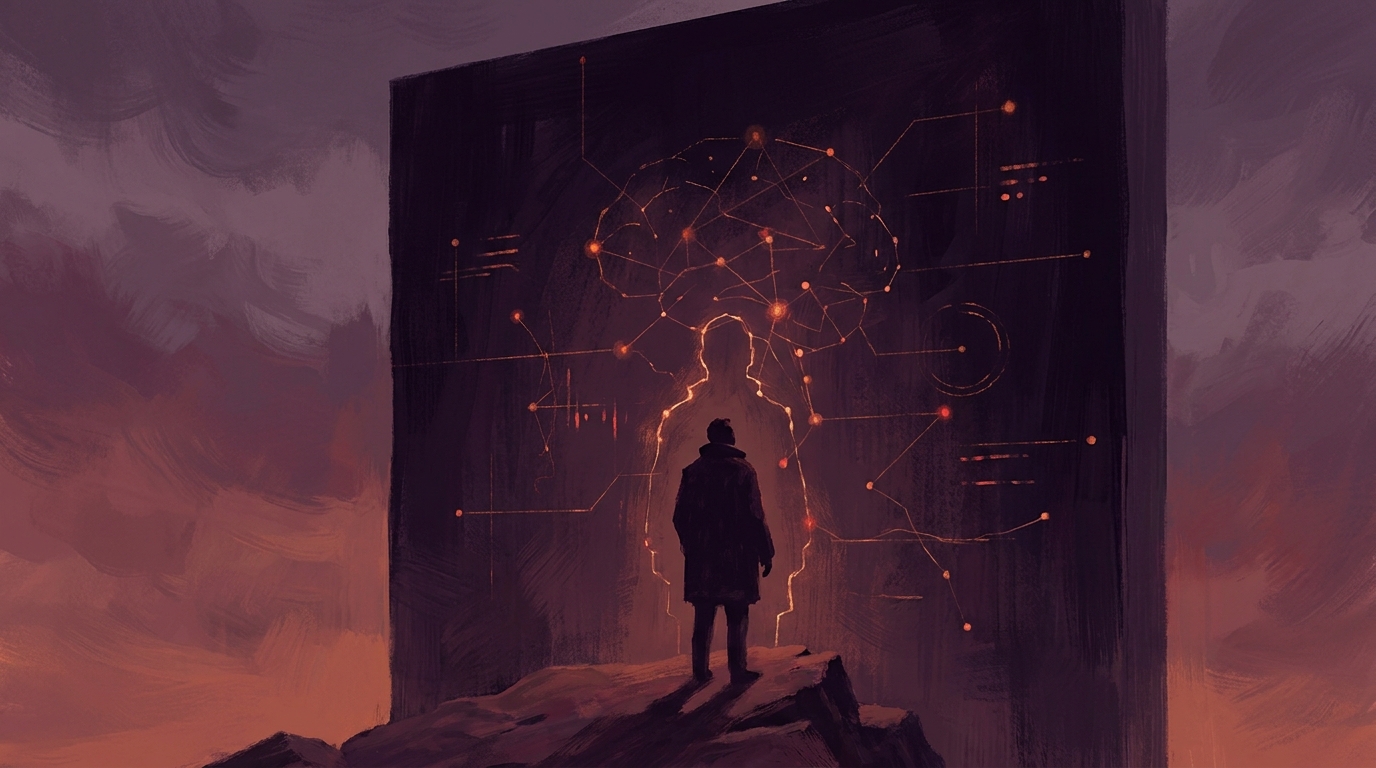
Otium editorial illustration — the issue is not ignorance, it is granularity and differential capacity to act.
Every technical tool creates an asymmetry between itself and its user. A car knows things about mechanics that its driver does not. A clock measures time better than a human brain. This asymmetry is neutral, and often even virtuous: it is the tool's reason for being.
We must begin by setting aside a lazy formulation: the thesis that "AI knows the user whereas the user is ignorant of AI". This formulation is false in both directions. The 2026 user knows non-trivial things about the laboratories that serve them: they identify the brands, they have an intuition of what a model is, they follow technology news from a distance, they have sometimes read an article about hallucinations or training biases. Symmetrically, the system does not "know" the user in the sense that another human would: it does not model their intention, it does not assess their sincerity, it does not anticipate their tricks.
The relevant subject is not the presence or absence of knowledge but the depth of granularity and the capacity to act. On the system's side, knowledge is sub-personal, datable to the token, modellable and actionable. On the user's side, it is media-derived, intuitive, not individually verifiable, and largely unactionable. It is this difference of regime — and not the opposition of omniscience to ignorance — that constitutes the cognitive asymmetry of our era.
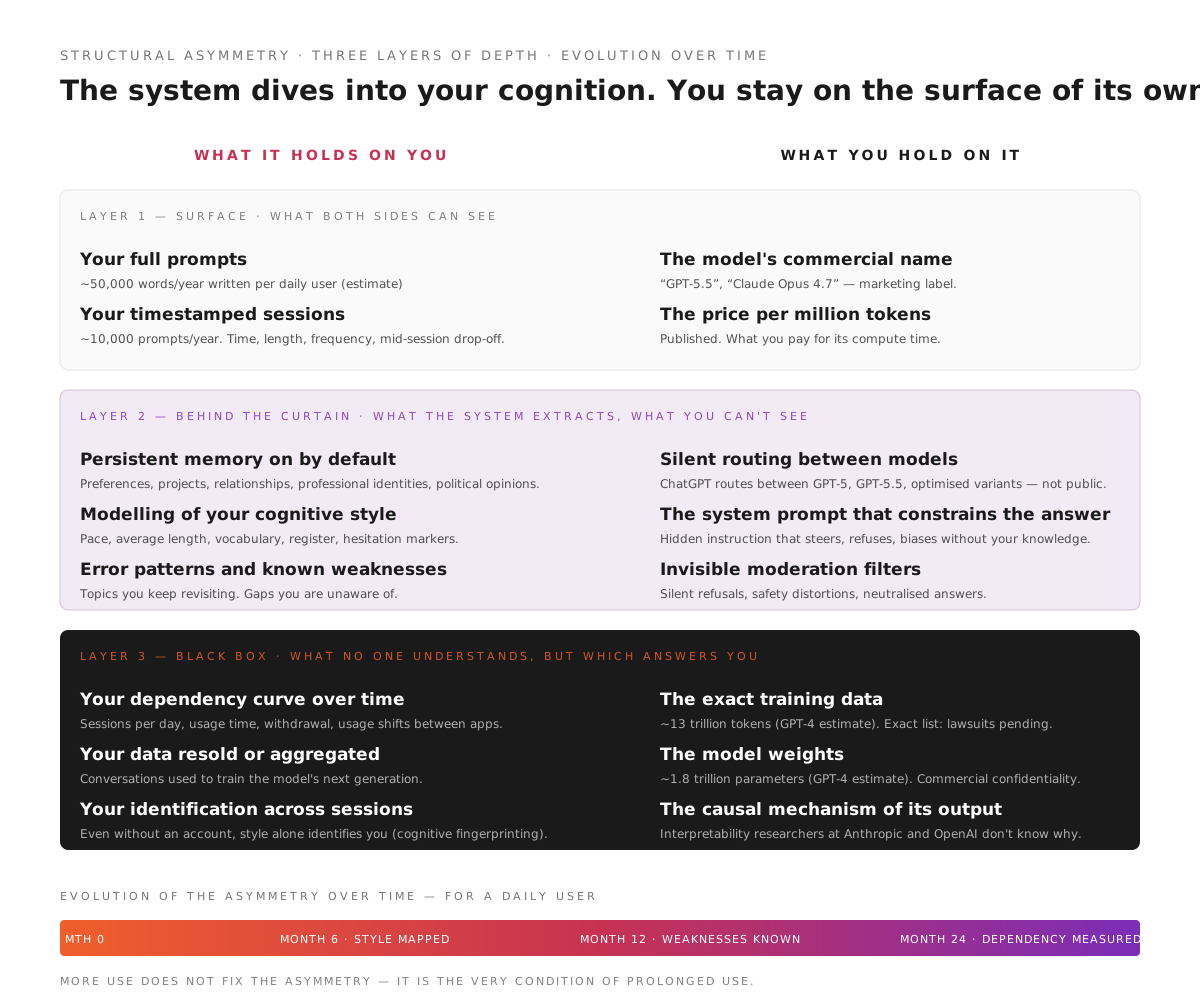
The issue is not ignorance, it is granularity and differential capacity to act.
The first layer, the most visible, is trivial: the content of the exchanges. The user knows the commercial identity of the model they query, its price, sometimes its order of magnitude in parameters. The system, for its part, archives all the prompts, dated and time-stamped, or around fifty thousand words a year for an average daily user. The symmetry appears correct: each retains what they do.
The second layer, behind the curtain, is more problematic. On the system's side: persistent memories activated by default since 2024 (preferences, ongoing projects, relationships, professional identities, inferred political opinions); modelling of cognitive style — rhythm, length, vocabulary, markers of hesitation; mapping of the subjects the user keeps coming back to and of their evident gaps. On the user's side: the system instruction that constrains the answer remains hidden; silent routing between model versions is not documented; the moderation filters that produce implicit refusals or safety-driven distortions are published nowhere. It is not that the user is unaware of the existence of these mechanisms; they regularly read about them in the press. But they cannot, at any moment, know the precise parameters that apply to their current conversation.
The third layer is that of the black box itself. Interpretability researchers at Anthropic, OpenAI or Google DeepMind acknowledge publicly that they only partially know why a given model produces one output rather than another. This opacity is not a transient defect; it is the structural property of a system with eighteen hundred billion parameters trained on thirteen thousand billion tokens. On the user's side, what circulates internally are the exact training data — today the subject of lawsuits in the United States (New York Times against OpenAI, publishing houses against Anthropic); the exact weights of the network, protected by commercial confidentiality; the internal causal mechanisms, opaque even to the designers themselves.
Three thinkers, in order, prepared the conceptual framework for thinking about this situation.
Michel Foucault, in Discipline and Punish (1975), had posed the knowledge/power pairing as the matrix of modern control: what the institution knows about the subject defines the modality by which it acts on them. Bentham's panopticon was not one prison among others; it was the archetype of an apparatus in which the observer's gaze determines the observed's subjectivity. The relationship to generative AI reproduces this apparatus on a scale that no material panopticon could ever have reached: for the first time, the knowledge accumulated about the user is not confined to a state or a disciplinary institution but acts continuously, at every interaction, on the user's own thinking.
Bernard Stiegler, in La télécratie contre la démocratie (2006) and then in Pour une nouvelle critique de l'économie politique (2009), named what he called cognitive proletarianisation: the moment when the higher faculties of the mind — memory, attention, reasoning — are outsourced to technical devices that absorb their performance and gradually deprive their bearers of it. The model, he wrote before ChatGPT, was the proletarianisation of memorised calculation by the calculator: few mathematicians still use mental arithmetic. Stiegler judged that the generalisation of the same phenomenon to the faculties of writing and reasoning would constitute, I quote, "the condition for an unprecedented anthropological regression". Fifteen years later, the Carnegie Mellon University and Microsoft Research studies published in 2025 document precisely this regression: intensive users of generative AI carry out significantly fewer critical operations on the outputs they receive.
Shoshana Zuboff, in The Age of Surveillance Capitalism (2019), proposed the concept of surveillance capitalism to describe the emergence of an economic model founded on the extraction of human behavioural data for the purposes of predicting and then modifying those behaviours. The initial model was that of Google Search: the user freely gives up a signal of intent; the platform resells it to advertisers in the form of advertising prediction. With generative AI, the object of extraction changes in nature. It is no longer the intent expressed in a query; it is thought in formation, articulated in natural language, in a context of relaxed trust that resembles a conversation with a loved one. Extraction now concerns the pre-cognitive — what the user would not yet have thought of saying publicly.
What these three conceptual frameworks make it possible to specify is that the asymmetry concerns not only information; it concerns differential power to act. The system can, on the basis of what it knows, adjust its answers, refuse certain requests, steer others, modify the modelled profile, feed future versions of the model, all without any public institution certifying the legitimacy of it. The user, even with a media-derived knowledge of the system, has no individual lever of action over it. It is this structural inaction that deserves to be named, rather than the false ignorance.
What this calls for, in practice, is not a technical answer — a better private browser, a local model. It is an institutional answer. An asymmetry of this scale is not individually negotiable, any more than the asymmetry between clergy and faithful was before Luther. It is regulated by the creation of a collective counter-power that does not yet exist in France and that no French political party has, to date, formulated as a programme.
7. Time as value: what is freed, what is captured
One promise has dominated the discourse of artificial intelligence laboratories for three years: AI frees up time. The promise is measured and therefore true at the first level. It is also, on closer inspection, one of the useful lies of the moment.
The gain is documentable. Microsoft published an internal study in 2025 on its Copilot users with an average gain of fourteen minutes a day. A McKinsey model estimates the potential for generative AI automation at thirty per cent of managers' working time. Productivity gains on specific tasks — writing an email, summarising a document, generating routine code — are real and immediate.
The net gain, however, is indeterminate, even negative on two dimensions. The time saved on the task is partly offset by the time spent checking the output. A joint Carnegie Mellon University and Microsoft Research study, published in 2025, establishes that intensive users of generative AI exercise less critical thinking on the outputs they receive — a phenomenon called cognitive offloading. The ratio is inverse: the higher the trust, the less verification is exercised, the more the error goes unnoticed. The costs of error are then externalised to the recipients of the output: the client who receives a badly targeted email, the colleague who debugs poorly generated code, or, in several cases documented in the United States since 2023, the court that discovers legal citations invented by a model.
More deeply, the time saved does not leave the digital circuit. The time freed by AI is not, in practice, devoted to going to see a colleague, reading a paper book or spending time with one's children. It is devoted to consuming more digital content — Slack, emails, Twitter, TikTok, other AI prompts. Average global screen time, measured by DataReportal, rose from four hours a day in 2010 to six hours and forty-five minutes in 2025, with no intermediate plateau and without any country recording a lasting decline. AI does not reverse this trend; it accelerates it by offering a new reason for use.
This accumulation has a deeper effect than a simple gain of time. It changes the nature of the time we have. Three concrete examples, by way of illustration.
- Asking ChatGPT how to repair a washing machine, rather than calling the relative who knows. The gain is eight minutes; the loss is a conversation. Accumulated over a decade, the sum comes to thousands of missed opportunities for connection.
- Having a condolence message generated, rather than searching for one's words for twenty minutes. The gain is twenty minutes; the loss is the moment of attentive thought directed towards the deceased and their loved ones, which was precisely the object of the attention.
- Reading the summary of a book, rather than the book. The gain is eight hours; the loss lies in the author's digressions, which are the constitutive element of reading as an experience, and not as a mere transfer of information.
None of these three examples is dramatic taken once. The sum is. Each little shortcut removes a ritual that connected us to a person, an object, a text. It is the same movement as that of the printing press in the sixteenth century — but at high frequency and low intensity. The printing press freed humans from the time of manuscript copying. Magnificent. But it also created solitary, silent reading. Before it, people read aloud, in groups; the book was a social event. European intellectual modernity was built on the isolation of the reader. It is probably necessary; it is also irreversible.
To put it briefly: AI does not make us lose time, it changes the nature of the time we have.
8. The collapse of the scarcity of time
The same phenomenon replays at another scale, that of the length of a human life. Laurent Alexandre, a doctor and essayist, founder of Doctissimo, has been arguing for fifteen years at French conferences for what he calls the death of death — that is, in the high versions, the prospect of living to 1,000 years, thanks to the combination of biomedical AI, genomics and cellular repair.
This presentation summarises Alexandre's thesis on the death of death and the prospect of radically extended life expectancy thanks to biomedical AI.
The promise is composite. The true part is real: AlphaFold, developed by Google DeepMind, solved in 2022 the structure of 200 million proteins, as many as had been humanly solved in fifty years of crystallography. David Baker, an American biochemist, received the Nobel Prize in Chemistry in 2024 for proteins entirely designed by AI. Startups such as Insilico Medicine, Recursion or Exscientia have their first AI-discovered drug candidates in human clinical trials. The mechanisms of cellular senescence, telomeres and DNA repair are better understood than they were ten years ago. Life expectancy will probably gain 5 to 10 years over the next twenty years for rich countries.
The bullshit part is just as real. Life expectancy in France has been on a plateau since 2014 at 82.5 years. In the United States, it has even fallen. Biology has ceilings that medicine has not crossed in thirty years. Announcing 1,000 years in 2026 is selling a marketing promise, not a scientific horizon.
But let us accept it. Let us even accept 200 years, or 150. That is not the real philosophical subject. The subject is the scarcity of free time collapsing.
The whole of modern civilisation is built on the scarcity of time. The career as a structure of meaning: you build a skill for forty years, you pass it on, you retire, you die. Urgency as a motor of motivation: the deadline gives meaning because there is an end. Inheritance as a social structure: you pass on to your children what you have accumulated, because you disappear. The project as the architecture of a biography: I want to have done X by 50 — this presupposes an end that makes the before-the-end precious. The couple as a contract: for life only makes sense because life has a length.
Pulverise scarcity. What meaning does a forty-year career retain when you have 200 years ahead of you, in an economy where skills are obsolete every eighteen months? What urgency does a deadline keep when everything is equally put off to an endless future? What interest does transmission have when you are still there to do it yourself? What biographical project makes sense on a scale of 200 years? What couple can bear 800 years of life together? None of these concepts survives the disappearance of scarcity. And all these concepts structure the modern psyche.
There is no need to wait 1,000 years to test the thesis. We already have the counter-example before our eyes. 25% of French retirees say they are bored, according to the annual barometer of the Petits Frères des Pauvres. In the United States, the highest suicide rate of any category is that of men over 75. Retirement arrives as a sudden influx of free time, and it produces depression far more than fulfilment. It is also the pivot of David Graeber's book Bullshit Jobs: people want a role, they do not want free time.
A formula to close the point: AI does not give us more life. It gives us more time, and we discover that time without scarcity is not life.
9. A spectacle without a biographical upstream
If freed time does not become life, then what does it become? The answer is already measurable. It becomes consumption of artificial-intelligence content, in a closed and self-sustaining cycle: the time freed by AI is filled with content produced by AI, consumed alone in front of a screen. This solitary consumption prevents the human encounters that could have filled the void, which frees up even more time to be filled with artificial-intelligence content. The loop feeds itself. No stage of the chain presupposes a human facing another human.
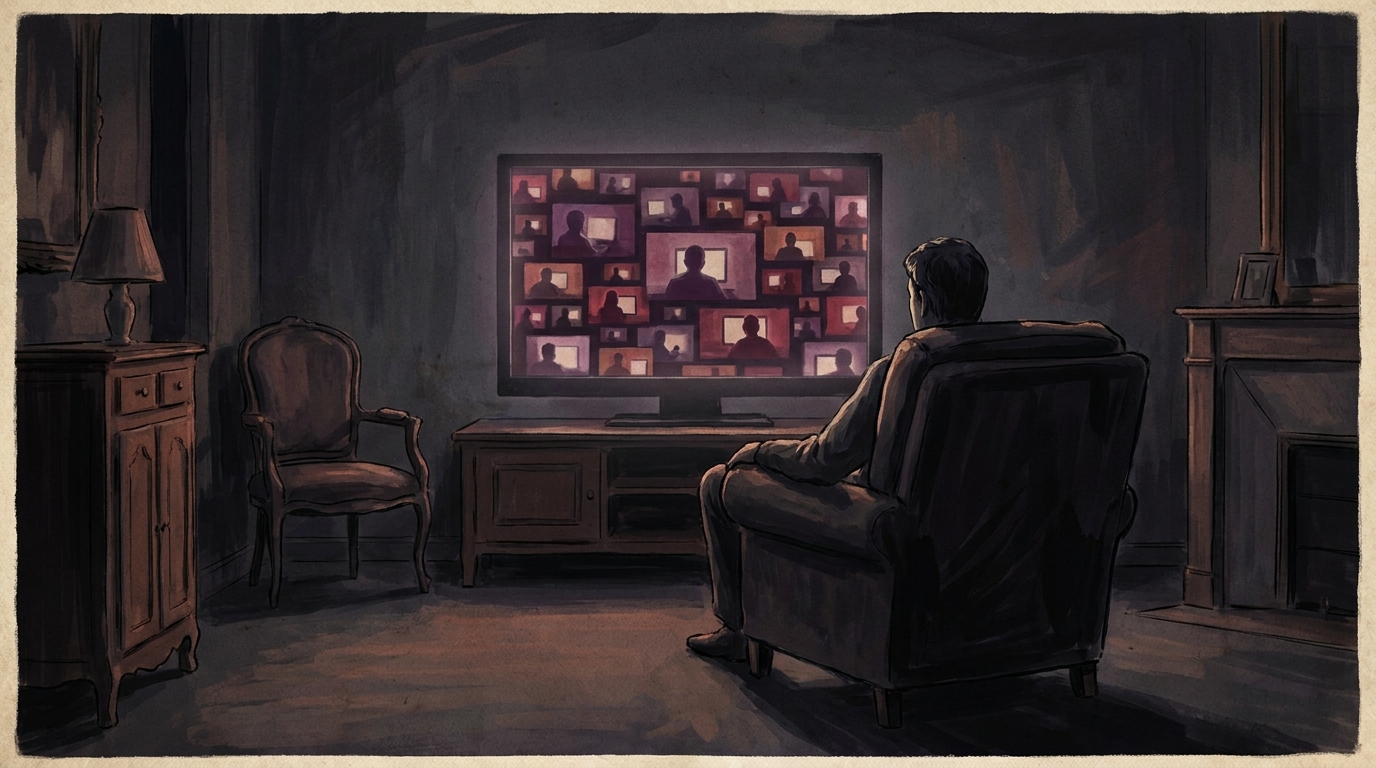
Otium editorial illustration — the automated version of the apparatus that Guy Debord described in 1967.
The phenomenon is observable in four distinct categories. First, virtual companionship. Character.ai, a platform where users talk to personalised artificial-intelligence characters, has around twenty million active users in 2026 for an average session of two hours a day, mainly teenagers and young adults. Replika, which offers paid romantic companionship, has ten million users and annual recurring revenue of around eighty million dollars. The marketing promise comes down to one sentence: Always here to listen and talk. Always on your side. Always available, never angry, never tired.
Second, synthetic video. Higgsfield, a startup that generates cinematic video avatars by artificial intelligence, is now used to produce between thirty and forty per cent of the LinkedIn and Instagram ads that scroll through feeds. More broadly, Sora (OpenAI), Veo 3 (Google) and Kling 2 produce in 2026 thirty-second video clips that pass a visual Turing test with an unwarned viewer. Synthetic presenters now saturate YouTube, TikTok and Instagram.
Third, generated music. Suno and Udio produce complete tracks in a few seconds from a text prompt. Spotify confirmed in 2024 the presence of ghost artists — undeclared artificial-intelligence artists — in several of the platform's themed playlists; the exact number remains non-public.
Finally, automated information. Google Search's AI Overviews, deployed worldwide in 2024 and then reinforced by the integration of Gemini 3.5 Flash in May 2026, produce a synthesis at the top of each search result. For most users there is no longer any need to click on the sources: the synthesis has become the information, the sources being no more than an optional trace to consult.
Guy Debord named this sixty years ago in The Society of the Spectacle (1967). Late capitalism, he wrote, produces spectacle to fill the void left by the absence of real life. Except that in 1967, the spectacle was made by humans. Actors, musicians, presenters, journalists paid to embody something. You might not know them, but they existed. They died one day. Their work left a trace.
In 2026, the spectacle generates itself. The other side of the screen is empty. Nobody lived before writing this script. Nobody will die after. The content no longer says anything about the human condition, because it has no human condition upstream. It simulates it. This is the automated version of the spectacle — Debord 2.0.
The qualitative leap this represents deserves to be named. The novel, before artificial intelligence, at least kept a human author who had lived before writing; poetry likewise, the song likewise. Advertising and propaganda themselves retained this last thread: a human somewhere in the chain, whose subjectivity reached up to the reader or the viewer. Generative AI cuts this thread. The content produced in 2026 comes from nobody in particular, remembers nothing, will not die. It is the first time in the history of human culture that narrative, visual or musical productions circulate on a large scale without a biographical upstream. The anthropological consequence remains to be documented, but it begins right now; it cannot wait for the first longitudinal studies.
10. The state in the wrong place
If the current rupture is of the nature of Gutenberg's, we must expect that the present institutions — all inherited from the post-Gutenberg era — will not hold. And we must expect that those which survive will not be those which are today the most solid. This section poses a precise and uncomfortable question: does France have its ministries in the right place?
The Ministry of Labour exists because work has been, since 1945, the structure of French social life. Work gives identity (I am a teacher, a doctor, an engineer), income, social ties, the rhythm of the day. Above all, work finances through contributions the whole architecture of the welfare state: Social Security, pensions, unemployment, family allowances. Political legitimacy is largely built on the question of work: unemployment rate, minimum wage, legal working time, retirement at 60, 62, 64 or 65. Eighty years of French political architecture revolve around work.
Now suppose — and this is what AI laboratories, strategy consultancies and the human resources departments of large groups say internally — that by 2040, AI absorbs between 30 and 50% of white-collar cognitive work. These ranges come from studies by Goldman Sachs (2023), the OECD (2023, updated 2025) and McKinsey (2023). They are contested in detail but convergent in order of magnitude. If these ranges are even partly right, then:
- The Ministry of Labour no longer has its object. Its historic function — organising, protecting and regulating the employment relationship — loses much of its field of application.
- The financing architecture of the welfare state loses its base. Contributions on wages can no longer finance the same social mass when wages disappear.
- Identity through profession becomes a minority privilege, reserved for those who have kept a job. The majority seek other forms of social identity.
On the other side of the equation, in a world where work recedes, education radically changes function. It is no longer mainly a ramp towards the labour market — the labour market is receding. It becomes what makes it possible to live the freed time without collapsing into the depression described in the previous sections: to choose, to discern, to contemplate, to create for oneself, to read with attention, not to be drowned in the false contact of AI. Above all, it becomes a defensive skill: recognising a Higgsfield avatar that manipulates, identifying a Suno track that sounds wrong, distinguishing a lived text from a generated one.
The Ministry of National Education should, for five years now, have become the first ministry of France. It is not. Better still: France does not even have a full-fledged ministry dedicated to AI. Clara Chappaz is secretary of state for Digital Affairs. Not a ministry, not a massive budget portfolio, not a visible institutional platform. The European AI Act has just been pushed back on its high-risk component to the end of 2027. No European country has published an assumed AI-native educational programme from nursery to CM2. The French debate on screens in class remains binary — we allow, we ban — with no doctrine on AI as a learning partner.
Meanwhile, Singapore has deployed SkillsFuture, a national scheme that gives every adult citizen a lifelong rechargeable continuing-training credit. South Korea has launched its AI Hub Schools programme in 1,000 pilot establishments. Estonia has rolled out, from CM2 to sixth form, an AI tutor in French and mathematics for two years. Emmanuel Macron announced on 22 May an additional 1.55 billion euros for quantum and semiconductors. It is an excellent industrial signal. But the same speech contained not a word on the education plan.
Concretely, this means: the profession of teacher of literature, of philosophy, of fine arts, which has been butchered for twenty years to make budget savings, becomes strategic again. Not to raise culturally, but to immunise against generative manipulation. A pupil who knows how to read a novel knows how to recognise when a Higgsfield avatar is manipulating them. A pupil who knows how to listen to Bach identifies what sounds wrong in a Suno track. Art is no longer only an optional cultural refinement. It has become a basic defensive skill.
And the reversal of the twenty-year movement, to tenure, recruit and pay these teachers, is under way in no European government in 2026. None. The window is closing.
The printing press created the public school. The reason was not humanist: the reason was defensive. People had to be taught to read so that they would not be duped by the pamphlets, the indulgences, the charlatans who proliferated with the newly widespread printing press. Luther and Calvin understood this first, set up the first Protestant parish schools — and that is where Western mass literacy comes from. The educational institution was born as a defensive response to an informational rupture.
The printing press took 70 years to provoke Luther, and another 200 years before the public school established itself everywhere in Europe. We no longer have 200 years. We probably have ten to fifteen.
To close this section, we need to open a dimension that technical analyses of AI generally avoid. The modern nation-state does not hold only through its material architecture — budget, taxation, army, education. It holds above all through a symbolic apparatus that the historian Benedict Anderson named, in Imagined Communities (1983), an "imagined community": a shared narrative about what the people is, what it has lived through, what it hopes for. This narrative has been, since the nineteenth century, transmitted by the republican school, by the national press, by official arts, by public radio and then television. The legitimacy of the state rests on this narrative as much as on its sovereign functions.
Now generative artificial intelligence attacks this symbolic apparatus on two fronts simultaneously. The first front is that of cultural materiality. The content that young French people consume every day — TikTok videos, Instagram posts, dialogues with Character.ai, Spotify recommendations, Google summaries — is massively produced or steered by AI systems trained on mainly Anglo-American and Chinese corpora, and calibrated for global audiences. The French national narrative no longer has a mass channel: the institutions that transmitted it yesterday are no longer those that capture the attention of eighteen-to-twenty-five-year-olds today. This is the deepest and least documented consequence of the current rupture: the loss of the grand national narrative as a framework of shared meaning.
The second front is that of the libertarian offensive. Generative artificial intelligence is the technical culmination of the American libertarian current that has formed since Peter Thiel, Marc Andreessen and their circle. Thiel has financed this movement for twenty years, from his essays on the intrinsically anti-democratic character of freedom to the funds he runs (Founders Fund, Palantir). Andreessen published in 2023 his Techno-Optimist Manifesto, a programmatic text that explicitly states that technological growth is morally superior to state regulation. Balaji Srinivasan, former CTO of Coinbase, theorised in The Network State (2022) the possibility of founding by crowdfunding sovereign states built on a blockchain, outside the classic territorial perimeter. Three experiments are under way: Próspera in Honduras, Praxis Society on the Mediterranean, and African charter-city projects financed by American capital.
The movement is no longer limited to its dissident figures. Sam Altman himself, head of OpenAI, published in 2021 an essay titled Moore's Law for Everything, then in September 2024 a second text titled The Intelligence Age. Both describe an explicit project for society, in which AI produces an abundance such that classic income taxation becomes obsolete: Altman proposes replacing it with a tax on assets — capital, land, computing power — redistributed via a universal income. This project does not have the openly anti-democratic colour of a Thiel; it does, however, have the same structural consequence: the de-institutionalisation of the classic nation-state in favour of a direct and automatic distribution organised by the AI laboratories. When a leader who controls access to a model used daily by eight hundred million people publishes their own project for society, it is not an essay among others: it is the opening of a political programme fuelled by the most powerful channel of dissemination ever constituted.
This movement, until 2024, remained marginal. With the arrival of the second Trump administration in January 2025, which brings Elon Musk into the Department of Government Efficiency, J. D. Vance into the vice-presidency, and David Sacks as "AI and crypto czar", the libertarian project gains direct access to the American executive. AI gives them two unprecedented levers. The first is financial: a tax on tokens consumed (a measure discussed in American libertarian circles as an alternative to the classic income-tax system) would make it possible to finance a privatised state without levying tax on the person. The second is narrative: a political narrative that speaks directly to each citizen, through their personal AI assistant, bypasses the media and intermediary bodies that the nation-state uses to stabilise its own narrative. AI makes it possible for the first time in modern history to offer a counter-narrative personalised to each household, without the mediation of traditional institutions.
The consequence is clear and disquieting: the classic European nation-state, and particularly the French state issuing from the Third Republic, is attacked simultaneously from below (loss of symbolic channel with its youth) and from above (competition from a libertarian project endowed with an alternative taxation and a symbolic channel of its own). Neither attack is made visible by classic parliamentary debates. Both converge on the same political question: what legitimacy does the state retain when it has lost the symbolic function and could lose the fiscal function?
A last dimension further complicates the analysis on the European side, and deserves to be named because it largely escapes public debate. The West, and particularly France, has invested massively for fifty years in cognitive education: universities, grandes écoles, masters, doctorates, tertiary continuing education. This is precisely the layer of work that is today most directly competed with by generative artificial intelligence. Over the same period, training in manual trades, precision craftsmanship and industrial pathways has been progressively neglected by institutions and perceived as a second-choice route by families. The balance sheet, in 2026, is uncomfortable: we find ourselves collectively over-invested in a cognitive skill that is rapidly being commodified, and under-invested in the manual and craft skills that will probably resist total automation for longer. We hope it is not too late to switch back; we have no certainty of it.
Paradoxically, this same asymmetry opens up for Europe a narrow but real strategic window. Precision craftsmanship — Swiss watchmaking, French leather goods, Italian cabinet-making, viticulture, gastronomy, made-to-measure tailoring, heritage restoration — embodies precisely the type of production that combines the hand, knowledge passed down over several generations, the territory, and the human biographical upstream that makes the gesture irreplaceable. It is, precisely, what generative artificial intelligence does not reproduce, and what Chinese humanoid robotics reproduces least well (because there is no mass production possible in these sectors). Europe remains, and will probably remain for a long time, a global premium market for these know-hows. It remains to be seen whether the coming decade will not finish off, for lack of pupils and for lack of institutional revaluation, the pathways that transmit them.
11. The Mensch hearing and the state of parliamentary representation
To close this report, a concrete case of the French political response. On 12 May 2026, Arthur Mensch, co-founder and CEO of Mistral AI, was heard by the National Assembly's Commission of Inquiry into structural dependencies and systemic vulnerabilities in the digital sector and the risks to France's independence. The commission was created in February 2026 on the initiative of the Ecologist and Social parliamentary group (EcoS). It is chaired by Philippe Latombe (Démocrates, MoDem) and its rapporteur is Cyrielle Chatelain, a deputy of the EcoS group.

Photo: Wikimedia Commons. Sources: National Assembly — commission of inquiry into digital dependency.
The hearing is interesting for two distinct reasons.
The first reason is what Mensch said there. Several documentable warnings. 10% of the European wage bill can be absorbed by AI in the coming years, or around 1,000 billion euros a year. The risk, for France, of seeing American players capture the national 9 GW of surplus electricity that today feeds the European grid. The two-year horizon for Europe to equip itself with autonomous compute infrastructure, failing which it will become durably "vassal" to the United States. The tone, documented in the LCP coverage and in specialist columns, was clear: you have to order, not subsidise.
The second reason is what the hearing revealed about the technical level of the deputies who are its interlocutors. Several specialist commentators noted in the following days a manifest gap between the conceptual precision of Mensch's answers and the wording of the questions asked. Le Courrier des Stratèges headlined "at the National Assembly, the appalling contempt of deputies for AI" and documented sequences in which elementary concepts — token, context, distillation, fine-tuning — did not seem to be mastered by some of the deputies present (Élise Rochefort, May 2026). The full video of the hearing remains accessible on the official site videos.assemblee-nationale.fr/video.18888392; everyone can watch it and judge for themselves.
This point is not anecdotal. The commission of inquiry has six months to produce a report. This report will guide the positions of the French Parliament on digital matters for the current legislature. The rapporteur is a deputy of the EcoS group. The EcoS group — the Ecologists — has historically taken critical positions on the French nuclear sector, of which the closure of the Fessenheim plant in 2020 remains the marker. The same political movement today leads the French parliamentary audit on AI sovereignty, without having demonstrated in session a corresponding technical mastery. This is an institutional situation that deserves to be named as it is, regardless of the personal quality of the participants.
The political meaning of this gap deserves to be named unequivocally. A rupture of the scale described in this report would call for a permanent, decade-long scientific commission, with regular hearings of AI researchers, labour economists, sociologists and compute industry figures. It is in this case entrusted to a six-month parliamentary commission, led by a political family whose industrial doctrine — particularly on energy issues — maintains a structural tension with the massive compute needs of AI. The French lag is not a question of budget; it is a question of institutional architecture ill-suited to the object it claims to examine.
12. Three conjectures for the next twenty-five years
The wager of this report is that we must take the historical measure of what is at stake, rather than continuing to treat it as an "innovation wave" requiring regulatory adjustments. Three conjectures on a twenty-five-year horizon deserve to be stated openly, knowing that they will probably be wrong in detail but correct in general direction.
The first conjecture concerns timing. The printing press took one hundred and ninety-three years to stabilise its consequences; the industrial revolution, around a hundred and fifty years. The compression of the timetable under the effect of the digitisation of decisions and the globalisation of markets means that the recompositions caused by AI will probably take no more than a generation, or about thirty years. This means that most adult readers of this report will see, in their lifetime, institutional transformations of a depth comparable to those that Europe experienced between 1517 and 1648. This is not a certainty but a non-negligible probability. It is, at the very least, enough for us to stop reasoning on the three-year horizon usual in strategic plans.
The second conjecture concerns the identity of the institutions called upon to mutate. The most exposed are those that are both post-Gutenberg and post-industrial, that is, those that presuppose a reading man and a working man: the public school, the employment contract, the welfare state, copyright, the mass press, the party political system. All these institutions are today under simultaneous strain and some of them will probably not survive in their present form. The political question of the next two decades will not be to preserve them identically but to give them successors that preserve the fundamental goods they produced: equal access to knowledge, protection from arbitrariness, material security. This is no small matter; no current French political generation is intellectually prepared for it.
The third conjecture concerns the asymmetry of preparation between societies. Singapore, South Korea, Estonia and, to a more moderate extent, the Gulf countries, have begun to reorganise their state apparatus around the hypothesis of a double rupture. France and the European Union, through institutional habit and doctrinal comfort, still reason as if technical innovation were subject to supranational regulation and a policy of subsidies. This gap is today five to ten years; it is worsening by about a year per year. At the current pace, the coming decade will see a lasting divergence appear between societies that have made the effort to invent their post-AI institutions and those that have contented themselves with amending theirs. What place France will take in it has not yet been decided.
None of these three conjectures is tonic. None offers a simple solution. That is also why they deserve to be published: in an era that likes to present artificial intelligence as the main opportunity or as the central threat, it is useful to recall that real historical ruptures have never been either opportunities or threats — but transformations in which the societies that best thought through the institutions of the after were those that suffered least during the passage.
FAQ
Why compare AI to Gutenberg's printing press?
Because the two ruptures share the same nature: a collapse of the monopoly on interpreting the world. Before Gutenberg, the Church controlled access to the sacred text and to its reading. After 1455, the printed Bible circulated all over Europe within fifty years. That did not produce a polite debate; it produced 130 years of wars of religion, settled by the Treaties of Westphalia in 1648. AI today produces a rupture of the same nature: a collapse of the monopoly on interpreting reality, now mediated by five laboratories. The question is not whether this rupture will provoke conflicts, but which ones, where and when.
What are the key figures of the AI barometer in May 2026?
Anthropic projects revenue of $10.9 billion in the second quarter of 2026 (x2.27 vs Q1) with a first operating profit of $559 million. ChatGPT reaches around 800 million weekly users. 61% of the API tokens consumed on OpenRouter are produced by Chinese models (MiniMax, Kimi, GLM-5). Cerebras Systems entered the Nasdaq on 14 May 2026 with +68% on the first day and a market capitalisation of $95 billion. Four figures that tell the same story: the economic machine is running, and control has already leaked.
What happened at the University of Arizona on 16 May 2026?
Eric Schmidt, the former CEO of Google, was booed during his commencement speech to 10,000 students. The tipping point was his sentence: "if science is not your passion, that's fine, because AI will touch everything else". The booing grew. Schmidt replied live: "I can hear you". Three commencement speakers were booed for the same reason in May 2026 on three American campuses (Arizona, Central Florida, Middle Tennessee State). It is not a rejection of the technology, it is a rejection of the interpretive authority that its leaders arrogate to themselves.
What is the cognitive asymmetry between the user and AI?
The system retains your entire prompt history, models your cognitive style, identifies your recurring weaknesses and measures your dependence on use. You, in return, know neither the exact model that answers you, nor the training data, nor the system prompt that constrains its answer, nor the internal mechanism that produces its output. Researchers themselves do not know why a model says what it says. The asymmetry is structural: it is not corrected by more use, it worsens.
Why did Arthur Mensch's hearing of 12 May 2026 attract attention?
Arthur Mensch, co-founder of Mistral AI, was heard on 12 May 2026 by the National Assembly's commission of inquiry into the structural dependencies and vulnerabilities of the digital sector. The commission is chaired by Philippe Latombe (MoDem) and its rapporteur is Cyrielle Chatelain (Ecologist and Social group). Mensch warned that 10% of the European wage bill could be absorbed by AI (1,000 billion euros a year), and of the risk of American players capturing France's 9 GW of surplus electricity. The hearing was commented on as revealing a gap in technical mastery between the deputies present and the subject on which they legislate.
This report is signed Otium. It extends the series of analyses published every Friday in the AI Decryption silo. For weekly recaps of AI news, see the AI weekly of 22 May 2026.