On 28 May 2026, for its third birthday, Mistral held its very first AI Now Summit in Paris. It was not just another product keynote: the company changed its nature there. Le Chat becomes Vibe, an agent platform; Mistral launches a physical AI for industry offering with Airbus, BMW and EDF as launch customers; it has absorbed the start-up Emmi AI; and it announces an inference data centre in Les Ulis. In a single day, the model lab declares itself a full-stack AI company. Here is what this really reveals — beyond the press release.
Contents
- Three years, a thousand people, heading for full-stack
- Vibe: Le Chat becomes an agent platform
- Physical AI: Mistral goes after industry
- Airbus, BMW, EDF, CMA CGM: the customers who validate the thesis
- Sovereign demand: when the State signs (€140M at the Caisse des Dépôts)
- Dassault Systèmes: "natural partner" — and yet the share price falls
- Les Ulis and Bruyères-le-Châtel: controlling your compute
- The engine: valuation, ASML and the sovereign triangle
- Should Mistral be imposed? The debate the summit does not settle
- What it says about Mistral's strategy
- FAQ
1. Three years, a thousand people, heading for full-stack
Mistral is three years old and now claims 1,000 employees and a target of €1 billion in revenue in 2026 (VentureBeat, Maddyness). The summit's message is clear: Mistral no longer wants to be just a model supplier, but a full-stack AI company — from the model to the application, via infrastructure and agents. It is a repositioning, not a simple move upmarket.
The distance travelled gives the measure of the shift. Founded in April 2023 by Arthur Mensch (ex-DeepMind), Timothée Lacroix and Guillaume Lample (both ex-Meta FAIR), Mistral first made its name with open models — Mistral 7B as early as September 2023, distributed under a free licence. Three years later, the three founders take the stage together — Mensch as CEO, Lacroix as CTO, Lample as chief scientist — to unfold a trajectory that runs, in their own words, "from bare-metal GPU clusters to physical simulations of aircraft wings". The open-model lab has turned into a company that wants to hold the whole value chain.
This repositioning is not an opportunistic move: it extends a thesis that Arthur Mensch defends publicly, including before institutions. At his hearing by the National Assembly's commission of inquiry into digital vulnerabilities (May 2026), he hammered home that there is no AI sovereignty as long as compute, models and applications depend on players outside Europe. The summit turns that speech into a three-act roadmap: agents (Vibe), industry (physical AI) and infrastructure (the data centre). We analysed that hearing in a dedicated article — the hearing of Arthur Mensch before the commission of inquiry; this summit is its industrial extension, almost point by point.
2. Vibe: Le Chat becomes an agent platform
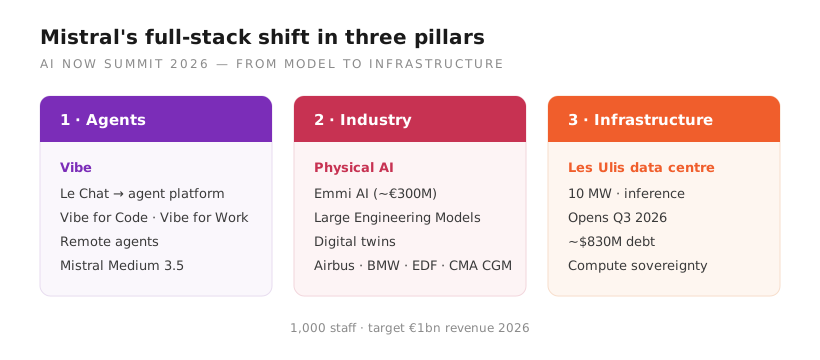
The Le Chat assistant, launched in early 2024, is renamed Vibe and rethought as a unified agent platform. Two distinct offerings: Vibe for Code for developers (coding agents, including remote ones), and Vibe for Work for business teams — agents that run scheduled tasks in the background, query a database, search emails or a CRM, or prepare a summary of the day (Mistral AI). The remote agents rely on the Mistral Medium 3.5 model.
In practice, what Vibe changes comes down to one word: delegation. The coding agents no longer run in your terminal but in the cloud — they execute in parallel, autonomously, and notify you when they are done; you launch them from the Vibe CLI or directly in the interface. On the business side, the Work mode (in preview) carries an agent able to chain long tasks: research, analysis, cross-tool actions. The engine of these remote agents, Mistral Medium 3.5, is a dense model of 128 billion parameters released with open weights (modified MIT licence), which runs self-hosted on only four GPUs and claims 77.6% on SWE-Bench Verified (Mistral AI). In other words: a competitive coding-agent level, but with no dependence on an American cloud — and deployable behind a company's firewall.
The logic matches that of the whole industry in 2026: we are moving from the chatbot to the fleet of agents that act. Vibe is Mistral's answer to ChatGPT on the consumer side and to coding agents on the developer side. The difference Mistral puts forward is not raw performance but control: open weights, self-hosting, data that does not leave. For a European SMB or mid-sized company, this is exactly the argument that was missing until now against American offerings.
3. Physical AI: Mistral goes after industry
This is the most strategic announcement. Mistral launches Mistral for industrial engineering: a stack combining physics models, engineering expertise and robotics, for critical industrial operations (Mistral AI — Physics AI). The technical foundation comes from the acquisition of Emmi AI (May 2026, about €300M, more than 30 researchers integrated), specialised in Large Engineering Models and digital twins faithful to the laws of physics (Mistral AI — Emmi, Les Echos). The offering covers the whole product life cycle: design, validation, production, quality, operations.
Emmi AI is not a name chosen at random. A spin-off of Johannes Kepler University Linz and NXAI — the company of Sepp Hochreiter, the inventor of LSTM networks —, founded in late 2024 and led by the researcher Johannes Brandstetter, the Austrian start-up had raised €15M in seed funding (a national record) before being absorbed. Its roughly 35 researchers, from JKU, Oxford and Harvard, build so-called surrogate models: neural networks that approximate physical simulations in real time — airflows, thermodynamics, material deformation — where classical numerical methods (CFD, finite elements) require hours of computation on HPC clusters (Emmi AI).
The gain is not marginal, it is one of kind: bringing a design iteration down from several hours to a few seconds does not make the engineer "faster", it changes the very way a product is designed — you explore thousands of variants instead of validating three. This is the promise of the digital twin faithful to the laws of physics, applied to car crashes, the aerodynamics of a wing or the strength of a material. Linz also becomes a Mistral office, alongside Paris, London, Amsterdam, Munich, San Francisco and Singapore: the acquisition is also a capture of rare talent in a niche that few players master.
Why it is smart. Physical AI is a field where Europe has a real advantage: industrial champions (aerospace, automotive, energy) and engineering know-how. Rather than taking on the Americans head-on in generic consumer LLMs, Mistral chooses a field where business context and proprietary data matter more than the raw size of the model — and where a slightly less "large" but well-integrated model beats a generic behemoth.
4. Airbus, BMW, EDF, CMA CGM: the customers who validate the thesis
The offering arrives with top-tier launch customers (The Next Web, L'Usine Nouvelle):
- Airbus — a five-year partnership covering commercial aviation, helicopters, defence and space. Concretely, Airbus is buying licences for the whole Mistral suite, deployed in sovereign clouds, "from initial design to on-board capabilities", with strict control of critical data. The point that made the market flinch: the explicit mention of engineering and design (we come back to this in section 5).
- BMW — at the heart of the "Large Industry Model" (LIM) initiative: multimodal models that "understand the physics" of the vehicle, to reason over complex engineering data and optimise crash-test procedures — typically the use case where Emmi AI's surrogate replaces hours of numerical simulation.
- EDF — a five-year agreement in nuclear: optimising operations, accelerating engineering, supporting projects linked to the future EPR2 reactors, and developing generative AI solutions adapted to the constraints (safety, traceability) of a nuclear operator.
- CMA CGM — launch on 1 June of "MAIA, Powered by Mistral", an agent platform meant to equip about 80,000 employees of the group (CMA CGM, CEVA Logistics, CMA Media) — a large-scale deployment, not a pilot.
A caution of honesty is in order, because press releases know how to stage things. Fact: the contracts are signed and named. But: the amounts remain almost all unquantified (ActuIA). We know the scope and the duration, rarely the value. A "multi-year" partnership can be a massive commitment or a pilot envelope: as long as revenues are not detailed, the right reflex is to read these announcements as signals of confidence — real ones — rather than as proof of turnover.
And the momentum goes beyond industry: on the finance side, BNP Paribas chose Mistral to embed generative AI at the heart of its businesses — a strong sovereign signal in a regulated sector, and a customer that the bank preferred to American frontier models (Usine Digitale, 01net).
The common thread of this list is criticality: aerospace and defence (Airbus), nuclear energy (EDF), global maritime logistics (CMA CGM), systemic banking (BNP Paribas). These are precisely the sectors where depending on an American frontier model — subject to a third party's cloud, export controls and the Cloud Act — stops being a mere technical choice and becomes a strategic risk. It is there, and not in a consumer demo, that Mistral's sovereign argument stops being a slogan and becomes a purchasing criterion.
These names are therefore not decorative: they validate that industrial groups and critical institutions are entrusting sensitive workloads to a European player. For an SMB, the signal is indirect but real — when Airbus and BNP Paribas come down in favour of the sovereign option, European AI stops being an activist bet and becomes a credible, documented, "bankable" supplier option that you can present to a purchasing committee without having to justify yourself.
5. Sovereign demand: when the State signs
The summit stages the supply. A contract signed a few days earlier reveals the demand — and, for once, with a figure. On 11 May 2026, following a tender, the Caisse des Dépôts selected Mistral to deploy 40,000 generative AI licences to about 100,000 users across the group and its subsidiaries: a contract worth up to €140 million over two renewable years, part of the "Horizon numérique 2030" plan endowed with 18 billion (ChannelNews).
The scope is precise: a general-purpose assistant (Le Chat), help with designing information systems, and an "AI studio" to develop internal use cases. The deployment is carried by a consortium of integrators — Sopra Steria and Computacenter — and hosted in the future 44 MW data centre that Mistral is building at Bruyères-le-Châtel (Essonne). This is the piece that was missing from the story: not a "multi-year" partnership with a hushed amount, but a quantified public cheque, awarded by tender, with an end-to-end sovereign hosting requirement.
And this is not isolated. Through the Banque des Territoires (Caisse des Dépôts group), a sovereign "Territoires d'IA" programme aims at up to 100,000 public servants. In other words: the State and the public sector no longer merely support Mistral in words, they are becoming its first big customers. Excellent news for revenue — and the starting point of a debate we take up below.
6. Dassault Systèmes: "natural partner" — and yet the share price falls
Officially, Mistral insists it is not competing with Dassault Systèmes, but is "a natural partner" to it. The market read it differently: Dassault Systèmes' share price dropped on the stock market when the Airbus and BMW partnerships were announced (Investir — Les Echos).
To understand the investors' reflex, one must gauge what Dassault Systèmes represents at Airbus. Just a year ago, a major agreement deployed the 3DEXPERIENCE platform on more than 20,000 Airbus workstations, making Dassault's solutions the backbone of product lifecycle management (PLM) for all of the group's future civil and military programmes (MarketScreener). When the Airbus-Mistral press release mentions engineering and design, it touches, at least in appearance, Dassault's historic home turf.
The fear is now clearly named: that generative models able to produce code, technical documentation and design elements will erode the added value and margins of established business software suites. But the real scope has to be distinguished: the announced scope overlaps some 3DEXPERIENCE use cases, without eating into the PLM foundation on which Dassault has made itself indispensable as critical infrastructure. Better still: Mistral and Dassault are themselves partners, the former's AI being integrated into the latter's offering. The fall in the share price therefore reflects less a verdict than a repricing of risk — the market is discovering that the line between "partner" and "competitor" has become blurred.
7. Les Ulis and Bruyères-le-Châtel: controlling your compute
Mistral announces an inference data centre in Les Ulis (Essonne): 10 MW, opening targeted for the third quarter of 2026, financed in part by a debt facility of about $830 million (Cryptonomist, Le Monde Informatique). The stated aim: direct control over compute capacity, hence less dependence on the compute supply chain, and more security and transparency for customers subject to sovereignty requirements.
Why an inference data centre, and not a training one? Because it is inference — running the models in production, not making them — that becomes the critical cost item when agents multiply. Each Vibe agent launched in the background consumes compute continuously, not just for the duration of a chatbot answer. Mastering this link on French soil addresses two issues at once: margin (no longer renting all of one's capacity at full price from a hyperscaler) and compliance (guaranteeing a regulated customer that its processing physically stays in Europe).
Les Ulis is, moreover, only the visible part. In parallel, Mistral is building a much more massive site at Bruyères-le-Châtel (Essonne), of the order of 44 MW — the very one that will host the Caisse des Dépôts deployment. Two scales, one logic: an inference tier brought closer to customers (Les Ulis) and heavy capacity for the big sovereign contracts (Bruyères). Infrastructure stops being a cost item endured and becomes a selling point.
This is the third leg of the full-stack shift: after agents (Vibe) and industry (physical AI), infrastructure. Here again, the coherence is sovereign: mastering compute on European soil, rather than building an AI company whose core — compute — would remain rented from the players it claims to compete with.
8. The engine: valuation, ASML and the sovereign triangle
This full-stack ambition has a financial and industrial engine. Valued at around €11.7 billion (post-money, Series C of September 2025), Mistral has raised more than $3 billion in total. Its main investor is not an American fund but ASML, the Dutch maker of lithography machines: about €1.3 billion injected, nearly 11% of the capital, the largest shareholder (DCD). To this is added a debt facility of $830 million (March 2026) to acquire nearly 13,800 Nvidia GPUs for the Paris data centre.
The result is a sovereign triangle: Nvidia supplies the compute, Mistral the models, ASML the European industrial and financial anchor. On the model side, the range has expanded — Mistral Large 3 (mixture-of-experts, 41 billion active parameters out of 675 in total), Medium 3.5 (dense, 128 billion parameters, 256k-token context — the model that powers the Vibe agents), and small open models (14, 8 and 3 billion) (Mistral 3). Added to these are Forge, which lets companies train and own their own models on-premise, and the Agents API.
Arthur Mensch's thesis fits in one sentence: you cannot have AI sovereignty if all your compute runs on an American cloud. Industry, infrastructure and open models follow from it — a coherence that few European players can claim. For the regulatory and geopolitical context, see also our analysis of the hearing of Arthur Mensch before the commission of inquiry.
9. Should Mistral be imposed? The debate the summit does not settle
Everything above draws an impressive trajectory. But it rests in part on a lever that Mistral embraces — and openly calls for: public procurement. In April 2026, the company published a white paper, "European AI: a playbook to own it", which details 22 measures for European AI sovereignty. The flagship measure: a European preference clause in public contracts, based on a criterion of value added localised in Europe (L'Usine Digitale).
The logic is defensible. It is the very thesis that Arthur Mensch carried before the commission of inquiry of the National Assembly: without swift action, France "risks becoming a vassal" of the American giants, and AI sovereignty requires public demand that primes the pump. The summit, the Caisse des Dépôts contract and the white paper form a coherent whole — the supply, the demand, and the rule that pushes the latter towards the former.
Except that coherence is not self-evidence. A BFM Business programme sums up the criticism in one line: "Imposing Mistral AI? It is not the right solution." Two objections deserve to be taken seriously, without caricature:
- The hidden cost for the user. Imposing European purchasing when the American alternative keeps, on some uses, a lead of one or two generations amounts to making sovereignty be paid for in quality. It is then the administration — hence the taxpayer and the public servant — that absorbs the performance gap.
- The single champion. Is there really "sovereignty" if it comes down to a single national player? And what is a rule worth when the one who benefits from it is also the one who drafts its recommendations (the white paper)? The risk is not Mistral's bad faith, it is a structural conflict of interest and the drying up of European plurality.
For the full context of Mensch's speech — the "not ruled out" of a rise in unemployment, the shift of the value of labour towards capital, energy as the next shortage and his reversal on the AI Act — see our analysis of the hearing of Arthur Mensch before the commission of inquiry. On the technical side, the CTO Timothée Lacroix extended these themes at the summit (keynote "The End of AI as We Know It") and in an interview with BFM Tech&Co filmed on the day of the event.
10. What it says about Mistral's strategy
| Pillar | Announcement | What it aims at |
|---|---|---|
| Agents | Le Chat → Vibe (for Code / for Work), Medium 3.5, remote agents | Stay in the race for consumer + developer agent platforms |
| Industry | Physical AI, Emmi AI (~€300M), Airbus / BMW / EDF / CMA CGM | Capture a field where Europe has an advantage (context, data, sovereignty) |
| Infrastructure | Les Ulis inference data centre (10 MW, Q3 2026, ~$830M debt) | Control compute, sell sovereignty as an argument |
First, fact: in a single day, Mistral went from "model lab" to a declared "full-stack company". Second, hypothesis: the industrial/physical bet is probably more defensible than the race for generic LLMs, because it shifts competition to business context and trust, where the raw size of the model counts for less. Third, open question: holding three fronts (agents, industry, infrastructure) with 1,000 people against giants with tens of thousands of employees is a balancing act — executing, financing and differentiating on all three at once remains to be proven. We will avoid concluding "Europe has won" on a single day of announcements: this is a trajectory to be judged over several quarters.
11. FAQ
What does the Caisse des Dépôts contract mean for Mistral?
Following a tender, the Caisse des Dépôts selected Mistral to deploy 40,000 generative AI licences to about 100,000 users across the group and its subsidiaries: a contract worth up to €140M over two renewable years ("Horizon numérique 2030" plan), operated by Sopra Steria and Computacenter and hosted in Mistral's future 44 MW data centre at Bruyères-le-Châtel.
Should Mistral be imposed in public procurement?
Mistral is campaigning for a European preference clause in public procurement (white paper "European AI: a playbook to own it", April 2026). The sovereignty logic is defensible, but two objections exist: making sovereignty be paid for in quality when the alternative has a lead, and the risk of a single champion that drafts the recommendations it benefits from. The debate is not settled.
What is Mistral Vibe?
Vibe is the new name for Le Chat, turned into an agent platform: Vibe for Code (developers, remote coding agents) and Vibe for Work (business teams, scheduled agents that query databases, emails, CRM, or summarise the day). The remote agents rely on Mistral Medium 3.5.
What is Mistral's physical AI?
A stack combining physics models, engineering and robotics for industry, built on the acquisition of Emmi AI (~€300M, 30+ researchers, Large Engineering Models and digital twins). It addresses the whole product life cycle: design, validation, production, quality, operations.
Which industrial groups have signed with Mistral?
Airbus (five-year agreement: aircraft, helicopters, defence, space), BMW ("Large Industry Model", crash simulation), EDF and CMA CGM as launch customers, announced on 28 May 2026.
What is the Les Ulis data centre?
A 10 MW inference site in Essonne, opening targeted for Q3 2026, financed in part by ~$830M of debt, to control Mistral's compute capacity and reduce its dependence on the compute chain.
- Mistral AI — AI Now Summit 2026
- Mistral AI — Physics AI research
- Mistral AI — Emmi joins Mistral
- VentureBeat — Vibe, industrial AI, data centre
- The Next Web — industrial AI Airbus / BMW / EDF
- L'Usine Nouvelle — Mistral's B2B offensive
- Les Echos — why Mistral is playing the industrial AI card
- Investir / Les Echos — Dassault Systèmes drops
- Les Echos — acquisition of Emmi AI
- Le Monde Informatique — heading for infrastructure and industry
- Maddyness — Mistral blows out its third candle
- IT Social — Vibe, physical AI, Les Ulis data centre
- Cryptonomist — ~$830M debt facility for the data centre
- ChannelNews — 40,000 Mistral licences at the Caisse des Dépôts (up to €140M)
- L'Usine Digitale — Mensch, "not becoming a vassal" + European preference
- BFM Tech&Co — interview with Timothée Lacroix (Mistral) at the summit
- BFM Tech&Co — "Mistral AI flexes its muscles in AI" (28/05/2026)
- BFM Business — "Imposing Mistral AI? It is not the right solution"