The current French social contract was written in 1945, for an economy in which full employment was the political horizon and work was the main source of income, dignity and contributions. Eight decades later, AI mechanically decouples wealth creation from job creation. None of the founding pillars holds as it stands in an economy where productivity gains accrue to the owners of models. The question here is not whether the social contract will be rewritten. It is how, by whom, and with what urgency. A decryption of the concrete proposals on the table in 2026.
1. What AI breaks in the 1945 social contract
The post-war political compromise rested on four simple pillars: salaried work for every willing adult, social contributions financing collective protection, public schooling as a meritocratic lift, and intergenerational solidarity in which the young paid for the old.
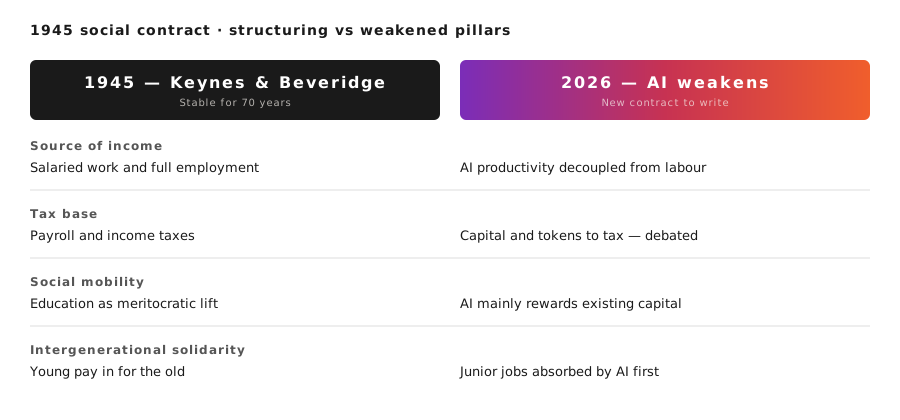
Analytical framework consolidated from RAND — AI and the Social Contract, NBER — Public Finance in the Age of AI.
AI attacks all four pillars simultaneously, through a different mechanism each time.
Income from work. The NBER (working paper w34873) summarises the academic diagnosis: productivity growth and wealth creation are separating from employment and wages. Wealth goes mostly to the owners of computing capacity. Workers, for their part, are displaced or see their relative share fall. This is not a hypothesis, it is already observed: Morgan Stanley measured 8% net jobs lost in the United Kingdom over 12 months linked to AI in 2025.
The tax base. The tax systems of developed economies rely 55-70% on taxing labour (income tax + contributions). If labour falls as a relative share, the tax base erodes automatically, just as social needs increase. The mechanical contradiction is already documented in the NBER's 5-10 year projections.
School as a lift. The implicit contract was simple: "study, and you will have a better job than your parents". If AI primarily absorbs entry-level cognitive jobs (junior roles in law, accounting, financial analysis, development), the promise is broken for an entire generation.
Intergenerational solidarity. The pay-as-you-go pension system assumes a stable flow of contributions from the young. If AI disproportionately absorbs the first jobs of working life, the imbalance sets in durably.
2. The theoretical framework re-emerging: techno-feudalism
Part of the academic ecosystem now speaks of techno-feudalism to describe the default trajectory, absent political intervention. The term is not flashy: it describes an organisation in which a minority class owns the productive infrastructure (data centres, AI models, training grounds) and the majority gets access to services in exchange for their attention, their data or a subsistence income.
An arXiv paper from March 2025 formalises the hypothesis: without economic rights attached to citizens over the value generated by AI, AGI would produce a technological feudal model (Techno-Feudalism and the Rise of AGI). The serfdom metaphor is not merely rhetorical: it points to the shift from an economy of contractual rights (salary, tax, pension) to an economy of conditional flows (revocable access to services, status dependent on platforms).
This framework is not a prediction. It is a foil that structures the alternative proposals currently under debate.
3. AI sovereign funds: a first concrete avenue
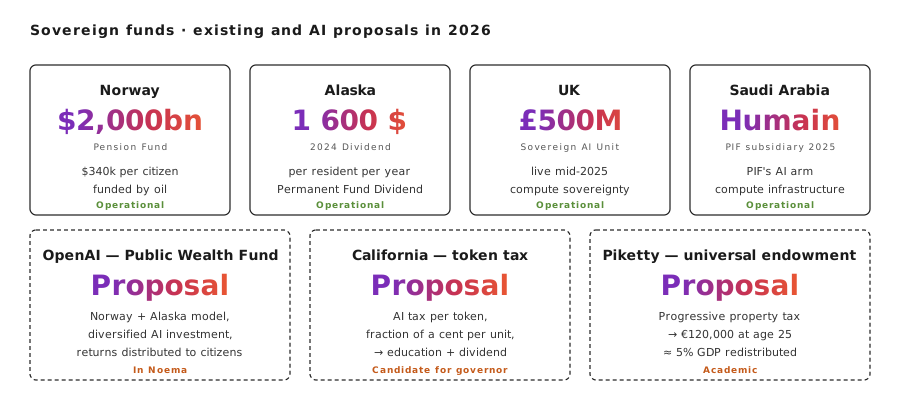
The most advanced proposal comes, paradoxically, from OpenAI. In a manifesto published on Noema in 2025, the company proposes a Public Wealth Fund modelled on the Norwegian oil fund and Alaska's Permanent Fund: a state investment vehicle, funded by a specific tax on AI companies, which would redistribute part of the returns to each citizen.
The Norwegian reference is not rhetorical. The Norwegian oil fund manages $2,000 billion for 5.5 million citizens, or about $340,000 per head in reserve. In Alaska, the Permanent Fund Dividend pays an annual cheque to every resident ($1,600 in 2024). The principle is simple: a collective resource (oil yesterday, AI tomorrow) finances a shared endowment.
The initiatives under way go in several parallel directions.
- United Kingdom: £500 million for a Sovereign AI Unit launched in mid-2025, primarily targeting national compute sovereignty.
- Saudi Arabia: the PIF fund created Humain, a subsidiary dedicated to AI infrastructure.
- United Arab Emirates: Abu Dhabi is aligning its sovereign funds with AI positions.
- California: a candidate for the Democratic nomination for governor proposed a per-token AI tax (a fraction of a cent per unit of data processed by Big Tech) to fund a state fund dedicated to education, training and potentially a direct dividend (Gizmodo).
- Piketty: a universal endowment of €120,000 at age 25, funded by progressive taxation of property.
The common point: detaching the source of income from individual labour and tying it to a share of the collective wealth produced.
4. Per-token taxation: a new lever
The Californian proposal deserves a closer look, because it opens a technical lever that classic taxation systems do not know how to activate.
Taxing an AI company on its revenue runs into tax location: OpenAI and Anthropic declare their revenues in the United States, and European subsidiaries remit royalties. Taxing per employee does not work: these companies employ few people relative to the value they create. Taxing per exported GPU or per processed request, by contrast, targets the physical unit of AI value production.
The fraction of a cent proposed per token looked marginal. At the scale of current volumes (Anthropic and OpenAI together process several tens of billions of tokens per second), it represents several tens of billions of dollars a year that can be mobilised without moving the companies. It is this same mechanism that the OECD is watching with interest for a possible international extension.
5. The union front: valuable but fragmentary
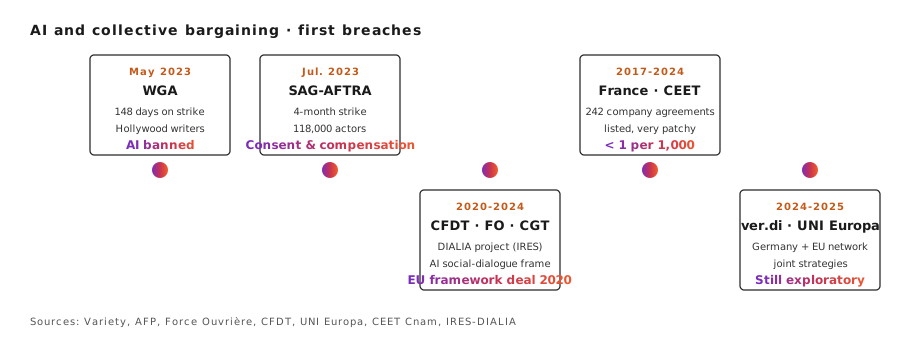
Sources: Force Ouvrière, IRES DIALIA, UNI Europa.
While academics debate sovereign funds, unions are negotiating concrete clauses.
WGA (May 2023). After a 148-day strike, the Writers Guild of America obtained a contract that bans the replacement of screenwriters by AI and guarantees full pay for projects using AI. It is the first major industrial agreement to position AI as a tool subordinate to humans, not as a substitute.
SAG-AFTRA (July 2023). Four months of strike later, American actors obtained a minimum framework on the use of AI: explicit consent for any use of an actor's image or voice, separate compensation, a defined time scope. The agreement structures all subsequent negotiation in the creative industry.
France — the DIALIA project (IRES, 2020-2024). CFDT, CFE-CGC, FO Cadres and UGICT-CGT coordinate a methodological framework for AI social dialogue, anchored in the 2020 European framework agreement on digitalisation. 242 French company agreements incorporated clauses touching on AI between 2017 and 2024, according to the CEET-Cnam. The scale is thin: fewer than one agreement in a thousand explicitly mentions AI.
Germany — ver.di and UNI Europa. The German services union and the European services network (UNI Europa) initiated a joint AI strategy in 2024, still at an exploratory stage.
These advances remain sectoral and defensive (protecting what exists) rather than structural (reorganising the distribution of value). They nonetheless document that collective bargaining on AI is technically possible, contrary to the deterministic discourse of some employers.
6. The gap between proposals and political decision
This latency is explained by three interdependent reasons.
The transnational dimension. A country that taxes its AI companies alone risks seeing them leave. Without an international agreement, the free rider wins. The example of the 15% global minimum tax negotiated by the OECD in 2021-2023 (partially implemented from 2024) shows that such agreements are technically possible, but over a 5 to 10 year horizon. AI moves faster than international negotiation cycles.
The orbit vehicle. The Terafab article published right here (The real energy cost of AI in 2026) describes Musk's proposal to host most AI compute in space, powered by space-based solar panels. Beyond the technical discourse, the political meaning is explicit: escaping national regulation by placing servers outside its jurisdiction.
Uncertainty about speed. Projections of the employment impact vary from 15 to 60% of jobs affected over a 10-year horizon, depending on the source. Governments, faced with such wide uncertainty, prefer to wait for clearer data rather than legislate on the basis of hypotheses. The political cost of acting too early is more visible than the social cost of acting too late.
7. What a business leader can do right now
The subject may seem distant, macroeconomic, beyond the reach of an SMB. It is not. Three operational decisions fall directly under the AI social contract inside a company in 2026.
The internal distribution of AI productivity gains. If your company deploys AI agents that save 20% of a team's time, the question is not technical. It is contractual. Who captures the saving? The company by raising its margins, employees by reducing their working time, customers by lowering prices? This decision is part of your internal social contract, whether explicit or not.
Governance of employee data. AI agents read, analyse and synthesise your teams' output. It is, in effect, the raw material of a learning process. SAG-AFTRA and the WGA have codified it: the use of voice, image and output is a right that is negotiated. Even in an SMB of 20 people, this question must appear in the internal rules or company agreements.
Training and redeployment. If AI absorbs certain tasks, the difference between laying off and retraining comes down to a commitment. Companies that make, from 2026, an explicit commitment to prioritise training for affected roles (rather than redundancy) are anticipating what will eventually be a regulatory framework.
Conclusion
The 1945 social contract was not negotiated in serenity. It was forged in urgency, under the pressure of the Liberation, the Resistance and an organised working class. The current one will not be rewritten by consensus either. It will be negotiated under tension, in a sequence where shocks (waves of AI layoffs, major fraud scandals, political panics tied to presidential elections) will force decision-makers' hands.
The proposals exist: a citizen sovereign fund, per-token taxation, a universal capital endowment, sector agreements protecting certain uses. None is obvious, all are imperfect, each carries a different political project. What is certain is that the status quo is not a viable option at 10 years. The 1945 pillars will give way, with or without a political response.
The useful question in 2026 is no longer "should the social contract be rewritten?". It is "which one, under what pressure, and who will write its first lines?". Leaving those three questions without explicit public debate amounts to accepting, by default, the version that the main owners of AI capital will write alone. That is exactly what is happening today.