Here is the figure that should temper any promise of "10x productivity thanks to AI". A 2026 economic study, covering more than 100,000 GitHub developers, measures what AI agents really change. The verdict: they boost the code written by 180%, but the software actually shipped increases by only 30%. The gap between the two is no detail. It is the whole difference between a sales promise and a real ROI, and the lesson applies well beyond code.
1. The study, and the figure that bothers
The work is titled "Writing Code vs. Shipping Code", published as an NBER working paper in 2026 by Mert Demirer, Leon Musolff and Liyuan Yang (CEPR/VoxEU). The researchers tracked more than 100,000 developers before and after the adoption of three generations of AI tools, from simple autocompletion to autonomous agents.
The growth in commits is spectacular and increasing: autocompletion adds 40%, interactive agents 140%, autonomous agents 180%. But when you look not at the code written but at the software shipped, the 180% gain melts to 50% more projects, and to only 30% more real releases.
2. The funnel: from commit to release
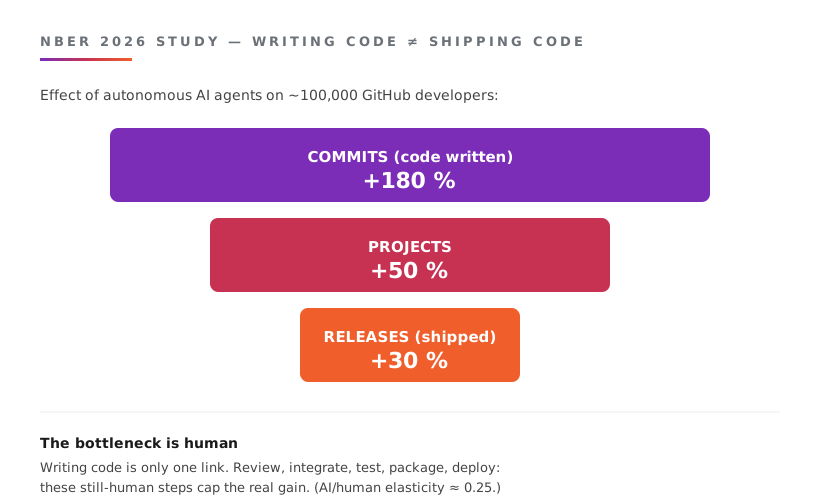
Source: Demirer, Musolff & Yang, "Writing Code vs. Shipping Code", NBER 2026 (via CEPR).
The funnel says it all. The code written explodes, but each step towards production shaves off some of the gain. It is the sign of a system in which one link has been accelerated without touching the others: work piles up upstream, without coming out any faster downstream.
3. Why the bottleneck remains human
Producing software is not just writing lines. It means reviewing the code, integrating it with the rest, testing it, packaging it, deploying it, handling the feedback. These links remain largely human, and they are what set the real pace. Accelerating writing without strengthening what follows is widening the mouth of a funnel whose outlet has not moved.
This dynamic echoes exactly what we observed in the Ford case: automating one link without preparing the others does not create the promised performance, it moves the problem.
4. What it changes for your AI investment
For an executive, the lesson is directly transferable, and well beyond software development. Every function you "augment" with AI — writing, support, analysis, sales — follows the same law: the real gain is not in the speed of production of one link, but in the fluidity of the whole chain up to the result delivered to the customer.
Three reflexes follow. Measure output, not volume. An agent that produces three times more drafts creates value only if three times more pieces of content actually get through. Identify your weak link before buying the tool. If your bottleneck is validation, accelerating production will only lengthen the queue. Strengthen the chain at the same time as the tool. ROI comes from the system, not from the software in isolation.
This is also why a cautious method — one workflow at a time, measured through to delivery — almost always beats the large-scale, all-directions AI rollout.
Frequently asked questions
What does the NBER study say about the productivity of AI coding agents?
Across more than 100,000 GitHub developers, autonomous agents increase commits by 180%, but projects by 50% and real releases by only 30%. Writing code accelerates far faster than shipping it.
Why is the AI productivity gain capped?
Because reviewing, integrating, testing, packaging and deploying remain human. Accelerating writing alone does not move the whole forward. The estimated elasticity of substitution, 0.25, indicates that AI and humans are complements, not substitutes.
What does this mean for a company investing in AI?
ROI comes from the fluidity of the whole chain, not from the tool alone. Investing in an agent without strengthening review, testing and deployment mostly produces work in progress that piles up. The gain is measured in releases, not in volume.
Conclusion
This study is a useful antidote to the prevailing narrative. AI genuinely accelerates part of the work; that is not in dispute. But turning that acceleration into delivered value means looking at the entire system, not just the one link that the tool makes spectacular.
The real question is therefore not "how many times faster does AI produce", but "what, in our organisation, prevents this surplus from reaching the customer". Answering that is worth more than any new tool.