The average outbound team stacks seven to twelve tools in 2026. Apollo for data, Clay for enrichment, Instantly for sending, HubSpot for the CRM, Lemlist as a duplicate, Dropcontact as a backup, Smartlead for agencies, Gojiberry for signals, not counting LinkedIn Sales Navigator and three Chrome extensions. The total cost often exceeds that of a junior salesperson, and half the tools do the same job. This article breaks the stack into four stable layers, shows where Claude and n8n really fit in, and gives three recommended stacks according to team size. The figures below come from official price lists or from independent comparisons published in 2026.
A note on currencies. Prices for American tools (Apollo, Clay, Instantly, Smartlead, Salesforge, Lemlist, Pipedrive) are shown in USD — the official billing currency, even for European customers. HubSpot, Dropcontact and La Growth Machine have official pricing in EUR for France, reproduced as is. Total budget ranges are in EUR with an approximate conversion at USD/EUR parity of 1:1 (2026 rate).
- Four layers, not ten tools
- Layer 1 — Sourcing & data
- Layer 2 — Enrichment
- Layer 3 — Sending & deliverability
- Layer 4 — CRM
- The cross-cutting layer — n8n and Claude
- The buying signals case — Gojiberry and intent-based
- Summary comparison
- Three stacks by size
- Building your own SaaS with Claude?
- Conclusion
- FAQ
1. Four layers, not ten tools
An effective outbound stack fits into four stable layers, plus a cross-cutting orchestration layer. Every tool you buy must belong to a precise layer and do that job better than the others. If two tools overlap on the same layer, it is one OR the other, not both.
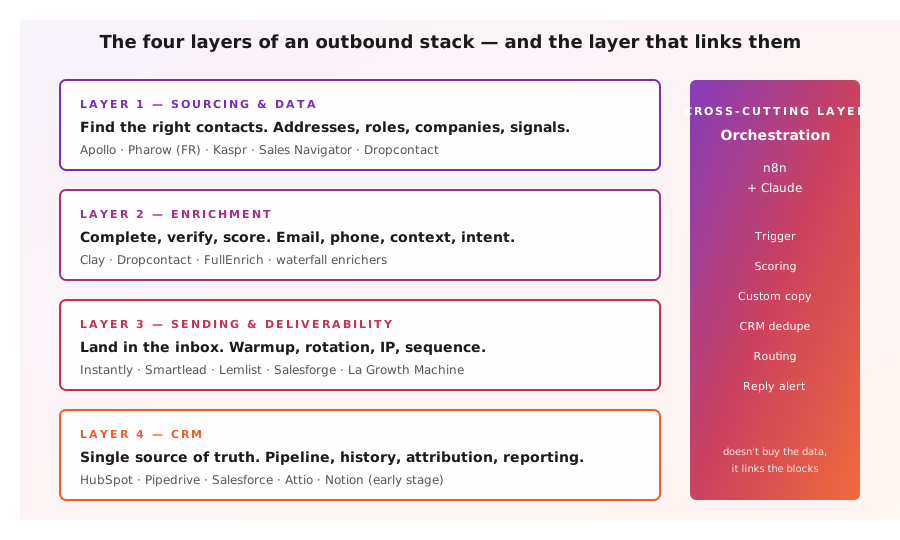
Otium framework, consolidated from the architectures published by Clay, Apollo, Instantly, La Growth Machine.
The logic is simple: the data layer buys raw material (whom to contact), the enrichment layer adds context (verified email, job title, signals), the sending layer manages the deliverability infrastructure (warmup, rotation, IPs), and the CRM remains the single source of truth for the pipeline. Orchestration links these layers without replacing any of them.
The classic trap: buying a tool that covers three layers at once (Apollo does data + sending + light CRM, Lemlist does base + sending + LinkedIn, Salesforge does sending + sequences + AI agent). You pay more for mediocre modules in two layers out of three. The rule: one tool = one job.

























Brand icons used for illustration purposes — names and logos remain the property of their respective publishers.
2. Layer 1 — Sourcing & data
The job of this layer: turn an ICP (Ideal Customer Profile) criterion into a list of identified contacts. The real cost of a data tool is measured in credits per contact exported or enriched, not in monthly subscription.
Apollo — the global standard
Apollo.io remains the reference in 2026 with a base of 265 million contacts and 30 million companies, filterable on 65 criteria. The Basic plan starts at $49 per user per month (billed annually, $59 monthly), the Pro plan at $79 ($99 monthly), and the Organization plan at $119 ($149 monthly). Apollo bills in USD internationally. The credit system hides the real cost: exporting a lead, viewing a mobile number, enriching a contact consumes credits. Intensive outbound teams often end up between $150 and $400 per user per month after overages and add-ons.
Main limit: the accuracy of European data is lower than in the United States. Emails on French and European domains show a lower verification rate, and European mobile numbers are much less well covered.
Pharow — the French alternative
Pharow is positioned as the French alternative to Apollo. A base of 3.4 million French companies and 10 million prospects, with filters based on SIREN, NAF code, headcount and seniority in the role. Live email and telephone enrichment via partners. Native export to HubSpot, Pipedrive, Lemlist, La Growth Machine. For a French SMB prospecting exclusively in France, Pharow often gives better accuracy than Apollo for an equivalent price.
Kaspr — LinkedIn-first
Kaspr specialises in real-time enrichment from LinkedIn, with a Chrome extension that retrieves emails and mobile numbers on profiles. European coverage is considered superior to Apollo's on mobile numbers. A complementary rather than equivalent approach to Apollo: you do not build an initial base with it, you enrich profile by profile.
LinkedIn Sales Navigator — unavoidable for sourcing
Sales Navigator remains the reference filter for identifying recent contacts and detecting job changes, hiring announcements and the ICP's publications. No tool replaces it on data freshness. Cost: about $100 per user per month (USD billing internationally). Most serious outbound stacks keep it alongside Apollo or Pharow.
3. Layer 2 — Enrichment
Once the list is built, you need to verify emails, complete job titles and add context (team size, tech stack, buying signals). This is the layer that distinguishes crude prospecting from targeted prospecting.
Clay — enrichment orchestrator
Clay became the standard in 2026. After its pricing overhaul of 11 March 2026, the Launch plan is $185 a month ($167 annually, 2,500 data credits, 15,000 actions), the Growth plan $495 ($446 annually, 6,000 data credits, 40,000 actions, CRM integration). Clay does not own its own data: it orchestrates dozens of third-party providers (Dropcontact, Apollo, ZoomInfo, Hunter, SignalHire, etc.) in a cascade known as a waterfall.
The principle of the waterfall: you test five providers in succession to find a contact's email, and stop at the first that responds. An obvious advantage in coverage. Hidden cost: a five-provider waterfall consumes five credits, not one. On large volumes, the real cost quickly explodes.
Clay also integrates an AI assistant (Claygent) that can query Claude or GPT models directly to analyse several sources and generate a text report per contact. This is what justifies the price: a Claygent that reads a prospect's website, their LinkedIn and their latest funding round to produce a specific commercial angle is often worth the investment.
Dropcontact — the GDPR-native enricher
Dropcontact is a French email finder founded in 2016. A radically different approach: zero database, real-time email generation via a proprietary algorithm, structural GDPR compliance. No stored data, no scraping. Pricing starts at €24 a month for 1,000 credits, €79 for 5,000 credits. Accuracy of verified emails is around 98% on standard corporate domains, but the overall match rate is 60 to 70%.
Dropcontact is used in two ways: standalone by French teams who want a GDPR-clean stack, or as one of the providers in the Clay waterfall for European uses. Native integration with Pipedrive, HubSpot and Salesforce.
FullEnrich, Hunter and the others
The European ecosystem has about ten serious enrichers (FullEnrich, Hunter, Datagma, Findymail, Prospeo, Anymailfinder). They differ in geographic coverage and accuracy on certain segments. The logic to remember: a single enricher never has 100% coverage. It is the combination in a waterfall that maximises the match rate.
4. Layer 3 — Sending & deliverability
This is the most technical and most underestimated layer. The quality of an outbound stack is measured here: how many emails land in the inbox, and not in spam.
Instantly — the 2026 standard
Instantly.ai has been the deliverability reference since 2024. The Growth plan starts at $47 a month ($37.60 annually) with unlimited email accounts, unlimited warmup, 1,000 contacts and 5,000 emails a month. The Hypergrowth plan at $97 covers 25,000 contacts and 100,000 emails. The Light Speed plan at $358 targets agencies with 100,000 contacts and 500,000 emails.
The key argument: the SISR system (Server & IP Sharding and Rotation) automatically allocates dedicated IP blocks and rotates flagged IPs in real time. Email accounts connect by the hundreds, and warmup runs in parallel with sending. Instantly's own recommendation: 20 to 30 days of warmup minimum on a new domain before sending cold.
Limits pointed out in several independent tests in 2026: no real-time alerts, no automated inbox placement test, and warmup alone does not protect against bounce spikes.
Smartlead — the agency option
Smartlead explicitly targets agencies with unlimited accounts, advanced deliverability telemetry, and a unified inbox (Master Inbox) to manage replies from all domains. Plans from $39 (Basic, 6,000 emails a month), $94 (Pro, 150,000 emails) and $174 and up (Enterprise). Difference from Instantly: Smartlead relies on users' Google Workspace or Microsoft 365 inboxes, with no proprietary sending infrastructure.
Lemlist — multichannel and personalisation
Lemlist offers two public plans: Email Pro at $79 per user per month ($63 annually), Multichannel Expert at $109 ($87 annually). Lemlist accepts EUR billing via Stripe, excluding VAT. The historical differentiator: built-in image and video personalisation, and access to a base of 450 million contacts included in Multichannel Expert. This latter feature makes it possible to replace an Apollo or ZoomInfo subscription for teams that do not need advanced filters.
Lemwarm, the built-in warmup tool, remains solid. Instantly's raw deliverability is nevertheless better in 2026 according to independent tests. The choice of Lemlist is mainly justified for teams doing systematic video personalisation or wanting an all-in-one tool without stacking base + sending + LinkedIn.
Salesforge — the outsider
Salesforge bets on AI agents for automatic sequence writing, unlimited mailboxes and an integrated Warmforge with inbox placement testing. An interesting approach for teams that want to delegate writing. Less track record than Instantly or Smartlead on long-term deliverability.
La Growth Machine — for LinkedIn-first multichannel
La Growth Machine is the French reference for automated multichannel (LinkedIn + email + voice + X in the same sequence). An approach complementary to Instantly: European B2B teams often use it for LinkedIn sequences and keep Instantly for pure email volume. Pricing: €60 a month for the Basic plan (per LinkedIn identity), €80 Pro, €120 Ultimate (annual).
5. Layer 4 — CRM
The CRM is not optional once a team exceeds two salespeople. It is the single source of truth for the pipeline, the history of interactions, the reporting.
HubSpot — the default for SMBs
In 2026, HubSpot Sales Hub offers four tiers: Free, Starter (€20 per user per month), Professional (€90 per seat), Enterprise (€150 per seat). Professional adds $1,500 of setup fees, Enterprise $3,500 (fees billed in USD by HubSpot). HubSpot raised its prices by 6% in August 2025 and announces another increase of 5 to 7% in 2026.
HubSpot remains the default choice for SMBs with between 5 and 50 salespeople. Native integration with Apollo, Clay, Instantly, Lemlist, Dropcontact, LinkedIn. Limit: it becomes expensive beyond 30 users, and the reporting layer falls short of Salesforce on advanced cases.
Pipedrive, Attio, Salesforce — the alternatives
Pipedrive is simpler and cheaper ($14 to $99 per user per month depending on the plans billed annually, add 20 to 30% for monthly). Well suited to teams of fewer than 10 salespeople who want a visual pipeline without complexity.
Attio is the newcomer, an "AI-native CRM" funded by Redpoint and Sequoia. Accessible pricing, modern experience, but a more limited integration ecosystem than HubSpot in 2026.
Salesforce remains the reference for large accounts, outside the scope of this article, which targets SMBs.
6. The cross-cutting layer — n8n and Claude
All the tools above integrate natively with one another through their own connectors. That is enough for simple workflows. As soon as you want conditional logic, custom scoring, or copy generated according to context, you need an orchestration layer.
n8n — the open source that scales
n8n is an open-source, self-hostable workflow automation tool that plays the same role as Zapier or Make, more powerful and cheaper at volume. It offers more than 400 native integrations, including Apollo, Clay, Instantly, HubSpot, Lemlist, Dropcontact, Slack, Notion. The pricing model is execution-based (self-hosted free, Cloud from a few tens of euros a month).
In 2026, n8n integrated MCP (Model Context Protocol) support, which lets Claude read and write workflows directly in the n8n instance. In practical terms: you can ask Claude "create a workflow that triggers on a new HubSpot lead, enriches it via Clay, qualifies it via Claude, and sends an Instantly sequence if the score is above 70" and get a deployed, working workflow.
Claude — the reasoning, not the data
Claude steps in on four tasks where human reasoning is too slow and automatic rules too poor:
- Lead scoring. Given an enriched contact, Claude rates the ICP fit, identifies buying signals, and proposes a priority and a go/no-go. More precise than a numerical score calculated manually.
- Mass personalised copywriting. From the enriched context (job title, tech stack, latest news), Claude generates three variants of an email. The salesperson chooses, or lets the A/B test decide.
- Qualification of replies. When a prospect replies, Claude classifies the reply (positive, negative, information request, off-topic), automatically unsubscribes them from the sequence and notifies the appropriate salesperson.
- Account summaries. Before a call, Claude reads the HubSpot history, the prospect's website and latest LinkedIn posts and produces a two-paragraph brief.
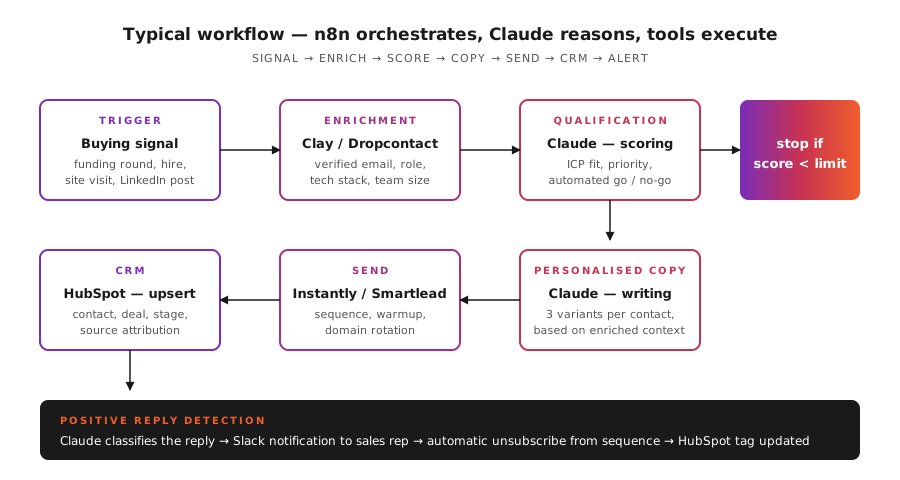
Architecture inspired by public n8n templates, notably website lead capture with Apollo + HubSpot and Apollo + LinkedIn + GPT enrichment for HubSpot, adapted for Claude via the Anthropic API.
What Claude does not replace: the Apollo contact base (265 million accumulated profiles), Instantly's warmed-up IP pools (years of warmup), HubSpot's native integrations. What it consolidates: part of Clay (custom enrichment and signal generation), part of Lavender or Twain (sales copywriting), part of Crystal or Humantic (profile analysis).
Solid tutorials to get started
The public ecosystem matured in 2026. For a French-speaking SMB that wants to draw inspiration rather than start from zero:
- Complete French-language guide: Automatiser sa prospection commerciale avec n8n et Claude (Ocade Fusion, 2026).
- Detailed technical tutorial: n8n + Claude API: Complete Automation Guide 2026.
- Public workflows on the n8n marketplace: search "Apollo", "Clay", "HubSpot" on n8n.io/workflows.
- Complete open-source system: claude-ai-sales-system (12 turnkey AI sales workflows with Claude config).
7. The buying signals case — Gojiberry and intent-based
One category of tools fits into none of the four layers: the so-called intent-based or signal-driven tools. Instead of starting from a cold list and sending in bulk, they detect prospects who are in the process of buying (visits to pricing pages, engagement with a competitor, job changes, funding rounds) and trigger a "warm" approach.
Gojiberry AI falls into this category. A tool out of Y Combinator, positioned as a "GTM brain" for small sales teams. It detects signals (competitor engagement, hiring spike, relevant LinkedIn post), scores leads by ICP fit plus intent, automatically generates and sends personalised messages on LinkedIn and by email, and learns continuously from what converts. Gojiberry claims reply rates 2 to 5 times higher in its internal cases — a figure to verify through your own experimentation, not to take as is.
The intent-based approach is complementary to the classic outbound stack, not a substitute. Volumes are lower (you detect a few dozen signals a week), but the conversion rate is markedly higher. For an SMB, two cases justify investing: (1) if the sales cycle is long and the average ticket high, (2) if the team is small and cannot sustain a massive cold volume.
Direct competitors to watch: Common Room (community-driven category), 6sense, Bombora, Warmly. The market is young, tools are evolving fast, and the performance figures published by the vendors themselves remain to be tested internally before signing an annual contract.
8. Summary comparison
A condensed table to fix ideas. Prices are indicative and taken from official pages or from independent 2026 comparisons. Annual billing typically saves 20% on most tools.
| Tool | Layer | Entry price | Main strength | Main limit |
|---|---|---|---|---|
| Apollo.io | Data + light sending | $49 / user / month (annual) | Global base of 265 M contacts | Lower EU accuracy, opaque credit system |
| Pharow | French data | on quote | French base of 3.4 M companies, SIREN/NAF filters | Coverage limited to France |
| Kaspr | LinkedIn enrichment | ~€45 / user / month (EU) | EU mobiles better covered than Apollo | Not a base, profile-by-profile enrichment |
| Clay | Enrichment + partial orchestration | $185 / month | Waterfalls + Claygent AI | Credit cost explodes quickly, learning curve |
| Dropcontact | GDPR email finder | €24 / month (1k credits, FR) | GDPR-native, zero database | 60-70% match rate, no orchestration |
| Instantly | Sending + warmup | $47 / month | Deliverability and automatic IP rotation | No real-time alerts, limited personalisation |
| Smartlead | Sending (agency) | $39 / month | Unified Master Inbox, large volumes | Relies on your Google/MS inboxes, no own infrastructure |
| Lemlist | Sending + multichannel | $79 / user / month | Video/image personalisation, 450 M base included | Deliverability a notch below Instantly |
| Salesforge | Sending + AI agents | $40-100 / month | Warmforge + AI writing | Less long-term track record |
| La Growth Machine | LinkedIn-first multichannel | €60-120 / identity / month | LinkedIn + email + voice sequences | Less pure email volume than Instantly |
| HubSpot Sales | CRM | €20 / user / month (Starter, official FR) | Widest integration ecosystem | Expensive beyond 30 users |
| Pipedrive | CRM | $14 / user / month | Simple visual pipeline | Fewer advanced modules |
| Gojiberry AI | Intent-based | on request | Signals + automated LinkedIn outreach | Young category, to be tested before committing |
| n8n | Orchestration | free (self-host) | 400+ integrations, MCP support 2026 | Requires technical skill to exploit |
| Claude API | Cross-cutting reasoning | pay-per-token | Scoring, copy, reply classification | Replaces neither data nor sending infrastructure |
9. Three stacks by size
The right stack depends on the number of salespeople who will use it and the monthly volume. Three typical cases to fix the orders of magnitude.
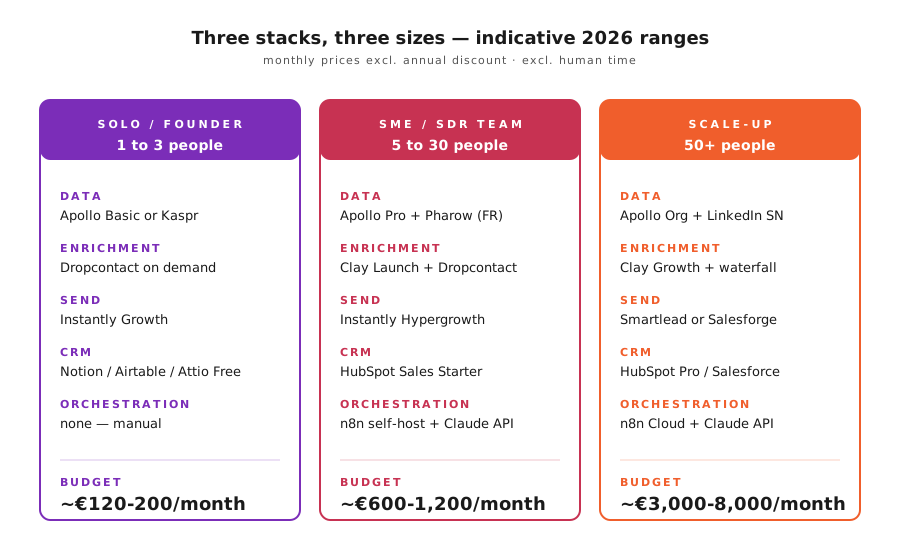
Ranges exclude annual discount and human time. Real costs often exceed listed pricing by 30% after overages.
Solo and founder (1 to 3 people)
Apollo Basic or Kaspr for data ($49 to $79 a month). Instantly Growth for sending ($47). Dropcontact on demand to verify sensitive emails (€24). Notion or Airtable as a manual pipeline (free). No HubSpot, no Clay. Total budget: €120 to €200 a month (USD/EUR mix converted at ~1:1 parity).
At this stage, the bottleneck is never the tooling: it is the human time spent finding the right hook and replying quickly. Claude+n8n automation can wait until the first 100 prospects have been tested manually.
SMB (5 to 30 people)
Apollo Pro ($79 per user) + Pharow if purely France (on quote). Clay Launch ($185) + Dropcontact standalone (€79) for GDPR compliance. Instantly Hypergrowth ($97) or Lemlist Multichannel depending on the personalisation need. HubSpot Sales Starter (€20 per user). n8n self-host + Claude API as orchestrator (€50 to €200 a month depending on API volume).
Total budget for 10 users: €600 to €1,200 a month (estimate, USD/EUR mix at parity). This is the break-even point where orchestration starts to pay: a well-designed n8n workflow saves several hours a week on qualification and copy.
Scale-up (50 people and more)
Apollo Organization + LinkedIn Sales Navigator per salesperson. Clay Growth with custom waterfalls. Smartlead or Salesforge for high multi-domain sending volumes. HubSpot Pro or Salesforce depending on history. n8n Cloud + Claude API as central orchestrator, supervised by a dedicated RevOps.
Total budget: €3,000 to €8,000 a month depending on the mix (estimate, USD/EUR mix at parity). From this volume, it becomes possible to justify in-house development on the layers where the gap to the standard is costly (typically scoring on proprietary signals).
10. Building your own prospecting SaaS with Claude?
The temptation is recurrent in 2026: with Claude Code and LLMs, you can generate a custom CRM in a few weeks, so why pay for HubSpot or Apollo? The real figures say otherwise.
The development cost of a custom CRM equivalent to HubSpot Starter is between €40,000 and €80,000 for a simple MVP, and between €75,000 and €150,000 for a complete SMB version, over 5 to 8 months. The hidden costs then hit: data migration (€3,000 to €15,000), third-party API integrations (€1,500 to €10,000 per integration), user training (€2,000 to €8,000), perpetual maintenance.
Break-even is observed in the following cases: more than 50 internal users with a SaaS bill above €60,000 a year, very specific sales workflows (often regulatory: health, defence, banking), data ownership and compliance requirements.
For almost all French-speaking SMBs, the conclusion is simple: buy the stack, automate the orchestration, do not try to rebuild Apollo or HubSpot. Your team's time is better invested in finding sales angles than in maintaining a home-made CRM.
What we can legitimately do with Claude Code:
- A small internal portal that presents the day's scored leads with the Claude briefs, read-only on the HubSpot and Clay APIs (1 to 2 weeks of development).
- Custom scoring that combines HubSpot + Clay + proprietary signals (application logs, support tickets) that standard tools cannot exploit.
- Specific reporting dashboards that go beyond the Looker / HubSpot reporting framework.
- Contextualised commercial proposal generators, plugged into the CRM via API.
None of these cases replaces HubSpot or Apollo. They add a layer on top, and use Claude where it really brings value: contextual reasoning on data that is already there.
11. Conclusion
The 2026 outbound stack is not the 2022 outbound stack. Data has become a commodity (Apollo, Pharow, Kaspr are 80% alike), sending has hardened (Instantly and Smartlead have won on deliverability), enrichment has become more sophisticated (Clay and its waterfalls, Dropcontact for GDPR), and a new intelligent orchestration layer has become accessible (n8n + Claude).
The SMB mistake in 2026 is no longer a lack of tools. It is stacking too many. Four layers, one tool per layer, one orchestration layer. The rest is noise, or sales pitch disguised as a stack.
To go further on the audit method before touching the stack, see our article on the AI audit to identify blockages and the one on the company AI charter, which frames your sales teams' internal use of Claude and n8n tools.
12. FAQ
Should you keep Apollo and Instantly in parallel?
Yes, provided you specialise each tool on a single job. Apollo for data and sourcing, Instantly for sending and deliverability. If you send from Apollo and from Instantly at the same time on the same domains, you pay twice and you fragment the reporting.
Lemlist or Instantly?
Instantly holds up better on deliverability infrastructure in 2026 (warmup, IP rotation, high volumes). Lemlist retains an advantage in image and video personalisation and in its built-in multichannel email + LinkedIn base. For most outbound teams, Instantly is the default choice. For those doing systematic video personalisation, Lemlist remains relevant.
Does Dropcontact replace Clay?
No. Dropcontact is an algorithmic email finder, GDPR-native, with a match rate of around 60 to 70% on standard domains. Clay is a multi-source enrichment platform that orchestrates dozens of providers (including Dropcontact) in a cascade. Dropcontact can replace part of Clay for simple uses; it replaces neither the waterfalls, nor the buying signals, nor the multi-provider orchestration.
Can Claude and n8n replace Apollo or Instantly?
No. Claude and n8n orchestrate and reason — they do not own the contact database (Apollo, 265 million profiles) nor the infrastructure of warmed-up IP pools (Instantly, years of warmup). They consolidate custom enrichment, scoring and copy generation. The data layer and the sending layer remain bought separately.
Is building your own prospecting SaaS with Claude viable?
For almost all SMBs, no. An equivalent custom development costs between €40,000 and €150,000 and 6 to 12 months for an MVP, not including data or sending infrastructure. It only pays off beyond 50 internal users or for very specific compliance needs. The assembled and orchestrated stack remains faster and cheaper.
Which stack for a team of fewer than five people?
Apollo Basic or Kaspr for data, Instantly Growth for sending, Notion or Airtable for the pipeline. Dropcontact on demand to verify sensitive emails. Total budget between €120 and €200 a month. HubSpot and Clay are not justified at this stage, they slow down the initial learning.
- Apollo.io — official 2026 price list
- Clay — official pricing after the March 2026 overhaul
- Instantly.ai — Growth, Hypergrowth, Light Speed plans
- HubSpot Sales Hub — 2026 pricing
- Dropcontact — 2026 pricing and GDPR compliance
- Pharow vs Apollo — 2026 France comparison
- GrowthRoom — Dropcontact vs FullEnrich
- La Growth Machine — Apollo alternatives 2026
- Salesforge — Smartlead vs Instantly
- Y Combinator — Gojiberry AI profile
- n8n — Claude integration
- GitHub — claude-ai-sales-system (n8n workflows)
- Ocade Fusion — automating prospecting with n8n and Claude (FR)
- Galaxy Weblinks — the real cost of a custom CRM in 2026