Of 100 AI agent pilots launched in companies since 2024, 88 never reached production. The figure comes from cross-checked studies by Anaconda, Forrester, the MIT Sloan CIO Panel and a16z, and it is backed by Gartner's April 2026 predictions. By contrast, the survivors are not scattered: they reproduce six stable archetypes, with a framed technical stack, known unit costs and measurable ROI. The rest, in May 2026, is still demo or POC sold as production.
1. What working in production means
The word “production” is misused. In marketing communication, an AI agent goes into “production” as soon as it is plugged into a real channel (an incoming email, a customer conversation, a received invoice). In operational reality, an agent in production meets three cumulative conditions.
First condition: it runs without constant supervision. A human does not validate every action. They step in on predefined escalation cases. Otherwise it is not an agent, it is a copilot.
Second condition: it produces measurable value. Time saved, tickets resolved, invoices processed, leads qualified, appointments booked. A number appears on a dashboard. Without a metric, it is a POC in disguise.
Third condition: it withstands edge cases. Missing data, unexpected format, user escalation, model outage. The agent routes, falls back to human mode, logs the error. It does not break the business process.
Recent figures converge. According to S&P Global Market Intelligence and McKinsey (March 2026), 31 % of companies have at least one AI agent in production, with 47 % in banking and insurance, 18 % in healthcare, 14 % in the public sector. Gartner predicts that 40 % of agentic AI projects launched in 2025-2026 will be cancelled by the end of 2027 because of runaway costs or unproven business value (Gartner, June 2025). RAND Corporation puts the overall failure rate of AI projects to deliver their promised business value at 80.3 %.
The six archetypes below are those found among the 12 % that survive. They are not exotic. They are repeated because they hold up.
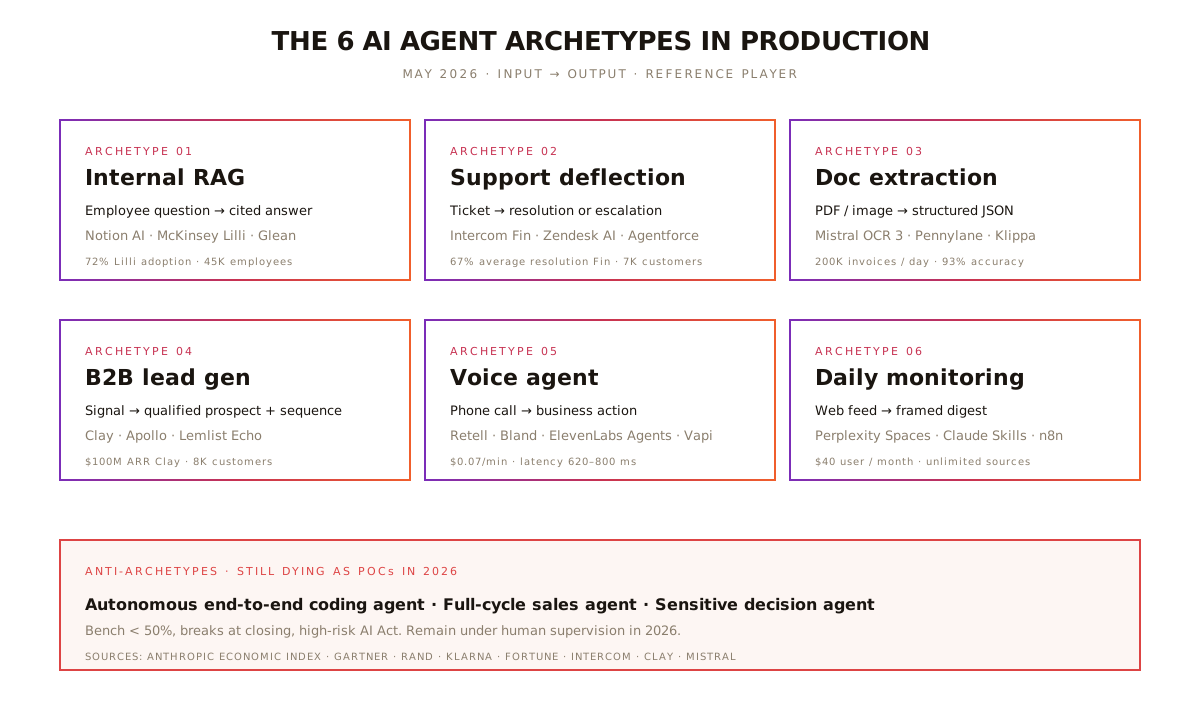
Each archetype combines a business use case, a stable technical stack and at least one documented public deployment with quantified ROI.
2. Archetype 1 — Internal RAG on a knowledge base
The agent ingests internal documentation (Notion, Drive, SharePoint, Slack, Confluence, Jira), builds a vectorised representation, and answers employees' questions while citing its sources. Canonical RAG architecture: semantic search, ranking, cited generation.
Why it holds up
The scope is bounded (internal documents), the risk of hallucination is mitigated by source citation, and the success metric is clear (information search time, internal adoption rate). McKinsey reports 72 % adoption of Lilli across its 45,000 employees in March 2026, with a documented time saving of 30 % on research and synthesis tasks (McKinsey, March 2026). Lilli aggregates 40 sources and more than 100,000 documents. A fintech documented by TechAhead runs more than 300 custom agents daily on Notion as its knowledge base.
Unit cost
For Notion AI Business, expect $20 per user per month on top of the main plan. For a custom deployment (vector DB + Claude / GPT-4o), expect €0.02 to €0.15 per query depending on the context window and frequency of use. The heavy item remains the initial indexing (between €5,000 and €50,000 depending on the volume of documents) and corpus maintenance (weekly updates, removal of duplicates, certification of content).
Pitfalls in production
Three recurring pitfalls. First: silent obsolescence. The RAG confidently cites an outdated internal note, and the user has no way of knowing. Notion has partly solved this with a system of “verified” pages in Business+ (eesel AI). Second: collapse at scale. Below 1,000 documents, Notion AI works without difficulty. Beyond 50,000, without content governance, quality drops. Third: leakage of sensitive data. Without permission-based partitioning, an agent can expose an HR or financial document to an employee who has no right to it.
When it works, when it breaks
Works: a company whose structured documentation is already centralised, medium size (200-5,000 employees), a delimited scope (HR, legal, internal customer support, assignment reports). Breaks: documentation scattered across ten tools, unidentified content owners, no freshness process.
3. Archetype 2 — Tier-1 support deflection
The agent receives the customer conversation (chat, email, form), consults the product knowledge base, answers common questions, and escalates to a human when it detects a complex intent, strong emotion or an out-of-scope case.
Why it holds up
The use case is mature, ROI is binary (resolution rate without a human), and the integrated platforms (Intercom Fin, Zendesk AI, Salesforce Agentforce) absorb the technical complexity. Intercom Fin reports a 67 % average resolution rate across 7,000 customers and more than 40 million conversations handled cumulatively (Intercom data, December 2025). Lightspeed reaches 65 %, Sharesies 70 % in 12 weeks, Clay around 50 %, Fundrise more than 50 % in three months (Fin AI, case studies 2026).
Unit cost
Intercom Fin charges between $0.99 and $1.50 per resolution depending on the plan. For 10,000 monthly conversations with 67 % resolution, the monthly bill falls between $6,600 and $10,000 (Fin AI Pricing Guide 2026). For a custom deployment using Claude or GPT-4o orchestrated by n8n, the cost drops to around $0.15-0.35 per conversation, but the integration and maintenance effort is multiplied by five.
The Klarna warning
Pitfalls in production
The main pitfall is pushing the deflection rate beyond 70-75 %. Customer satisfaction starts to fall, trust in the brand erodes, and complex cases reach the human already frustrated. Second pitfall: lexical drift. The model changes the official tone without anyone seeing it. Third pitfall: the cost-quality trade-off. A cheaper model (Haiku 4.5, Gemini Flash) handles three times more conversations but makes three times more errors on edge cases.
When it works, when it breaks
Works: SaaS / e-commerce / fintech with a ticket volume above 5,000 per month, an established scope of recurring questions, a human team kept for escalations. Breaks: premium brands where brand voice is a differentiator, regulated sectors (healthcare, life insurance, financial advice) where every answer carries legal liability.
4. Archetype 3 — Structured document extraction
The agent receives an invoice, a contract, a CV, a purchase order, a supporting document. It OCRs it, identifies the key fields (date, amount, invoice number, supplier, IBAN, line items, totals), and produces JSON ready to be ingested into an ERP or business tool.
Why it holds up
This is the most mature archetype in the category. The task is bounded (extract fields from a document), validation is binary (the field is correct or it is not), and the business value is immediate (accounting time saved). Pennylane processes more than 200,000 invoices a day through its OCR with a 93 % accuracy rate, relying on Klippa Doxis technology (Klippa, Pennylane case study). Mistral OCR 3, released in 2026, charges $2 per 1,000 pages, or $1 in batch mode (Mistral AI, 2026), and reaches 100 % extraction on multi-page PDF invoices in public tests.
Unit cost
The cheapest archetype in the panel. Mistral OCR 3 charges $0.002 per page in batch. Pennylane includes OCR in its subscription (€16-99 per month depending on the SMB plan). A turnkey-processed invoice costs between €0.02 and €0.15 depending on the stack, against €1.50 to €3 for manual entry. Immediate ROI from 200 invoices a month.
Pitfalls in production
Three pitfalls. First: the quality of the upstream scan. A skewed scan, a poorly framed smartphone photo, a password-protected PDF, and the OCR returns noise. Second: supplier variability. Across 500 supplier invoices, there are 500 different layouts. The model holds at 80-90 % without specific training. Third: final human validation. Even at 93 % accuracy, the remaining 7 % can contain a VAT error that is costly to correct. Pennylane displays the fields for the user to validate.
The 2026 e-invoicing context
The archetype gets a regulatory boost in France: the e-invoicing obligation rolled out over 2026-2027 forces companies to structure their incoming and outgoing flows in the Factur-X format (PDF + XML). The DGFiP counted 136 approved dematerialisation platforms as of 29 January 2026 (Tout pour la gestion, 2026). OCR extraction covers the residual unstructured flows and the historical flows during the transition.
When it works, when it breaks
Works: SMBs and mid-caps with a monthly volume above 200 invoices, recurring contracts, structured administrative management. Breaks: handwritten documents, foreign supporting documents in non-Latin alphabets without specific training, complex legal contracts where clause extraction requires business reasoning.
5. Archetype 4 — Automated B2B lead gen
The agent detects a signal (a decision-maker changes jobs, a company raises funds, a website adds a target keyword), enriches the prospect through several data sources, qualifies against ICP criteria, and triggers a personalised email or LinkedIn sequence. This is the archetype that saw the strongest growth in usage between late 2025 and early 2026.
Why it holds up
The Anthropic Economic Index published in March 2026 shows that business workflows for sales and outreach automation (lead research and qualification, CRM data updates, email drafting, sales content generation) doubled between November 2025 and February 2026 on the Anthropic API (Anthropic Economic Index, March 2026). Clay reached $100 million in ARR in November 2025, tripling its annual revenue in twelve months, with more than 8,000 customers including OpenAI and HubSpot (Clay, $100M ARR). Employee secondary valuation at $5 billion in March 2026 (TechCrunch, February 2026).
Unit cost
Clay charges by credit: between $149 a month (Starter plan, 2,000 credits) and several thousand dollars on the Enterprise plan. A prospect enriched with a data waterfall (LinkedIn, discovered email, phone, intent data, decision signals) costs between $0.30 and $1.20 each depending on the sources activated. The AI layer (Claygent or Claude/GPT in orchestration) adds $0.05 to $0.20 per prospect for qualification and message personalisation.
Pitfalls in production
First pitfall: fake personalisation. If the agent generates an “I saw your LinkedIn post about X” for 500 prospects with a generic post, the decision-maker senses the AI in two seconds. Second: damage to sender reputation. A volume above 200 emails a day per address, bounces at 3 %, and the company's domains get blacklisted. Third: GDPR compliance. B2B prospecting remains permitted in France if the content is strictly professional and related to the recipient's role (CNIL), but scraping personal data through third-party platforms engages the liability of the principal.
When it works, when it breaks
Works: B2B SaaS with a medium sales cycle, a ticket above €5,000 a year, a sales team that takes over once a reply comes in. Breaks: a ticket under €500, self-service sales, a saturated market where decision-makers already receive 30 AI solicitations a week, niche markets where databases cover only 30 % of the ICP.
6. Archetype 5 — Voice agent, inbound or outbound
The agent receives or places a real phone call. It speaks in a synthesised voice, qualifies the person on the line, books an appointment in a calendar, passes the conversation to the CRM, and escalates to a human on cue. The most dynamic stack in the panel in 2026.
Why it holds up
Platforms have improved voice quality and brought latencies below 800 ms (Retell at 620 ms on average in 2026, Bland AI at 800 ms according to independent reviews). The cost per minute has converged towards $0.07 to $0.14 with transparent billing. The mature use cases are inbound lead qualification, appointment booking, customer callbacks, post-purchase surveys and switchboard screening. The voices are almost indistinguishable from a human voice in French on the best ElevenLabs or Cartesia models.
Unit cost
Retell AI at $0.07 per minute pay-as-you-go with no platform fees. Bland AI at $0.09 per minute base, up to $0.14 per minute with add-ons (custom voice, knowledge base, recording). For 1,000 monthly minutes: Retell at $70-310, Bland at $90-140, Synthflow around $230, Air AI at $399 or more (Retell AI, pricing comparison 2026).
Pitfalls in production
First pitfall: the hang-up reflex. In France, the spontaneous hang-up rate on an AI voice agent exceeds 40 % on outbound cold calls. The archetype works better inbound or on an already engaged prospect. Second: visible latency. Beyond 900 ms, the person on the line senses that “something is off” without always being able to say what. Third: fragility on complex cases. An emotional complaint, a multilingual customer who mixes two languages, a speaker who interrupts: the agent gets muddled. The hybrid mode with human escalation remains indispensable.
French legal framework
Three essential rules. Disclosing the AI nature at the start of the call is becoming an expected practice (and is required by the AI Act from 2026 for critical interactions). Consent to recording in line with the ePrivacy directive. The opt-out list / Bloctel still applies and ignoring it exposes you to DGCCRF sanctions.
When it works, when it breaks
Works: inbound lead qualification, appointment booking, NPS surveys, overdue account reminders with a well-framed script, tier-0 support on recurring questions. Breaks: complex sales, personalised advice (legal, medical, financial), a market saturated with AI cold calls.
7. Archetype 6 — Monitoring and daily watch
The agent continuously scans defined sources (competitor sites, trade press, regulatory feeds, social signals, patents), filters against criteria, summarises, and sends a framed digest to Slack, email or a dashboard. A particularity: this is the simplest archetype to get running, and the one where n8n is the most systematic.
Why it holds up
Perplexity Enterprise Pro turned Spaces into shared knowledge hubs in 2026: 500 files maximum per Space, org-only access controls, extended audit logs. NVIDIA, Databricks, Dell, Bridgewater Associates and Latham & Watkins use it for competitive monitoring and sector research (RedHub, Perplexity Spaces enterprise). For teams that want custom, n8n combined with Claude (Skills) or OpenAI scrapes a list of defined sources, summarises with a specific prompt, and sends the digest every morning at 7am.
Unit cost
Perplexity Enterprise Pro at $40 per user per month. Custom: Claude Pro at $20 a month + self-hosted n8n (almost free) + a scraping server ($10-50 a month). The marginal cost of an added source is zero, which makes the archetype linearly scalable.
Pitfalls in production
First pitfall: the unread digest. If the digest runs to two pages, nobody reads it. Frame it with relevance scoring and a hard cut-off at the top 5. Second: the moving target. Competitors change their sites, RSS feeds disappear, pages close behind a paywall. Weekly maintenance is indispensable. Third: scraping compliance. Site terms of use, robots.txt, GDPR jurisdiction to be reviewed every six months.
When it works, when it breaks
Works: the executive committee of a mid-cap that wants a daily sector brief, sales teams tracking buying signals, lawyers monitoring case law or a regulatory text, agencies briefing their clients. Breaks: low signal-to-noise markets (the agent summarises emptiness), companies without a dedicated person to act on the digest.
8. The orchestrator under the hood: why n8n returns in four archetypes out of six
A reading of the six archetypes above brings out a cross-cutting player: n8n. It is the orchestrator that links the model to business tools (CRM, mail, telephony, scraping, database). In 2026, n8n claims more than 200,000 active users, 3,000 enterprise customers, more than 70,000 GitHub stars, and raised $180 million in a Series C in October 2025 at a valuation of $2.5 billion (Trigi Digital, n8n enterprise 2026).
Of the six archetypes, n8n is present in four. In tier-1 support, it routes tickets between Claude or GPT, the knowledge base, human escalation and the CRM. In B2B lead gen, it enriches prospects (Pappers, Apollo, web scraping) and triggers the outbound sequence in Lemlist or Smartlead. In the voice agent, it takes over after the call (Calendly appointment creation, CRM update, Slack notification, recap email). In monitoring, it is the backbone (cron + scrape + Claude summarises + digest sent).
In internal RAG and document extraction, n8n is optional. Notion AI and McKinsey Lilli have their own built-in orchestration layer. Pennylane and Mistral OCR work as turnkey SaaS or through a direct API with no need for a third-party orchestrator.
Alternatives exist: Make (no-code SaaS, simpler but more expensive at scale), Zapier (mature but limited for advanced AI uses and very expensive at volume), native Python/TypeScript code (maximum flexibility, real maintenance debt), Temporal and Inngest (specialised in long-running async workflows). In France, n8n has been the dominant orchestrator among AI integrators since 2025, driven by open source, the possibility of self-hosting and native MCP integration.
On the scope of the six business / ops archetypes described here, n8n remains superior for four concrete reasons. Audience and surface: an ops person, a salesperson or a marketer edits an n8n workflow visually; they do not modify a Claude Code skill in TypeScript. Multi-source, trigger-driven: n8n constantly listens for incoming webhooks from Stripe, Calendly, Intercom, Salesforce, Twilio, plus cron and polling. Claude Code Routines do cron but not the native 24/7 webhook that drives 80 % of support, lead gen and post-call voice. Marginal cost of non-AI nodes: in a typical workflow (incoming ticket → enrich CRM → route by tag → call Claude if relevant → otherwise escalate to a human → notify Slack → log to DB), only one node out of six is AI. In Claude Code, each run consumes a full conversation. At 5,000 tickets a month, the bill explodes. Model lock-in: Claude Code = Anthropic only. n8n routes to Claude for drafting, Haiku for qualification, Mistral OCR for documents, ElevenLabs for voice depending on the step.
A breaking scenario to watch: if Anthropic publishes a multi-trigger, multi-model visual orchestrator on top of Claude Code, n8n is in danger on the dev segment within 12 to 18 months. Not before.
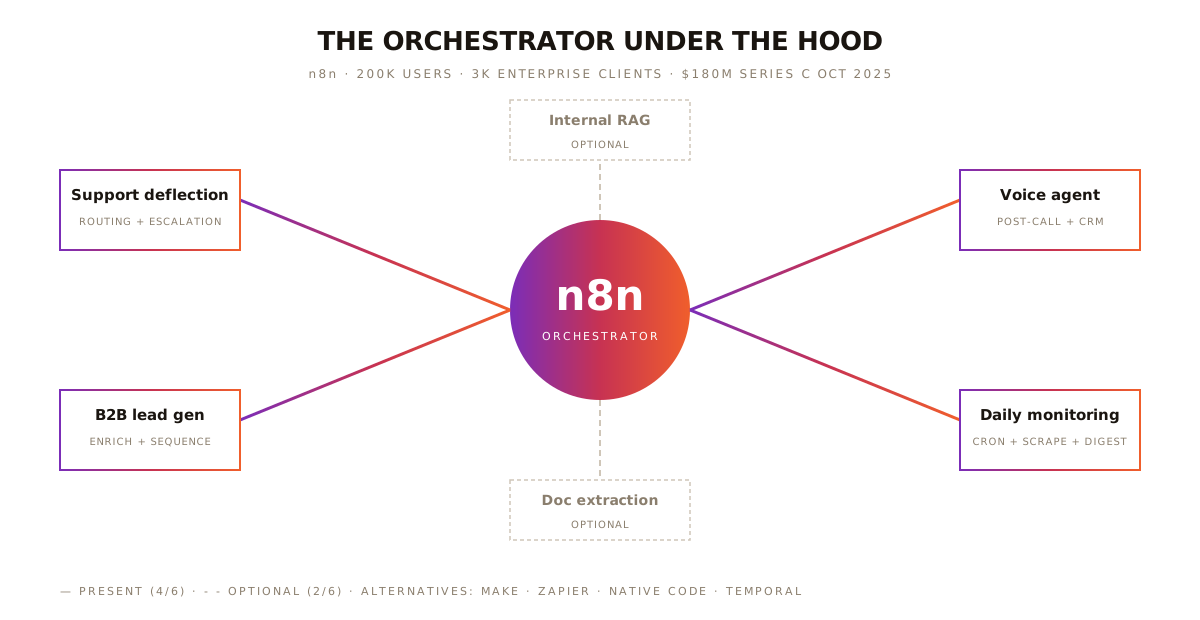
The orchestrator is not an archetype. It is the layer that links the model to business tools. Sources: n8n 200 k active users, 3 k enterprise customers, $180M Series C Oct 2025.
9. Anti-archetypes: what still dies in POC in 2026
The six archetypes survive. Three other families, despite their media visibility, do not clear the bar of reliable production in 2026.
10. Decision grid by company size
For a very small business or SMB (10-100 employees) getting started: document extraction (archetype 3) first — immediate ROI, time-to-prod of 4 to 8 weeks, low operational risk. Monitoring (archetype 6) second — zero marginal cost, value perceptible within the week.
For a mid-cap (100-2,000 employees) with customer volume: tier-1 support deflection (archetype 2) — clear ROI on support cost, to be framed in hybrid mode from the outset. Internal RAG (archetype 1) in parallel if the documentation is already centralised.
For a B2B SaaS scale-up with a sales team: B2B lead gen (archetype 4) — perfectly aligned with the Anthropic Economic Index 2026 usage (sales workflows doubled in four months). Voice agent (archetype 5) as a complement on inbound qualification.
For a large group (5,000+ employees): internal RAG (archetype 1) as the foundation, followed by support deflection (2) on B2C volumes, document extraction (3) on administrative flows. Lead gen (4), voice (5) and monitoring (6) as business pilot projects.
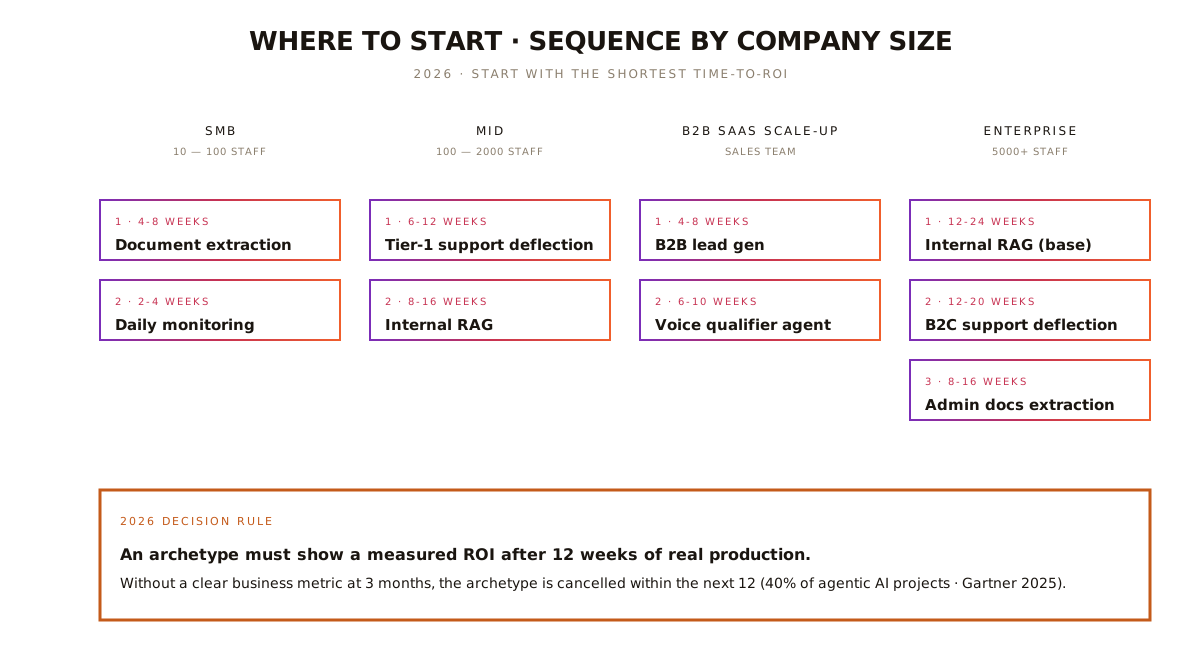
The order of deployment matters as much as the choice of archetype. Starting with the archetype with the shortest time-to-ROI builds internal trust before committing to archetypes with a longer cycle.
11. Total cost: what the API bill does not tell you
The API cost displayed by vendors represents only about 10 % of the real cost of an agent in production. Five layers add up.
Tokens (10 %). The model's inference cost. Variable depending on volume, model and cache use. Anthropic offers a cache at 10 % of the price on stable content (-90 %), OpenAI has a batch at -50 %.
Infrastructure (15 %). Vector DB, orchestrator (self-hosted or cloud n8n), scraping servers, storage, monitoring. Often underestimated in POC, visible from a few thousand requests.
Integration (25 %). Connectors to the existing information system (CRM, ERP, helpdesk, telephony). This is where projects slip: adapting a business logic to the agent, not the other way round.
Supervision (35 %). The heaviest item. Logs, observability, dashboards, human reviewers on a sample, continuous improvement. An agent in prod without supervision drifts within six weeks.
Change management (15 %). Training human teams to live with the agent, adjusting roles, internal communication, a process for handling disagreements. The most invisible layer and the most decisive for adoption.
12. Conclusion: six archetypes, one discipline
The six archetypes described are not exhaustive. But they represent the overwhelming majority of AI agent deployments in production in 2026. Internal RAG, support deflection, document extraction, B2B lead gen, voice agent, daily monitoring. The rest is in POC, in demo or in marketing.
The difference between the 12 % that reach prod and the 88 % that die is not decided by the model. It is decided by three choices: a framed use case, a clear business metric, an owned human supervision. The archetypes are only a shortcut to those three choices.
The orchestrator is not an archetype, but it is the glue in four out of six. n8n establishes itself in 2026 as the reference in the French-speaking AI ecosystem, with Make and native code as alternatives depending on constraints.
The anti-archetypes — autonomous coding agent, full-cycle sales agent, decision-making agent on a sensitive matter — will remain in POC in 2026. Selling them as production-ready is an operational and legal risk. Klarna learned that in 2024-2025. The industry took note.
What remains is choosing the first archetype. It is rarely the most impressive one that pays off fastest. It is the most bounded.