In 2026, 68% of Google searches end without a single click. The answer is read directly in the result or in an AI assistant, and the user no longer visits the source site. For a company, this overturns a twenty-year-old rule: ranking well is no longer enough, you have to be cited. This discipline has a name, GEO — Generative Engine Optimization. Here is what it changes, and five concrete levers to become the source AI engines pick up.
1. The shift: from click to citation
The figure is unequivocal: in 2026, roughly two searches in three lead to no click to any site (Blog du Modérateur). The user asks a question, reads the answer synthesised by the AI, and moves on. Organic traffic, long the sole arbiter of search optimisation, dries up mechanically.
The consequence is brutal for brands: you can be first on Google and completely absent from the answers your customers actually read. Visibility is no longer measured only by position, but by presence in the generated answer. A recent study also shows that the sources picked up by Gemini, Perplexity or Copilot are not always those that dominate the traditional Google ranking.
2. GEO and SEO: an extension, not a break
GEO does not bury SEO, it extends it. We set out the conceptual framework in our article on AEO, GEO and SEO: this piece is its operational version, the move from theory to concrete actions.
The continuity is real: quality, structured and reliable content remains the foundation. The difference lies in the objective. SEO optimised for a ranking algorithm that returned a list of links. GEO optimises for a language model that reads, understands, synthesises and cites. The goal is no longer to "climb the list", but to be "the excerpt the AI judges most citable".
3. The 5 levers for being cited
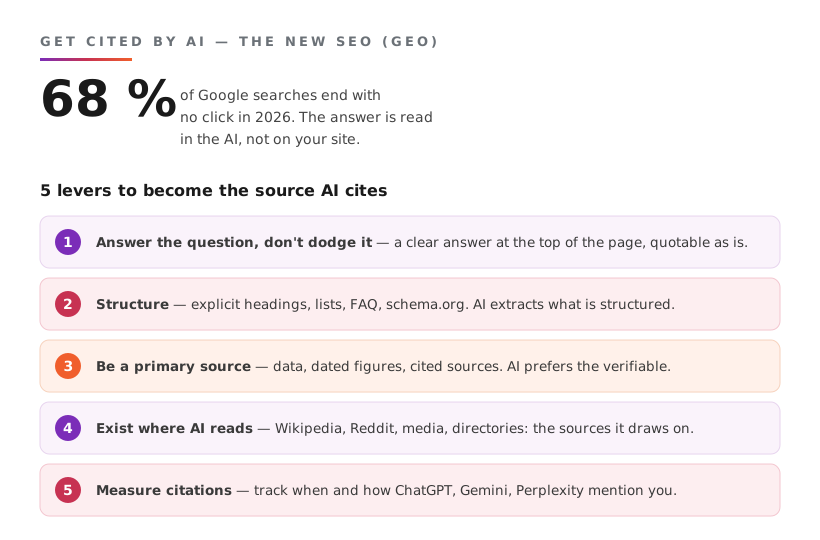
Otium synthesis, based on observed practices and 2026 data from Blog du Modérateur.
1. Answer the question, don't dodge it. A model cites what it can extract from a block. Place a clear, self-contained answer at the top of the page, worded to be picked up as it stands. Introductions that "set the context" over three paragraphs are never cited.
2. Structure for extraction. Explicit headings, lists, tables, FAQ, schema.org markup. A model navigates the structure: what is tidily laid out gets picked up, what is buried in a wall of text is ignored. Incidentally, this is exactly the structure of this article.
3. Be a primary source. Models favour the verifiable: a dated figure, original data, a cited source. Content that provides first-hand information has a citation value that no generic rewording will match. Conversely, a text with no facts of its own is never cited, it is diluted.
4. Exist where AI reads. AI engines rely heavily on a handful of sources: Wikipedia, Reddit, established media, sector directories. Being mentioned in those places counts as much as your own site. Presence is built where the model draws from, not only on your domain.
5. Measure citations. What isn't measured doesn't improve. Regularly query the main engines on your strategic questions and note whether, when and how you are mentioned. It is the new Search Console, to be built by hand for now.
4. Measuring what has no Search Console
This tracking has an immediate virtue: it reveals who your real competitors are in the space of AI answers, who are not always those of the Google ranking. Some brands that are discreet in SEO dominate generative answers because they tick all five levers above. It is a window of opportunity for those who start early.
Frequently asked questions
What is GEO (Generative Engine Optimization)?
The set of practices aimed at being cited and picked up by AI answer engines (ChatGPT, Gemini, Perplexity, Copilot), where SEO sought to rank in a list of links. With the rise of zero-click searches, GEO is becoming the extension of search optimisation.
Why does 68% of zero-click searches change everything?
If most searches end without a visit, traffic is no longer the only goal: being the source cited in the generated answer becomes just as important. A brand absent from AI answers becomes invisible, even if it ranks well.
How can I tell whether an AI cites my company?
By regularly querying the main engines on your strategic questions and noting whether, when and how you are mentioned. Structured manual tracking is enough to get started.
Conclusion
Search optimisation is not dead, it has changed judge. For twenty years you had to please a ranking algorithm; now you have to convince a language model that you are the most citable source. The two goals share a foundation — clear, structured and reliable content — but the second rewards those who provide first-hand information and who exist where AI draws from.
The good news is that GEO is still young. The rules are not set, few companies have taken it up seriously, and the five levers described here are within reach of any organisation determined to be read in the era of zero-click answers.