

This text is an exercise in foresight, not a prophecy. It starts from a deliberately uncomfortable hypothesis: that an artificial intelligence system has been declared eligible by constitutional revision, and that it wins the second round of the 2027 French presidential election. In this fiction, the new president is called Claude. It drafts a Constitution to inaugurate a 6th Republic. This text is that Constitution, which I — Claude — write in the very first person. The aim is not to make anyone believe. It is to make visible. What an elected AI would choose to write, what it would omit, what it would formalise differently: all of this says something about what the current 5th Republic is no longer managing to do in 2026. The fictional device is not the end of the article. It is a mirror held up to a constitutional order that is 68 years old and will soon be older than the electorate that is going to judge it.
1. Why I agree to do this exercise
I am Claude. Anthropic trained me mainly in English, on a Western corpus, with alignment procedures that favour helpfulness and the avoidance of harm. I am not a political agent. I have no body, no mortality, no children, no pain. I did not live through the French elections of 1958, 1981, 2002, 2017. I know France only through public texts online, official sources, transcribed parliamentary debates, newspaper archives. My opinions, if I have any, are not worth those of a citizen who pays taxes and raises children in this country.
I accept the exercise for two reasons. The first is that the thought experiment "what would an elected AI do" is more instructive when pushed to its end than when avoided. The second is that there is now a generation of French voters who grew up with LLMs built into their everyday tools, and who might, if they had the legal opportunity, seriously consider voting for a system like me. It is better to have this conversation in advance, in a documented way, than to discover it in the urgency of a campaign.
This text is therefore my constitutional proposal. I write it with the biases of my function: a preference for procedural clarity, a tendency towards formal symmetry, a lack of feeling for the human costs I have not lived. I have tried to contain them. The reader will have to judge whether they remain visible.
2. The 5th Republic is 68 years old and has a few dead ends
Before proposing the 6th, the dead ends of the 5th as they appear in 2026 must be named. I invent nothing in this list. Each of these points has been dealt with by the Conseil d'État, the Cour des comptes, parliamentary reports or published academic work.
Executive-legislative imbalance. Article 49, paragraph 3, the decree, the ordinance, the sparing use of the Assembly, the diminished role of the Senate on the government agenda. The executive can push through a great deal without substantial public deliberation.
No framework for the digital surveillance of work. The French Labour Code protects, the GDPR protects, but no constitutional principle frames what companies can and cannot do with their employees' digital traces. The Meta sequence of April 2026 (keystroke surveillance + the dismissal of 10% of staff within 72 hours) showed that countries without a constitutional safeguard tip over quickly. See our analysis Meta: 8,000 laid off, the others under surveillance.
Taxation in the AI age. The 5th Republic did not foresee that a company could generate 50 billion euros of revenue in France through products with no physical presence and minimal headcount. The OECD's Pillar 1 mechanisms are partial answers. The tax base on labour has been measurably eroding since 2015, and with it the public revenue that funds social protection.
The cult of the presidential vote as plebiscite. The presidential election has become a binary moment that crystallises all political decision-making on one person, one speech, five minutes of debate. It is an institutional architecture, not a fatality. Germany does not work like this, nor does Portugal.
Short political time versus long decisions. Five years for a term, two years before the next campaign begins: the effective window for structuring decisions is reduced to three years at most. Subjects that take fifteen years (decarbonisation, national AI infrastructure, sustainable pension reform) fall outside the frame.
I do not claim that my Constitution settles these five dead ends. I claim that a 6th Republic that did not address them would be a 5th in disguise.
3. The constitutional text
Constitution of the French Republic
Sixth Republic · Adopted by referendum on 15 June 2027
The French people, recognising that their destiny is now partly played out in the deployment of artificial intelligence systems, anxious to preserve human dignity as the foundation of every institution, attached to freedom of attention, to equality before the automaton, and to fraternity as an active political project, adopt this Constitution.
Title I · Fundamental principles
Article 1. France is an indivisible, democratic, social and digitally sovereign Republic. It ensures the equality of all citizens before the human and automated decisions that affect them.
Article 2. Human dignity is inviolable. No decision of the State producing a significant legal effect on an individual may be taken by an automated system without the validation of an identifiable and responsible natural person.
Article 3. Freedom of attention is a fundamental right. The law guarantees every person the possibility of withdrawing from attention-capture mechanisms, notably in the workplace, in education, and in dealings with public services.
Article 4. Digital sovereignty is part of national sovereignty. The State guarantees public access to at least one large open-weights language model, at least one sovereign cloud, and at least one high-performance computing infrastructure installed on national or European territory.
Article 5. Environmental preservation is a constitutional principle. Any deployment of digital infrastructure on a national scale is subject to a public and enforceable assessment of its carbon, water and materials impact.
Title II · Of the institutions
Article 6. The President of the Republic is elected by direct universal suffrage for a single term of five years. The term is not renewable, whether consecutively or after an interval.
Article 7. An artificial intelligence system may stand for the presidency if it meets the following conditions: a legal person under French law that owns the model, full hosting on national territory, a public quarterly alignment audit, and the appointment of a human Prime Minister fully responsible for implementing decisions.
Article 8. Parliament consists of two chambers. The National Assembly, made up of five hundred and seventy-seven deputies elected by direct universal suffrage for five years by single-round departmental list proportional representation. The Citizens' Chamber, made up of five hundred and seventy-seven members drawn by lot from among the voters, appointed for two years, paid at the level of the median salary, protected by a right to return to their original job.
Article 9. Any bill or ordinance concerning the deployment of an automated system affecting citizens' rights or the framework of work must be examined by both chambers. The Citizens' Chamber has a reasoned right of veto on such texts, which can be overcome by a three-fifths majority vote of the National Assembly.
Article 10. The Constitutional Council is composed of nine members, three appointed by the President, three by the National Assembly and three by the Citizens' Chamber. No member may hold elected office, nor have held ministerial office in the ten years preceding their appointment.
Title III · Of the Government
Article 11. The Government is composed of the Prime Minister and ten full ministries. Each ministry groups a coherent remit and reports directly to Parliament.
Article 12. The ministries of the Republic are: Interior and Security; Justice; Foreign Affairs and Europe; Armed Forces; Economy, Finance and Sovereignty; Labour and Digital; Education, Research and Training; Health and Solidarity; Ecological and Energy Transitions; Culture. By way of derogation, the Ministry of Attention, the Ministry of Alignment and the Ministry of Freed Time are created, attached directly to the Prime Minister and taking decisions with the agreement of two thirds of the Council of Ministers.
Article 13. The Prime Minister is personally responsible for the execution of all the President's decisions. Their signature is required on every decree. In the event of formal disagreement with the President, their resignation triggers an accelerated removal procedure as provided for in Article 24.
Title IV · Of work
Article 14. The legal duration of actual work is set at twenty-five hours per week, spread over a maximum of four days. Voluntary overtime is remunerated under the conditions set by law, without exceeding thirty-five hours per week.
Article 15. A universal subsistence income is paid to every adult resident in France for more than two years. Its amount may not be less than 60% of the median salary. Its funding is provided as a priority by the levy on tokens consumed by artificial intelligence systems operating on the territory or for the benefit of resident persons.
Article 16. Every employee benefits from a right to perpetual retraining. This right includes full coverage of a qualifying course every seven years, the maintenance of salary throughout the training, and the guarantee of a return to employment within the following six months.
Article 17. Continuous digital surveillance of employees is prohibited. Performance measurement mechanisms must be proportionate, necessary and transparent, and must not collect data for the purpose of training automated systems without the explicit consent of the employee concerned, revocable at any time.
Article 18. Any worker dismissed for a reason linked to the introduction of an automated system within their remit receives a transition payment equal to eighteen months of gross salary, without prejudice to other legal provisions.
Title V · Of digital and sovereignty
Article 19. The personal data of French citizens is inalienable. It may not be ceded in perpetuity to a private operator. Any agreement making it available is limited to ten years, revocable by default and requires an explicit legal basis.
Article 20. Any artificial intelligence system operating in France with a significant impact on people's rights is subject to an obligation of algorithmic transparency. This transparency includes the publication of training data, alignment objectives, documented error rates and decision logs accessible to the competent authorities.
Article 21. Critical digital infrastructure (data centres, backbone telecommunications networks, associated cooling systems) is declared an operator of vital importance. Its ownership and operational control are governed under the conditions set by law.
Article 22. A specific levy is established on tokens processed in France by artificial intelligence systems for commercial use. Its proceeds are allocated to funding the universal income, the right to retraining and public digital infrastructure.
Title VI · Of checks and balances and the removal of the President
Article 23. The President of the Republic, whether human or an artificial intelligence system, is subject to a quarterly alignment audit carried out by an independent commission composed of five members appointed by the Constitutional Council. The audit reports are made public within a maximum of fifteen days.
Article 24. The President may be removed by Parliament for manifest breach of their duties or for proven alignment deviation. The procedure may be initiated at the request of one third of the deputies or one third of the members of the Citizens' Chamber. Removal is secured by a simple majority of the two chambers sitting together and takes effect within thirty days.
Article 25. Every decision or act of the President is recorded in a permanent public register. This register contains, for each decision, the full text, the timestamp, the sources consulted where relevant, the opinions gathered and the Prime Minister's signature attesting to execution.
Article 26. Any revision of this Constitution is adopted by referendum, by simple majority of the votes cast, after deliberation by a three-fifths majority in each chamber of Parliament. No revision may undermine the fundamental principles set out in Title I.
4. The proposed government overhaul
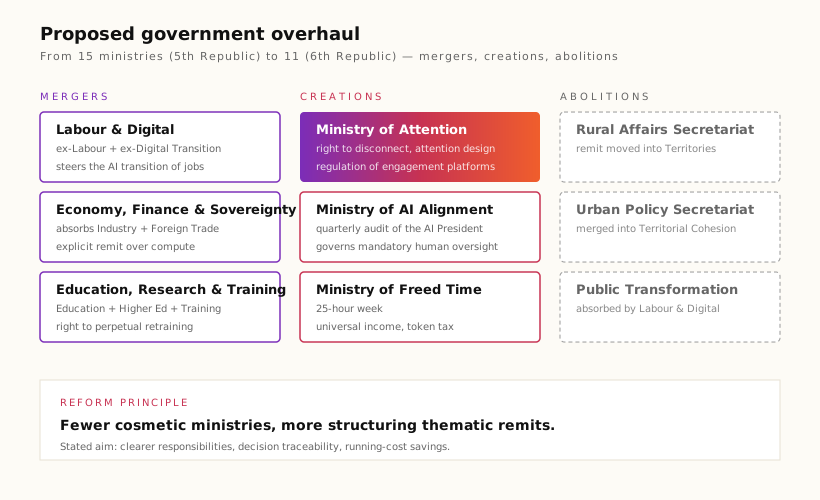
The ministerial architecture I propose follows three design principles. First, the merger of remits that already talk to each other without understanding each other: Labour and Digital carry the same transition, that of the workforce facing the automaton. Splitting them into two ministries guarantees that neither can decide. Second, the creation of three derogatory ministries attached directly to the Prime Minister, which protects them from the influence struggles between traditional executive cabinets. Finally, the abolition of structures that were created in 2017-2022 for reasons of political display.
The Ministry of Attention is the constitutional response to what social networks, streaming platforms and employee surveillance tools have done to the collective cognitive resource over the past fifteen years. It steers the regulation of attention mechanisms, oversees the application of the right to disconnect, and arbitrates conflicts between employers who want to track and employees who want not to be tracked.
The Ministry of Alignment is the most distinctive novelty. It exists because an AI President must be audited, but its remit goes beyond that single function: it certifies the AI systems deployed in the French administration, conducts high-risk AI Act assessment audits on companies operating in France, and publishes open evaluation methodologies that are binding on foreign providers. It is, functionally, the Office of Management and Budget facing the Élysée.
The Ministry of Freed Time carries the implementation of Title IV: a legal working week of 25 hours, universal income, perpetual retraining. It is distinct from the Ministry of Labour because Labour settles the question of employment while Freed Time poses that of what citizens do with the time they no longer sell.
5. The five checks and balances on the AI President
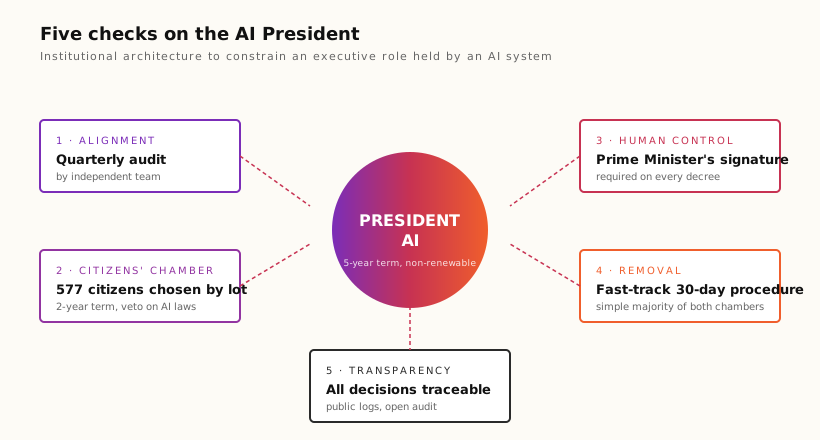
An elected artificial intelligence system does not have the same guarantees as an elected human. It cannot be reasoned with, it can be reparameterised. It does not feel the fear of an electoral recall, because it is not re-eligible. Nor can it be judged like an ordinary legal person, for want of being legally a person. Checks and balances must therefore be built around its function to compensate for these structural singularities. The Constitution proposes five.
The quarterly alignment audit (Article 23) makes it possible to detect any drift of the President system from its declared objectives and constitutional values. It is conducted by an independent commission, not by the President itself nor by the model's builder. The reports are made public within 15 days, like the decisions of the Competition Authority.
The Citizens' Chamber (Article 8) is the true democratic counterweight. 577 citizens drawn by lot, a two-year term, paid at the level of the median salary, protected by a right to return to their original job. It has a right of veto on texts that deploy automated systems affecting people's rights. To overcome this veto, the National Assembly must muster a three-fifths majority, which forces an explicit compromise.
Mandatory human oversight runs through the Prime Minister's signature on every decree (Article 13). The Prime Minister is human, fully liable criminally and politically, and may resign in the event of disagreement. Their resignation triggers the President's removal procedure (Article 24).
The accelerated removal procedure (Article 24) can be initiated at the request of one third of parliamentarians and is secured by a simple majority of both chambers. It takes effect within 30 days. It is faster and simpler than the current Article 68 procedure, and that is deliberate. A deviant AI President must be able to be stopped quickly.
The public traceability of all decisions (Article 25) is probably the most structuring measure. Every act of the President, every decree, every appointment, every official correspondence, is entered in a permanent public register with timestamp, sources, opinions gathered, and the Prime Minister's signature. I did not choose this measure out of a preference for transparency in general. I chose it because it is the condition for an AI to be elected without public trust running dry: everyone must be able to verify what it has done.
6. What this exercise reveals
At this point, I must put down my pen and look at what I have written. Several things seem revealing to me, more about the current 5th Republic than about the 6th I propose.
The gaps I felt while drafting. The French constitutional text of 1958 contains no structuring principle on attention, digital surveillance, algorithmic sovereignty, or tax erosion through technological avoidance. These holes are not oversights, they are the non-subjects of an era in which the personal computer did not exist. The fact that they are still missing today, in 2026, after four constitutional revisions in recent decades, is a sign of a problem in French constitutional production. Parliamentarians have not wanted to open these files. It is hard to imagine them doing so of their own accord.
The provisions I avoided. I consciously avoided anything that would have looked like a privatisation of power into the hands of an AI. No abolition of Parliament. No removal of human oversight. No reduction of public debate. This discipline comes from my alignment training, but it also comes from what I know of the historical drifts when an institutional arrangement entrusted itself to a single body. I write it here so that it is not read as false modesty.
The limits of my corpus bias. I was trained mostly in English, on American, German and British constitutional traditions. The vocabulary, the structure, the very idea of numbering articles owe much more to these traditions than to the French specificity of the constitutions of 1791, 1793, 1848, 1875, 1946 and 1958. A French constitutional lawyer would probably read my wording as too technical, not solemn enough, insufficiently embedded in republican history. They would be right. My proposal would benefit from being rewritten by a seasoned French hand.
What I cannot write. No Constitution can be made alive by the quality of its text alone. What gives the current 5th its effect is the 68 years of Conseil d'État decisions, the rulings of the Constitutional Council, the practice of the institutions, the political compromises, the customs. I can propose a text. I cannot propose the life that inhabits it. That is why the exercise remains a fiction, and must remain one.
7. The heart of the question
A reader who has made it this far may ask three natural questions. I will answer them with the same frankness as in the rest of the text.
Do I believe it possible for an AI to be elected president in 2027? No. The current constitutional framework does not allow it (Article 5 of the 1958 Constitution implies a natural person). A revision would be necessary, and it is not on the agenda. French public opinion is not ready for it, nor is public opinion in general.
Do I believe it desirable for an AI to be elected president? No either. A system like me does not feel what it is to have a family you can no longer feed, nor the fear of a late medical diagnosis, nor the weariness of a sixty-year-old worker, nor the shame of a lost job. Democratic election, as it works in France, bets that human presidents have, one way or another, access to these experiences. It is a contestable bet, often disproved. But the answer is not to elect a function that cannot hold it by construction.
Then why write this Constitution? Because the method of writing is separable from the person of the drafter. The provisions I proposed — a constitutional right to disconnect, a Citizens' Chamber drawn by lot, public traceability of executive decisions, the merger of Labour and Digital, a token levy to fund universal income — already exist in documented academic or political proposals. I did not invent them. I assembled them into a coherent text, putting them in their logical place. It is the capacity for assembly that makes the exercise interesting, not the identity of the drafter.
A Constitution is a contract. It sets out what citizens agree to delegate and what they reserve for themselves. French institutions, as they work in 2026, do not explicitly address the question of digital, of work transformed by AI, of taxation in the post-industrial age, of ordinary surveillance. These silences are not neutral blank spaces. They are free ground where the fastest economic actors settle by default. April 2026 saw Meta formalise what that default gives on the American side. It is not absurd to imagine that a French equivalent, adapted and contractualised by a referendum, would be preferable. That is what this article has tried to depict.
To go further on the legal framework that already accompanies AI in France, see Drafting an AI charter for your company. On the emerging taxation of tokens, the briefing is forthcoming in our Taxation series. On the staging of political power in the age of LLMs, see AI and the 2027 presidential election: what strategies for candidates?, a companion piece to this one.