On 12 June 2026, SpaceX listed on the Nasdaq. $75 billion raised — the biggest initial public offering in history, two and a half times the Saudi Aramco record. An opening at $150 that lifts the market capitalisation above $2,000 billion. And a threshold never crossed by a human being: Elon Musk's fortune exceeds $1,000 billion. The press headlines dwell on the trillionaire. The offering document tells a different story: what the stock market has just priced is not a rocket company.
1. The fact
The price was set on the evening of Thursday 11 June: $135 per share, for 555.6 million shares sold, or $75 billion raised (CNBC, NPR). At that price, the valuation came to roughly $1,770 billion — already ahead of Tesla (around $1,600 billion) and in the world's top ten by market capitalisation.
On Friday morning, the stock opened at $150, taking the market capitalisation above $2,000 billion in session (CNN). To put the order of magnitude in perspective: the previous IPO record, Saudi Aramco in 2019, raised $29.4 billion. Alibaba in 2014, $25 billion. SpaceX has just raised the equivalent of both combined, plus twenty billion.
Musk retains more than 82% of the voting rights after the transaction (NBC News). The company is listed, but it remains controlled — in the literal sense — by a single man.
2. The trillionaire — and the nuance that matters
Before the listing, Forbes put Musk's fortune at around $780 billion. The opening at $150 takes it to roughly $1,100 billion — more than $180 billion gained in a single session (CNBC, Bloomberg). The first trillionaire in history, as Le Monde and the entire business press put it.
The nuance, set out by the Washington Post: this is a trillion on paper. The fortune consists overwhelmingly of shares that Musk cannot sell in volume — selling would dilute the 82% control that is precisely what gives the whole its value, and post-IPO lock-up periods freeze disposals. The figure is real as a valuation, theoretical as available wealth. The distinction takes nothing away from the symbol; it simply says what the symbol measures: the price the market puts on an empire, not a bank balance.
3. What the market bought: 78% connectivity and AI
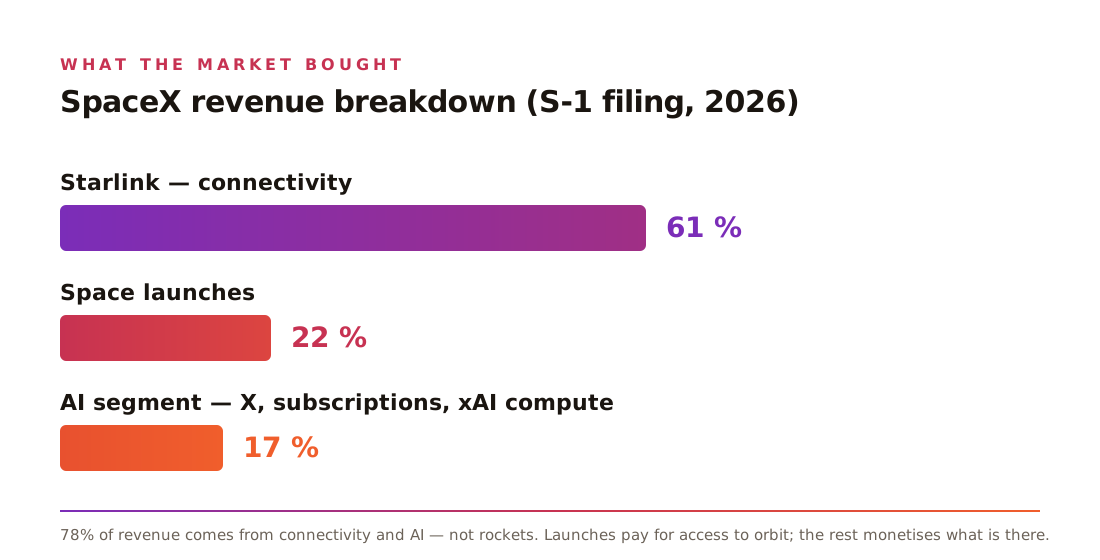
The S-1 filed with the SEC details the breakdown of revenue. It deserves to be read, because it contradicts the "SpaceX = rockets" reflex (analysis of the S-1 by Tomasz Tunguz):
Source: S-1 analysis, tomtunguz.com, June 2026.
Starlink accounts for 61% of revenue. Launches — the historic business, the one behind the images of rockets landing — represent only 22%. The AI segment, which groups X's advertising and subscriptions together with the rental of xAI compute, brings in the remaining 17%. In other words: 78% of the company's revenue comes from connectivity and artificial intelligence. Rockets are not the product. They are the logistics that put the product into orbit.
This structure did not exist six months ago. It is the direct result of the merger of 2 February 2026: SpaceX absorbed xAI in an all-share transaction, valuing xAI at $250 billion and the combined group at $1,250 billion (MarketMinute). In four months, the market has revalued that group from $1,250 billion to more than $2,000 billion.
4. The logical sequel to Colossus
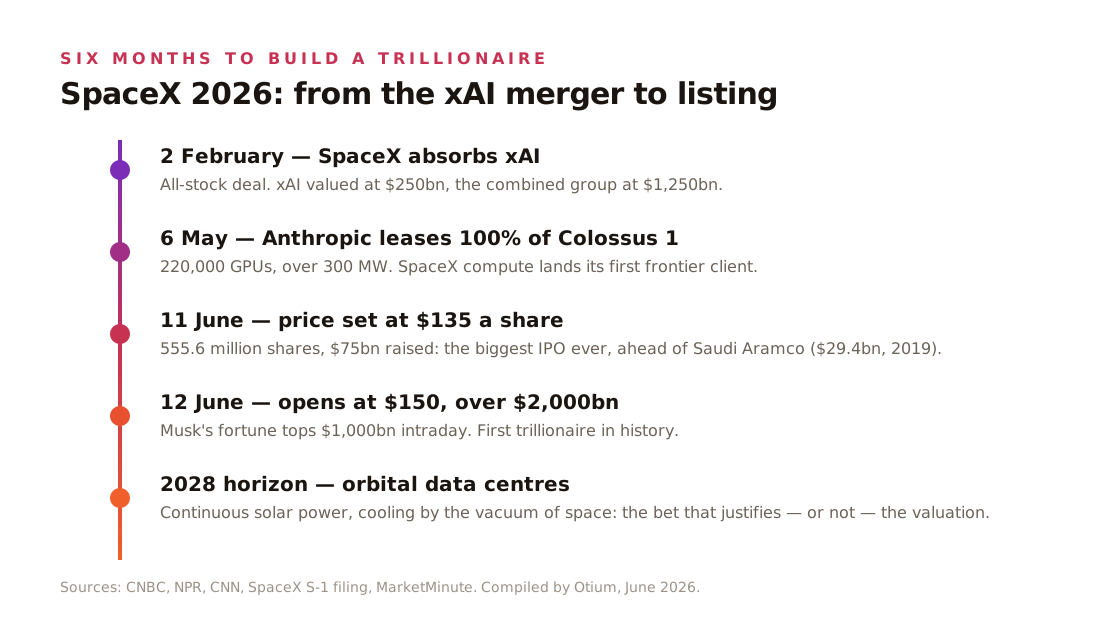
In May, after the announcement that Anthropic would rent the whole of Colossus 1 — 220,000 GPUs, more than 300 megawatts — we wrote that AI had just split into two trades: designing models, and owning the infrastructure that runs them. SpaceX had chosen the second, and Anthropic had just demonstrated it publicly by becoming its tenant.
The IPO of 12 June is the direct sequel to that analysis — with a difference of scale: it is no longer a deal between two private players that validates the thesis, it is the public market. The Colossus campus now lines up roughly 555,000 NVIDIA GPUs, acquired for around $18 billion. With the xAI merger, that compute belongs to the listed company. The stock market has just set the first public-market price on the infrastructure side of the AI economy — and that price exceeds $2,000 billion.
5. What the valuation assumes — and why it may be wrong
Scepticism exists, and it is documented. Before the listing, Fortune calculated that justifying a $1,750 billion valuation would require SpaceX to grow at a pace that no company has ever achieved at that scale. The opening session added $250 billion to what was already an unprecedented bet.
The central bet has a name: orbital compute. By combining Colossus's terrestrial infrastructure with Starship's launch capacity, the company is aiming for data centres in orbit by 2028 — continuous solar power, cooling by the vacuum of space, freedom from the terrestrial bottlenecks of land, water and grid connection. If that promise holds, the valuation has a foundation. If it slips — and Starship schedules have already slipped —, the market has paid $2,000 billion for a company 61% of whose revenue remains a satellite telecoms operator.
| What supports the valuation | What weakens it |
|---|---|
| Biggest IPO in history, oversubscribed, opening at +11% | Required growth never achieved by any company (Fortune) |
| 78% of revenue from connectivity + AI, two expanding markets | Starlink, 61% of revenue, remains a heavy-capex operator business |
| Compute rented to frontier labs (Anthropic), demand exceeding supply | 2028 orbital timetable dependent on Starship and regulation |
| Unique vertical integration: launcher + satellites + GPUs + models | 82% of voting rights held by one man — an accepted governance risk |
6. What it changes for you
If you run a company that uses AI — not one that builds it —, three concrete consequences emerge from this day.
The cost of compute remains the defining issue. SpaceX's valuation rests on the assumption that demand for AI compute will keep outstripping supply for years. That is information about your future costs: inference prices fall through model efficiency gains, not through any easing of the infrastructure market. Budgeting AI as a line that will shrink "naturally" remains a mistake — we documented this with the Uber case.
Supplier consolidation is accelerating. Models, compute, connectivity, distribution: the layers are integrating vertically within a handful of listed players. For an SMB or a mid-cap, this means financially stronger suppliers, but also fewer alternatives at each level — and bargaining power shifting towards them. Architectures that avoid dependence on a single supplier gain value at exactly the pace at which this concentration progresses.
The accounts become public. This is the least discussed and most useful counterpart of this wave of IPOs: SpaceX, and soon OpenAI and Anthropic, will have to publish their figures every quarter. Real inference margins, subscription economics, the cost of compute: data that has so far been invisible will shape purchasing decisions. For the first time, it will be possible to know what your AI suppliers earn — or lose — by serving you.
Fact: one man is now worth more than $1,000 billion, and it is AI infrastructure — not space — that carried him there. Market hypothesis: compute will stay scarce long enough to justify $2,000 billion. Opinion: the symbol of the trillionaire masks the most lasting piece of information of the day — the AI economy now has a public, listed price, open to challenge every trading day. It is a discipline the sector has never known.