Marketing is the profession where AI has changed the most in two years, and the one where the most tools get piled up without method. Whether you are the CEO of a five-person company carrying marketing single-handedly, or the CMO of a large group arbitrating six-figure budgets — in any sector — the finding is the same: the average team pays for twenty to thirty subscriptions, half of which do the same job and the other half of which are used only twice a year. The landscape confirms it — Scott Brinker's State of Martech 2026 counts 15,505 martech tools (a plateau, after a hundredfold increase since 2011), and 90% of teams are already plugging AI agents into them. The game is no longer adding tools: it is organising and orchestrating. Worse still: the tool lists floating around online are out of date. They still show Midjourney as "the" image generator, whereas the 2026 marketing leaders are gpt-image-2 and Nano Banana Pro; they say nothing of video generation (Veo, Kling, Higgsfield), nor of agents that publish themselves via MCP, nor of brand safety in the age of AI content. This article is the complete map: eight stable layers, the tools that really matter in 2026, tutorials to get started, and three costed stacks by team size. It is the second instalment of our "stacks by profession" series, after the sales prospecting stack.
Note on currencies. Prices for American tools (Semrush, Ahrefs, Surfer, OpenAI, Midjourney, Ideogram, HeyGen, Synthesia, Opus Clip, Buffer, Taplio, ActiveCampaign, Hotjar, Canva, Adobe, Higgsfield, SparkToro, Profound) are in USD, the official billing currency even in Europe. Brevo, HubSpot France, Metricool, Plausible, Peec AI and n8n publish official pricing in EUR, reproduced as is. Total budgets are in EUR at approximate 1:1 parity (2026 rate). Prices taken from official price lists, with monthly and annual billing distinguished. As AI image and video tools change every month, the rankings cited (Arena, benchmarks) are dated May 2026.
- Eight layers, not thirty subscriptions
- Layer 1 — Audience & insights
- Layer 2 — Research & SEO / GEO
- Layer 3 — Creation: text & ideation
- Layer 4 — Image & design
- Layer 5 — Video
- Layer 6 — Agentic distribution & social (MCP)
- Layer 7 — Email, automation & measurement
- Layer 8 — Brand safety & brand equity
- The cross-cutting layer — n8n, Claude & MCP
- Summary comparison
- Three stacks by size
- Building your marketing agents with Claude?
- What about all-in-one solutions (Holo, Kive, Sintra, Limova)?
- CMOs speak — marketing in the age of AI
- Conclusion
- FAQ
1. Eight layers, not thirty subscriptions
Marketing covers a wide field: understanding the audience, being found, producing, dressing up in image and video, distributing, converting, measuring, and protecting the brand. Eight stable layers, plus a cross-cutting orchestration layer. The rule does not change: every tool you pay for must belong to a specific layer and do its job there better than the others. Two tools that overlap on the same layer means one OR the other.
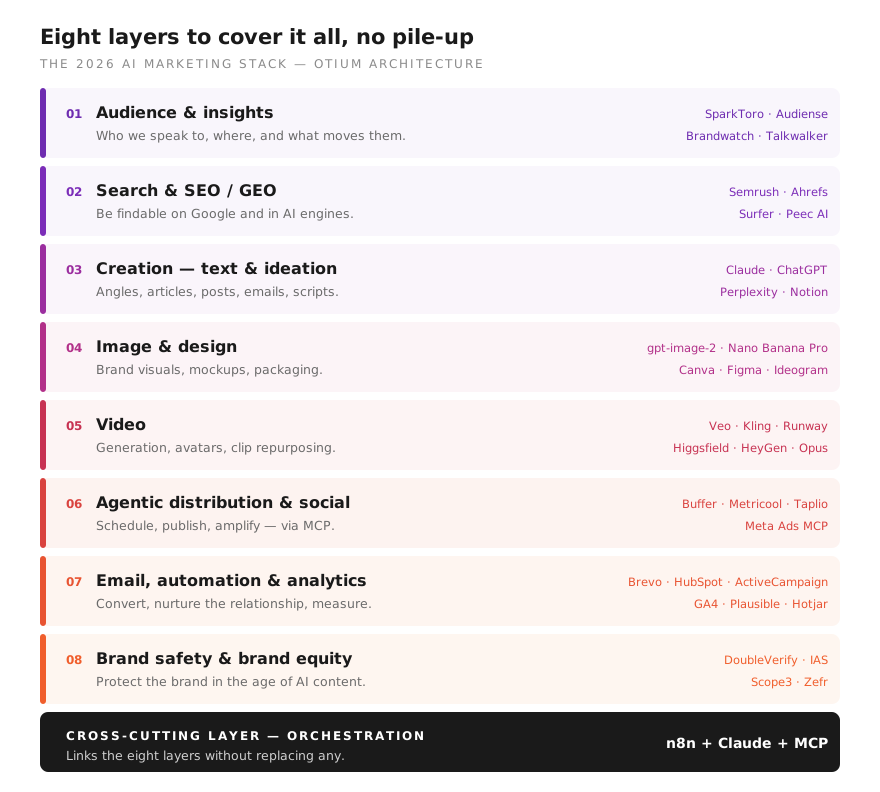
Otium framework, consolidated from the architectures and price lists published by the vendors cited, up to date as of May 2026.
The classic trap: the "all-in-one" suite that promises to cover the eight layers and does none of them properly, or the out-of-date tool list that stops at 2023. The rule stands: one tool = one job, and you choose the tool on the real state of the market, not on the reflex of two years ago.








































2. Layer 1 — Audience & insights
The layer most stacks forget, and the one that makes everything else relevant: who are you talking to, where do they spend their time, and what makes them react? Producing without this layer is creating in a vacuum.
SparkToro — where your audience really is
SparkToro answers a precise question: which podcasts, YouTube channels, social accounts, newsletters and sites does your audience actually follow? Limited free plan, paid from $50 per month up to $300 for agencies (USD). It is the cheapest discovery tool for framing a distribution strategy on channels where the audience is already present, rather than guessing.
Audiense — segmentation and data personas
Audiense goes further on segmentation: it breaks an audience into communities, profiling their interests and their influencers. Enterprise-positioned (indicative range $500 to $2,000 per month depending on scope). Relevant when segment-level personalisation justifies the investment.
Brandwatch, Talkwalker — social listening
To listen to what is said about your brand and your market in real time, Brandwatch (from around $800 per month, annual commitment) and Talkwalker (from around $500 per month) dominate social listening, with image and sentiment analysis. Enterprise tools: for an SMB, you often start with free native insights (Meta, LinkedIn, YouTube Studio, Google Trends) before investing in a dedicated platform.
3. Layer 2 — Research & SEO / GEO
Knowing what to write to be found. In 2026, "being found" has two sides: classic Google ranking, and visibility in AI engine answers — GEO.
Semrush and Ahrefs — the two references
Semrush is the most complete suite: Pro at $139.95 per month ($117 annually), Guru at $249.95, Business at $499.95 (USD). Ahrefs is the preferred alternative for its link index: Starter plan at $29 launched in January 2026, Lite at $129, Standard at $249 (the most recommended). For an SMB that produces content, Ahrefs Standard or Semrush Guru is enough.
Surfer SEO — optimisation at the writing stage
Surfer SEO comes in at the moment of writing, guiding structure and semantics based on the top 10 for a query. Essential at $99 per month ($79 annually), Scale at $219 (USD). Complementary to, not a substitute for, Semrush or Ahrefs.
GEO — visibility in AI answers
When a prospect asks ChatGPT or Perplexity "which provider for X?", your brand is cited or not — and nobody clicks a blue link. Peec AI (a Berlin-based vendor, raised $21M in November 2025, from around $89 per month) and Profound (Starter at $99) track your presence in AI engines. A young and volatile category: 40 to 60% of cited domains change every month. To adopt when a measurable share of your traffic already comes from AI assistants.
4. Layer 3 — Creation: text & ideation
The layer AI has commoditised the most. The question is no longer "which writing tool", but "do I need an overlay on top of a general-purpose model?".
Claude and ChatGPT — the foundation
Claude and ChatGPT cover the essentials: articles, pages, posts, scripts, emails. Individual subscription around $20 per month, team offers at about $25 to $30 per seat, programmatic use per token via API. The "canvas" functions — Claude Artifacts and ChatGPT Canvas — now let you iterate on a document, a landing page or an HTML visual directly in the conversation, which further reduces the need for third-party tools.
Perplexity and Notion — research and organisation
Perplexity (Pro around $20 per month) serves sourced research and quick monitoring ahead of a piece of content. Notion (from around $10 per seat, AI included depending on the plan) remains the hub where the editorial calendar, briefs and knowledge base live, which Claude can then consume.
Jasper, Copy.ai — the marketing overlays
Jasper (Creator at $49, Pro at $69, USD) and Copy.ai add campaign templates, a locked brand charter and collaboration. Their appeal has shrunk against Claude and ChatGPT: they are justified for teams that want to produce without ever writing a prompt.
5. Layer 4 — Image & design
This is where out-of-date lists do the most damage. Midjourney is no longer the 2026 marketing default: for brand visuals, the leaders are now those of OpenAI and Google, and the tool SMBs really use day to day is called Canva.
gpt-image-2 and Nano Banana Pro — the two leaders
gpt-image-2 (ChatGPT Images 2.0), released on 21 April 2026, is available on all ChatGPT plans (Plus at $20, free with limits) and via API (~$0.006 to $0.21 per image). The first reasoning model, 95%+ text accuracy, 2K, multilingual. Nano Banana Pro (Gemini 3 Pro Image, released on 20 November 2025) offers reference-quality text rendering, consistency across several images and identity preservation for up to five subjects. Access via Gemini (Google AI Pro at $19.99) or API ($0.039 at 1K, up to $0.24 at 4K). These two models rank at the top of the Arena text-to-image leaderboard in 2026, ahead of Midjourney on commercial visuals.
Video: The French Bot (YouTube, 2026). For educational purposes.
Ideogram, Midjourney and the specialists
Ideogram (Basic at $8, Plus at $20) remains the specialist in legible embedded text. Midjourney (Basic at $10, Standard at $30) keeps the edge on pure artistic quality. For photorealism, Imagen 4 Ultra (Google) is cited as the most convincing; Recraft, Reve, Seedream and Flux complete the landscape depending on use (vector and brand, conversational editing, versatility).
Canva and Figma — from model to finished design
Generating an image is not enough: you have to lay it out. Canva (Pro at $15 per month, Teams at $10 per seat) embeds in Magic Studio more than 20 AI tools (generation, retouching, translation, animation) in an editor the whole team knows how to use — it is an SMB's default design tool. Figma (free to start, paid per editor) and its AI functions (Figma Make) serve product teams and web mock-ups. Adobe Firefly (Standard at $9.99, Pro at $19.99) remains relevant for those already living in Creative Cloud, with a model trained on licensed data — an argument on commercial rights.
6. Layer 5 — Video
In two years, AI video has gone from gadget to production format. Three sub-uses: shot generation, the talking avatar, and clip repurposing.
Veo, Kling, Runway — generation
Veo 3.1 (Google) is the best all-rounder: 4K, native audio, strong prompt adherence (~$0.75 per second via Gemini/Flow). Kling 3.0 excels at complex motion and value for money (~$0.10 per second). Runway Gen-4.5 remains the pros' favourite for creative control (camera moves, motion brush, character consistency) — the option for ads and client deliverables. Note: OpenAI announced the shutdown of the Sora apps (web and mobile) on 26 April 2026 and of the Sora API on 24 September 2026 — not to be placed at the centre of a workflow.
Higgsfield — the aggregator that makes you want to try
Higgsfield deserves a separate mention: it aggregates more than 15 video models (Veo, Kling, and others) under a single subscription, with more than 70 cinematic camera presets, a Cinema Studio and a Marketing Studio designed for ads. Starter plan at $15, Plus at $34, Ultra at $84 (USD, credit-based). It is the tool that turns a single product image into a credible video ad in a few minutes.
Video: L'IA Pratique (YouTube, 2026). For educational purposes.
HeyGen, Synthesia — avatars
For "presenter" video without a shoot, HeyGen (Creator at $29, credit-based) and Synthesia (Starter at $18 annually, Creator at $64, 160+ languages) generate a talking avatar from a script. Ideal for explainer and multilingual videos — accepting the "avatar" look, which does not replace a real shoot at the high end of a brand.
Opus Clip, Submagic — repurposing
Opus Clip (Starter at $15, Pro at $29) and Submagic cut a long video into short subtitled clips ready for social networks. The cheapest distribution lever: one webinar becomes ten short formats.
7. Layer 6 — Agentic distribution & social (MCP)
Producing is pointless without distributing. And in 2026, distribution has changed in nature: you no longer just schedule, you delegate to agents that publish themselves.
Buffer, Metricool, Taplio — scheduling
Buffer (Essentials at $6 per channel, free for 3 channels) for simplicity. Metricool (Starter at €20, Advanced at €54, EUR) combines scheduling, analytics and competitive monitoring — often the best value for money for an SMB. Taplio (Standard around $65) for an executive's LinkedIn personal branding. Hootsuite remains the multi-network enterprise option.
The turning point: agentic distribution via MCP
The fundamental change of 2026 is MCP (Model Context Protocol), Anthropic's open standard that lets an AI agent act on external tools. Meta published an official Meta Ads MCP server on 29 April 2026, with more than 30 tools to create, optimise and report on Facebook and Instagram campaigns in natural language. In concrete terms: a Claude agent, orchestrated by n8n, can generate the visual, produce the video, write the copy, then publish and run the campaign. The agent acts, it no longer merely suggests. This is exactly what the tutorial below shows — 35 video ads produced and prepared in one minute via Claude and MCP.
Video: Aurélien Fagioli — IA Automatisation (YouTube, 2026). For educational purposes.
8. Layer 7 — Email, automation & measurement
Converting the audience into contacts, nurturing the relationship, measuring what works.
Brevo, HubSpot, ActiveCampaign — email & automation
Brevo (formerly Sendinblue, a French vendor, EUR) bills by email volume: Starter from €7 per month (5,000 emails), rising to €19 (10,000) and beyond. It is the French-language default. ActiveCampaign (Starter at $15 annually, Plus at $49) excels at behavioural automation. HubSpot Marketing Hub has two faces: Starter at €20 per month, but Professional at €792 per month (3 licences, + mandatory onboarding of €2,930) — a jump that is only justified to unify marketing, sales and CRM. Worth keeping in mind: HubSpot is most often a choice driven by the sales leadership or RevOps, rarely a CMO's priority. For pure marketing, Brevo or ActiveCampaign meet the need at a fraction of the price.
GA4, Plausible, Hotjar — measurement
Google Analytics 4 remains free and unavoidable for attribution. Plausible (a European vendor, data in the EU, cookie-free) is the privacy alternative: Starter at €9, Growth at €14 (EUR). Hotjar (Observe Plus at $39) adds heatmaps and session recordings — migrating to the Contentsquare platform, to be checked before signing.
9. Layer 8 — Brand safety & brand equity
The layer nobody puts in an "AI tools list", yet which becomes critical in the age of generative content. Two risks: your ads appearing next to toxic content or AI "slop" (brand safety), and your brand losing consistency and trust (brand equity).
DoubleVerify, IAS — verification
DoubleVerify and IAS (Integral Ad Science) are the two references in ad verification. In 2026, both detect low-quality AI content: DoubleVerify launched its AI SlopStopper for Social and its DV AI Verification offering in April 2026; IAS analyses text, design and behaviour to spot "Made-for-Advertising" sites. Meta has extended these third-party filters to Threads with DoubleVerify, IAS, Scope3 and Zefr. Enterprise tools (on quotation): relevant as soon as you buy programmatic advertising at volume.
Disclosure: the IAB and C2PA framework
On brand equity, the 2026 issue is the transparency of AI content. The IAB published its first AI Transparency and Disclosure Framework in January 2026, based on the C2PA standard (machine-readable provenance metadata). It is voluntary, but clearly flagging the use of AI in your visuals and videos is becoming a marker of trust — and a reflex to build into your brand charter now. For an SMB without large-scale media buying, brand safety comes down to two things: brand consistency and honest disclosure.
10. The cross-cutting layer — n8n, Claude & MCP
The eight layers integrate natively with one another for simple cases. As soon as you want conditional logic, content generated according to context, agents that chain tools together, you need an orchestration layer.
n8n and Claude — orchestrating and making things act
n8n (open source, free when self-hosted, Cloud from a few tens of euros a month) has more than 400 integrations and supports MCP: Claude can read and write workflows, and above all act on the connected tools. Claude steps in on tasks where judgement matters: drawing angles from an audience insight, writing three variants, repurposing an article into ten formats, sorting the content that converts from GA4 or Metricool metrics.
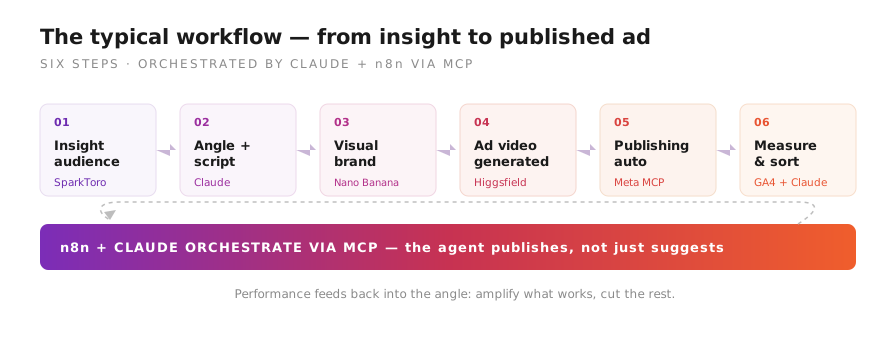
Architecture inspired by n8n's public marketing templates and the 2026 MCP demos, adapted for Claude via the Anthropic API and the Meta Ads MCP server.
Video: Aurélien Fagioli — IA Automatisation (YouTube, 2026). For educational purposes.
To go further, the n8n.io/workflows marketplace offers hundreds of public templates ready to adapt (search "content", "social media", "Meta").
What Claude and n8n do not replace: Semrush's SEO index, Google's and OpenAI's image models, SparkToro's audience data, Brevo's deliverability infrastructure. They are the layer of intelligence and action; the eight business layers are still bought separately.
11. Summary comparison
Condensed table. Prices taken from the official 2026 pages; annual billing saves 17 to 30% depending on the vendor. Currencies as per the intro note.
| Tool | Layer | Entry price | Main strength |
|---|---|---|---|
| SparkToro | Audience | free / $50 /month | Where your audience really is |
| Brandwatch | Social listening | ~$800 /month | Real-time market listening (enterprise) |
| Semrush | SEO | $139.95 /month | The most complete SEO suite |
| Ahrefs | SEO | $29 /month (Starter) | Link index + keywords |
| Peec AI | GEO | ~$89 /month | Visibility in AI engines |
| Claude / ChatGPT | Text | ~$20 /month | Writing + reasoning + canvas |
| gpt-image-2 | Image | included in ChatGPT ($20) | Text in the image, reasoning |
| Nano Banana Pro | Image | via Gemini ($19.99) | Text rendering + multi-image consistency |
| Ideogram | Image | $8 /month | Legible embedded text |
| Midjourney | Image | $10 /month | Artistic quality |
| Canva | Design | $15 /month (Pro) | Complete design + Magic Studio AI |
| Figma | Design | free / per editor | Web mock-ups + Figma Make |
| Veo 3.1 | Video | ~$0.75 /sec | Best all-rounder, 4K + audio |
| Kling 3.0 | Video | ~$0.10 /sec | Complex motion, value for money |
| Higgsfield | Video | $15 /month (Starter) | Multi-model aggregator + ads |
| HeyGen | Avatar video | $29 /month | Multilingual presenter video |
| Opus Clip | Repurposing | $15 /month | Auto-subtitled short clips |
| Buffer | Distribution | $6 /channel | Simple scheduling |
| Metricool | Distribution | €20 /month | Scheduling + analytics (EUR) |
| Meta Ads MCP | Agentic distribution | included (Meta API) | Agent that publishes and runs campaigns (MCP) |
| Brevo | €7 /month | GDPR-clean, French, volume-based (EUR) | |
| HubSpot Marketing | Email + CRM | €20 /month (Starter) | Unification — Pro at €792 |
| Plausible | Measurement | €9 /month | Privacy analytics, EU (EUR) |
| DoubleVerify / IAS | Brand safety | on quotation | Verification + AI slop detection |
| n8n + Claude | Orchestration | free + per token | Agents that act via MCP |
12. Three stacks by size
The right stack depends on who produces and at what volume. Three cases to fix the orders of magnitude.
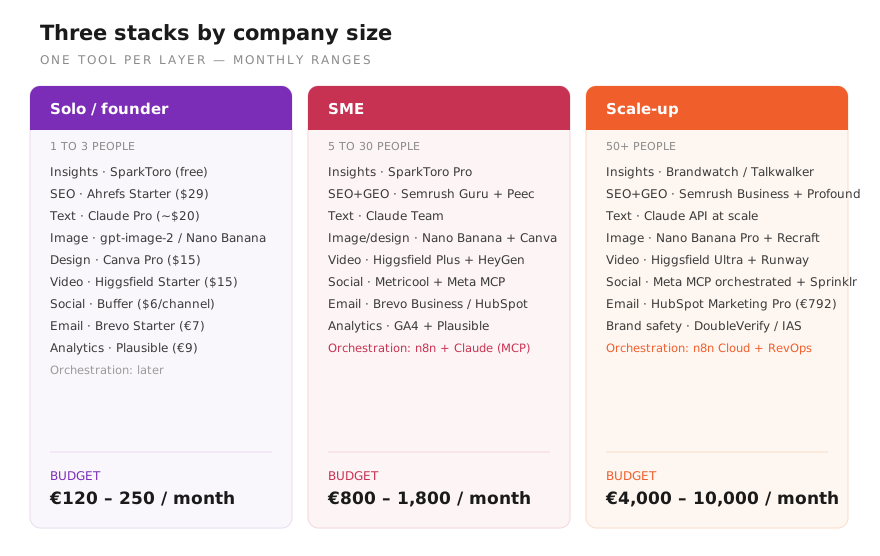
Ranges exclude annual discount and human time. Real costs often exceed the listed price by 30% after credits and seats.
Solo and founder (1 to 3 people)
SparkToro (free), Ahrefs Starter ($29), Claude Pro (≈$20), gpt-image-2 or Nano Banana Pro for images, Canva Pro ($15) for design, Higgsfield Starter ($15) for video, Buffer ($6/channel), Brevo Starter (€7), Plausible (€9). Total budget: €120 to €250 per month. MCP orchestration can wait until the first pieces of content have been tested by hand.
SMB (5 to 30 people)
SparkToro Pro + Semrush Guru + Peec AI. Claude Team + Canva Teams + Figma. Higgsfield Plus + HeyGen for video. Metricool + agentic distribution via Meta Ads MCP (n8n + Claude). Brevo Business or HubSpot Starter + GA4/Plausible. Total budget: €800 to €1,800 per month. This is the point where MCP orchestration starts to pay off: a well-designed workflow saves several days a month on production and distribution.
Scale-up (50 people and more)
Brandwatch or Talkwalker for listening, Semrush Business + Profound for SEO/GEO, Claude API at scale, Nano Banana Pro + Recraft + Higgsfield Ultra + Runway for creative, orchestrated Meta MCP + Sprinklr/Hootsuite, HubSpot Marketing Pro (€792), and DoubleVerify/IAS brand safety as soon as there is media buying. Total budget: €4,000 to €10,000 per month. At this volume, a dedicated marketing ops profile oversees n8n + Claude.
13. Building your marketing agents with Claude?
The nuance has changed since prospecting. Rebuilding a custom marketing-suite component still costs between €40,000 and €150,000 without the data or the infrastructure — to be avoided. But with MCP, Claude Code and n8n, an SMB can now assemble in a few weeks agents that act: an agent that turns a brief into ten ads and pushes them to Meta Ads MCP, an agent that detects high-performing content and generates variants of it, an agent that monitors GEO citations and raises alerts. These agents do not replace the tools — they drive them.
What is worth building: bespoke orchestration, proprietary editorial scoring, specific dashboards. What is not: rewriting the SEO index, the image models or the sending engine. Buy the layers, build the agents that link them.
14. What about all-in-one solutions (Holo, Kive, Sintra, Limova)?
A category is rising fast: "all-in-one" solutions and "AI employees" that promise to replace the entire stack with a single subscription. You will inevitably come across them — here is an honest reading of four of them, and where they fit among the eight layers.




Holo (tryholo.ai) — the on-brand ad factory
Holo scans your site with its "Brand DNA" technology (tone, palette, messages) then generates static ads, carousels, posts and emails in 95+ languages. A single plan at around $39 per month (from $19 annually for the Instagram ad generator). It is an excellent tool for the image + ad distribution layer for a solo operator or very small business that wants creatives without an agency — not a replacement for the eight layers.
Kive (kive.ai) — brand visual creation
Kive combines an AI-organised asset library, image generation and above all product shots (training a model on your products, placing them in scenes without a photo shoot). Free, Basic at $20 ($15 annually), Pro at $100. It is a superb tool for layer 4 (image & design), tailored to e-commerce and creative teams — it covers neither SEO, nor email, nor measurement.
Sintra (sintra.ai) — the "AI employees"
Sintra offers 12 specialised "AI employees" (social, email, SEO, support…) with a shared "Brain AI" memory. From $97 to $497 per month (250 credits included). The promise: replacing a team. In practice, it is a suite of general-purpose agents — handy for starting alone, but less deep than a dedicated tool per layer paired with Claude + n8n on demanding cases.
Limova (limova.ai) — the French-style suite of assistants
Limova (a start-up from Nice) lines up named AI assistants: John (visuals + posts), Lou (blog/SEO on WordPress, Shopify…), Elio (LinkedIn prospecting), TOM (call centre), Manue (accounting), Julia (legal). From €29 to €139 per month. Strengths: French, GDPR, multi-function. It targets French-speaking very small businesses and SMBs that want to delegate several tasks without assembling a stack.
15. CMOs speak — marketing in the age of AI
This stack is not a workshop theory. Here is how leading marketing departments tackle AI in practice — useful whether you run the marketing of an SMB alone or a team in a large group, in tech or in any other sector. The tools change; the underlying trade-offs (where to put the human, what to automate, how to protect the brand) are the same everywhere.
For a panoramic multi-company view, the panel "The best ways to use AI as a CMO in 2026" brings together five marketing departments on their real uses of AI.
16. Conclusion
The 2026 marketing stack has almost nothing in common with that of 2022. Writing has become a commodity, image and video are generated in minutes (gpt-image-2, Nano Banana Pro, Veo, Higgsfield), an AI visibility layer has appeared (GEO), distribution has become agentic (MCP, Meta Ads MCP), and brand protection has hardened in the face of mass AI content.
The mistake is no longer lacking tools. It is piling up thirty of them without method, and working from an out-of-date map. Eight layers, one tool per layer, agents that orchestrate via MCP. The rest is noise or commerce disguised as a stack.
For the downstream sales layer, see our sales prospecting stack. To frame your teams' AI uses, see the company AI charter and the AI audit method for identifying bottlenecks.
17. FAQ
What is the best AI image generator for marketing in 2026?
There is no longer a single winner. The two leaders are gpt-image-2 (ChatGPT Images 2.0, 95%+ text accuracy) and Nano Banana Pro (Gemini 3 Pro Image, text rendering and multi-image consistency). Ideogram remains strong on embedded text, Midjourney on artistic quality, Imagen 4 Ultra on photorealism. To pay for just one tool, Canva Magic Studio ($15/month) builds generation into a complete design editor.
What is MCP and how does it change marketing distribution?
MCP (Model Context Protocol) is an open standard from Anthropic that lets an AI agent act on external tools. Meta published an official Meta Ads MCP server on 29 April 2026, with 30+ tools for managing campaigns and reporting in natural language. A Claude agent connected via n8n can generate a visual, produce a video, then publish and run the campaign — the agent acts, it no longer merely suggests.
Do you need a brand safety tool when producing AI content?
Yes, as soon as you buy programmatic advertising or amplify creator content. DoubleVerify and IAS detect low-quality AI content and Made-for-Advertising sites to avoid poor adjacency. The IAB published an AI transparency framework in January 2026 based on C2PA. For an SMB without large-scale media buying, the issue comes down to brand consistency and disclosure.
Can Claude and n8n replace the whole marketing stack?
No. Claude writes, reasons and, via MCP, makes the tools act; n8n orchestrates. But they own neither Semrush's SEO index, nor Google's and OpenAI's image models, nor Brevo's infrastructure, nor SparkToro's audience data. They are the cross-cutting layer of intelligence and action; the eight business layers are still bought separately.
How much does a complete AI marketing stack cost for an SMB?
For a solo operator, €120 to €250 a month is enough. For an SMB of 5 to 30 people, expect €800 to €1,800 by adding Semrush, a GEO tool, n8n + Claude orchestration via MCP and advanced measurement. A scale-up exceeds €4,000 with brand safety, enterprise social listening and HubSpot Marketing Pro.
What marketing stack for a team of fewer than five people?
SparkToro (free), Ahrefs Starter ($29), Claude Pro (~$20), gpt-image-2 or Nano Banana Pro for images, Canva Pro ($15), Higgsfield Starter ($15), Buffer ($6/channel), Brevo Starter (€7), Plausible (€9). Total budget between €120 and €250 a month. MCP orchestration comes when volume justifies it.
- State of Martech 2026 — Scott Brinker & Frans Riemersma (15,505 tools, 90% AI agents)
- SparkToro — audience research 2026
- Brandwatch — social listening comparison 2026
- Semrush — official 2026 price list
- Ahrefs — Starter, Lite, Standard plans 2026
- Peec AI — GEO pricing 2026
- TechCrunch — Peec AI raises $21M for GEO
- OpenAI — ChatGPT Images 2.0 (gpt-image-2)
- TechCrunch — ChatGPT Images 2.0, 95%+ text accuracy
- Nano Banana Pro (Gemini 3 Pro Image) — pricing & specs
- Canva — Pro, Teams & Magic Studio 2026
- Higgsfield — Starter, Plus, Ultra plans
- AI video comparison — Veo 3.1, Kling 3.0, Runway (API costs)
- HeyGen — Creator and Business plans
- Opus Clip — pricing 2026
- Meta Ads MCP — guide to agentic ad management
- CMSWire — the next marketing stack: AI agents + MCP
- Buffer — per-channel pricing 2026
- Metricool — official EUR pricing
- Brevo — EUR pricing France (by email volume)
- HubSpot Marketing Hub — pricing 2026
- Plausible — plans and EUR pricing
- eMarketer — brand safety in the age of AI 2026
- DoubleVerify — DV AI Verification & SlopStopper
- n8n — public workflow marketplace